Related Posts
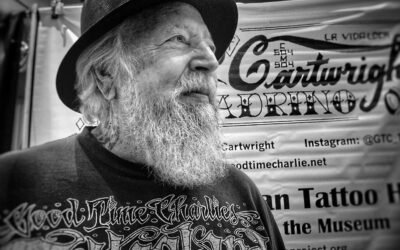
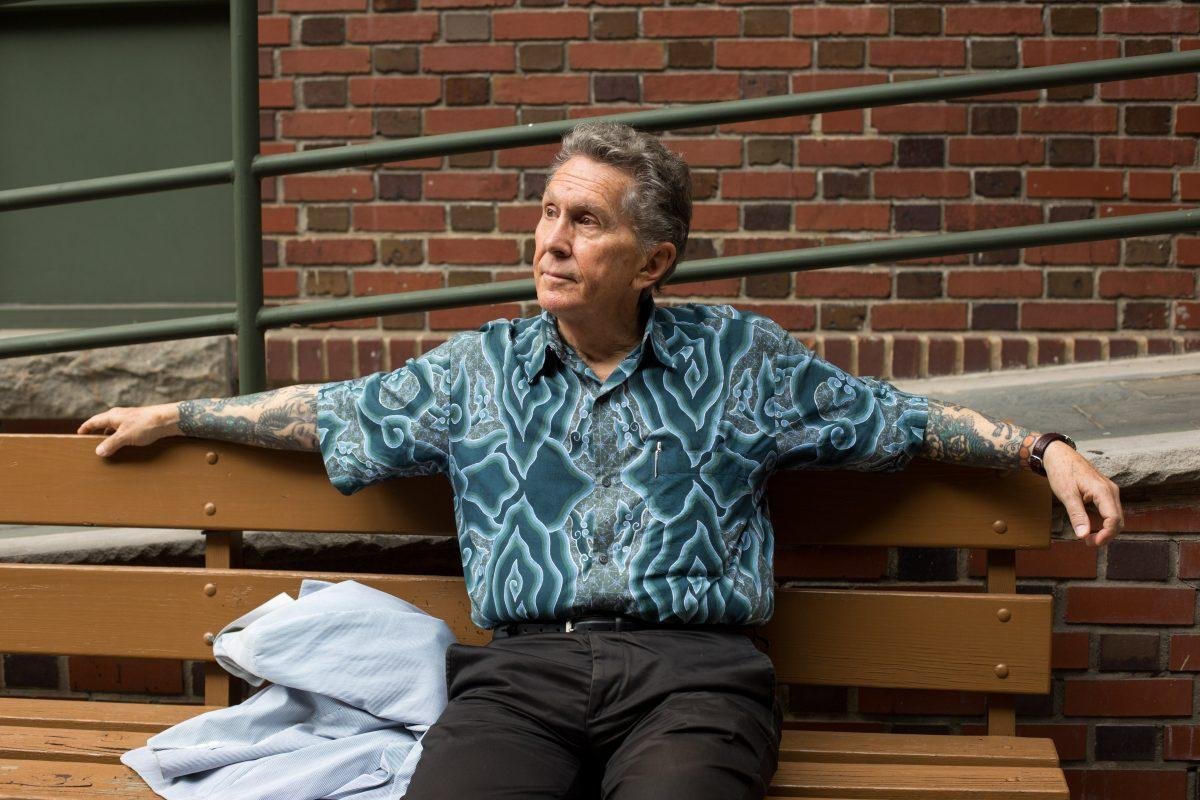
Don Ed Hardy
The man who made tattooing art, whether the art world wanted it or not
Don Ed Hardy is the most important figure in the transformation of American tattooing from a trade into an art form. This is a claim that can be stated without qualification, because the evidence for it is structural: before Hardy, American tattooing was a craft practised in street-level shops by self-taught tradespeople who selected designs from sheets pinned to the wall. After Hardy, American tattooing included custom design, fine art ambitions, Japanese compositional principles, gallery exhibitions, published scholarship, and the expectation that a tattoo could be a unique work of art made for a specific person on a specific body. Other artists contributed to this transformation — Sailor Jerry Collins, Phil Sparrow, Cliff Raven, the East LA single-needle pioneers, and many more — but Hardy was the one who saw the full scope of what tattooing could become, who had the training to articulate it, and who spent forty years building the infrastructure to make it real.
He is also the man whose name became synonymous with rhinestone-encrusted trucker hats, screaming skull t-shirts, and the most aggressively marketed fashion brand of the 2000s. The distance between these two facts — between the artist and the brand — is one of the more complicated stories in American cultural life, and it has shaped how Hardy is perceived in ways that obscure his actual contribution.
Des Moines, Corona del Mar, and the first drawings
Hardy was born Donald Edward Talbott Hardy on January 5, 1945, in Des Moines, Iowa. His family moved to Corona del Mar, in Newport Beach, California, when he was young, and he grew up in the conservative, affluent coastal community of Orange County — about as far from the underworld associations of tattooing as a childhood could be.
His interest in tattooing began at ten, when he encountered tattoos on a friend’s father who had them from military service. Hardy began drawing tattoo designs obsessively — copying flash, inventing his own designs, drawing on neighbourhood kids with pens and coloured pencils. By the time he was in high school, the interest had solidified into an intention: he would become a tattoo artist. His art teacher, Shirley Rice, introduced him to Picasso and encouraged him beyond the surf art that dominated the local visual culture. He had his first art exhibit at the Laguna Beach Art Festival after graduating from high school.
As a teenager, Hardy spent time observing tattoo artists at the Pike in Long Beach — the same amusement-district tattoo hub where Bert Grimm worked and where Charlie Cartwright would later learn the trade. He watched the established artists, studied the flash, and absorbed what he could. He also began copying the designs of Samuel Steward, a former college professor who tattooed under the name Phil Sparrow. When Steward showed Hardy a book of Japanese tattoos, Hardy experienced what he later described as being struck by “lightning” — a recognition that Japanese tattooing represented a level of ambition, complexity, and artistic seriousness that American tattooing had never attempted.
The education
He was offered a full scholarship and a graduate position for a Master of Fine Arts at Yale — the most competitive MFA programme in the country. He turned it down to tattoo.
The decision was deliberate and considered. Hardy has described his reasoning in terms that combine artistic conviction with subcultural attraction: “Tattooing in the 1960s was the most formally undeveloped and socially provocative medium I could think of, relegated in the public perception to the underworld of sailors, bikers and criminals.” He wanted to work in the medium precisely because it was marginal, because its potential was unrealised, and because he believed he could develop it. “I hated that tattooing was just looked down on as this scumbag thing,” he told Vice. “I wanted to fight that fight.”
The apprenticeship chain
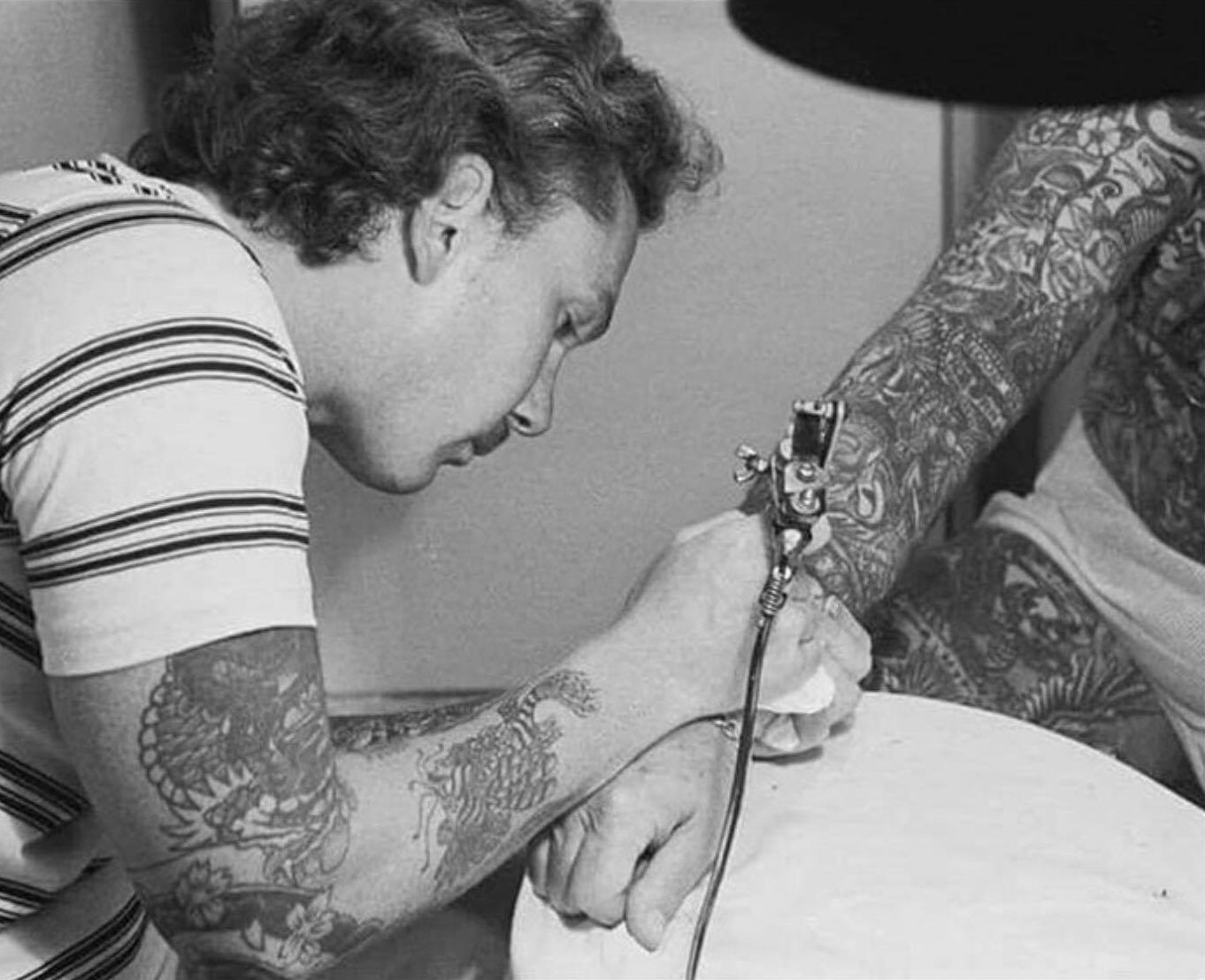
Hardy’s apprenticeship followed a path through the most important American tattoo figures of his generation.
Phil Sparrow (Samuel Steward). Hardy’s first mentor — a former college professor, friend of Gertrude Stein and Alice B. Toklas, gay man in mid-century America, and a tattooer who brought an intellectual and literary sensibility to the craft that was unique in the trade. Sparrow showed Hardy the Japanese tattoo book that changed his direction, tried to discourage him from tattooing (“It’s a deep dark world, and it’s a dying art form”), and eventually taught him anyway. Hardy later recalled Sparrow’s sarcastic prediction: “Yeah, Ed’s gonna be the Jesus Christ of tattooing.” Hardy’s reply: “Just wait.”
Zeke Owen (Seattle) and Doc Webb (San Diego) — established West Coast tattooers with whom Hardy studied after Sparrow.
Sailor Jerry Collins. Hardy formed a relationship with Norman “Sailor Jerry” Collins — the Honolulu-based master of American traditional tattooing — through extended correspondence. Collins was territorial, volatile, and legendarily difficult, but he recognised Hardy’s talent and ambition. Through Collins’s connections in Japan, Hardy gained access to a world that had been closed to non-Asian practitioners.
Gifu Horihide (Kazuo Oguri). In 1973, at Collins’s introduction, Ed Hardy travelled to Gifu, Japan, to study with the traditional tattoo master Gifu Horihide, who trained under Tokyo Horihide (Kakimoto Hideo). Hardy was, by most accounts, the first non-Asian tattoo artist to gain access to a Japanese master’s practice. He studied and tattooed in Japan — his clients at times including Yakuza members — and continued these visits through the 1970s and 1980s.
The Japanese experience was the central formative influence on his work: the compositional principles of irezumi (the treatment of the body as a single canvas, the integration of foreground imagery with background elements like wind bars and water, the seasonal and iconographic coherence of a bodysuit), the tonal range and colour palette of ukiyo-e woodblock prints, and the relationship between artist and client in the Japanese tradition (where the tattoo is designed by the artist for the specific body, not selected from a wall) all became foundational to Hardy’s practice.
Realistic Tattoo and the custom revolution
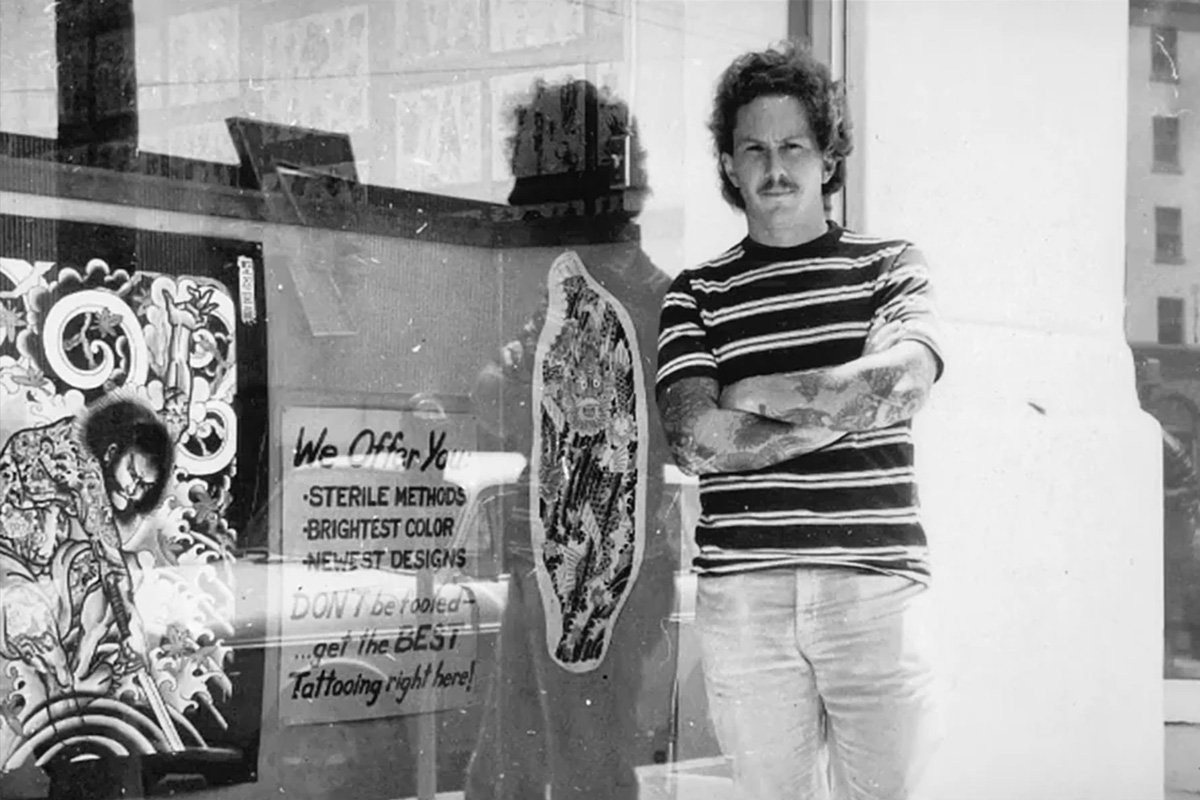
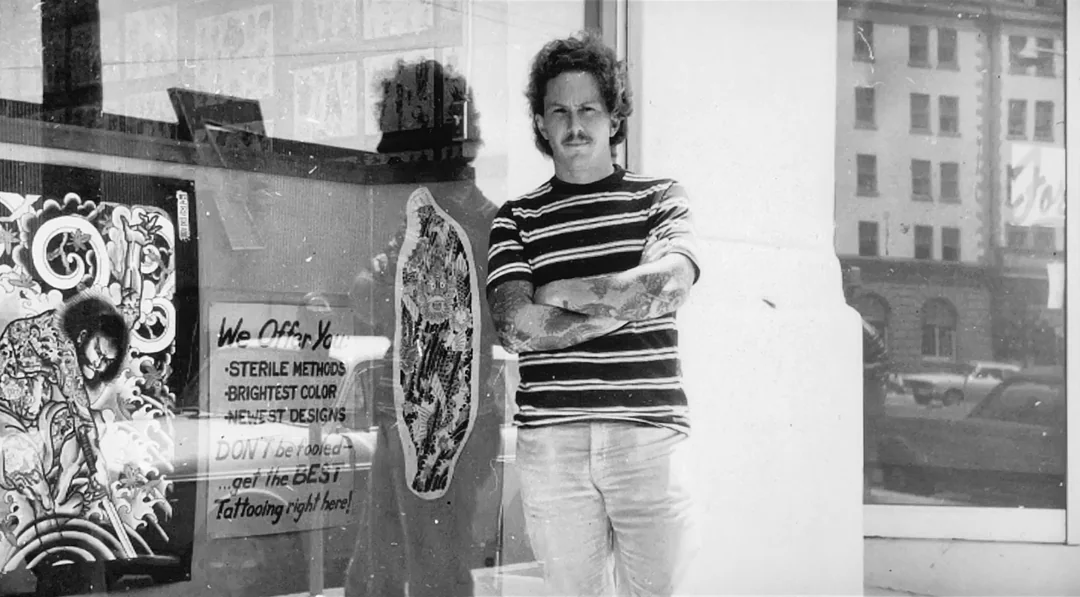
In 1974, Ed Hardy returned to San Francisco and opened Realistic Tattoo — a private, appointment-only studio that was the first of its kind in the city. The studio’s operating principle was radical for the time: no flash on the walls, no walk-ins, no menu of pre-designed options. Every tattoo was a custom commission, designed by Hardy in consultation with the client, tailored to their body, intentions, and aesthetic preferences.
This was a fundamental break with the existing tattoo shop model, where clients selected designs from flash sheets, and the artist executed the chosen image. Hardy’s approach treated the tattoo as a unique work of art and the artist-client relationship as a collaboration. “Some people had thought about a tattoo, but they didn’t want to walk into a shop and get, like, the McDonald’s menu that was on the wall,” he told Vice. “So my shop was different.”
The studio was renamed Tattoo City and operated from North Beach, San Francisco, from 1977 onward. Hardy ran the studio for decades, building a practice and a reputation that drew clients from across the country and eventually from around the world.
The East LA connection
In 1977, Hardy attended a tattoo convention where he met Charlie Cartwright and Jack Rudy from Good Time Charlie’s on Whittier Boulevard in East Los Angeles. The encounter — described in detail in the Cartwright and Rudy articles on this site — was a collision between two parallel revolutions in American tattooing. Hardy was developing the Japanese-influenced, custom-designed, fine-art approach. Cartwright and Rudy were developing the single-needle, black-and-grey, photorealistic approach derived from the Chicano prison tradition.
Hardy was struck by what the East LA artists were doing. “It made us rethink what we were aware of, what would be interesting and challenging and beautiful and cool,” he later said. The admiration was mutual: Freddy Negrete described the exchange with Hardy as “I didn’t want to do what he was doing, I wanted to know how he was doing it.”
Hardy purchased Good Time Charlie’s from Cartwright in 1977 and ran it as Tattooland on Whittier Boulevard until the early 1980s, when rising gang violence made the location untenable. His involvement gave the East LA tradition financial stability, institutional support, and access to a broader audience. The cross-pollination between Hardy’s Japanese-influenced colour work and the East LA single-needle tradition was one of the most productive exchanges in American tattoo history, and Hardy’s role in it — as buyer, supporter, and collaborator — is part of his contribution to the craft.
Don Ed Hardy Marks Publications and Tattootime
In 1982, Hardy and his wife, Francesca Passalacqua, formed Hardy Marks Publications. Under this imprint, they published the five-volume Tattootime series (1982–1991) — the first serious publications devoted to tattooing as an art form and a cultural practice. The volumes covered historical and contemporary tattooing across cultures, styles, and traditions, and they gave the tattoo world its first body of published scholarship and art criticism.
Hardy Marks has published more than twenty-five books on alternative art, including catalogues of the work of Rosie Camanga and Sailor Jerry Collins, and Hardy’s own retrospective monograph, Tattooing the Invisible Man (Smart Art Press, 2000). The publishing programme was a deliberate act of institution-building: Hardy understood that tattooing needed a literature — a body of serious writing about itself — if it was going to be taken seriously as an art form. He created that literature.
The fine art career
His most ambitious work is 2000 Dragons — a 500-foot-long scroll painting depicting 2,000 dragons, completed in 2000 to mark the turn of the century and the Year of the Dragon. The scroll has been exhibited at Track 16 Gallery in Santa Monica, the Museum of Contemporary Art in Denver, the Cuenca Biennial in Ecuador (representing the United States), and the Yerba Buena Centre for the Arts in San Francisco. In 2024, it was displayed at Grace Cathedral in San Francisco.
Major exhibitions include: Tattooing the Invisible Man at Track 16 Gallery, Santa Monica, 1999 (his first retrospective); Pictures of the Gone World at Kings Avenue Tattoo, New York; and Ed Hardy: Deeper than Skin at the de Young Museum, San Francisco, July–October 2019 — his first major museum retrospective, displaying over three hundred objects spanning six decades.
In 2000, the San Francisco Art Institute awarded Hardy an honorary doctorate — the same institution where he had earned his BFA in 1967 and whose Yale-bound MFA he had turned down to tattoo.
He retired from active tattooing in the early 2010s, citing arthritis. His son Doug Hardy carried on the tattooing practice at Tattoo City, trained by Michael Malone (Sailor Jerry’s successor in Honolulu) in the lineage that Hardy himself had helped establish.
Ed hardy: The brand
In the early 2000s, Hardy licensed his artwork to Ku USA, Inc. to produce a clothing line. The brand — Ed Hardy — launched commercially in 2004. In 2005, the worldwide licence was acquired by Christian Audigier, the French fashion marketer who had previously built the Von Dutch brand using the artwork of Kenny Howard.
Audigier applied to Hardy’s imagery the same aggressive marketing techniques that had worked for Von Dutch: direct celebrity placement, high-profile retail locations, and saturation marketing. The Ed Hardy brand exploded. At its peak, it had over seventy sublicensees, selling clothing, accessories, lighters, perfume, hair styling tools, and condoms. The imagery — Hardy’s tattoo designs, rendered in bright colours on t-shirts, hoodies, and hats, often embellished with rhinestones and metallic printing — became ubiquitous in the mid-2000s.
The brand’s trajectory was rapid: from cool to overexposed to kitsch within roughly five years. By 2010, “Ed Hardy” had become shorthand for garish, overbranded fashion — the visual opposite of the restrained, custom, one-of-a-kind ethos that Hardy’s tattoo practice represented. The irony was precise and painful: an artist who had spent four decades arguing that tattooing should be treated as a serious, personalised art form saw his name become synonymous with mass-produced merchandise that treated tattoo imagery as decoration.
Hardy settled a lawsuit with Audigier that gave the artist control over his images and how they were used. In his 2014 memoir Wear Your Dreams: My Life in Tattoos, Hardy addressed the brand episode directly. Reflecting on it in a 2019 interview, he noted that the aggressive licensing had commodified tattoo culture, transforming its subversive roots into superficial merchandise.
Since 2021, the Ed Hardy brand has experienced a revival, driven by the Y2K fashion revival among younger consumers. The brand has repositioned toward a more upmarket image, collaborating with designers including Namilia for Berlin Fashion Week 2024.
The contributions
Hardy’s contributions to tattooing are multiple and structural. Listing them is the clearest way to make the case.
He introduced Japanese compositional principles — the treatment of the body as a unified canvas, the integration of foreground and background, seasonal and iconographic coherence — into American tattooing. He was the first Western artist to study under a Japanese master and to bring that knowledge back.
He established the custom-design, appointment-only studio model as an alternative to the flash-based walk-in shop. This model is now the dominant format for serious tattoo studios worldwide.
He created the first body of published scholarship and art criticism on tattoos through Hardy Marks Publications and the Tattootime series.
He supported and provided institutional stability to the Chicano single-needle black-and-grey movement through his purchase and operation of Good Time Charlie’s/Tattooland.
He exhibited tattoo-related art in galleries and museums, and he received institutional recognition (the de Young retrospective, the SFAI honorary doctorate, the Cuenca Biennial) that positioned tattooing within the fine art world.
He mentored and supported a generation of artists — through the shop, through publications, through example — who went on to develop the craft in directions he did not anticipate but made possible.
Tattoo City and the closing
Tattoo City operated from North Beach, San Francisco, from 1977 until December 2024, for forty-seven years. In August 2024, the shop announced its closure, citing Hardy’s diagnosis with Alzheimer’s disease. The announcement, posted on the shop’s Instagram, read: “We are sad to announce that Tattoo City will be closing its doors at the end of 2024. With our founder Don Ed Hardy now dealing with Alzheimer’s disease and with his wonderful wife and long-time partner Francesca Passalaqua taking care of all of their affairs as well as the shop’s, we have decided that the time has come for this part of San Francisco tattoo history to come to an end.”
Hardy, who turned eighty in January 2025, was admitted to a memory care facility. Francesca Passalacqua Hardy and the family oversee his personal and professional affairs.
The closing of Tattoo City ends a physical lineage — the shop that Hardy built is gone — but the institutional and intellectual infrastructure he created (the publications, the exhibition history, the custom-studio model, the Japanese-American synthesis, the idea that tattooing is art) is permanent. It is built into the profession. Every serious tattoo studio in the world operates, whether its artists know it or not, within the framework that Hardy spent his career constructing.
Sources & further reading
- Don Ed Hardy, Wikipedia. Comprehensive biographical entry with citations, updated March 2026.
- JSTOR Daily, “Ed Hardy Changed Tattooing Forever.” Published August 2019.
- Vice, “Tattoo Artist Don Ed Hardy on the Evolution of Tattoo Art in America.” Published July 2024.
- Track 16 Gallery, artist page: Don Ed Hardy.
- Mullowney Printing Company, artist page: Don Ed Hardy.
- Shark’s Ink, artist page: Don Ed Hardy.
- Don Ed Hardy Art (official website): donedhardyart.com
- SFist, “SF’s Famed Ed Hardy’s Tattoo City to Close, Amidst Don Ed Hardy’s Ongoing Health Issues.” Published August 2024.
- KRON4 / Nexstar, “Ed Hardy’s Tattoo City to close in 2024.” Published August 2024.
- Hoodline, “Don Ed Hardy’s Tattoo City to Close After Decades of Influencing San Francisco Ink Culture.” Published November 2024.
- LA Weekly, “L.A. (L)INKED: Cultural Expression and the Art of Tattoo in Los Angeles.” Published December 2021.
- Dismantle Magazine, “American Tattoo Culture’s Messy Past and Hopeful Future.” Published September 2020.
- Don Ed Hardy, Wear Your Dreams: My Life in Tattoos. Thomas Dunne Books / St. Martin’s Press, 2014.
- Don Ed Hardy, Tattooing the Invisible Man: Bodies of Work. Hardy Marks Publications / Smart Art Press, 2000.
- Don Ed Hardy (ed.), Tattootime. Five volumes, Hardy Marks Publications, 1982–1991.
- De Young Museum, San Francisco, Ed Hardy: Deeper than Skin. July–October 2019.
- Anna Felicity Friedman, The World Atlas of Tattoo. Yale University Press, 2015.
- Matt Lodder, Painted People: Humanity in 21 Tattoos. Harper, 2024.
- Margo DeMello, Bodies of Inscription: A Cultural History of the Modern Tattoo Community. Duke University Press, 2000.