Geometric
Geometry: older than language
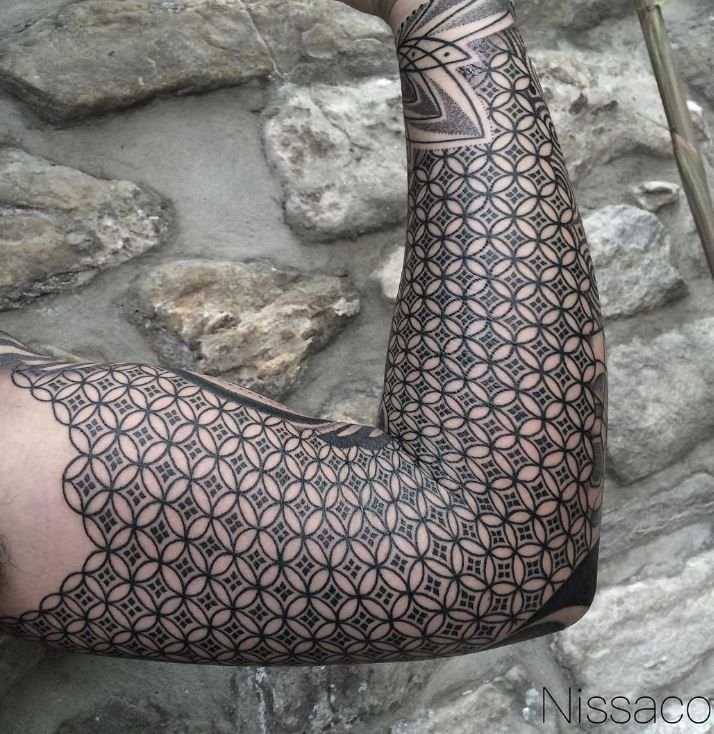
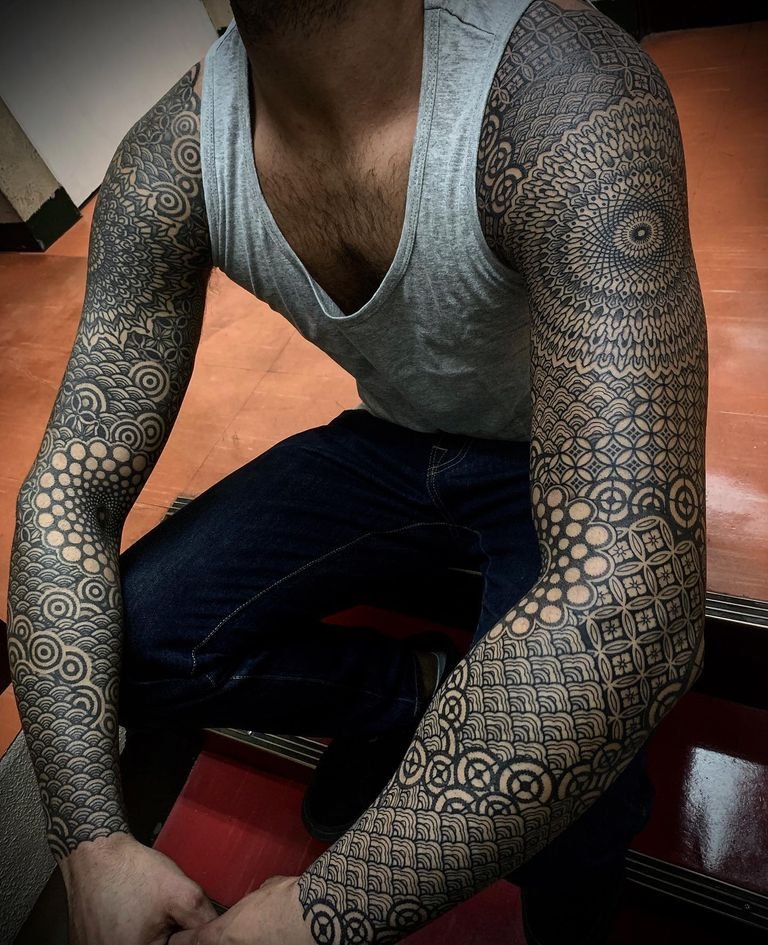
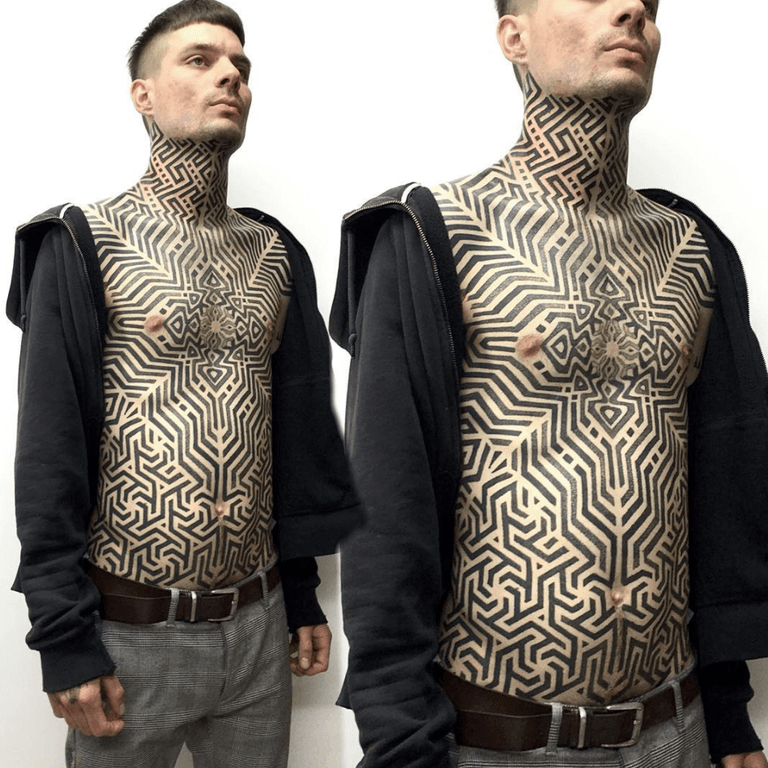
Geometric tattoos & the visual traditions behind them
Islamic geometric art
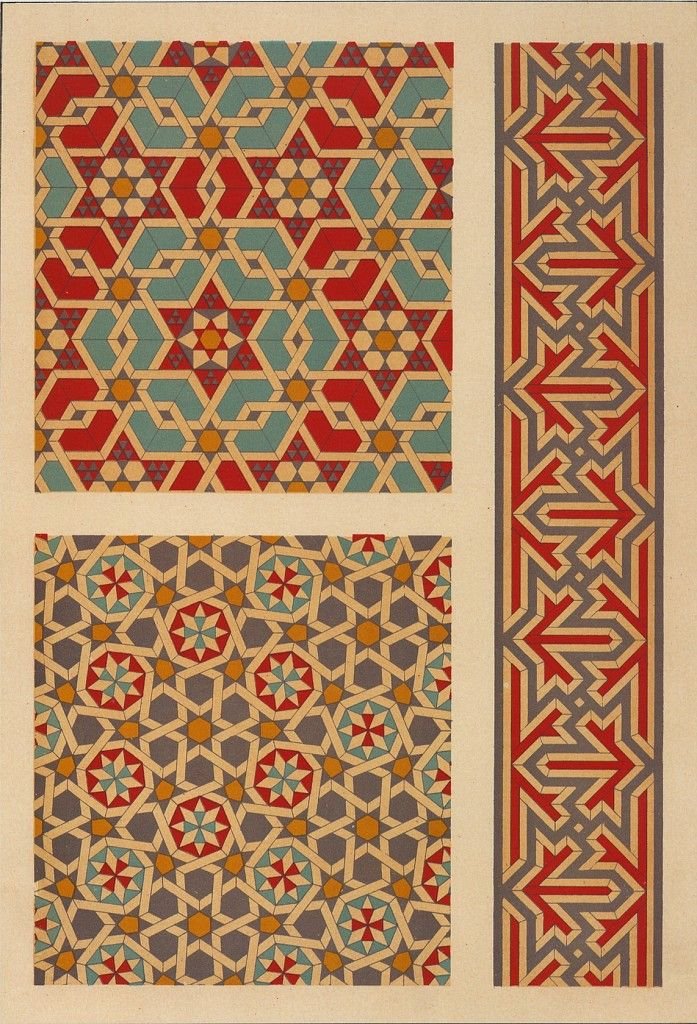
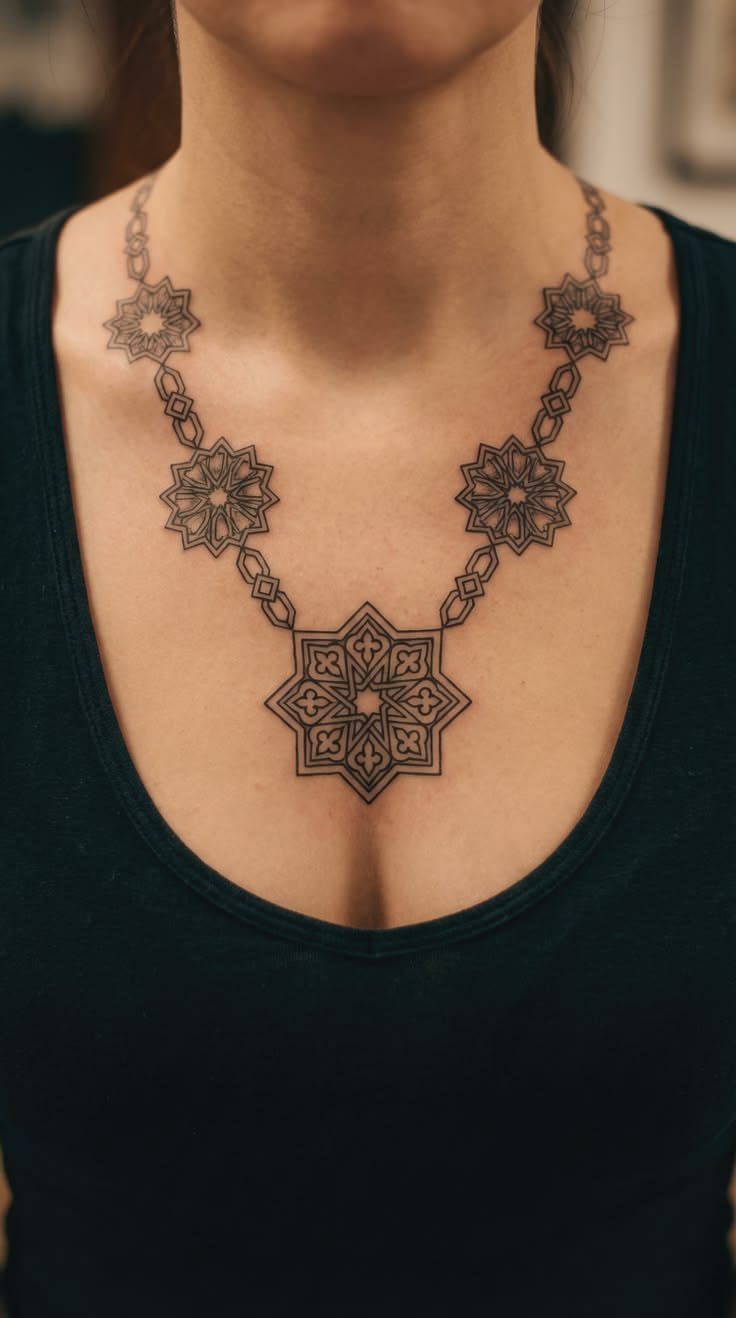
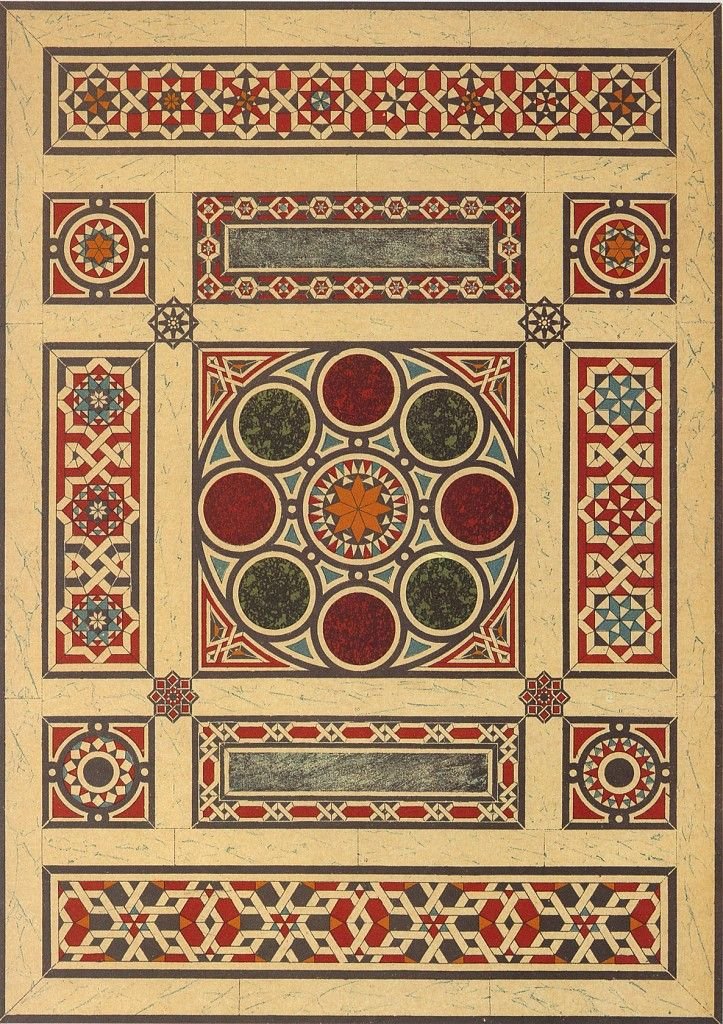
The most elaborate geometric design tradition in human history. Islamic art, particularly from the eighth century onward, developed a system of geometric patterning — based on the division of the circle, the repetition of polygon arrangements, and the interlocking of star-and-polygon networks — that produces patterns of extraordinary complexity from simple mathematical rules. The tradition reached its highest expression in the architectural decoration of mosques, madrasas, and palaces across the Islamic world, from the Alhambra in Spain to the Shah Mosque in Isfahan to the Topkapı Palace in Istanbul.
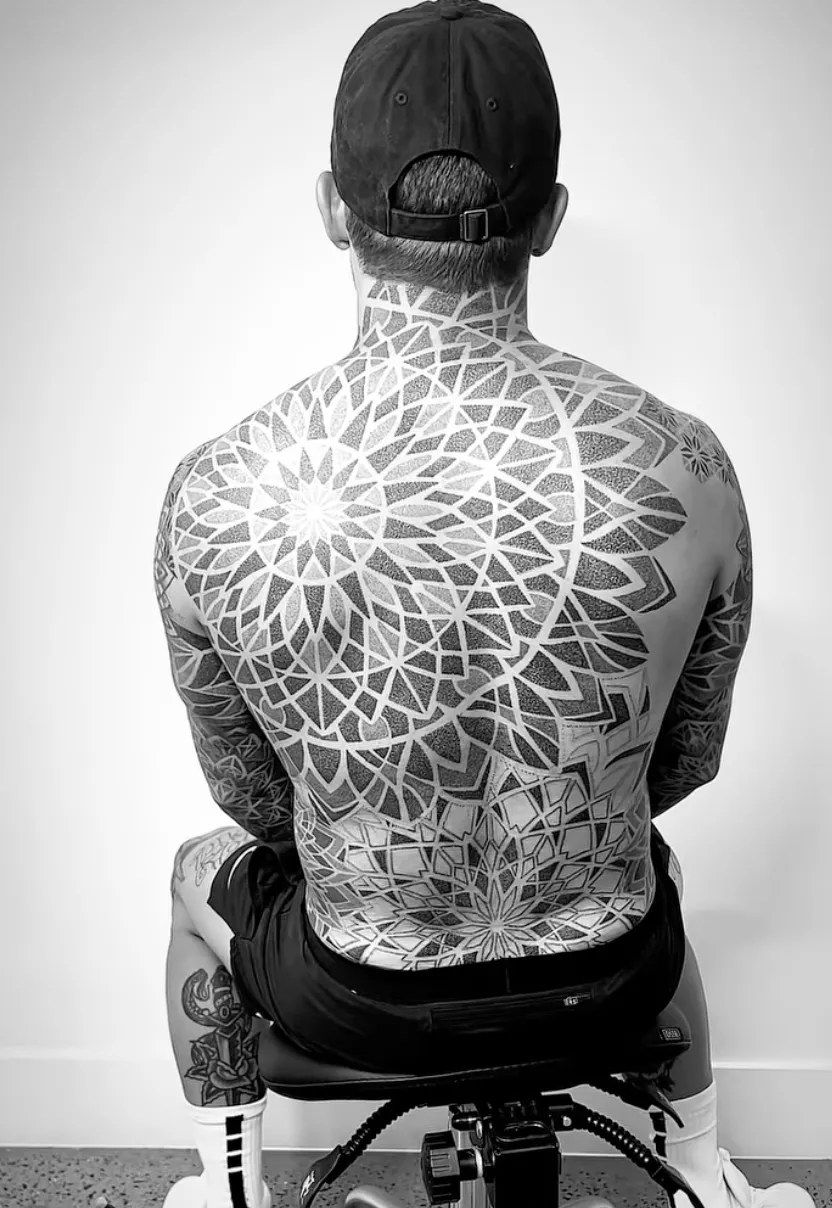
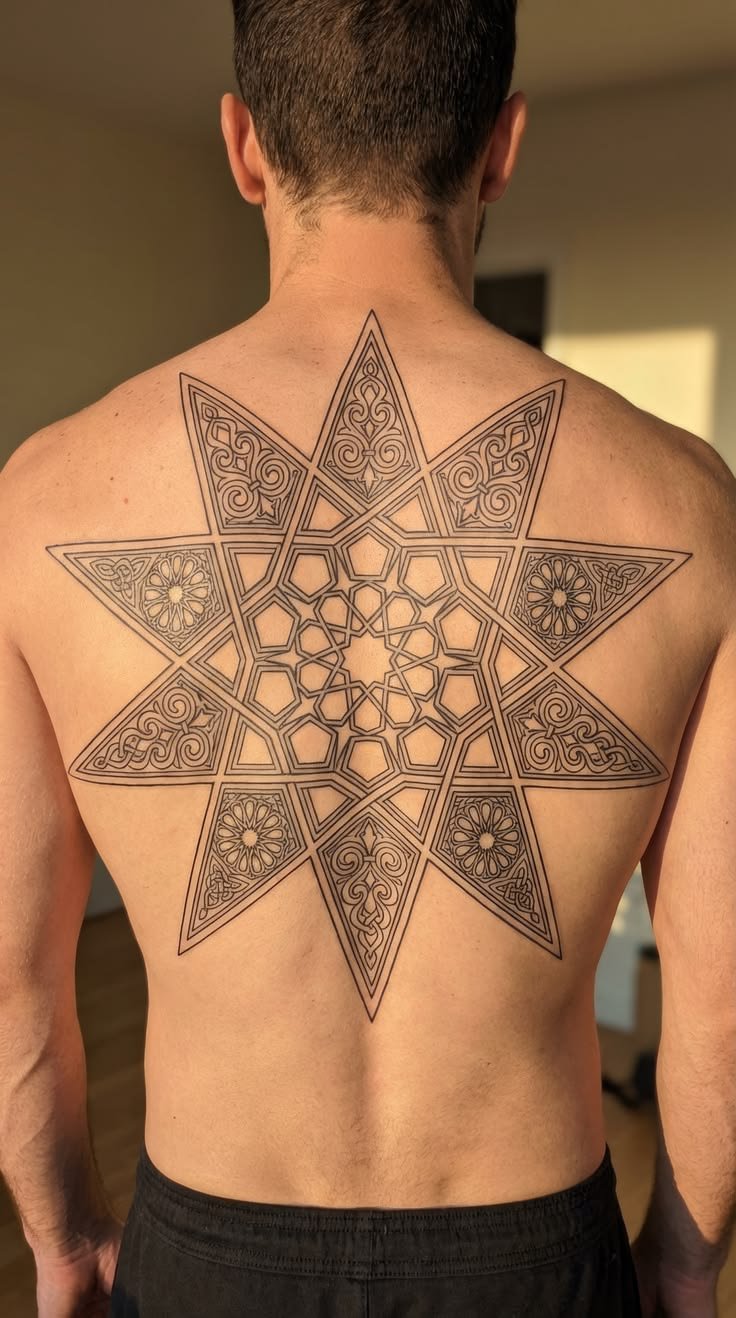
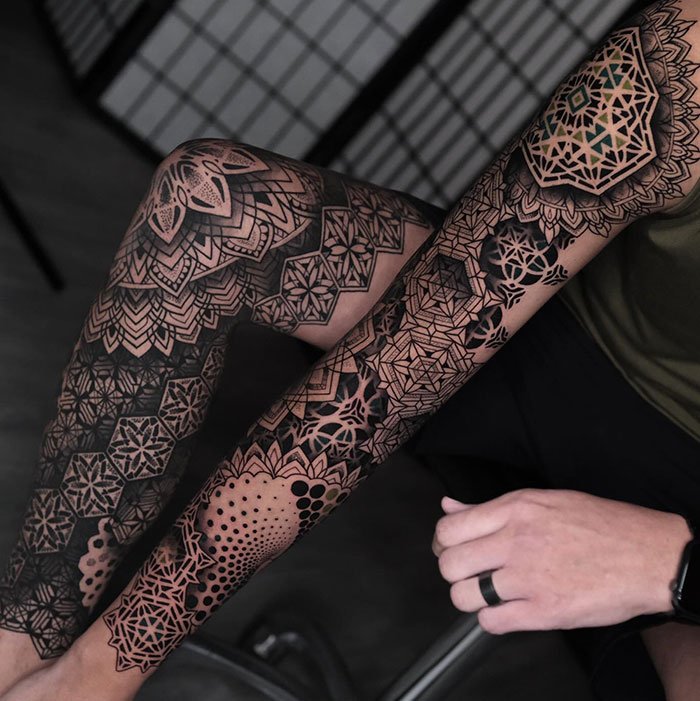
The relevance to tattooing is direct. Islamic geometric patterns — with their interlocking stars, their radiating symmetry, their capacity to fill any surface with an unbroken field of pattern — translate to skin with remarkable effectiveness. The patterns are scalable (they work at any size), wrap around curved surfaces (because they are built from modular, repeating units), and are visually striking in black ink on skin. A significant branch of geometric tattooing draws directly on Islamic geometric construction methods, and some tattoo artists study the same geometric principles that medieval Islamic artisans used.
The cultural sensitivity question: Islamic geometric art was developed within a specific religious and cultural context, and its patterns were created to decorate sacred and secular spaces. Using them as tattoo designs entails transferring imagery from one context to another and — since tattooing is generally prohibited in mainstream Islamic jurisprudence — applying a visual tradition from a culture that does not, in its orthodox form, endorse the medium. Different people draw the line differently. The geometric principles themselves (circle division, polygon tiling, symmetry operations) are mathematical and universal; the specific patterns as executed in specific historical buildings are cultural artefacts with specific origins. Most geometric tattoo artists draw on the principles rather than reproducing specific historical patterns directly.
Sacred geometry
The term “sacred geometry” covers a range of traditions — some ancient, some modern — that assign spiritual or cosmological significance to geometric forms.
- Platonic solids (tetrahedron, cube, octahedron, dodecahedron, icosahedron),
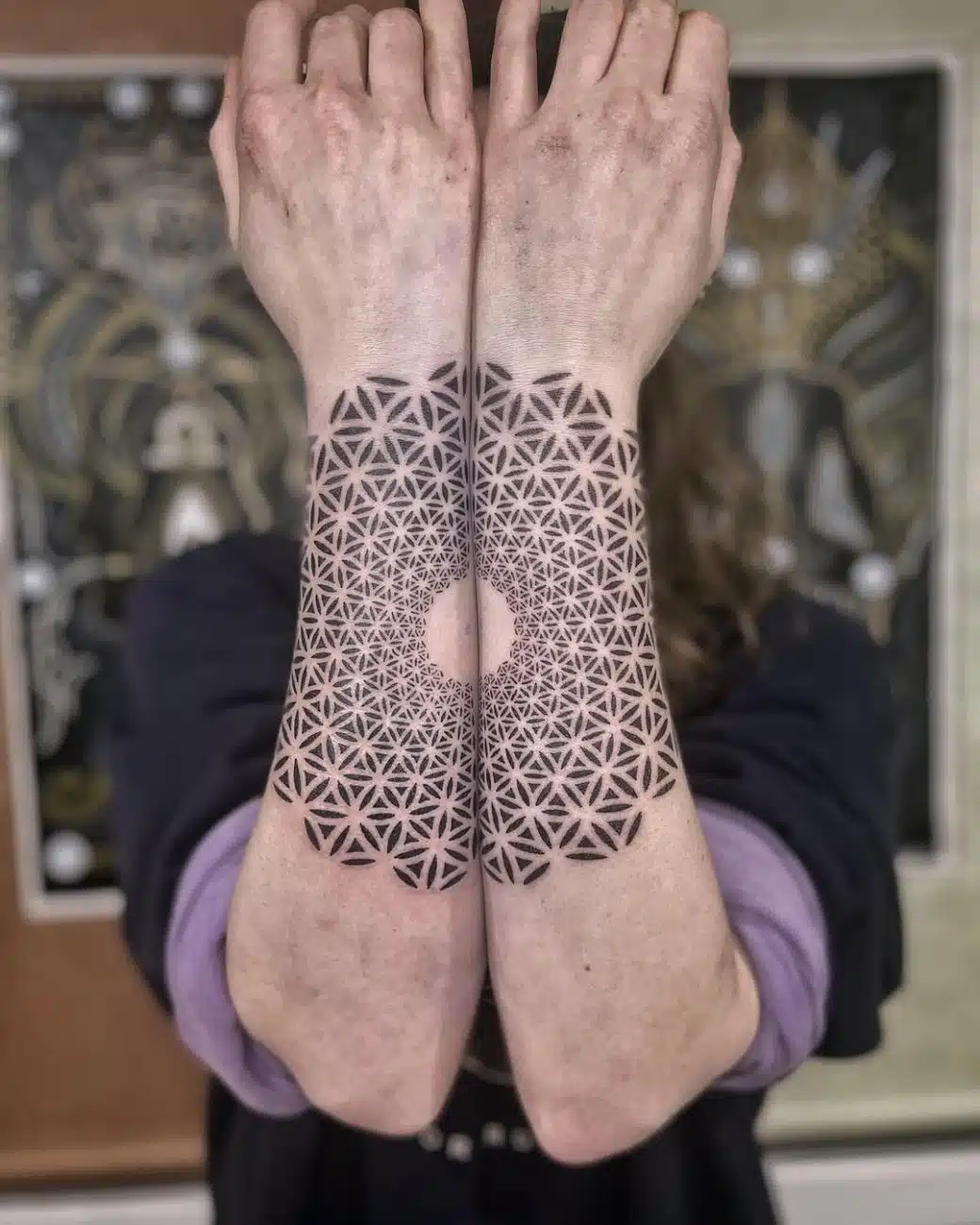
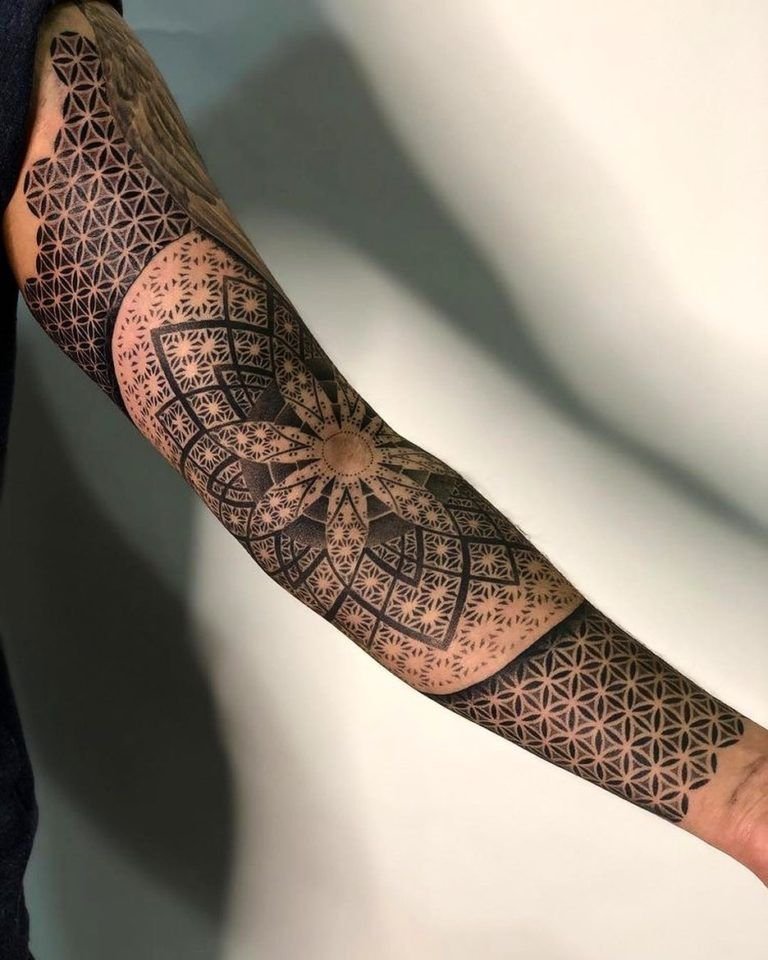
- Flower of Life (a pattern of overlapping circles found in multiple ancient contexts, including the Temple of Osiris at Abydos in Egypt),
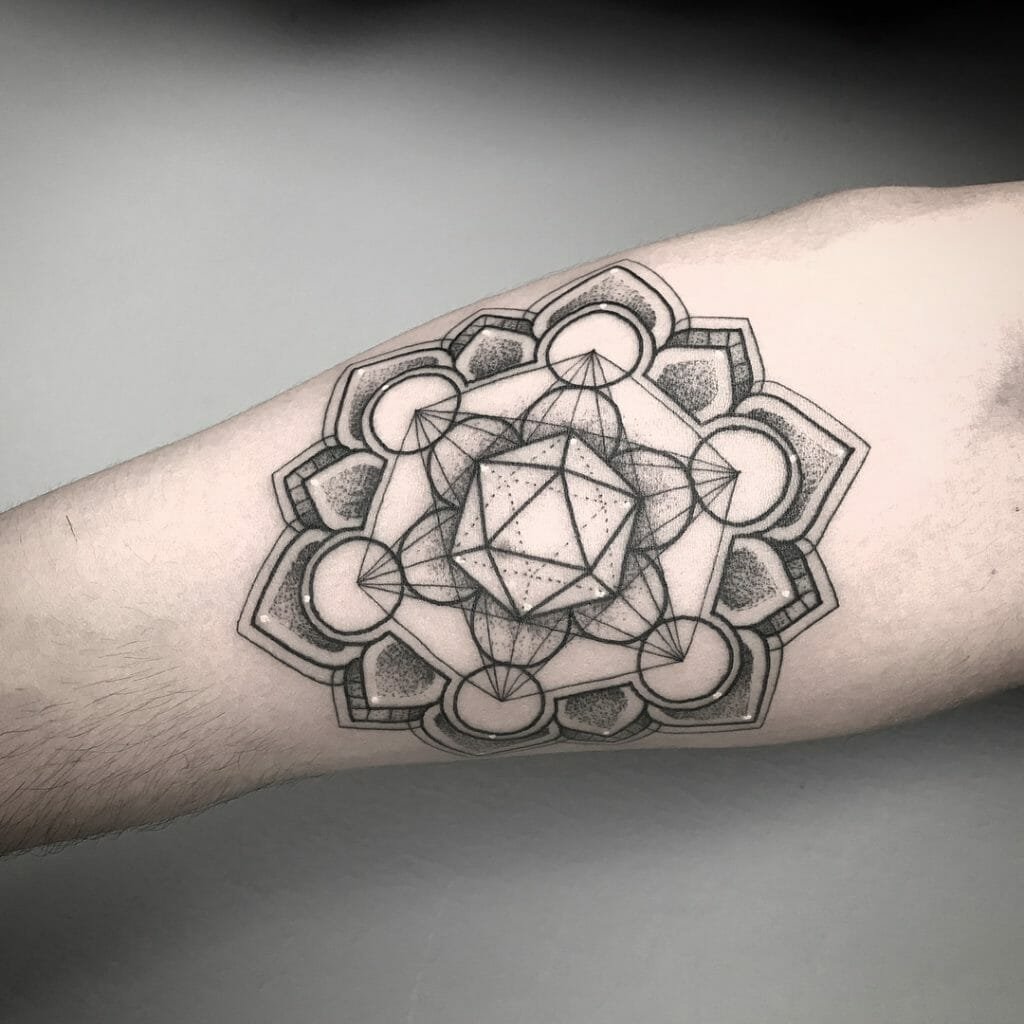
- Metatron’s Cube (a figure derived from the Flower of Life, named after the archangel Metatron in Jewish and Christian mystical traditions),
- The golden ratio and its associated spiral, the Fibonacci sequence, as expressed in natural forms,
— all fall under this heading.
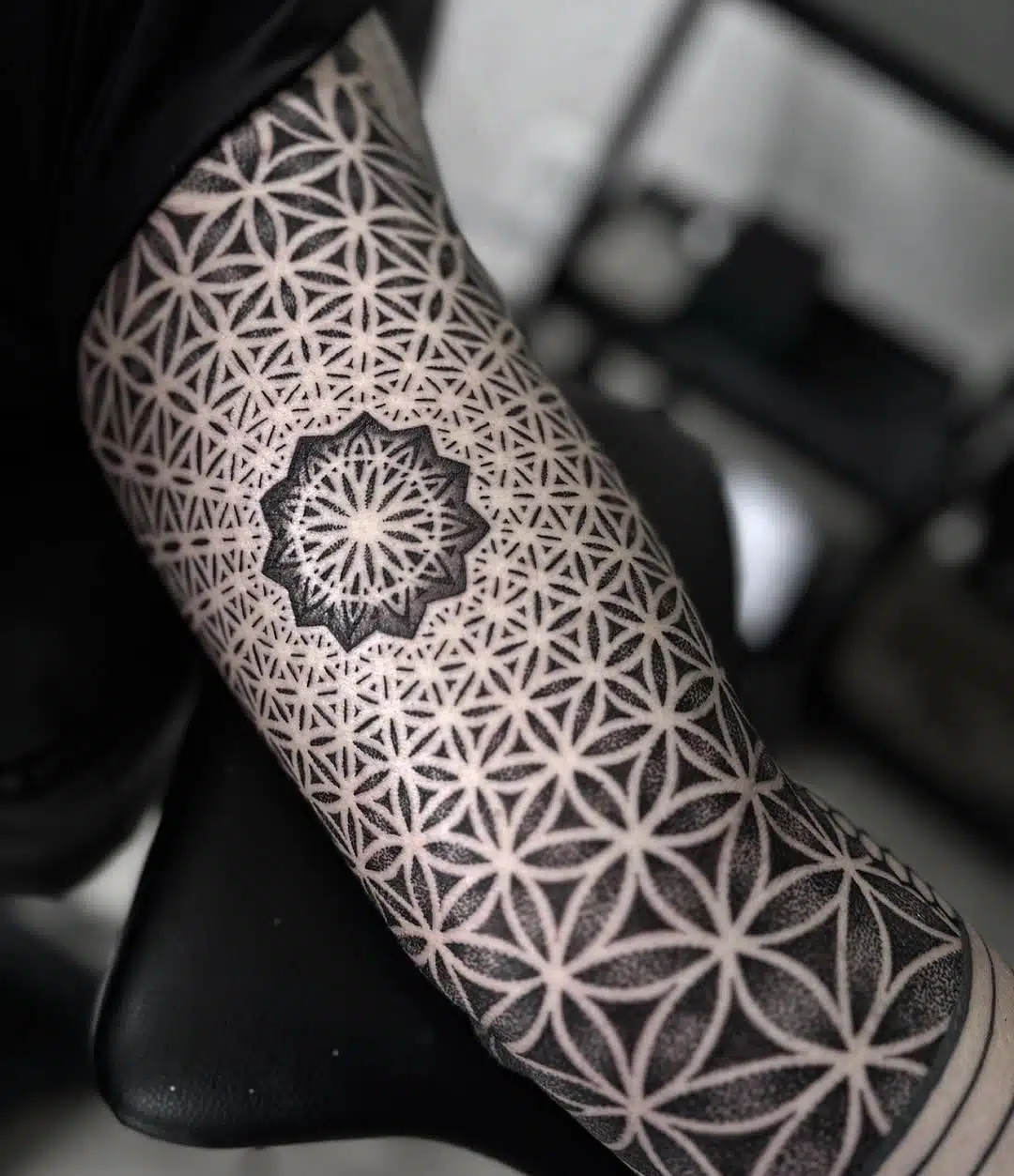
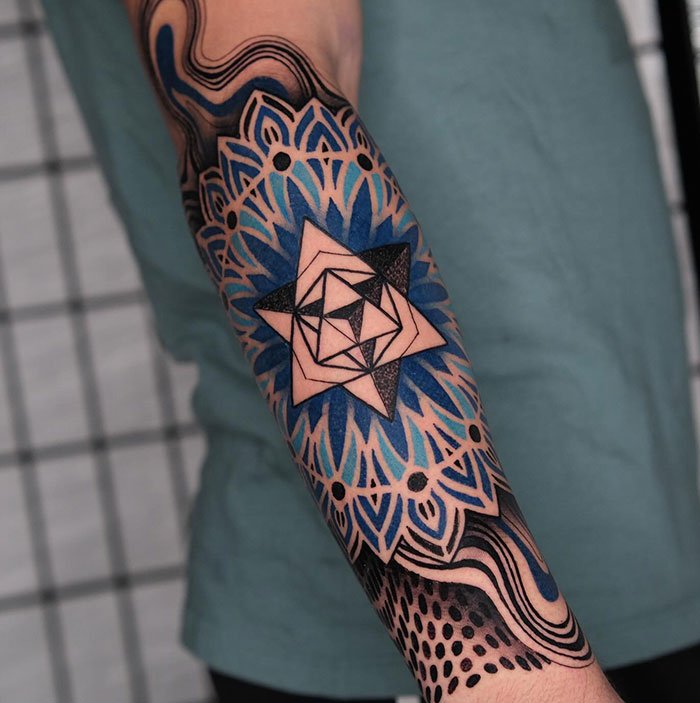
Sacred geometry tattoos are among the most commonly requested geometric designs. The Flower of Life, Metatron’s Cube, the Sri Yantra (a Hindu/tantric diagram of intersecting triangles), and various mandala forms appear frequently. For some clients, these designs carry genuine spiritual meaning — they are chosen as objects of contemplation, as representations of cosmic order, or as personal talismans. For other clients, the designs are chosen for their visual complexity and their aesthetic appeal, without the spiritual loading.
The term “sacred geometry” is used loosely in contemporary culture, and some of the claims made about specific figures (that the Flower of Life appears in every ancient culture, that the golden ratio governs all natural beauty) are overstated or inaccurate. The geometric figures themselves are real and often beautiful. The historical and spiritual claims attached to them range from well-documented (the use of specific geometric forms in Hindu tantric practice) to speculative (many of the claims about the Flower of Life’s universal significance).
Mandala traditions
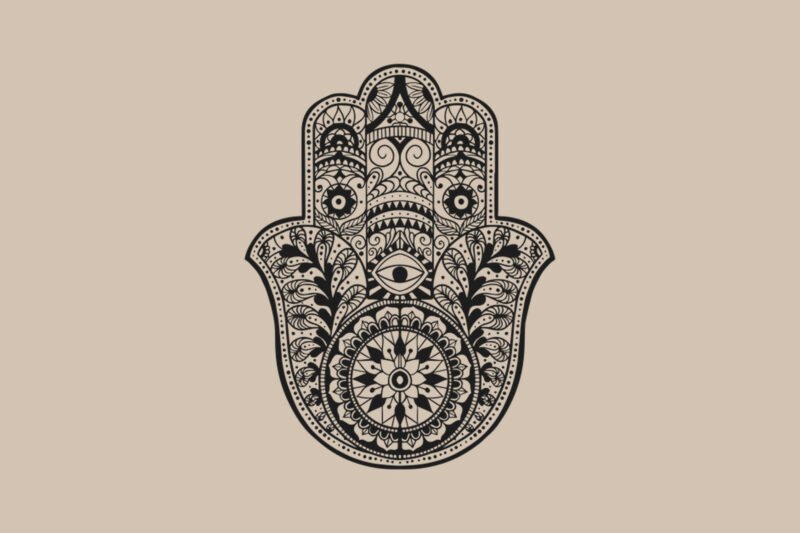
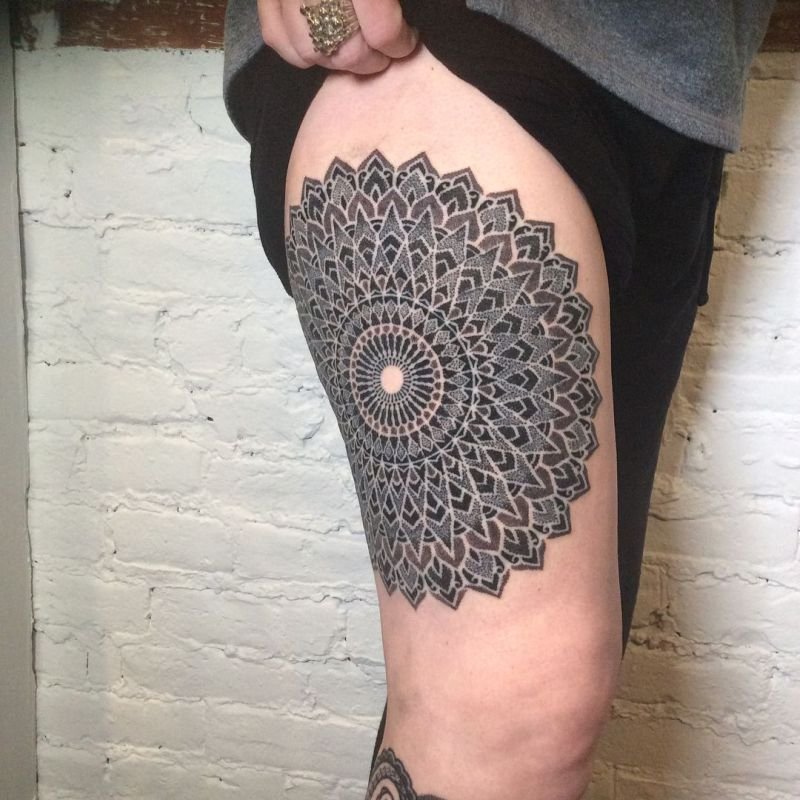
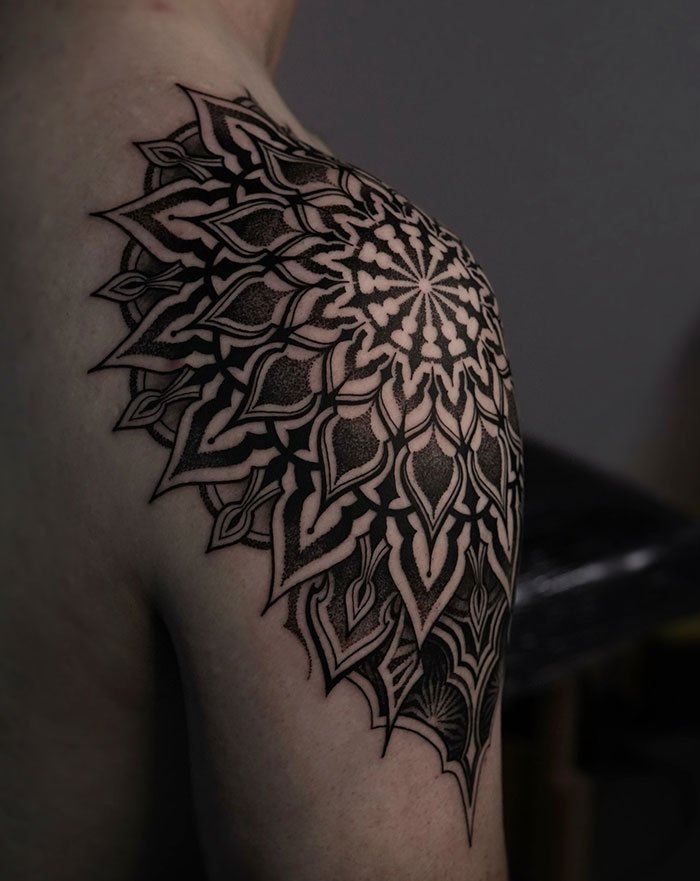
A mandala — from the Sanskrit maṇḍala, meaning “circle” — is a geometric diagram used as a focus for meditation and ritual in Hindu and Buddhist traditions. Traditional mandalas are constructed according to specific iconographic rules: concentric circles, squares, and lotus-petal forms arranged around a central point, often populated with deities, symbols, and directional guardians. Tibetan sand mandalas, constructed over days and then ritually destroyed, are the most widely known form. In tattooing, the mandala has been abstracted from its religious context into a general term for any circular, radially symmetrical, geometric composition.
A tattoo described as a mandala may follow the conventions of Hindu or Buddhist mandala construction, or it may be a purely geometric composition with radial symmetry and no religious reference. Both exist. The distinction matters for clients who intend their mandala tattoo to carry spiritual meaning — a design built according to actual mandala conventions is a different object from a design that borrows the word and the general shape.
European geometric traditions
Mathematical geometry
Some geometric tattoo work draws directly on mathematical structures:
- Penrose tilings (non-periodic tilings discovered by Roger Penrose in the 1970s),
- Fractal geometry (self-similar patterns at multiple scales, associated with Benoit Mandelbrot),
- Voronoi diagrams (partitions of space based on proximity to a set of points),
- Topological forms (Möbius strips, Klein bottles),
- Polyhedra rendered in wireframe or solid projection.
This branch of geometric tattooing is the most explicitly mathematical and often appeals to clients with backgrounds in science, engineering, or mathematics.
Geometry in nature
The branches of geometric tattooing
Geometric tattooing has diversified into several recognisable branches.

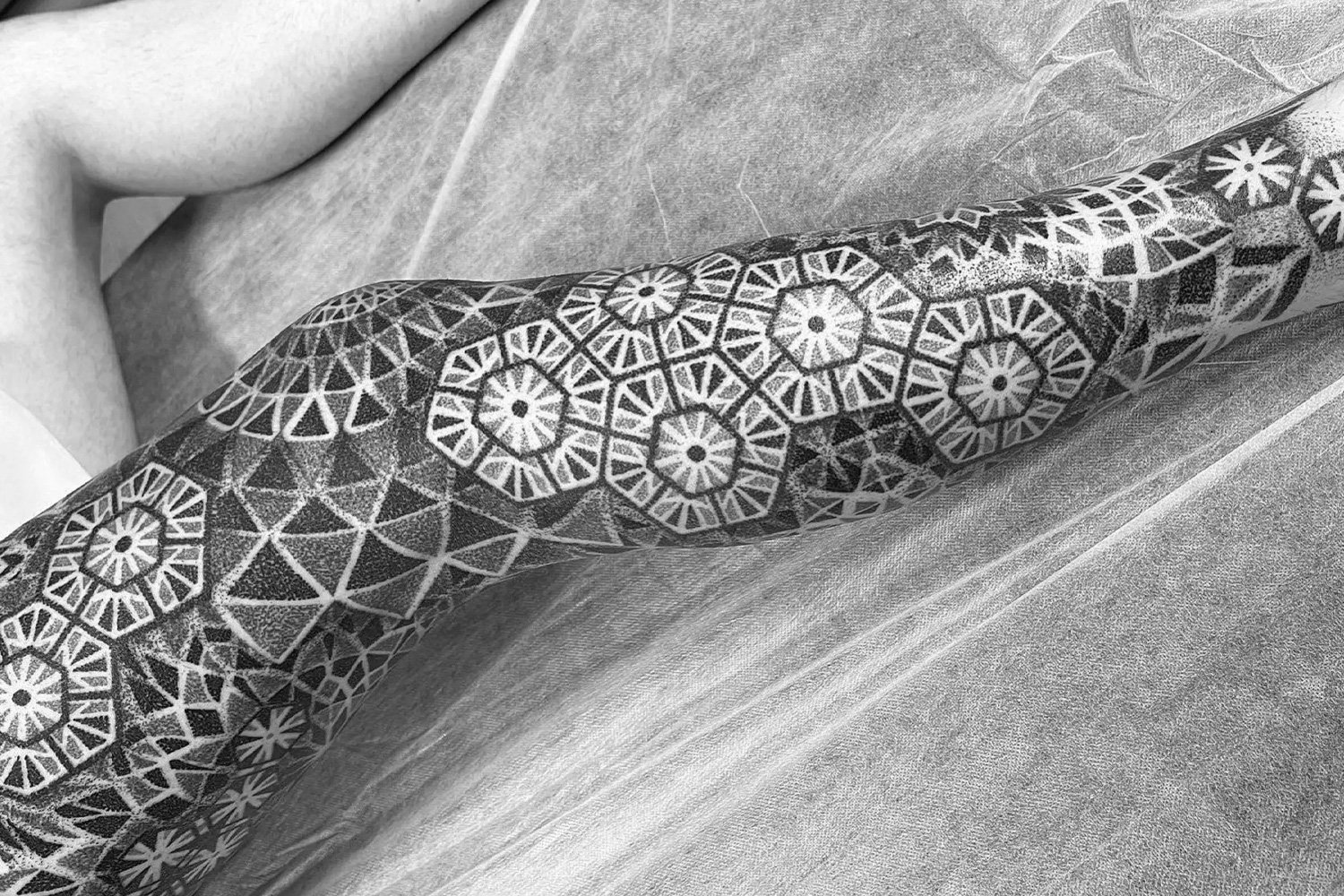
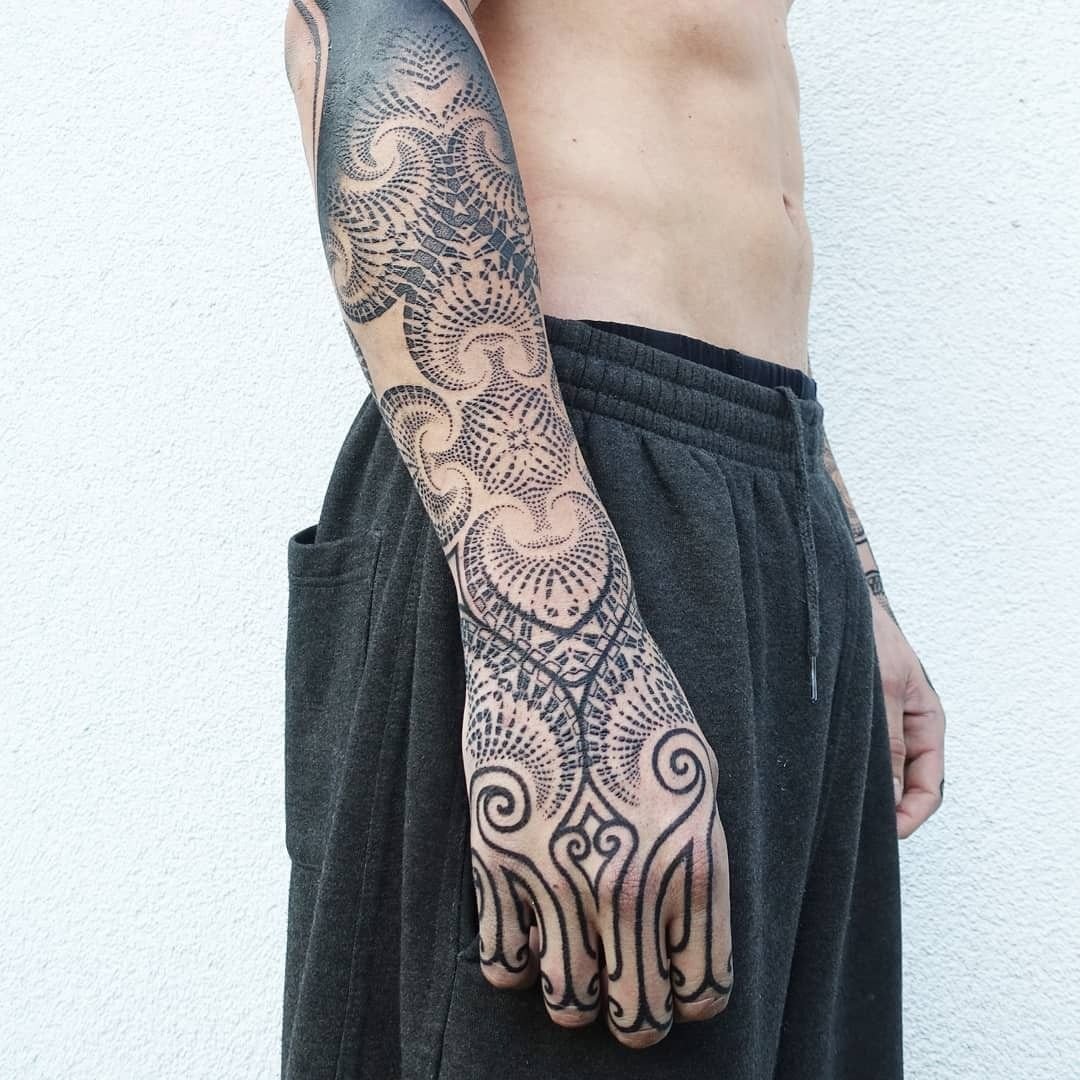
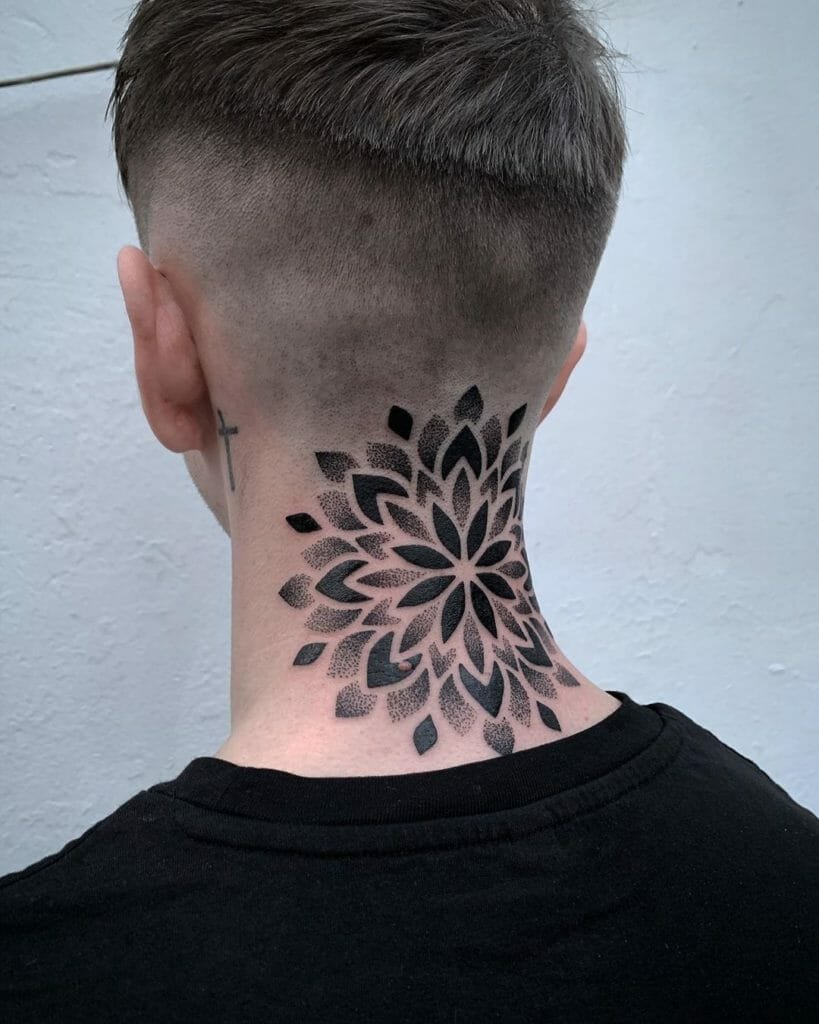
Dotwork geometric. Geometric tattoo compositions built from thousands of individually placed dots rather than from continuous lines. The density of the dots creates tonal variation — closely spaced dots read as darker, widely spaced dots read as lighter — and the technique produces a textured, granular quality that distinguishes dotwork geometric from line-based geometric. Mandalas, tessellations, and gradient-based compositions are common subjects. The technique is time-intensive (each dot is a separate needle entry) and demands exceptional consistency from the artist.
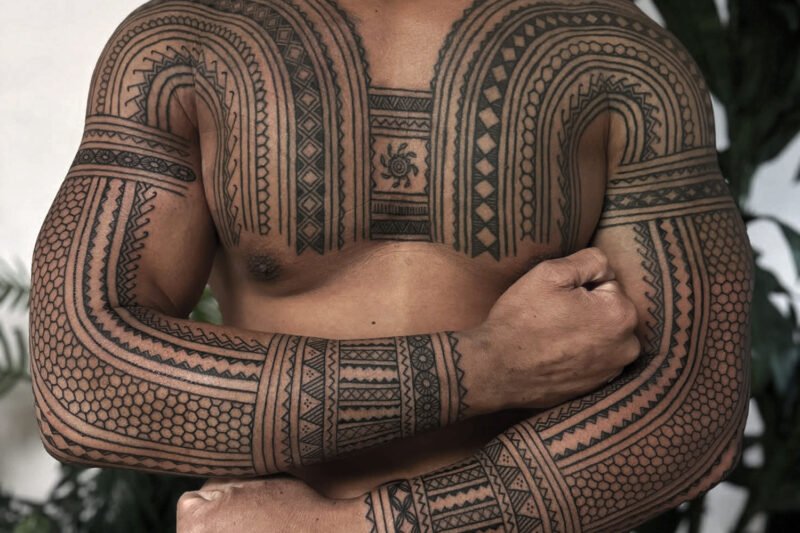
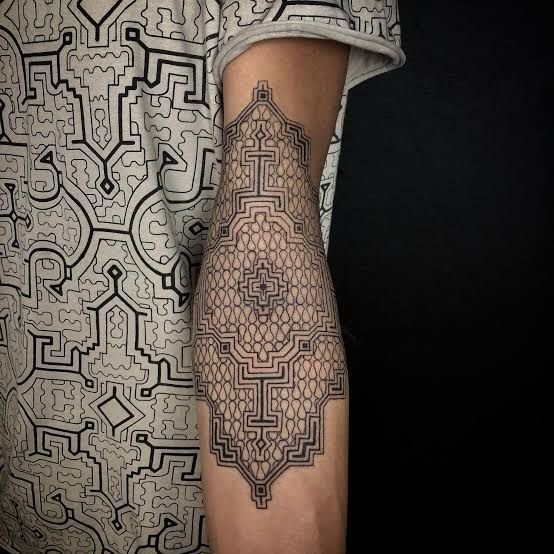
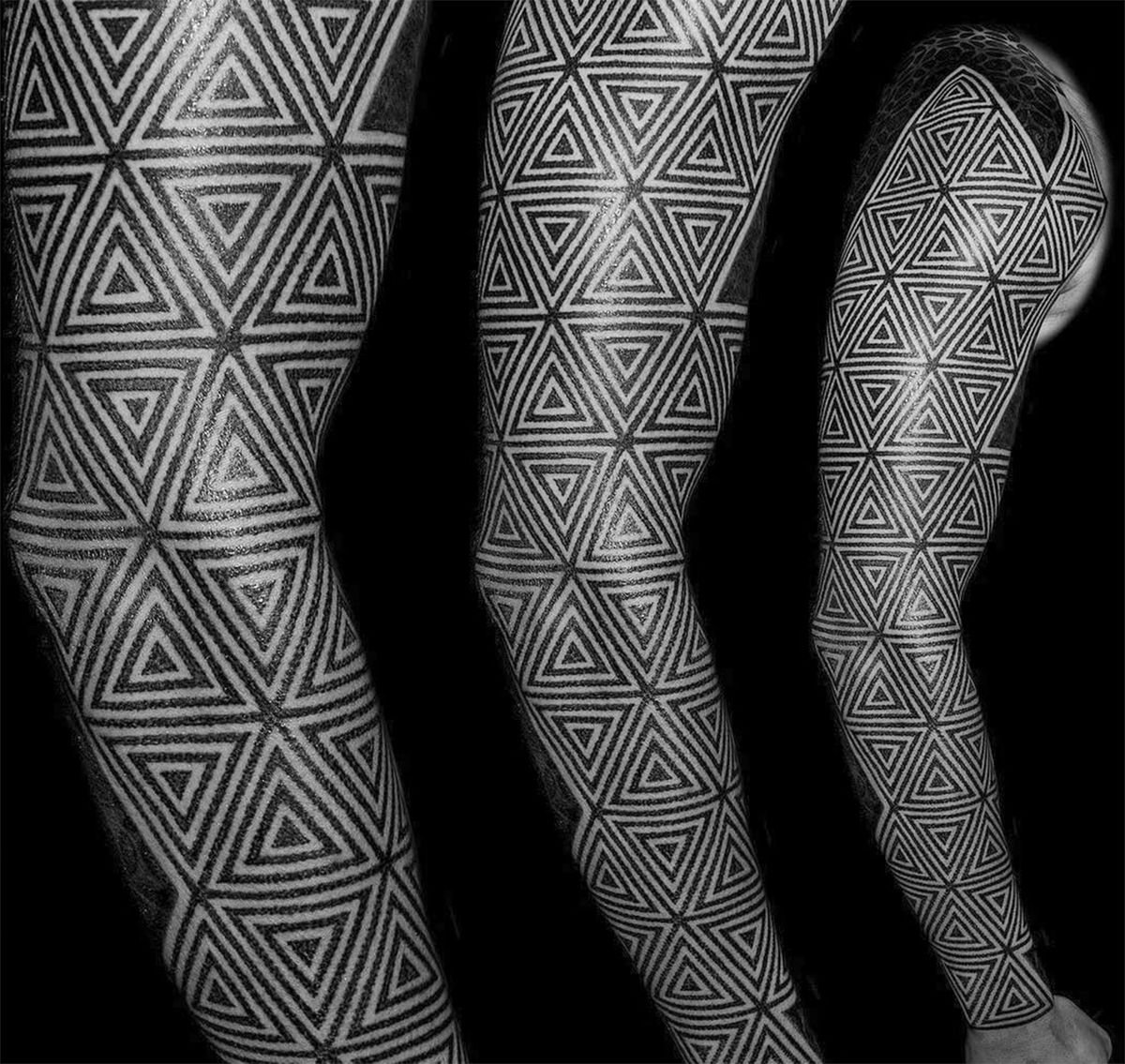
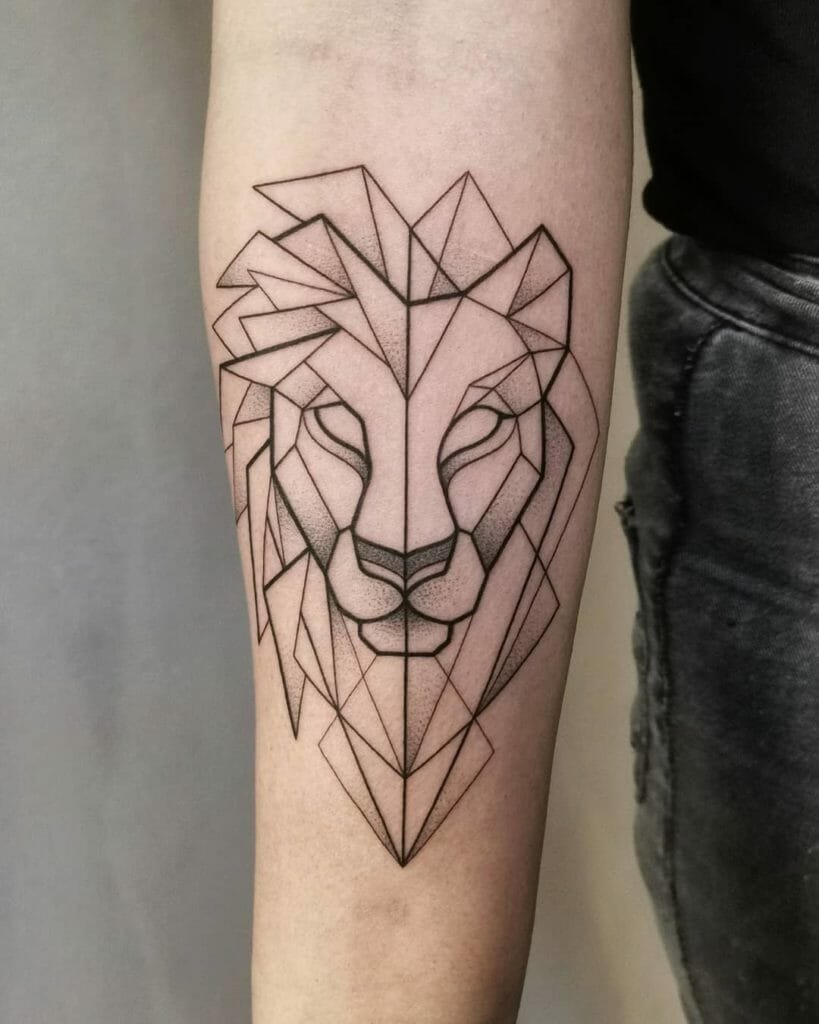
Line-based geometric. Geometric tattoo compositions built from continuous lines — outlines of shapes, wireframe structures, grids, and linear patterns. The visual effect is cleaner and more graphic than dotwork, and the technique demands line consistency: every line must be even in weight, straight where it should be straight, and curved where it should be curved. Errors in line quality are immediately visible in geometric work because the viewer’s eye expects mathematical regularity and detects deviation from it.
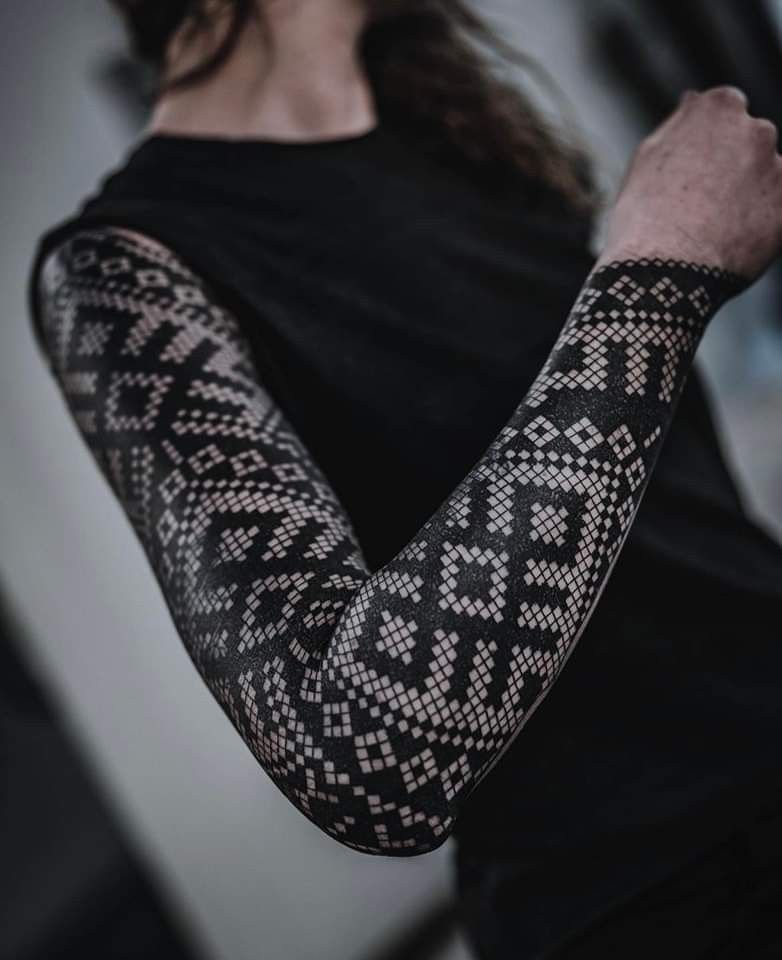
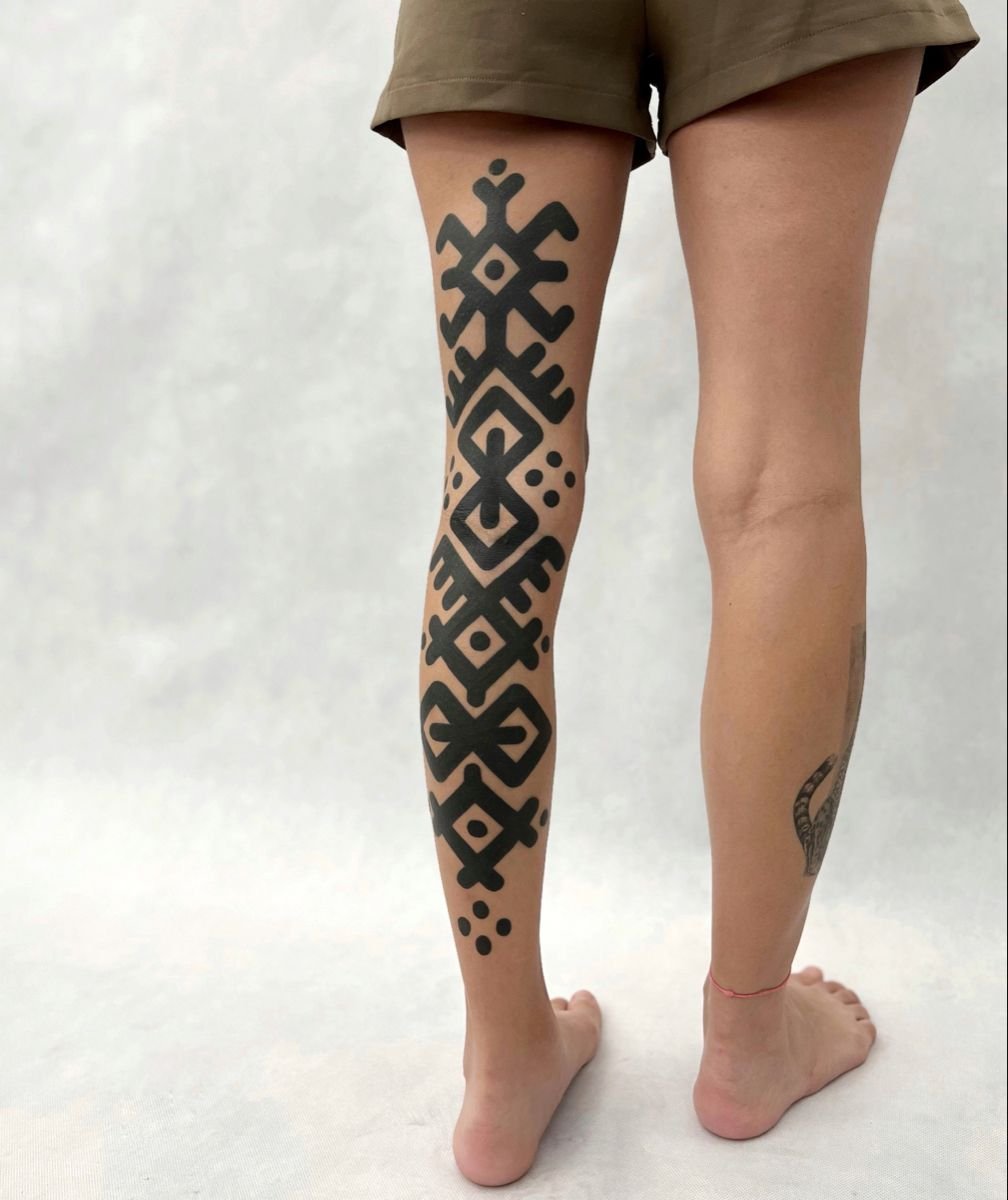
Solid geometric. Compositions using solid black fills within geometric shapes — triangles, hexagons, circles, and more complex polygons packed with dense black ink, arranged in patterns or used as standalone graphic elements. Solid geometric work overlaps with blackwork and shares its durability advantages.
Ornamental geometric. Geometric tattoo compositions that incorporate decorative elements drawn from ornamental traditions — lace patterns, filigree, scrollwork, or floral elements integrated with geometric frameworks. This branch overlaps with ornamental blackwork and with neo-traditional.
Geometric-figurative hybrids. Compositions that combine geometric forms with figurative elements — a realistic animal portrait framed within a geometric shape, a landscape visible through a geometric window, a botanical subject rendered with geometric precision. These hybrids are common in contemporary tattooing and sit at the boundary between geometric and illustrative work.
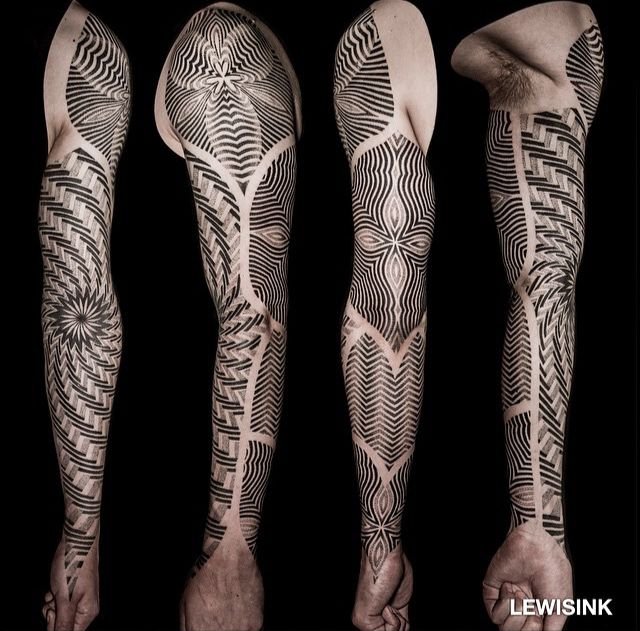
Op-art and illusion geometry. Geometric tattoo compositions designed to produce optical illusions — patterns that appear to vibrate, to have three-dimensional depth on a flat surface, or to shift and change as the viewer’s angle changes. These designs draw on the Op Art movement (Bridget Riley, Victor Vasarely) and on mathematical tiling theory.
Technical demands of geometric tattoos
Precision. The single most important quality. A line that wobbles in a portrait can be absorbed by the surrounding detail. A line that wobbles in a geometric composition is a permanent error with no surrounding detail to hide behind. Geometric tattoo work demands that every line be placed exactly where the design specifies, at exactly the right angle, with exactly the right spacing. This is a motor skill that takes years to develop.
Symmetry. Most geometric compositions are symmetrical — bilaterally, radially, or rotationally — and the human eye detects asymmetry in geometric forms more readily than in organic forms. A mandala with one section slightly larger than its mirror section reads as wrong, even to a viewer who cannot articulate what is wrong. Achieving symmetry on a three-dimensional, curved, moving body surface is substantially harder than achieving it on paper.
Stencil work. Because geometric precision cannot be reliably achieved freehand, most geometric tattoo artists work from carefully prepared stencils. The stencil must be geometrically accurate, correctly scaled to the body part, and applied to the skin with precise alignment. Any error in the stencil — a line slightly off-angle, a circle slightly out of round — will be permanently reproduced on the skin. Some artists construct their stencils digitally using vector graphics software; others use compass-and-ruler construction methods. Both approaches can produce excellent results.
Dotwork consistency. For dotwork geometric tattoos, each dot has to be the same size, the same depth, and at the correct spacing. Over the course of a large piece — which may contain tens of thousands of dots — maintaining this consistency requires concentration and physical endurance. Fatigue produces inconsistency, and inconsistency in dotwork is visible.
Wrapping. Geometric patterns that tile a flat surface have to be adapted when applied to a curved body. A hexagonal grid that tiles perfectly on paper will distort when wrapped around a forearm, and the artist has to anticipate and manage that distortion. The mathematical problem is analogous to map projection — flattening a sphere into a plane, or wrapping a plane onto a sphere — and artists who understand this tend to produce stronger work.
Ageing
Geometric tattoos age according to the same principles as any other blackwork.
Solid black geometric ages the best. Carbon black is the most stable pigment, and a well-packed solid geometric shape will hold its form for decades. The edges will soften very slightly over time as pigment migrates outward, but the overall shape remains legible.
Line-based geometric ages well if the lines are packed at sufficient depth and weight. Very fine lines — single-needle geometric work at small scale — will thicken over time, and closely spaced parallel lines may eventually merge. The design survives, but the crispness decreases. Artists who understand this build their geometric compositions with slightly more space between lines than would be ideal on paper, anticipating the convergence that time will produce.
Dotwork geometric tattoo ages with a specific character. Individual dots spread slightly, and a dotwork gradient that was crisp when fresh will be softer at ten years. The overall effect remains readable, but the finest dot-spacing distinctions blur. Dense dotwork holds up better than sparse dotwork, and larger dots hold up better than smaller ones.
Colour geometric tattoo — where it exists — is subject to the same colour-fading and shifting that affects all colour tattoo work. Geometric compositions that depend on precise colour relationships (complementary colour contrasts, specific hue distinctions between adjacent shapes) are vulnerable to those relationships drifting over time.
What works on skin
Scale determines detail survival. A geometric mandala with twenty concentric rings, each the size of a coaster, will hold its detail. The same design at the size of a coin will not — the inner rings will merge into a solid centre within a few years. Geometric work rewards a generous scale.
Flat, stable body planes hold geometry best. Upper arm, thigh, back, chest, calf, ribs. Areas with high mobility (elbows, knees, the front of the wrist) tend to stress geometric patterns, and movement can cause distortion over time. Fingers and feet are poor tools for any geometric work that requires precision.
Symmetrical compositions need symmetrical placements. A mandala on the sternum, a geometric pattern centred on the spine, a symmetrical forearm wrap — these work because the body’s own symmetry supports the design’s symmetry. A symmetrical composition placed off-centre on an asymmetrical body part will look wrong from the first day.
Black ink holds geometry better than colour. The precision that defines geometric work is best served by the most stable pigment. Colour geometric exists and can be striking, but the ageing risks are higher, and any colour shift affects the mathematical relationships between shapes.
Choosing a geometric tattoo artist
Look for mathematical precision in healed work. Straight lines, circles that are round, accurate angles, symmetry that holds — at one year and beyond. The healed photograph is the only honest test of whether the artist can deliver the precision the style demands.
Check the artist’s design process. Does the artist construct their own geometric designs, or do they execute client-supplied templates? An artist who constructs original geometric compositions — who understands circle division, tiling theory, and the principles of geometric ornament — will produce stronger and more coherent work than one who copies patterns from reference images.
Look for body-fitting. The best geometric work is designed for the specific body part and the specific client. A geometric composition that wraps a forearm should be designed for that forearm’s diameter and curvature, not scaled from a flat template. Evidence of custom body fitting in the portfolio is a strong indicator of quality.
Dotwork specialists are dotwork specialists. If you want dotwork geometric, find an artist who specialises in dotwork. The technique requires a specific skill set — consistent dot size, consistent depth, consistent spacing — that generalists may not have developed. The reverse is also true: a dotwork specialist may not be the strongest choice for line-based geometric work.
Sources & further reading
- Eric Broug, Islamic Geometric Patterns. Thames & Hudson, 2008.
- Eric Broug, Islamic Geometric Design. Thames & Hudson, 2013.
- Daud Sutton, Islamic Design: A Genius for Geometry. Wooden Books, 2007.
- Keith Critchlow, Islamic Patterns: An Analytical and Cosmological Approach. Thames & Hudson, 1976.
- Issam El-Said and Ayşe Parman, Geometric Concepts in Islamic Art. World of Islam Festival Publishing, 1976.
- Jay Bonner, Islamic Geometric Patterns: Their Historical Development and Traditional Methods of Construction. Springer, 2017.
- Robert Lawlor, Sacred Geometry: Philosophy and Practice. Thames & Hudson, 1982.
- Martin Gardner, Penrose Tiles to Trapdoor Ciphers and the Return of Dr. Matrix. W.H. Freeman, 1989.
- Benoit Mandelbrot, The Fractal Geometry of Nature. W.H. Freeman, 1982.
- Giuseppe Tucci, The Theory and Practice of the Mandala. Rider, 1961; reprinted Dover, 2001.
- George Bain, Celtic Art: The Methods of Construction. Constable, 1951; reprinted Dover, 1973.
- Peter S. Stevens, Handbook of Regular Patterns: An Introduction to Symmetry in Two Dimensions. MIT Press, 1981.
- D’Arcy Wentworth Thompson, On Growth and Form. Cambridge University Press, 1917; revised 1942.
- Lars Krutak, Spiritual Skin: Magical Tattoos and Scarification. Edition Reuss, 2012.
- Anna Felicity Friedman, The World Atlas of Tattoo. Yale University Press, 2015.
- Matt Lodder, Painted People: Humanity in 21 Tattoos. Harper, 2024.