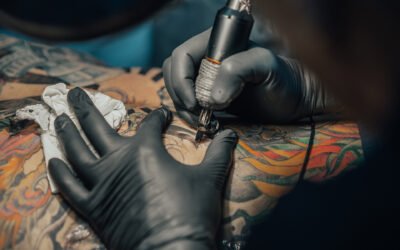
Tattooing involves real biology, real physics, and real chemistry — and understanding them changes how you think about the craft. The articles in this section cover the science behind tattooing: how needles deposit ink, what happens in the skin during and after a session, how the immune system interacts with pigment over decades, how different inks behave and age, what makes one placement hold better than another, and how the technology — machines, needles, cartridges — has developed to do all of this more precisely. Written for artists, clients, and anyone curious about what is actually happening beneath the surface.
A tattoo is ink trapped in the second layer of the skin. Everything else exists to get the ink to that layer and keep it there. The process is mechanical (a needle punctures the skin and deposits pigment), biological (the body reacts to the wound and to the foreign material), and a negotiation between the ink’s desire to stay put and the body’s slow, patient effort to remove it.