Related Posts

Fine Line
Everything just one needle makes possible
A standard tattoo liner uses a grouping of needles — five, seven, nine, sometimes more — bundled in a round configuration to deposit a band of ink in a single pass. The resulting line has weight and presence. It reads from across a room. It is the line that built American traditional, that holds the outlines of Japanese irezumi, that anchors neo-traditional work. It is, by default, a thick line, because thickness is what needle groupings produce.
Fine-line tattooing starts by removing most of those needles. A single needle, or a tight grouping of three (3RL), deposits ink in a line thin enough to resemble a pencil on paper, a pen on skin, a thread laid across the body. The resulting image has a different visual weight from anything a standard grouping can produce — lighter, more delicate, closer to drawing than to the graphic tradition that defines most tattooing. The choice of needle is a technical decision, but the aesthetic that follows from it has become one of the most recognisable and most requested looks in contemporary tattooing.
The fine line style is the most likely to be a person’s first tattoo in the 2020s. It is also the style most subject to misunderstanding — about what it can do, about how long it lasts, about where it comes from, and about what separates a well-executed fine line piece from a poorly executed one. Addressing those misunderstandings requires going back to the needle and working forward.
Where it comes from
Fine line tattooing has two distinct lineages, and confusing them leads to confusion about the style itself.
The first lineage is the Chicano single-needle tradition, developed in the California prison system in the 1960s and 70s and brought into professional shops by Freddy Negrete, Jack Rudy, and Charlie Cartwright at Good Time Charlie’s Tattooland in East Los Angeles from 1975 onward. This tradition used a single needle because that was what was available — one needle, one ink, and the skill to make them do everything. The visual result was fine-line black-and-grey work with smooth tonal gradients, used for portraiture, religious imagery, lettering, and the full Chicano iconographic vocabulary. The line was fine because the tools demanded it; the aesthetic followed from the constraint.
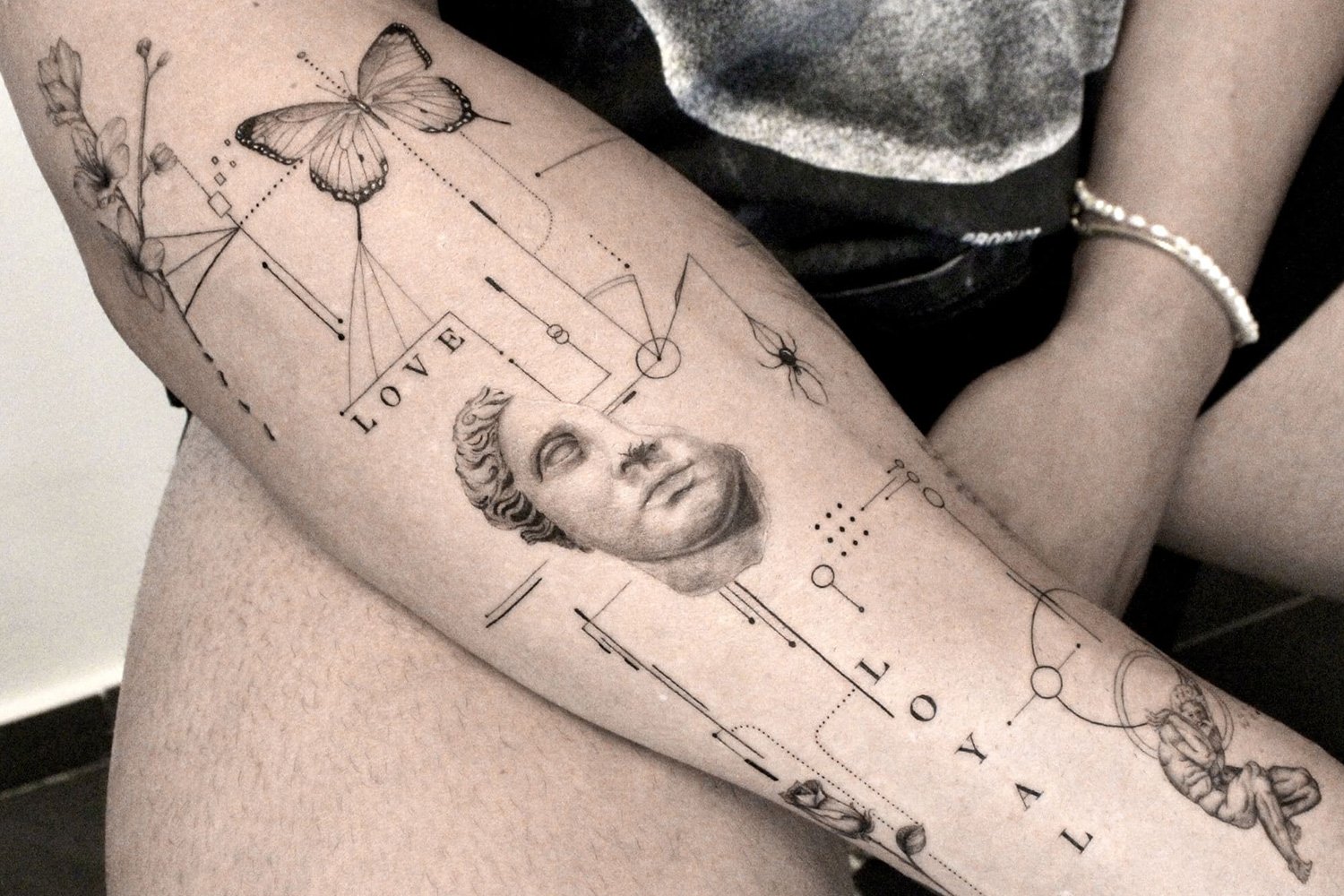
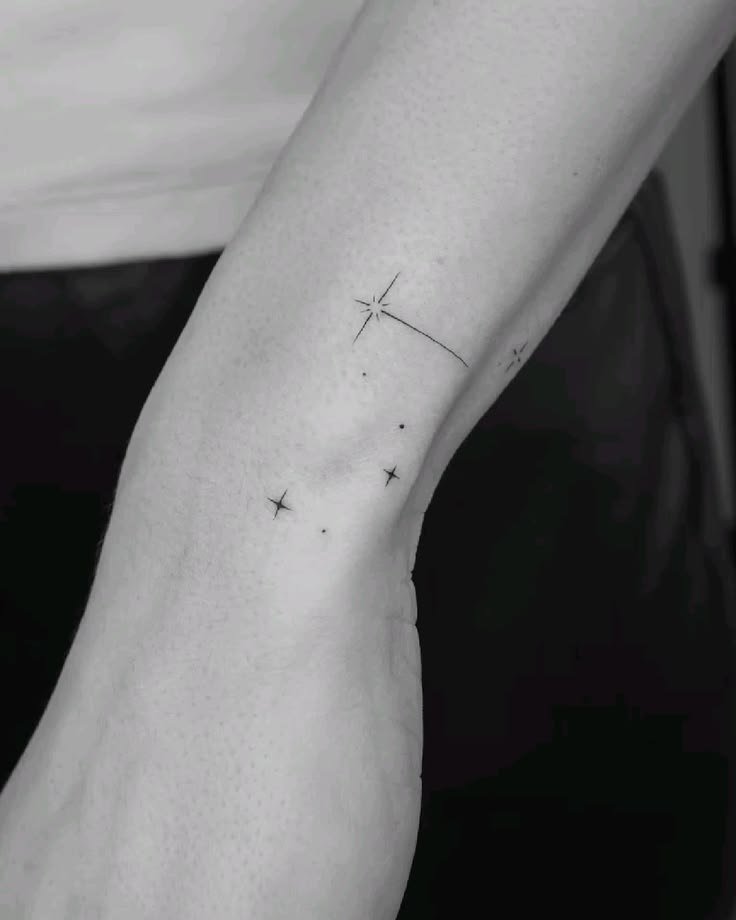
The second lineage is contemporary fine line, which emerged in the 2010s as a deliberate aesthetic choice by artists with access to every available needle configuration, who chose the finest for their visual effect. This lineage has different cultural roots — Korean tattooing, West Coast minimalism, fashion-adjacent studio culture, Instagram as a primary platform — and a different visual vocabulary: botanicals, small animals, geometric forms, delicate script, ornamental patterns, small illustrative compositions. The line is fine because the artist and the client want it to be; the aesthetic is the starting point rather than the consequence.
Both lineages use similar tools. They produce different kinds of work, for different reasons, within different cultural contexts. The Chicano tradition is covered in depth elsewhere on this site. This article focuses primarily on the contemporary fine line movement, while acknowledging its technical debt to the older tradition.
The contemporary movement
Contemporary fine line consolidated as a named style in the mid-2010s, driven by several converging developments.
The most important was the Korean tattoo scene. Tattooing in South Korea has operated under legal restrictions — a 1992 Supreme Court ruling classified it as a medical procedure performed only by licensed physicians, a ruling that has been inconsistently enforced and remains the subject of ongoing debate over reform. Despite the restrictions, a large and technically ambitious tattoo scene developed, organised through private studios, word of mouth, and social media. The aesthetic that emerged from this scene favoured small-scale, discreet, technically precise work — partly because the cultural context rewarded subtlety over visibility, and partly because the artists working in it brought sensibilities from illustration, graphic design, and fine art rather than from the American shop tradition.
Artists including Zihwa, Doy, Hongdam, and the collective at Sol Tattoo in Seoul developed a visual vocabulary that was immediately distinctive: single-needle botanical illustrations, small animal portraits, geometric ornaments, and delicate script, all rendered in fine black line with minimal or no shading. The work was shaped by Instagram from the start — small enough to photograph well on a phone screen, visually striking at the scale of a social media image, and aesthetically coherent across a portfolio grid. The platform was the environment, and the aesthetic grew inside it.
In the United States, Dr. Woo (Brian Woo) at Hideaway at Suite X in Los Angeles became the most visible practitioner of a related but distinct fine line approach — single-needle work with more tonal variation and a wider range of subject matter, including geometric compositions, celestial imagery, and small illustrative pieces. His celebrity clientele and his early adoption of Instagram as a portfolio platform gave the style enormous visibility in the American and international market.
JonBoy (Jonathan Valena) in New York developed a fine line practice focused on minimalist script, small symbols, and discreet placement, often for clients getting their first tattoo. Bang Bang (Keith McCurdy), also in New York, built a studio that offered fine line alongside other styles, with a celebrity-heavy client base that further amplified the style’s mainstream visibility.
In Europe, fine line developed through studios in Barcelona, London, Berlin, and Paris, often with artists who had trained in illustration or graphic design and who brought those disciplines’ line sensibilities into tattooing. The European branch of the style tends to draw more heavily on botanical illustration, folk ornament, and art nouveau line work than the Korean or American branches.
What defines the style
The line is the primary element.
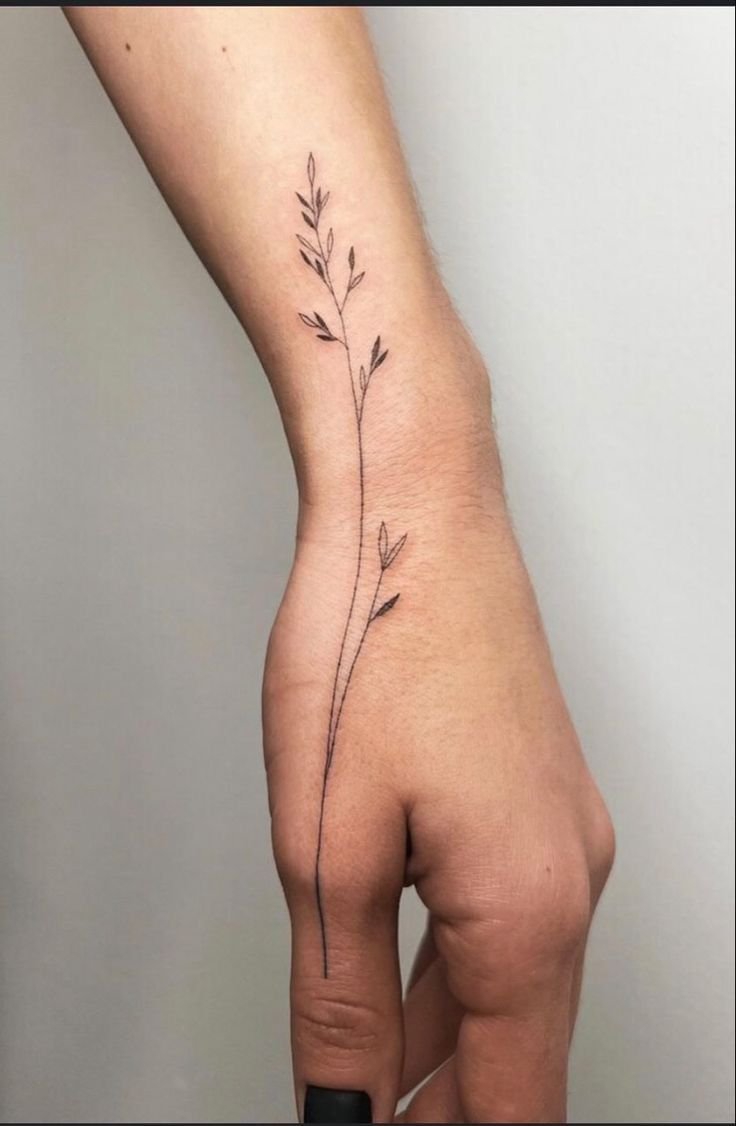
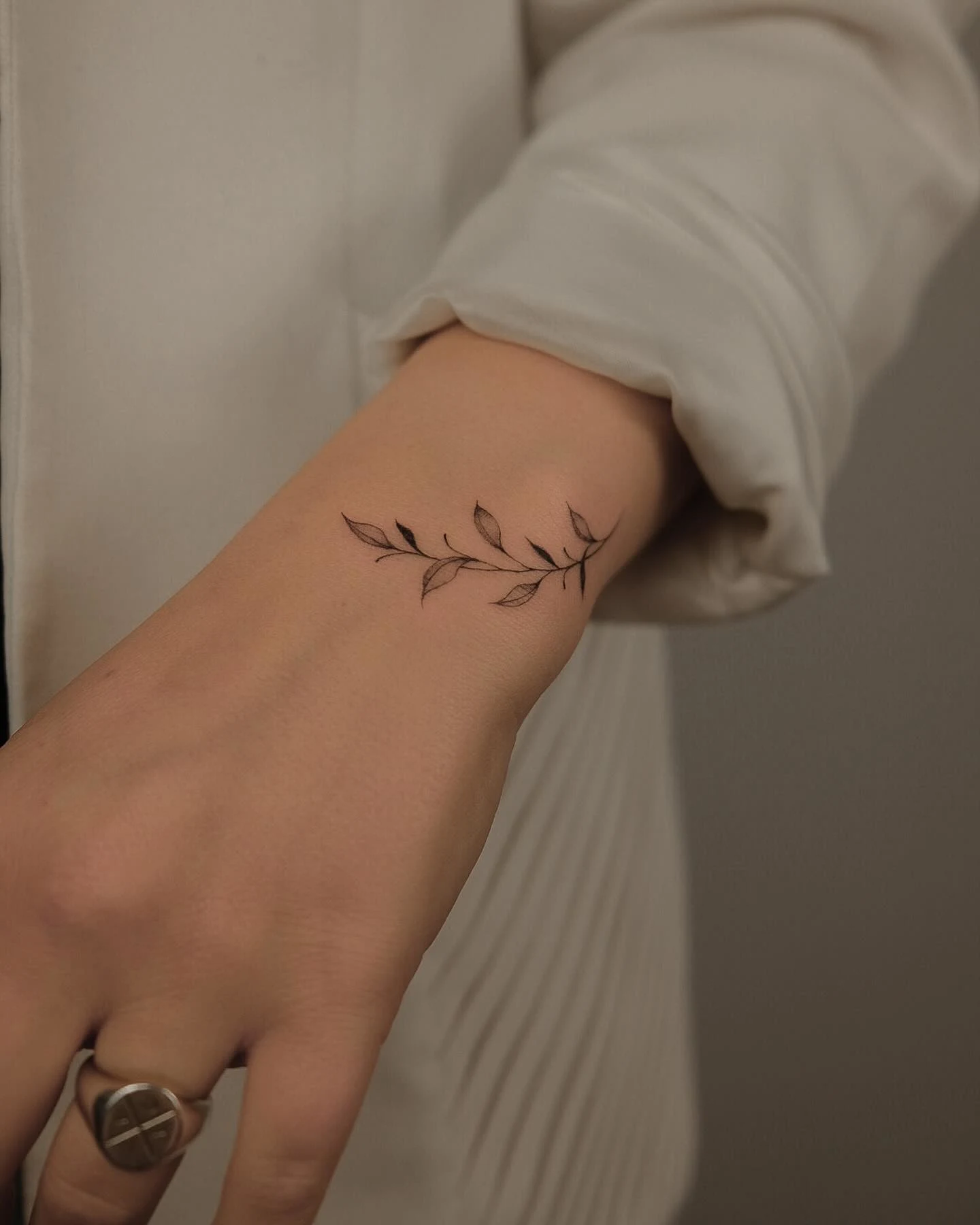
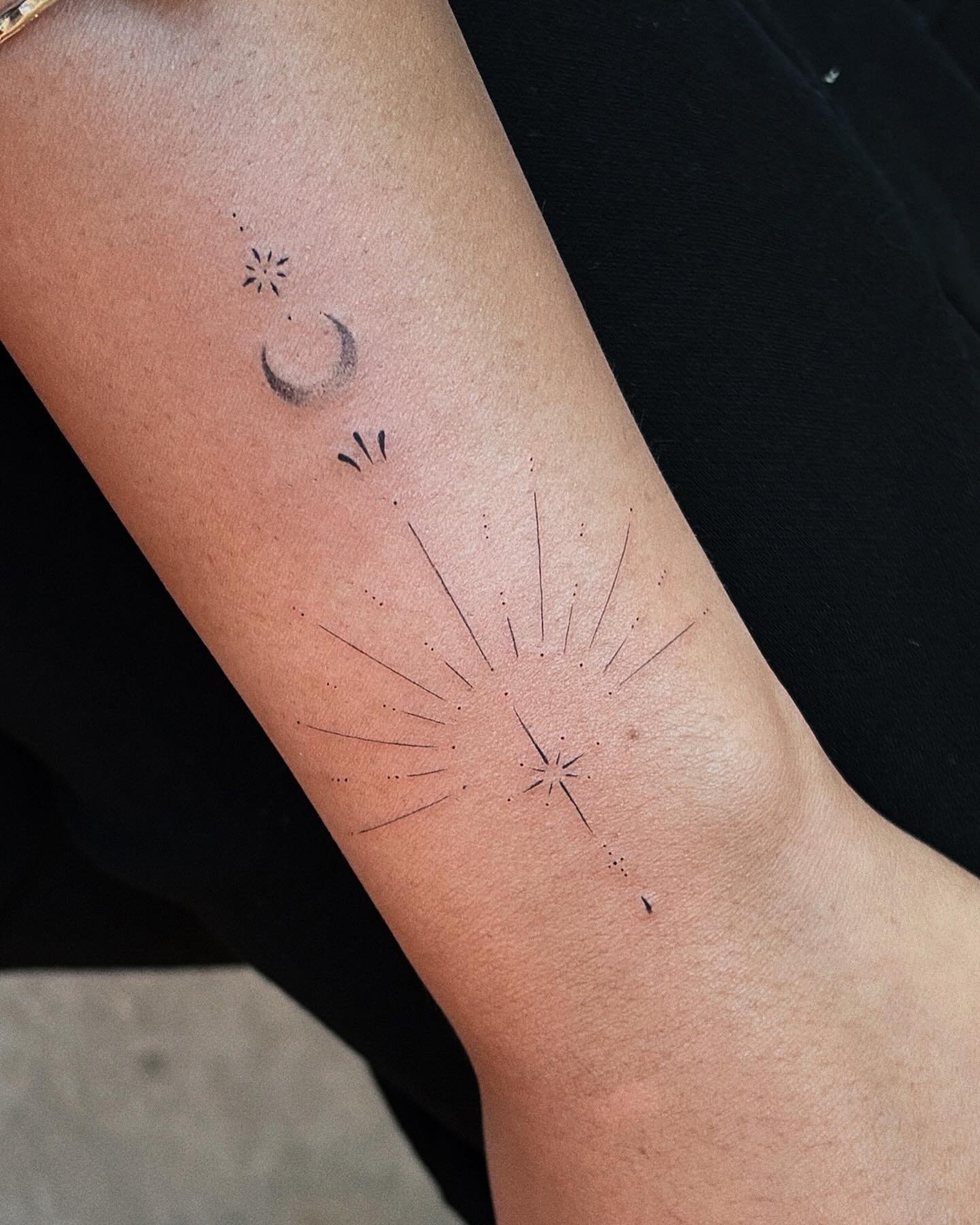
Where most tattoo styles use line as a container for colour or shading, fine line makes the line itself the subject. A fine line botanical is built from lines — the stem, the veins of the leaf, the curve of the petal — with minimal or no fill. The line carries the image.
Shading is minimal or absent.
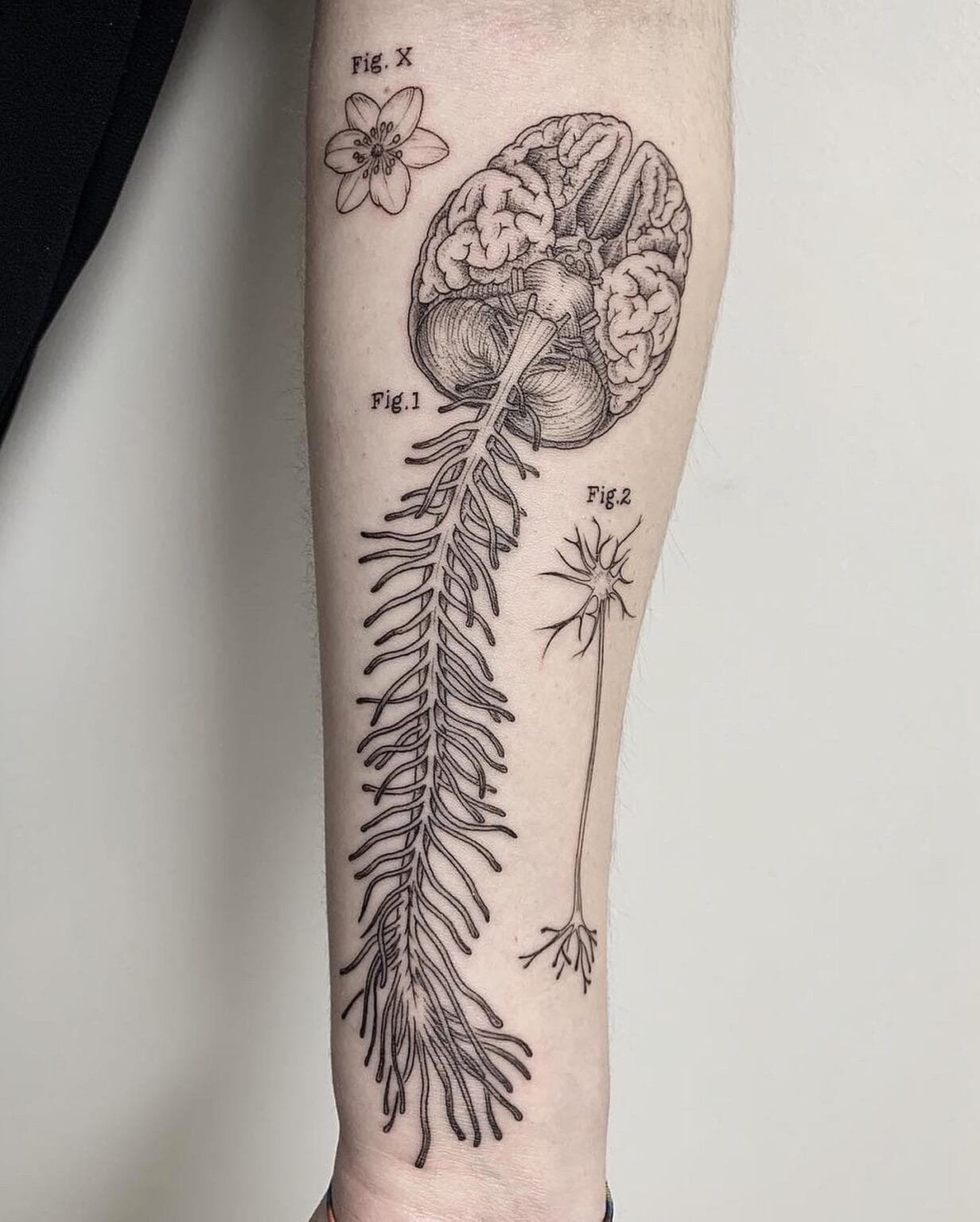
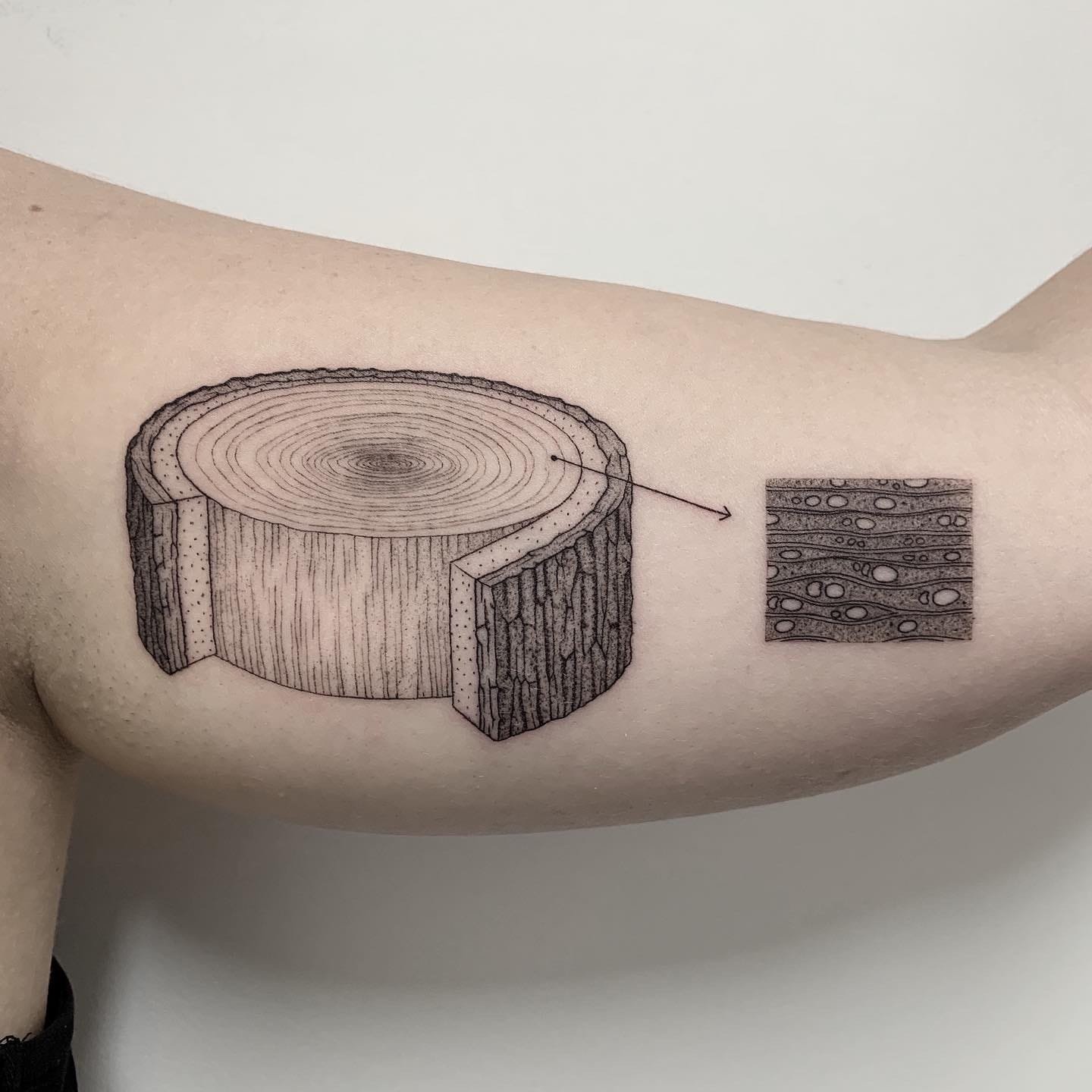
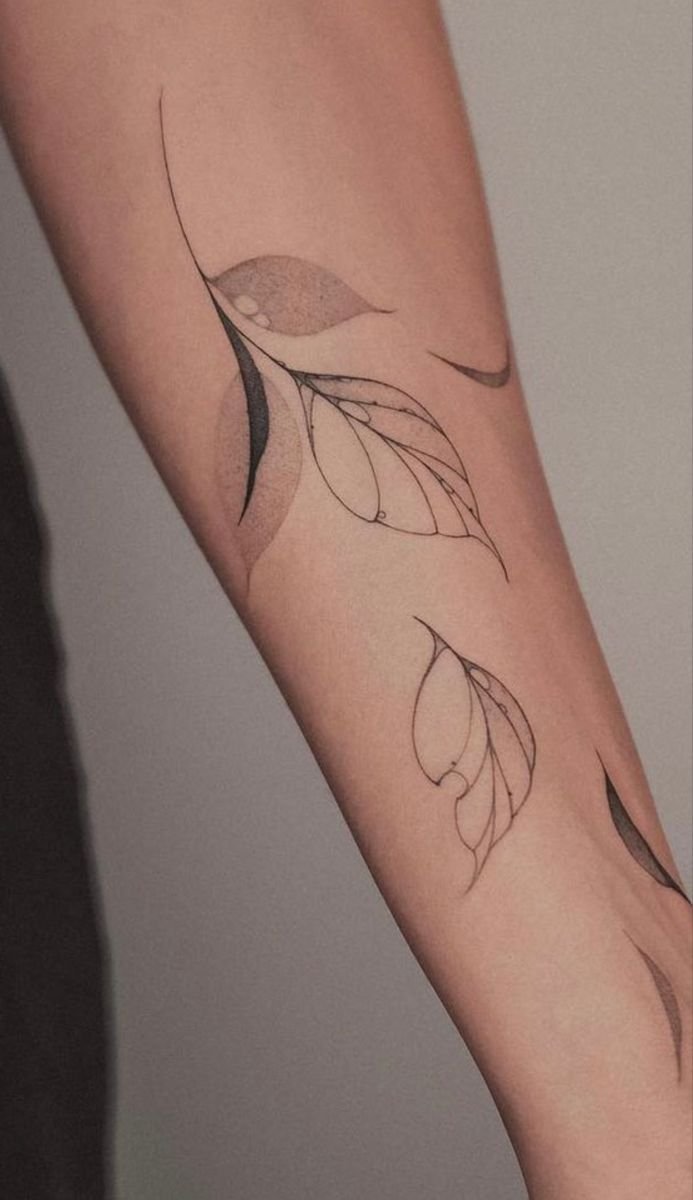
Many fine line pieces use no shading at all, relying entirely on line weight and line density to create the impression of form. Where shading is used, it is typically very light greywash or stipple work, applied sparingly and subordinate to the line.
Scale is small to medium.
Fine line work is most commonly requested at small scales — wrist, inner forearm, behind the ear, ankle, ribs. The style can be executed at larger scales, but the visual identity of the work is strongest at sizes where the fineness of the line is immediately apparent in relation to the body.
Subject matter favours the organic and the geometric.
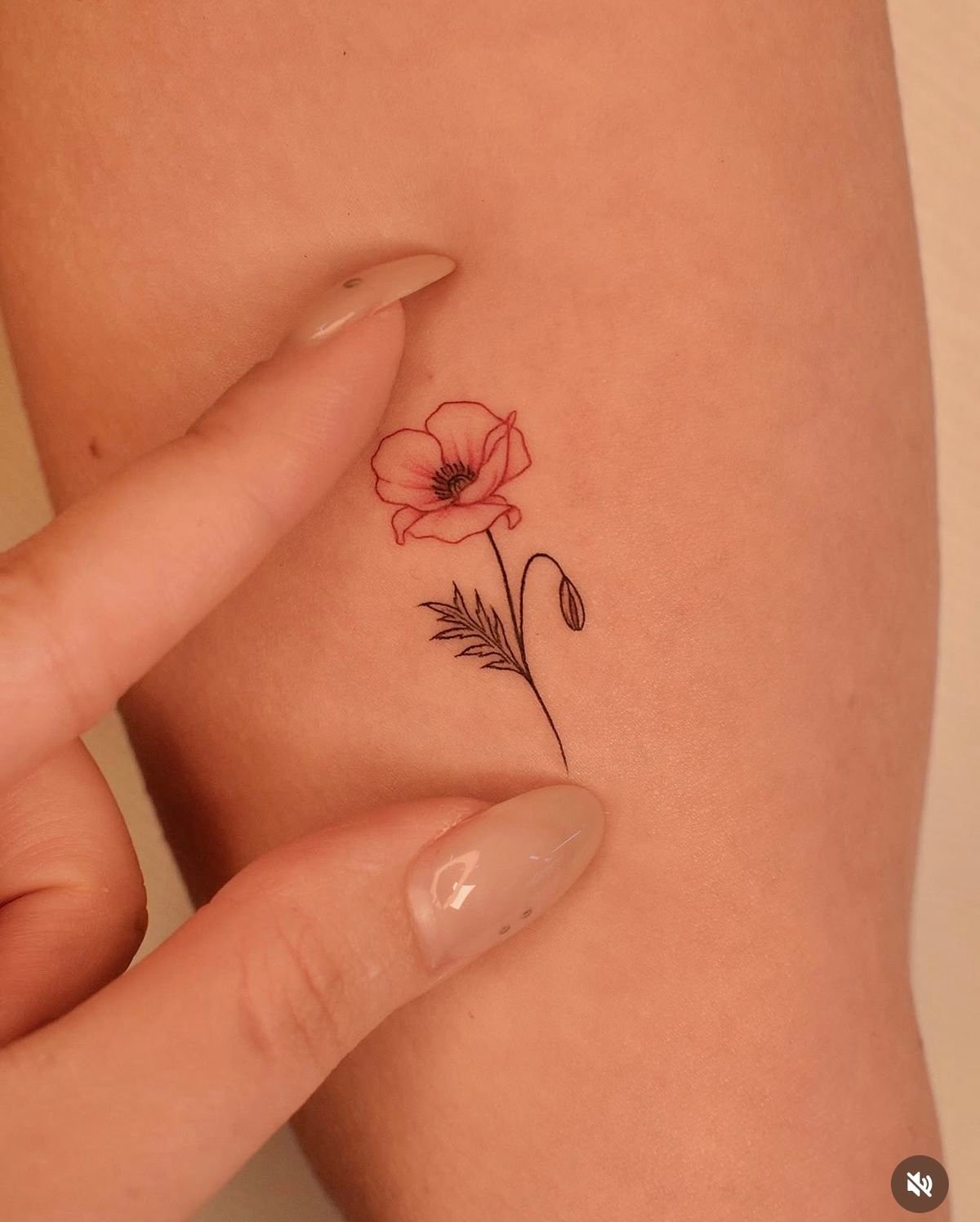
Botanicals (wildflowers, branches, ferns, specific species rendered with illustrative accuracy), small animals (birds, butterflies, insects, cats), celestial imagery (moons, stars, constellations), geometric forms (circles, triangles, mandalas, sacred geometry), script and lettering (usually in a handwritten or calligraphic style), and small illustrative compositions (a book, a coffee cup, a wave, a mountain silhouette) are the most common subjects. The vocabulary is broad but tends toward the personal and the quiet.
Placement is deliberate and often discreet.
Fine line pieces are frequently placed where they can be covered by clothing or shown selectively. The inner forearm, the back of the upper arm, the ribs, the collarbone area, and behind the ear are the most common placements. The style’s visual identity is connected to the idea of a tattoo as a private mark rather than a public statement.
Colour is rare.
The overwhelming majority of fine line work is done in black ink only. Where colour appears, it is usually a single accent — a small wash of watercolour-style pigment, a single red element in an otherwise black piece — rather than a full palette.
The technical demands
Line consistency
A fine line must be consistent along its length — the same depth, the same width, the same ink saturation from start to finish. Any variation reads immediately as a wobble, a hesitation, or a blown-out section. With a standard 7RL or 9RL liner, small inconsistencies are absorbed by the line’s width. With a single needle or 3RL, there is nowhere to hide. The line is either clean or it is visibly flawed.
Depth control
A single needle deposits ink in a very small area, and the correct depth — into the dermis, between roughly one and two millimetres — must be maintained precisely. Too shallow, and the ink will not hold; the line will fade or disappear within weeks. Too deep, and the ink will blow out — spreading beneath the skin into a fuzzy, widened line that defeats the purpose of the style. Blowouts in fine line work are more visually damaging than in heavier styles because the line is supposed to be fine; a blown-out fine line becomes a medium line with blurred edges, which looks like a mistake.
Skin reading
Different body areas, skin types, and skin conditions respond to fine-line work differently. Thin skin (inner wrist, inner arm, behind the ear) is more prone to blowout. Thick or calloused skin (fingers, palms, feet) is harder to tattoo at fine-needle gauge. Sun-damaged or scarred skin behaves unpredictably. A good fine line artist reads the skin before starting and adjusts technique accordingly — sometimes refusing a placement that will not hold the work.
Speed and confidence
Fine-line work requires a steady, confident hand moving at consistent speed. Slowing down deposits more ink; speeding up deposits less. The line has to be executed in smooth, continuous strokes, because lifting and re-entering the skin at single-needle gauge leaves visible start-stop marks that heavier needle groupings would conceal.
Machine selection
Contemporary fine line artists overwhelmingly use pen-style rotary machines, which produce less vibration and allow finer depth control than coil machines. The specific machine, its stroke length, and its operating voltage all affect the quality of fine-line work, and experienced practitioners are particular about their equipment in ways that generalist tattooers may not be.
Ageing and longevity
This is the section that matters most to anyone considering fine-line work, and the section where the most misinformation circulates. Fine line tattoos age differently from heavier tattoos, and the difference needs to be understood in specific terms rather than dismissed with “they fade” or defended with “they last forever.”
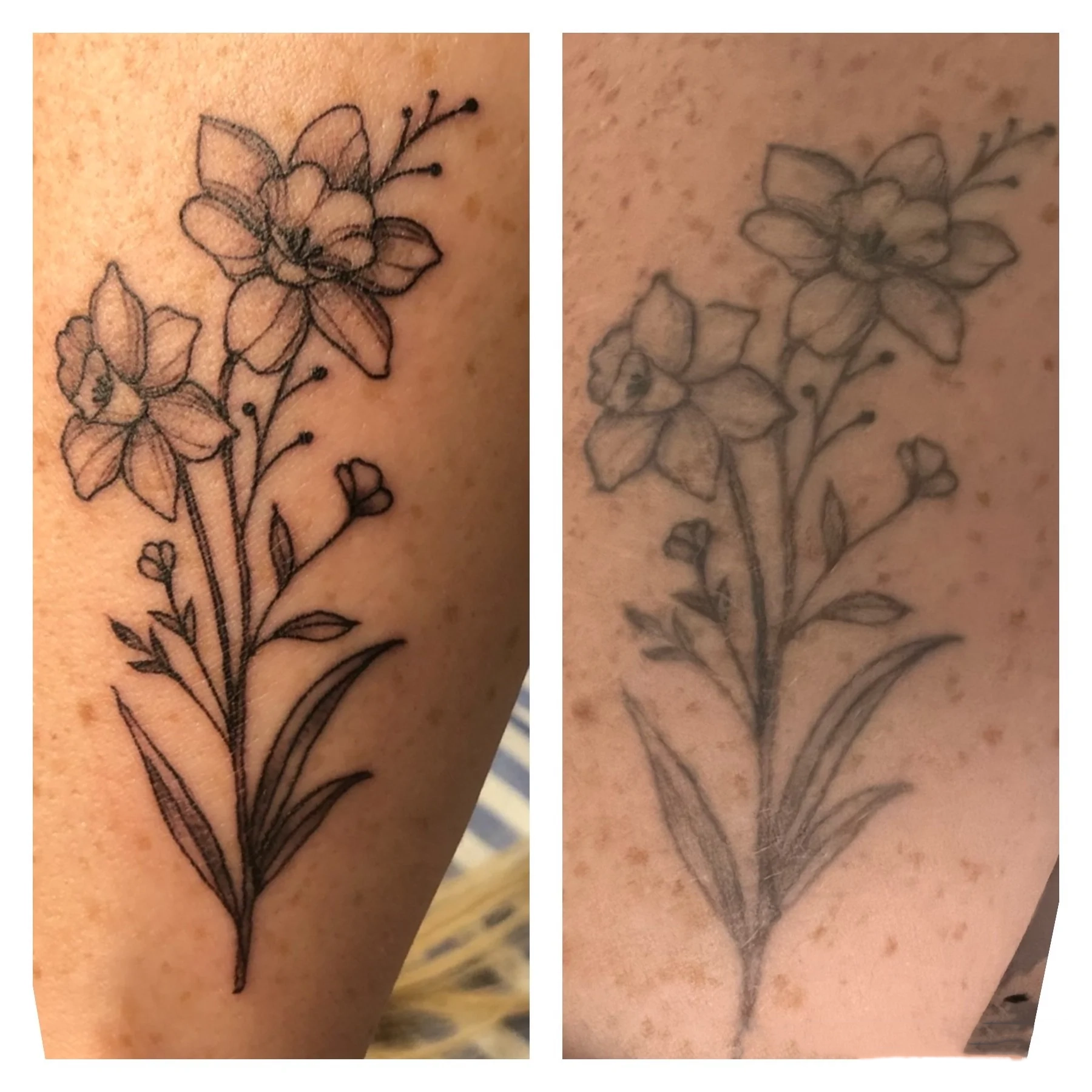
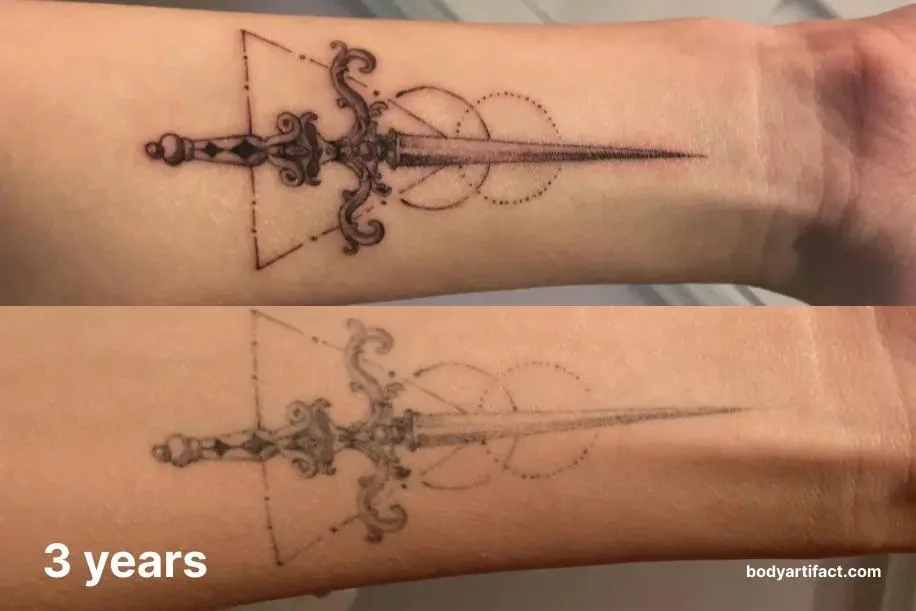
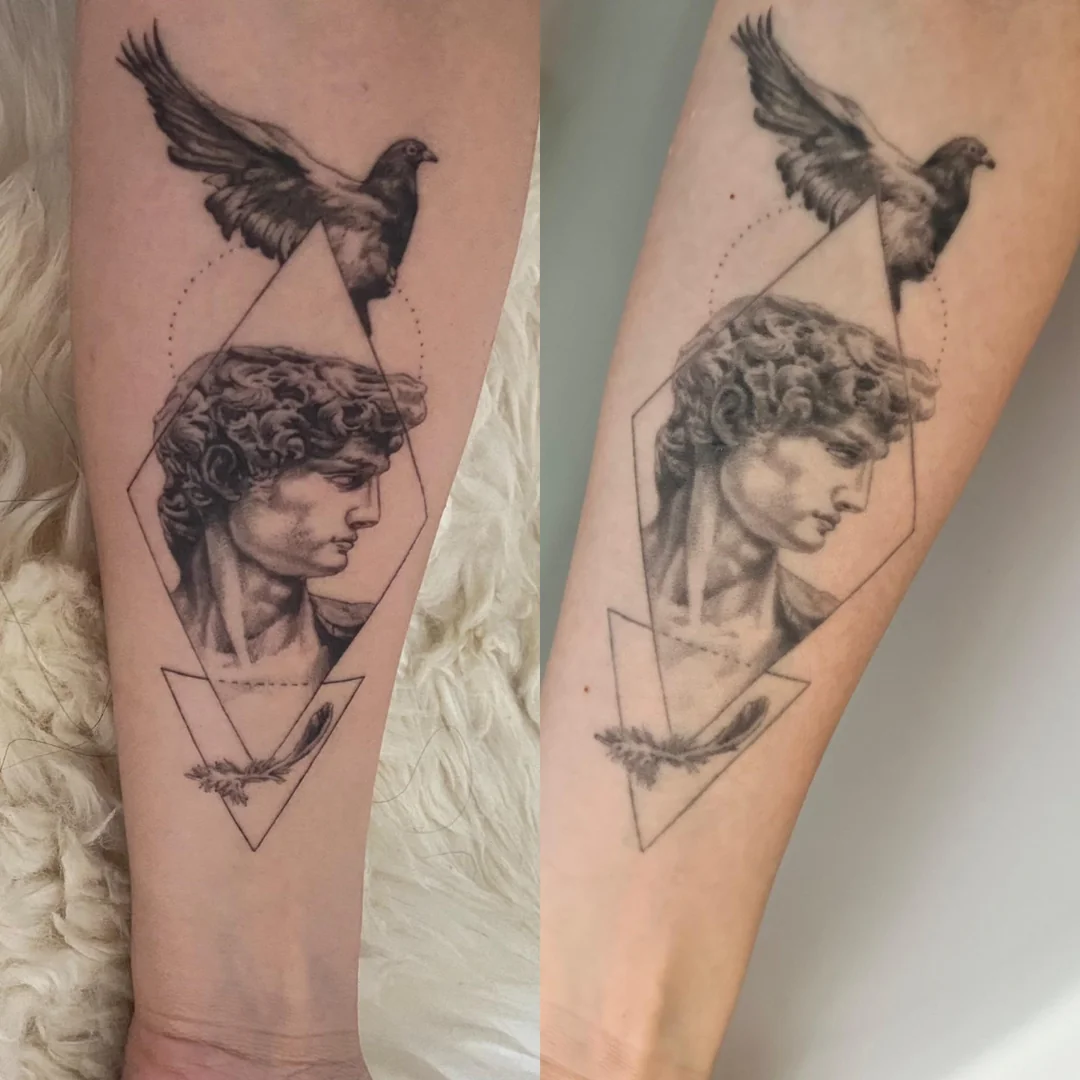
All tattoos spread. Pigment particles in the dermis migrate outward over time. This is a physical process that affects every tattoo regardless of style. In a heavily outlined traditional piece, the migration is proportionally small relative to the line width, and the piece still reads clearly. In a fine line piece, the same absolute amount of migration represents a larger proportion of the line width. A line that was 0.3mm wide when fresh may be 0.8mm wide after ten years. The line is still there; it is no longer fine.
Light lines fade more than heavy lines. A single-needle line deposits less ink per unit of length than a heavier grouping. Less ink means less pigment to survive the body’s gradual process of removing foreign particles. Lines that were deposited too lightly — a common error in less experienced fine line work — can fade substantially within three to five years.
Detail loss is proportional to scale. A fine line botanical at the size of a playing card will retain its major forms for many years, though the finest details (individual leaf veins, thin stems, tiny details) will soften. The same design at the size of a coin will lose most of its detail within five to ten years.
Placement affects ageing dramatically. Fine line pieces on the inner forearm, upper arm, and ribs — areas with moderate sun exposure and low friction — hold up best. Pieces on hands, fingers, feet, behind the ear, and the side of the wrist age fastest. Finger tattoos in fine line are the single most likely placement to require touch-up or to be lost entirely within a few years.
What the evidence shows so far. Contemporary fine line, as a named style, is roughly ten to twelve years old. The earliest serious pieces from the mid-2010s are now reaching the point where meaningful ageing data exists. The general picture: well-executed fine line work by skilled artists, placed on stable body areas, holds up better than the style’s critics suggest. The lines thicken, the finest details soften, and the overall impression shifts from “just done” to “settled.” Poorly executed work — lines deposited too lightly, placed on high-friction areas, or done at scales too small for the detail attempted — ages badly. The quality gap between good and poor fine lines widens with every passing year.
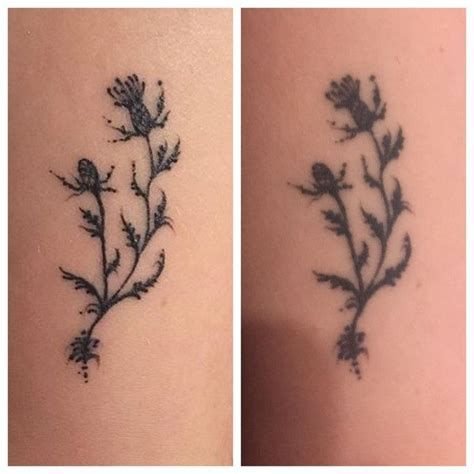
What works on skin and what does not
Size minimums are real. Most serious fine-line artists have a minimum size below which they will not work, or will simplify the design substantially. A detailed botanical at the size of a postage stamp may look extraordinary on the day; it will not look that way in five years. An artist who accepts any size without discussion is not accounting for the medium.
Simple designs age better than complex ones. A single stem with three leaves will hold its character longer than a detailed bouquet at the same size. A geometric circle will outlast a mandala with twenty concentric rings. Complexity at a small scale is the highest-risk combination in fine line work.
Placement should match ambition. A discreet fine line piece behind the ear is appropriate if the client understands that the location is high-friction and the piece will soften faster than the same work on the upper arm. A fine line sleeve — which some artists now offer — requires careful planning because the accumulated effect of many fine lines at different ages and stages of healing creates a more complex maintenance situation than a single piece.
Finger tattoos deserve a specific warning. Fine line finger tattoos are among the most requested and most regretted tattoo placements. The skin on the fingers is thin, highly mobile, and exposed to constant friction. Fine lines on fingers fade fast, blur fast, and often require touch-ups within one to two years. Some artists refuse the placement entirely; others will do it with an explicit conversation about expectations.
Choosing an artist
The quality range in fine line is wider than in almost any other style, partly because the apparent simplicity of the work attracts artists who have not developed the specific skills the style requires.
Look at healed photographs. This advice appears in every style article on this site, and it applies more urgently here than anywhere else. A fresh fine line tattoo always looks crisp. The test is what it looks like at one year, at three, at five. An artist who can show healed work at those intervals and whose lines are still clean is demonstrating real skill.
Check for blowouts in healed work. Zoom in on healed photographs and look at the lines. Are they consistent in width? Are there sections where the line has spread into a fuzzy blur? Blowouts in fine line work are the clearest evidence of insufficient depth control, and they are visible in photographs if you look for them.
Consider the artist’s drawing background. Fine line tattooing is closer to drawing than most other styles, and artists with strong illustration or fine art training tend to produce more compositionally intelligent work. A portfolio that shows evidence of original drawing skill — independent of client-supplied references — is a positive sign.
Be cautious of artists who work exclusively from trending references. The fine line Instagram economy produces a great deal of duplicated imagery — the same wildflower, the same wave, the same crescent moon appearing across hundreds of portfolios. An artist who produces only these trending images may be technically competent, but is unlikely to produce a piece with the compositional strength of someone working from their own visual intelligence.
Booking lead times. The most established fine line artists book months to a year or more in advance. Shorter waiting times are available with less established artists, and some of those artists are excellent. The waiting list is a filter, not a guarantee.
Fine Line now
Fine line is the dominant first-tattoo style in most Western markets in the 2020s. Its appeal is clear: it is visually light, personally scaled, discreet by default, and legible to people who may not identify with the heavier visual traditions of tattooing. It has broadened the tattoo client base substantially, bringing in people who might not have considered a tattoo in an earlier era when the available aesthetics were bolder and more conspicuous.
The style has also attracted legitimate criticism. The ageing concerns are real and are sometimes minimised by artists and studios with a financial interest in the style’s popularity. The trend-driven repetition of certain images — the fine line wildflower, the tiny butterfly, the single-word script — has produced a large body of work that is technically adequate and compositionally indistinguishable. The social media economy that drives much of the style’s visibility rewards fresh photographs over long-term outcomes, which creates a structural incentive to prioritise how a piece looks on the day over how it will look in a decade.
These are fair criticisms, and they coexist with the fact that the best fine line work is beautiful, technically accomplished, and — when executed by skilled artists at appropriate scales and placements — more durable than its detractors claim. The style has expanded what tattooing can look like on skin, and the technical refinements it has driven — in needle technology, machine precision, and depth control — have benefited the craft broadly.
The question for any individual client is specific and practical: is the piece I want, at the size I want, in the placement I want, going to hold up over the years I expect to wear it? A good fine line artist will answer that question honestly, including the answer “no, not at that size” or “not in that location.” Finding an artist willing to have that conversation is the first and most important step.
Sources & further reading
- Freddy Negrete with Steve Jones, Smile Now, Cry Later: Guns, Gangs, and Tattoos — My Life in Black and Grey. Seven Stories Press, 2016.
- Tattoo Nation, dir. Eric Schwartz, 2013.
- Margo DeMello, Bodies of Inscription: A Cultural History of the Modern Tattoo Community. Duke University Press, 2000.
- Anna Felicity Friedman, The World Atlas of Tattoo. Yale University Press, 2015.
- Matt Lodder, Painted People: Humanity in 21 Tattoos. Harper, 2024.
- Nick Schonberger and Rob Kingston, Forever: The New Tattoo. Gestalten, 2012.