Related Posts


Tiger tattoo
The animal in the room
The tiger is the largest living cat. An adult male Bengal can weigh over 250 kilograms and measure three metres from nose to tail. It is a solitary predator that hunts by ambush, covering the final distance to its prey with a short, explosive charge. It is also, among the big cats, the one most closely associated with killing humans — a distinction that has shaped its cultural meaning in every society that has lived alongside it.
The tiger’s range once extended from eastern Turkey to the Sea of Japan, and from Siberia to Bali. That range has collapsed catastrophically over the past century. Of the nine traditionally recognised subspecies, three — the Balinese, Javan, and Caspian — are extinct. The remaining six survive in fragmented populations across India, Southeast Asia, China, and the Russian Far East, with a global wild population estimated in the low thousands. The animal that appears in tattoo imagery across half the world’s cultures is, in the wild, approaching the edge of survival.
This matters for understanding tiger tattoos because the cultural weight of the animal was built during millennia when tigers were a real, physical presence in daily life — killing livestock, occasionally killing people, appearing at the margins of villages, heard at night. The tiger in Chinese cosmology, Japanese art, Korean folklore, Thai sacred tattooing, and South Asian devotional imagery is an animal that people actually encountered. The meanings attached to it — power, danger, protection, wrath, courage, the wild itself — were developed by people for whom the tiger was a neighbour, not a zoo exhibit.
China
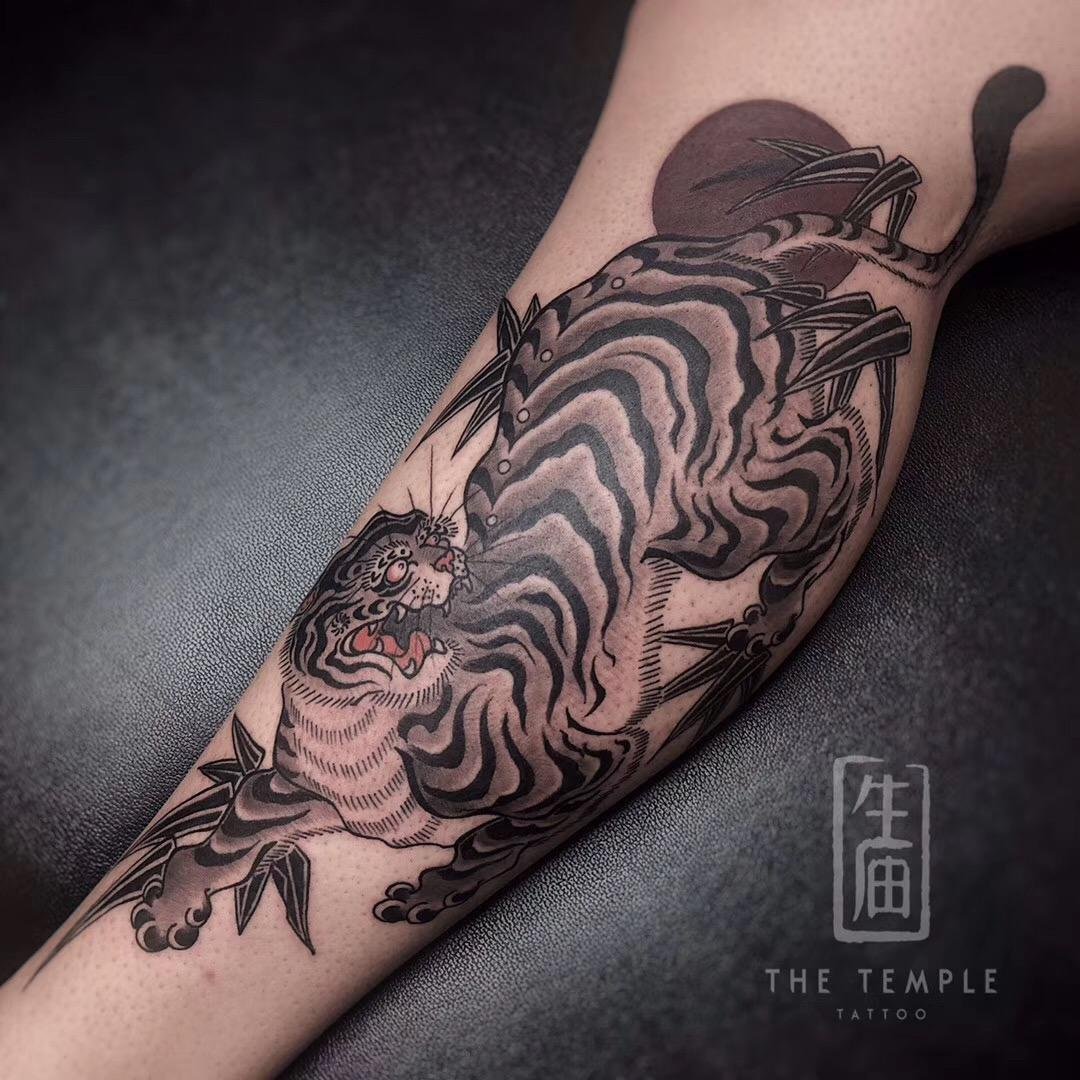
The tiger holds one of the oldest and most elaborated symbolic positions in any culture. In Chinese cosmology, it is one of the Four Symbols (Sì Xiàng) — the celestial guardians associated with the four cardinal directions and the four seasons. The White Tiger (Bái Hǔ) governs the west and autumn, paired with the Azure Dragon of the east, the Vermilion Bird of the south, and the Black Tortoise of the north.
This pairing of tiger and dragon is foundational. In Chinese thought, the two animals represent complementary forces: the dragon is associated with the emperor, heaven, ascending energy, water, and the east; the tiger is associated with martial power, earth, descending energy, wind, and the west. They are not opposites in the way Western dualism frames opposites — they are counterparts, each necessary to the balance of the other. The pairing appears across Chinese art, architecture, martial arts, medicine, and — through the transmission of Chinese cultural influence — throughout East Asian visual culture.
The tiger is also the third animal of the Chinese zodiac. People born in the Year of the Tiger are traditionally associated with courage, competitiveness, and unpredictability. The zodiac association is one of the most common reasons Chinese and Chinese-diasporic clients choose a tiger tattoo.
In Chinese folk belief, the tiger is a protector against evil spirits, fire, and thieves. Tiger imagery was placed on children’s clothing and shoes (hǔ tóu xié — tiger-head shoes) to ward off illness and malevolent forces. The character for king (wáng) was read into the natural markings on the tiger’s forehead — the dark stripes on the brow of many tigers can be interpreted as the three horizontal strokes and one vertical stroke of the character 王. Whether this reading came first and was projected onto the animal, or whether the marking was noticed and the association followed, is not recoverable; what survives is the identification of the tiger with kingship, authority, and legitimate power.
The tiger also appears in Chinese military symbolism. The hǔ fú — tiger tally — was a bronze or iron tiger figure split in two, with one half held by the emperor and the other by a military commander. Reuniting the halves authorised the mobilisation of troops. The animal’s association with martial authority is old, documented, and specific.
Japan
The tiger entered Japanese art through Chinese cultural transmission because Japan has had no native tiger population and never has. The animal that Japanese artists painted, carved, and tattooed was an animal they knew from Chinese and Korean art, from imported tiger skins, and from written and oral descriptions — not from direct observation. This matters because the Japanese tiger, particularly in pre-modern art, is often anatomically idiosyncratic in ways that reflect its status as an imagined animal: proportions that do not quite match a real tiger, postures that no living cat would adopt, faces that carry more expression than a biological tiger’s face supports.
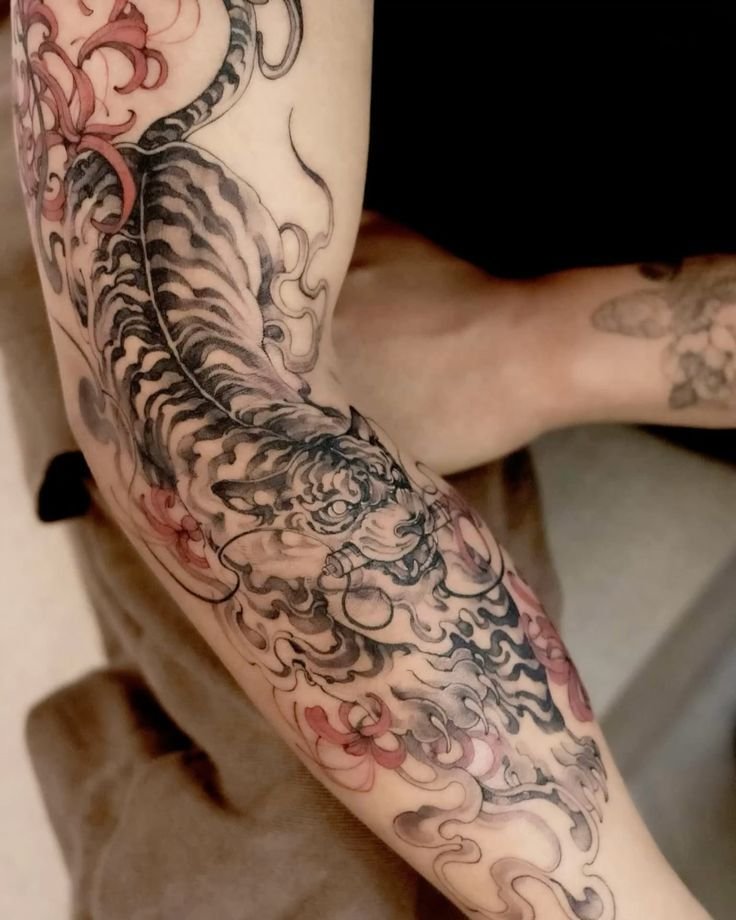
In Japanese tattooing (irezumi), the tiger is one of the major subjects and is almost always paired with specific contextual elements that carry meaning.
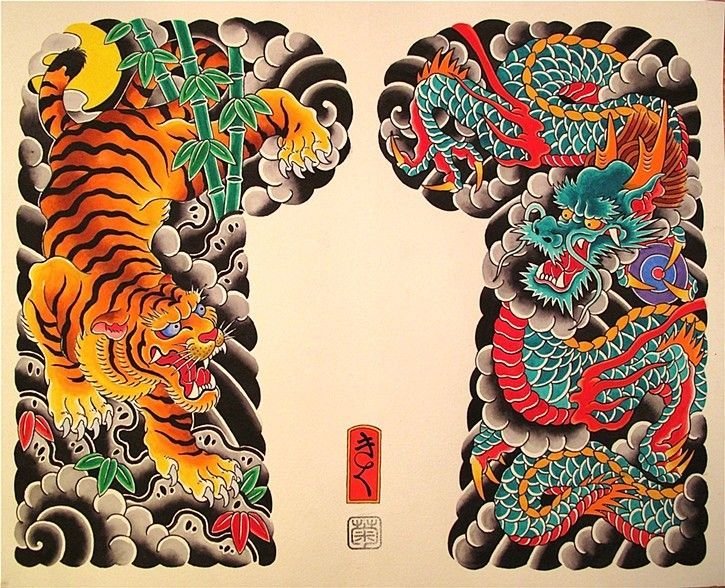
Tiger and dragon. The most important pairing is inherited from Chinese cosmology. In Japanese irezumi, a full back piece or a full sleeve frequently pairs the tiger and the dragon as complementary forces — the dragon ascending through clouds and water, the tiger descending through wind and bamboo. The pairing represents the balance of opposing energies: heaven and earth, spiritual and physical, flexible and forceful. A full back piece with both animals is one of the most traditional and most respected compositions in the irezumi repertoire.
Tiger and wind. In Japanese art, the tiger is associated with wind, just as the dragon is associated with water. Tigers in irezumi are often depicted with wind bars — stylised curved lines representing gusts — and with bamboo, which bends in the wind. The association comes from the Chinese saying that the dragon’s movement creates clouds and the tiger’s movement creates wind (lóng xíng yún, hǔ xíng fēng). In visual terms, the tiger in Japanese tattooing lives in a world of moving air.
Tiger and bamboo. Bamboo groves are the tiger’s landscape in East Asian art. The combination appears constantly in Japanese painting and tattooing. Bamboo is flexible, strong, hollow, and survives by bending — qualities that read as complementary to the tiger’s strength and directness. The visual composition of a tiger moving through bamboo also works exceptionally well in the long vertical format of a sleeve or a leg piece.
Seasonal association. In the Japanese system of seasonal imagery used in tattooing, the tiger is associated with autumn — consistent with its western-direction placement in the Chinese Four Symbols cosmology. Autumn maple leaves, chrysanthemums, and wind imagery can accompany a tiger in a seasonally coherent composition.
The tora (tiger) in Japanese culture also carries associations with courage and determination. The proverb koketsu ni irazunba koji wo ezu — “if you do not enter the tiger’s den, you cannot catch the tiger’s cub” — encapsulates the idea that nothing valuable is gained without risk.
Korea
The tiger holds a position in Korean culture that may be more central and more affectionate than in any other tradition. Korea was historically home to a substantial tiger population — the Siberian (Amur) tiger ranged across the Korean Peninsula — and tigers feature in Korean mythology, folk art, and national identity with a frequency and warmth that distinguish the Korean relationship to the animal from the more fearful or reverential treatments elsewhere.
The founding myth of Korea involves a tiger. In the Dangun creation narrative, a tiger and a bear both seek to become human. They are told to stay in a cave for one hundred days, eating only garlic and mugwort. The bear endures and is transformed into a woman, who becomes the mother of Dangun, the legendary founder of the first Korean kingdom. The tiger gives up and leaves the cave. The story casts the tiger as impatient, proud, and ultimately unable to submit to the discipline required for transformation — but also as an animal worthy of being offered the chance.
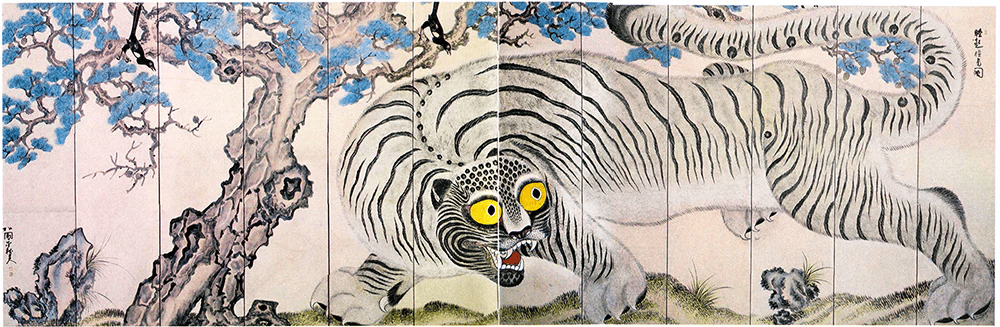
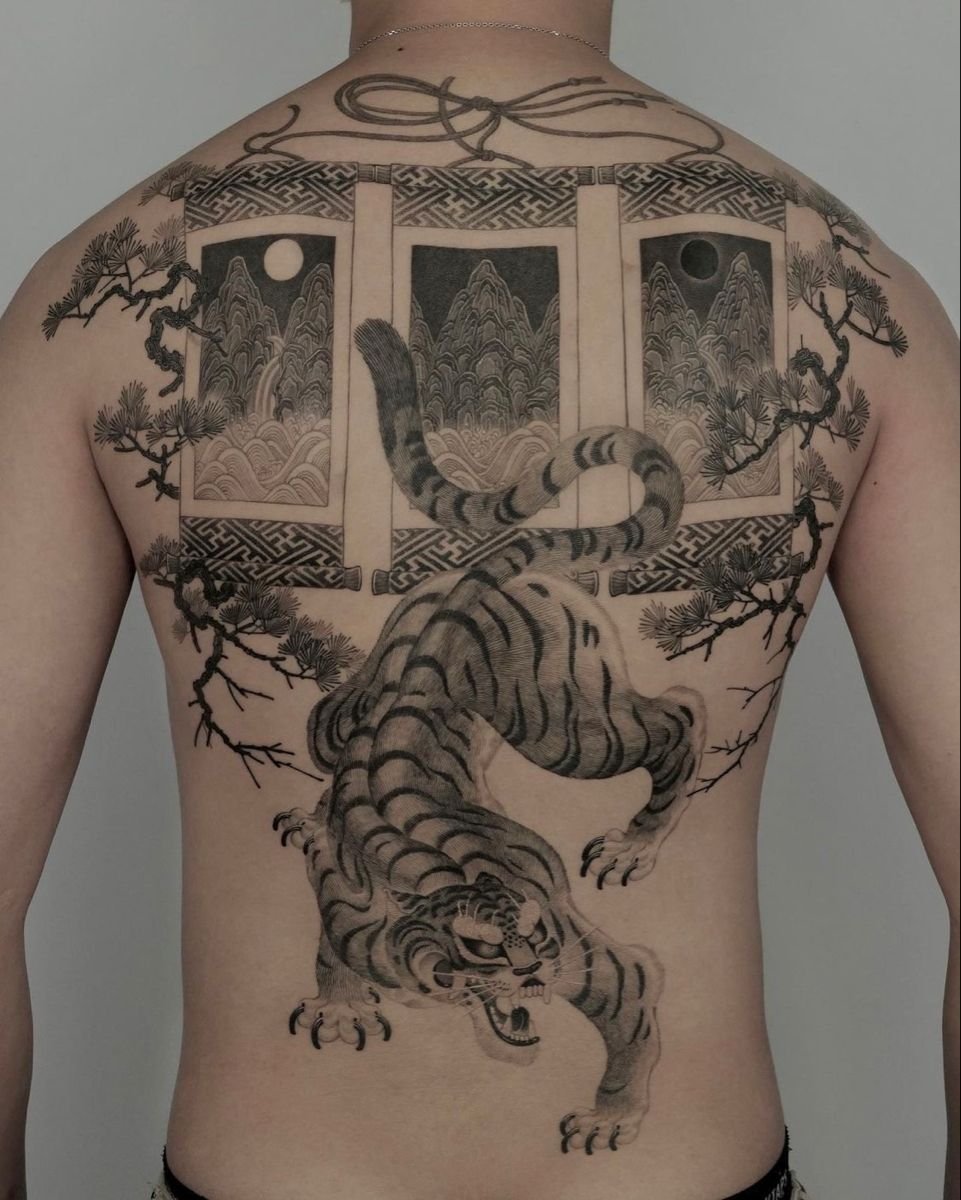
Korean folk art — particularly minhwa, the tradition of Korean folk painting — frequently depicts the tiger, often with humour. The kkachi horangi (magpie and tiger) motif, one of the most recognisable images in Korean visual culture, shows a tiger seated beneath a pine tree while a magpie chatters at it from the branches above. The tiger in these paintings is often drawn with a half-comic, half-dignified expression — somewhere between bemused and resigned. In Korean folk belief, the magpie is a messenger of good news. The pairing has been interpreted as the relationship between the common people (the magpie, small but vocal) and authority (the tiger, powerful but sometimes foolish). The tiger in Korean folk art is respected but not feared, unlike in traditions where the animal is primarily seen as a killer.
The tiger was the mascot of the 1988 Seoul Olympics (Hodori) and remains a national symbol. In Korean tattooing — which, as noted elsewhere on this site, has developed under legal restrictions — tiger imagery draws on both the minhwa folk tradition and the broader East Asian iconographic conventions shared with Chinese and Japanese art.
Thailand and Southeast Asia
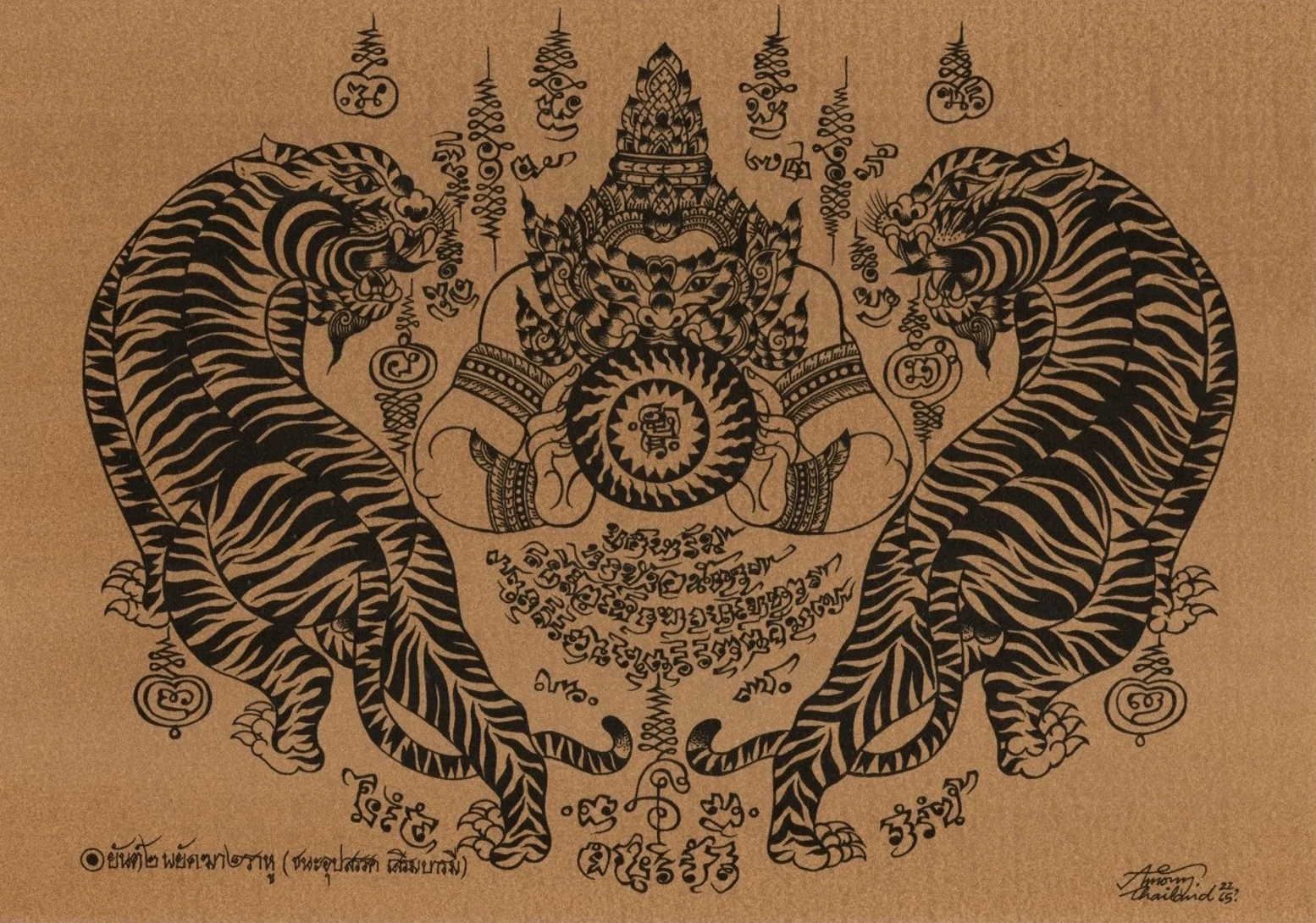
In Thai sacred tattooing (Sak Yant), the tiger is one of the most important protective animals. Sak Yant tattoos are traditionally applied by Buddhist monks or by ajarns (masters) using a long metal rod (khem sak) or a bamboo needle, and they carry specific magical properties depending on the design, the prayers recited during application, and the spiritual authority of the person applying them.
The Suea (tiger) Yant is among the most commonly requested Sak Yant designs. Two tigers facing each other — the paired tigers, Suea Koo — is a specific design associated with power, authority, and protection from physical harm. The single leaping tiger carries associations with courage and fearlessness. The five-line Yant (Hah Taew), one of the most widely recognised Sak Yant designs internationally, does not itself depict a tiger but is often accompanied by tiger imagery in broader compositions.
The cultural context of Sak Yant is important for anyone considering a tiger tattoo in this tradition. Sak Yant tattoos carry specific rules about behaviour, conduct, and spiritual practice — the tattoo’s protective power is understood to depend on the wearer’s adherence to certain precepts. Receiving a Sak Yant from a monk or ajarn involves a ritual that is not reducible to the act of tattooing, and the tiger in this context is a spiritual agent with specific powers rather than a decorative image. Non-Thai clients who seek Sak Yant tiger tattoos should understand this context and approach it with appropriate respect.
In Burmese, Cambodian, and Lao traditions, the tiger carries similar protective and martial associations, often within related Buddhist and animist frameworks.
South Asia
The tiger is the national animal of India and Bangladesh. In Hindu iconography, the tiger (or, in some traditions, the lion — the two are sometimes conflated in South Asian visual culture) is the vahana (mount) of the goddess Durga, one of the most powerful deities in the Hindu pantheon. Durga rides the tiger into battle against the demon Mahishasura, and the animal represents her ferocity, her power, and her capacity for righteous destruction. A Durga-and-tiger composition in South Asian tattooing carries devotional weight comparable to the Virgin of Guadalupe in Chicano tattooing — it is a religious image with specific meaning for the community that uses it.
The Bengal tiger is also central to the cultural identity of the Sundarbans region, the vast mangrove forest shared by India and Bangladesh, where human-tiger conflict has been a daily reality for centuries. The tigers of the Sundarbans are among the few populations that still regularly kill humans. The communities that live alongside them have developed a complex relationship with the animal — fear, respect, folk practices designed to ward off attacks (masks worn on the back of the head to confuse tigers that hunt from behind), and a body of stories and beliefs that treat the tiger as both enemy and neighbour.
Western tattooing
The tiger entered Western tattooing through several channels.
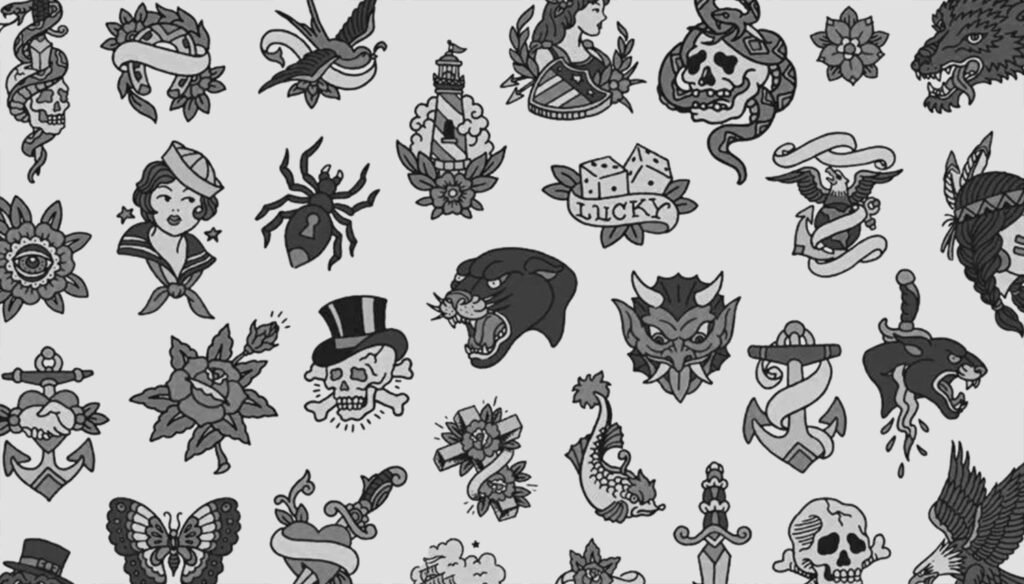
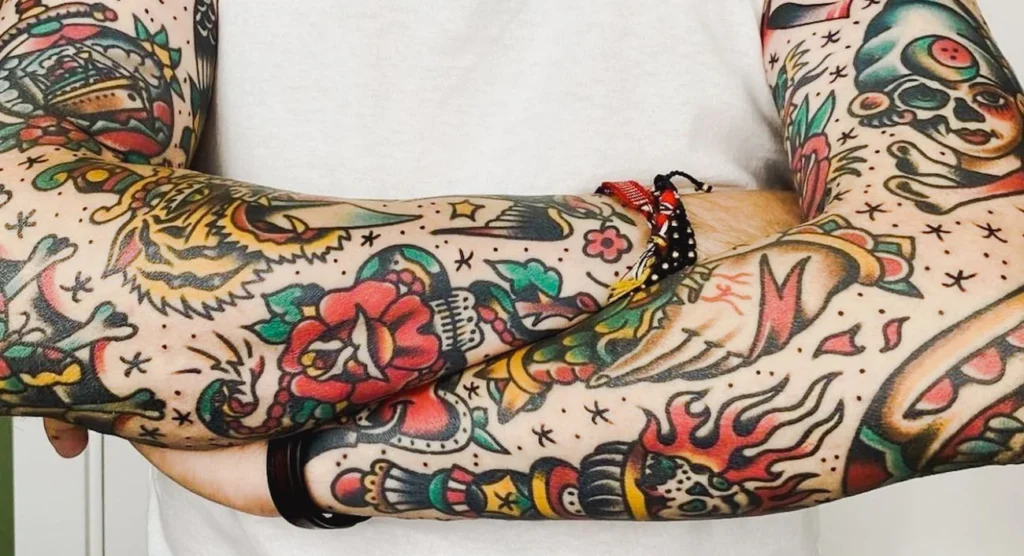
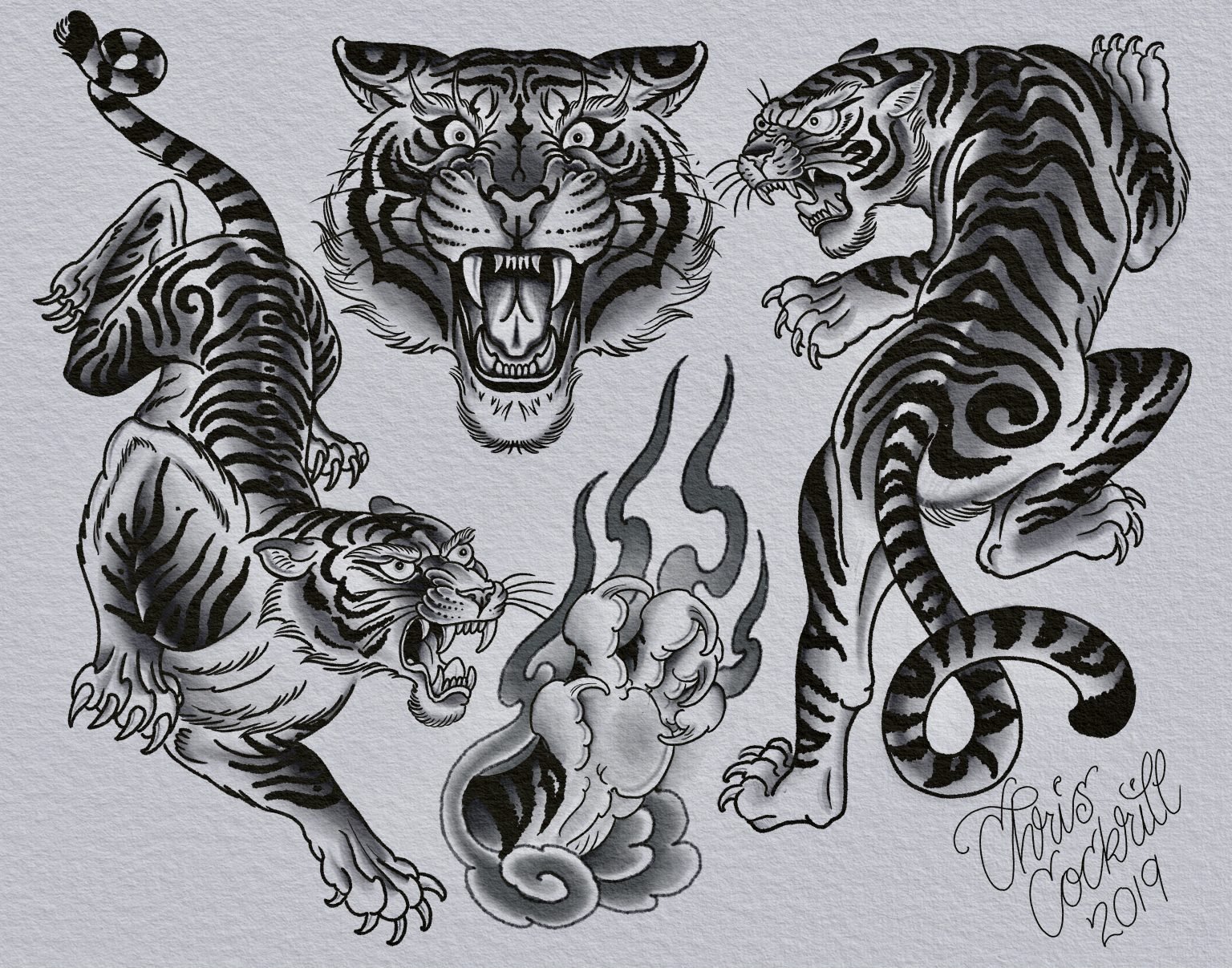
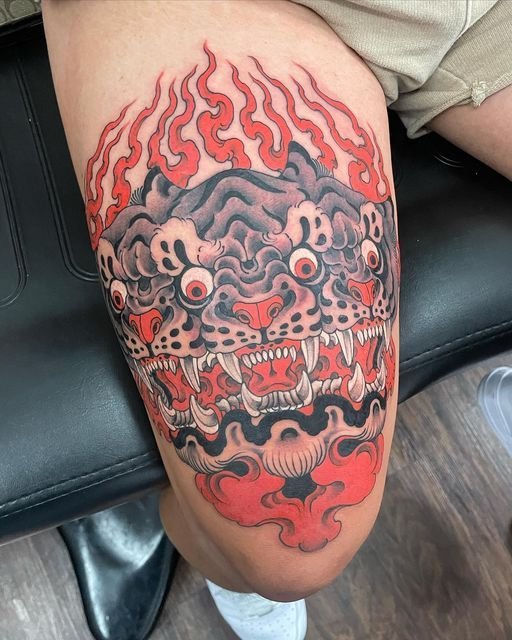
In American traditional tattoo style, the tiger appears as a flash subject alongside the panther, the eagle, and the snake. The traditional tiger is usually depicted in profile or three-quarter view, walking or snarling, in the same bold-outline, flat-colour vocabulary as the rest of the flash repertoire. The meaning in this context is simpler and more personal than in the Asian traditions — strength, aggression, a willingness to fight. The traditional tiger head, depicted front-on with an open mouth and bared teeth, is one of the most recognisable pieces of American flash.
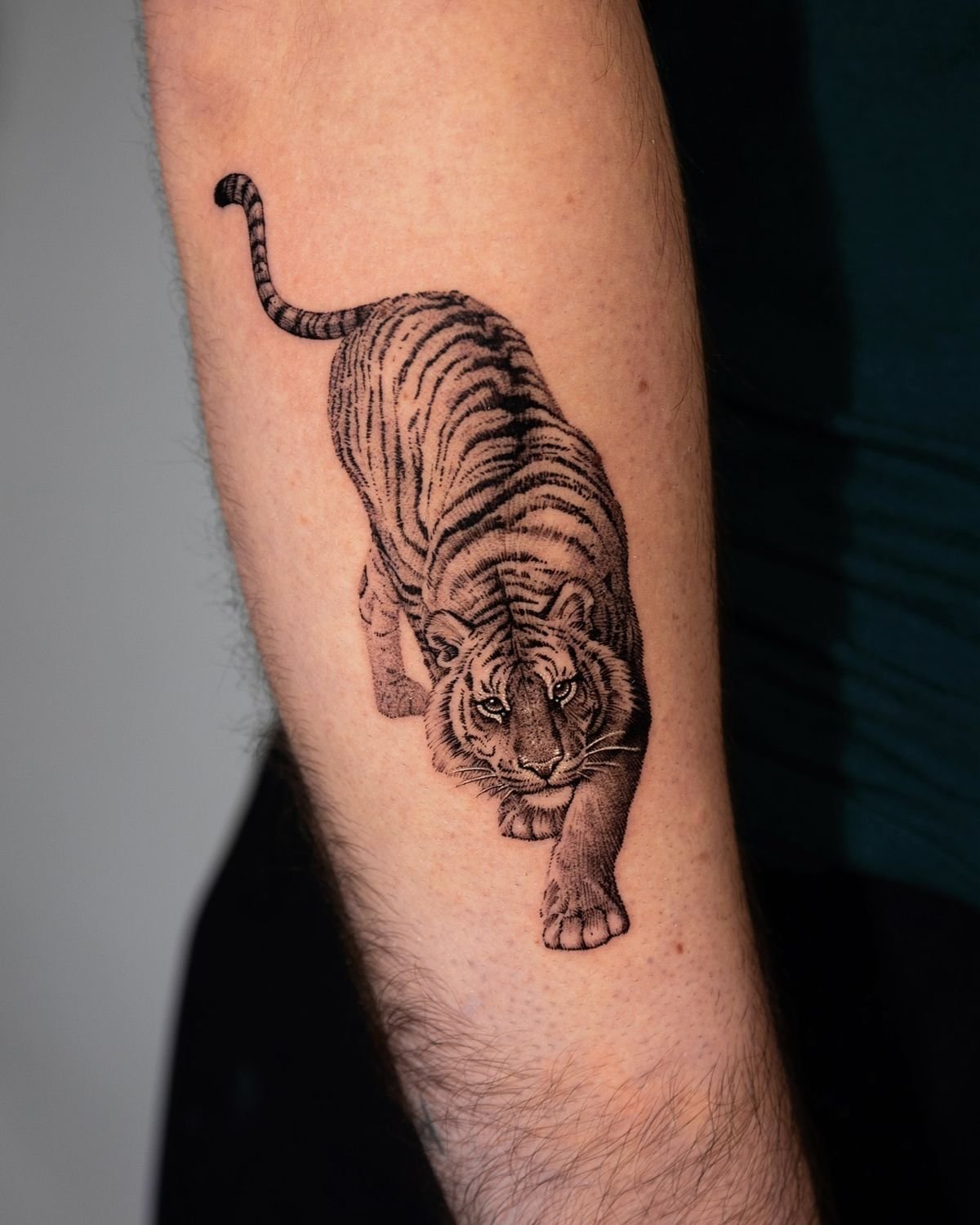
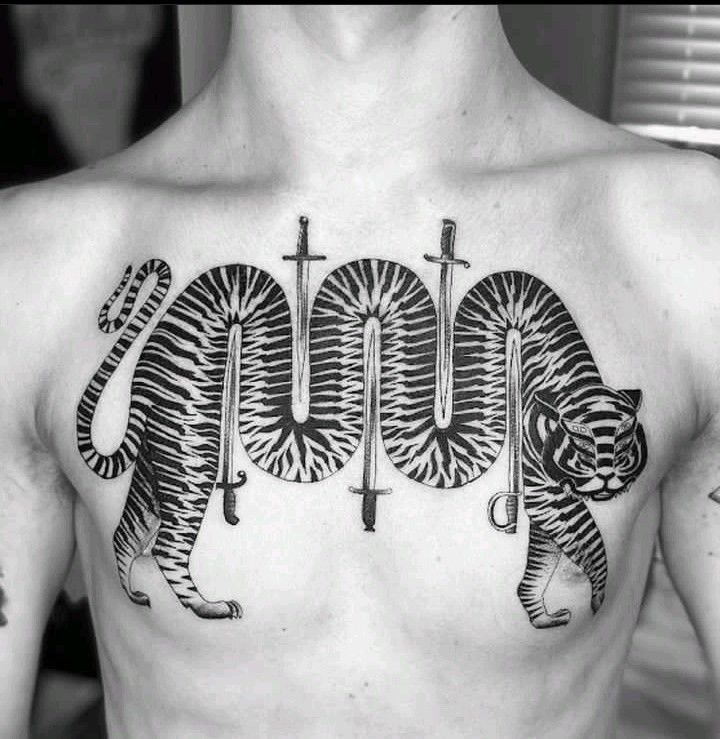
The crawling tiger — the animal rendered walking down a forearm or across a chest, with an elongated body and head turned toward the viewer — is a close relative of the crawling panther, one of the most iconic American traditional designs. The two pieces share the same composition and visual logic; the difference is colour (orange and black striped versus solid black) and, in some tellings, a slight difference in association — the panther more overtly linked to danger and menace, the tiger more linked to raw power.
Japanese-style tiger tattoos entered Western practice through the broader transmission of Japanese tattooing conventions into American and European studios from the 1970s onward, accelerated by the work of Ed Hardy, Filip Leu, and others who studied Japanese irezumi and brought its compositional principles into Western practice.
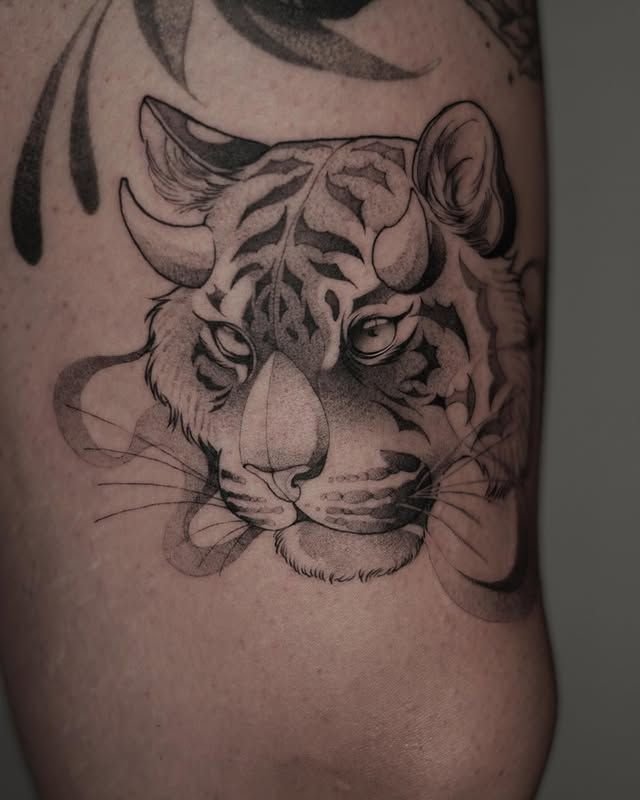
In contemporary Western tattooing, the tiger is one of the most frequently requested animal subjects across all styles — realism, neo-traditional, illustrative, fine line, and traditional all produce tiger pieces regularly. The meanings clients attach to the image are diverse: zodiac identity, personal strength, a connection to Asian heritage, memorial for a person associated with the animal, aesthetic preference, and — in some cases — the influence of popular culture, including the visibility of tiger imagery in martial arts, sport, and broader media.
What the tiger means as a tattoo
Power
Protection
Courage and the willingness to take risks
Wildness and independence
Balance — specifically, the other half of a pair
Royalty and authority
Across tattoo styles
Japanese Irezumi
American traditional
The tiger head, the crawling tiger, the snarling profile. Bold outline, flat colour, high contrast. The meaning is simpler and more immediate: this animal is dangerous, and I chose to put it on my body.
Neo-traditional
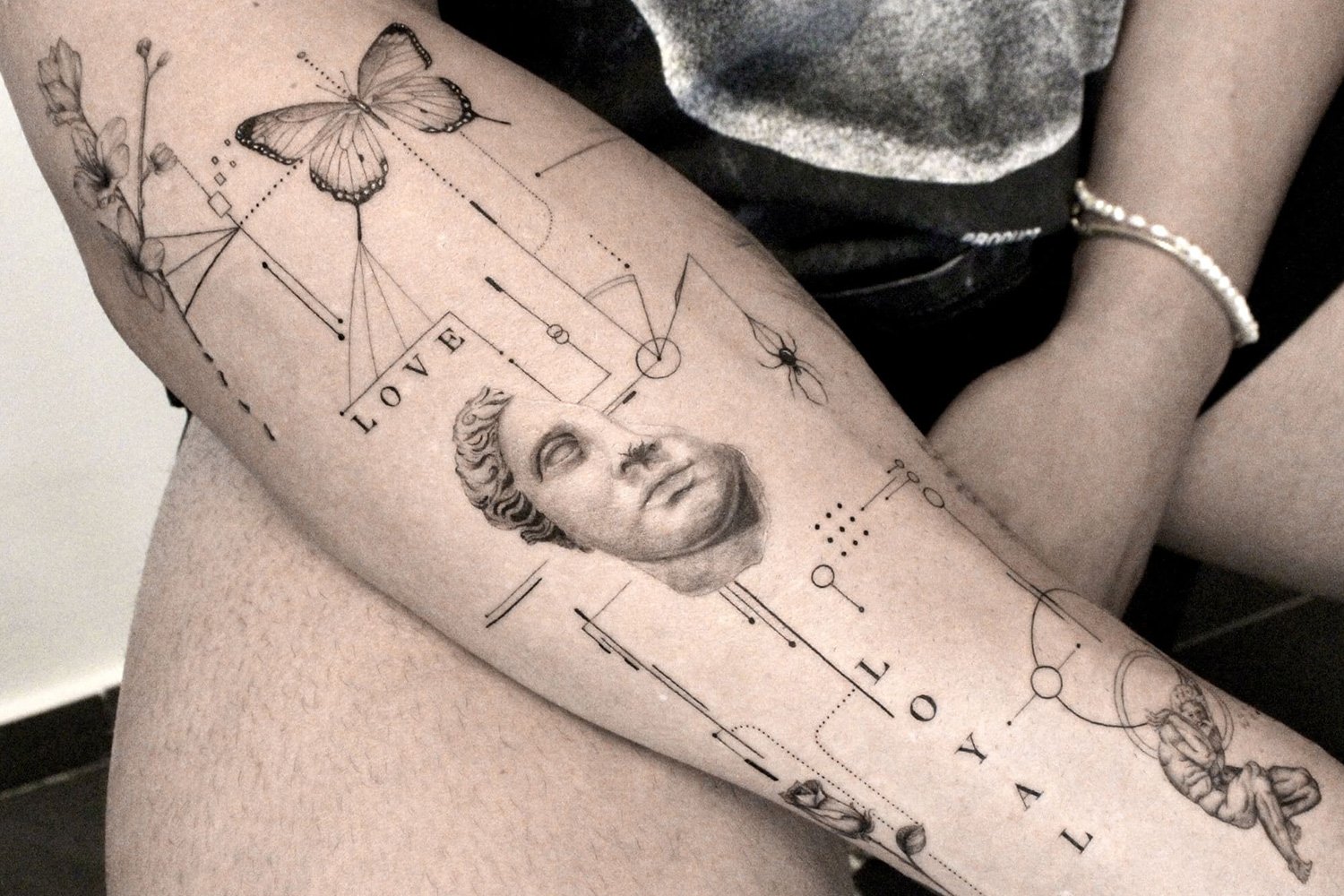
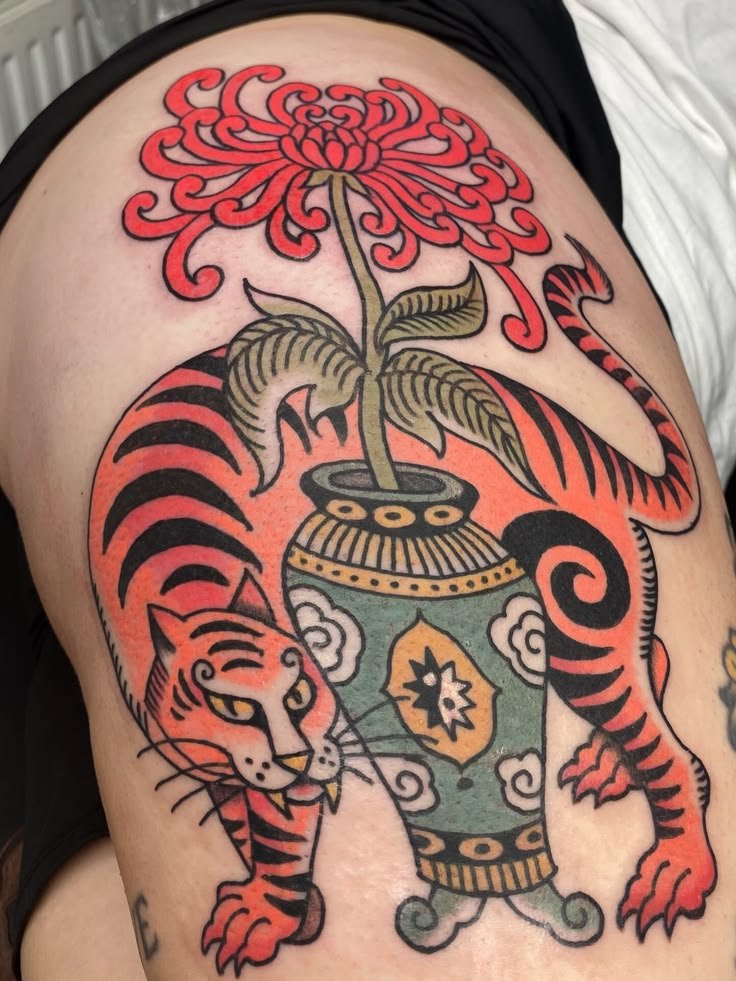
The tiger rendered with expanded palette, smoother shading, and ornamental framing. Often combined with botanical elements (peonies, chrysanthemums, tropical foliage) or with art nouveau decorative structures. The result is more illustrative and more decorative than the traditional or Japanese versions.
Realism
A photographic rendering of a tiger’s face or full body. The meaning shifts toward the specific — this is a particular tiger, a particular expression, a particular moment. Realism tiger pieces are among the most technically demanding animal tattoos because the facial structure and fur patterning are complex enough that any shortcut is visible.
Fine line
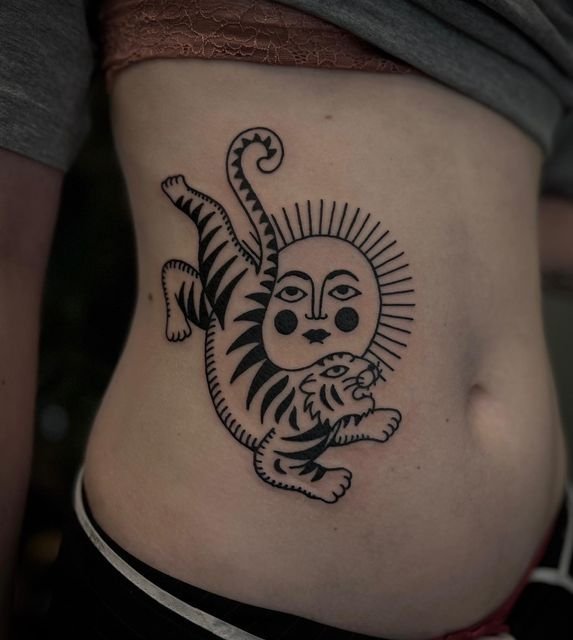
Blackwork and dotwork
Choosing a tiger tattoo
A few practical observations.
The tiger’s face is asymmetrical, mobile, and structurally complex. A realistic tiger portrait that does not capture the specific proportions of the skull, the set of the eyes, and the pattern of the stripes will read as wrong even to viewers who have never studied a tiger’s anatomy. The animal is too familiar for approximation. Artists who specialise in animal realism are the safest choice for photographic tiger work; generalists who attempt it often produce pieces that look feline but not specifically tiger.
The stripes are a design challenge. Tiger stripes are irregular, asymmetrical, and unique to each animal. In tattooing, the stripes have to be placed with enough irregularity to look natural and enough structure to read clearly on the skin. Overly regular stripes look artificial; overly random stripes look chaotic. The best tiger tattoos treat the stripe pattern as a compositional element in its own right.
Scale matters. A tiger rendered in realism, smaller than a large palm, rapidly loses facial detail as it heals and ages. Japanese and traditional tigers, because their visual structure is built on outline and flat shape rather than fine tonal detail, can work at smaller scales. A small, fine-line tiger — the profile or the eye alone — can work at very small scales if the design is simplified accordingly.
Cultural context should inform the composition. A client choosing a tiger-and-dragon pairing should understand what the pairing means in its tradition of origin. A client choosing a Sak Yant tiger should understand the practice’s spiritual framework. A client choosing a traditional flash tiger is under no such obligation — the image is part of a shared Western vocabulary that does not carry the same cultural weight. Knowing which category a particular tiger image falls into and approaching it accordingly is part of choosing well.
Sources & further reading
- Valmik Thapar, The Secret Life of Tigers. Oxford University Press, 1998.
- Valmik Thapar, Tiger: Portrait of a Predator. Collins, 1986.
- K. Ullas Karanth, A View from the Machan: How Science Can Save the Fragile Predator. Permanent Black, 2006.
- John Seidensticker and Susan Lumpkin, Great Cats: Majestic Creatures of the Wild. Rodale Press, 1991.
- Anne Birrell, Chinese Mythology: An Introduction. Johns Hopkins University Press, 1993.
- Patricia Bjaaland Welch, Chinese Art: A Guide to Motifs and Visual Imagery. Tuttle, 2008.
- Wolfram Eberhard, A Dictionary of Chinese Symbols. Routledge, 1986.
- Timothy Clark et al., The Japanese Tattoo. Abbeville Press, 2021.
- W.R. van Gulik, Irezumi: The Pattern of Dermatography in Japan. Brill, 1982.
- Mark Poysden and Marco Bratt, Japanese Tattooing Now: Memory and Transition. Schiffer, 2006.
- Jungmann Burglind, Pathways to Korean Culture: Paintings of the Joseon Dynasty, 1392–1910. Reaktion Books, 2014.
- Joe Cummings, Sacred Tattoos of Thailand: Exploring the Magic, Masters and Mystery of Sak Yant. Marshall Cavendish, 2011.
- David Smith, The Dance of Siva: Religion, Art and Poetry in South India. Cambridge University Press, 1996.
- Sy Montgomery, Spell of the Tiger: The Man-Eaters of Sundarbans. Chelsea Green, 1995.
- Steve Gilbert, Tattoo History: A Source Book. Juno Books, 2000.
- Laynie Rodzon. The Enduring Symbolism of Tigers in Korean Culture. Turpentine Creek Wildlife Refuge, 2025.