Related Posts
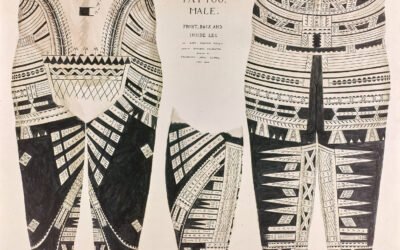

Marquesan tattooing
The most tattooed people in the Pacific
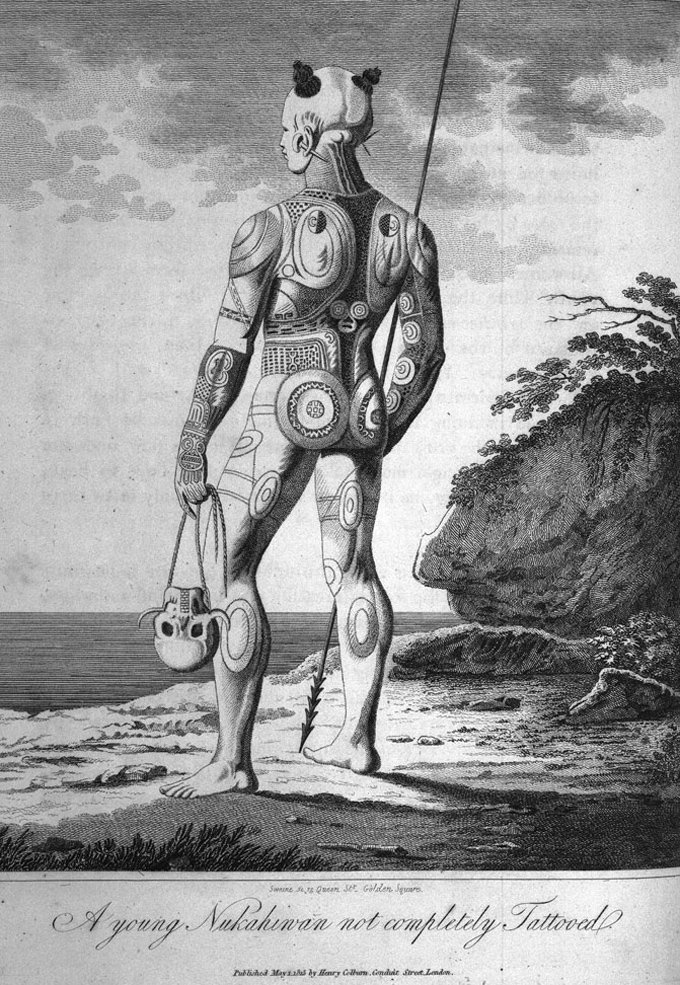
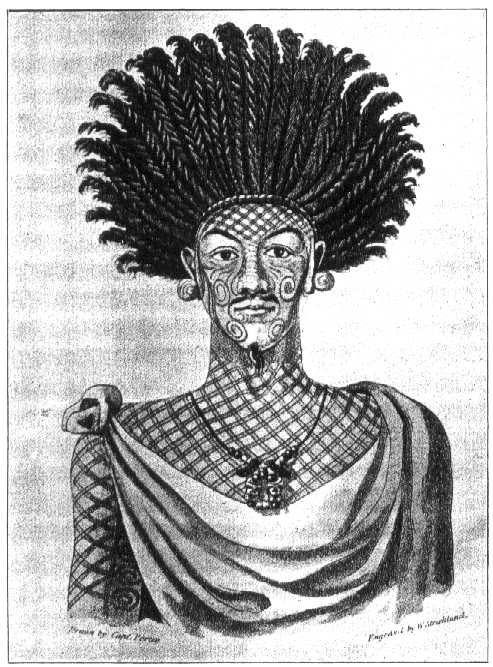
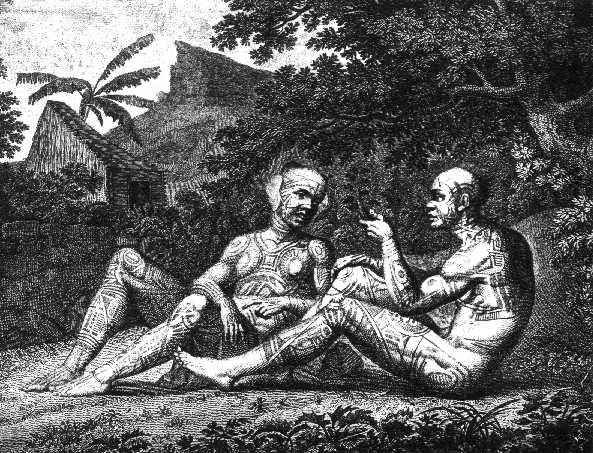
European explorers who reached the Marquesas Islands in the eighteenth and nineteenth centuries were consistent on one point: they had never seen people so extensively tattooed. The Marquesans tattooed their entire bodies — face, head, torso, arms, hands, legs, feet — in dense geometric compositions that left almost no skin unmarked. The Spanish explorer Álvaro de Mendaña, who reached the islands in 1595, was the first European to describe what he saw. Captain James Cook’s crew encountered the Marquesans in 1774. The Russian expedition led by Adam von Krusenstern, accompanied by the naturalist Georg Heinrich von Langsdorff, documented the islands in 1803–1805, producing engravings that remain among the most detailed early visual records of Marquesan body art. Each observer reached the same conclusion: the Marquesans had developed tattooing to a level of complexity and coverage that surpassed any other Pacific culture they had encountered.
The Marquesas Islands — Henua Enana (“the Land of Men”) in the Marquesan language, or Te Fenua Enata — are a volcanic archipelago of twelve islands in French Polynesia, roughly a thousand miles northeast of Tahiti. The islands are remote, rugged, and steeply mountainous, with deep valleys separated by ridges that historically isolated communities from each other. This isolation produced one of the tradition’s distinctive features: the motifs and their meanings could vary from island to island and from valley to valley. A motif that carried one meaning in Nuku Hiva might carry a different meaning in Hiva Oa. The tradition was unified in its visual grammar and cultural function, but diverse in its local expressions.
The Marquesan word for tattooing is patutiki — patu meaning “to strike” and tiki meaning “image.” A tattoo is a struck image. The practitioner was called a tuhuka patu tiki — a master of striking images — and the title carried authority and social prestige comparable to the other tuhuka (specialists, experts) who held essential roles in Marquesan society.
Who was getting tattooed
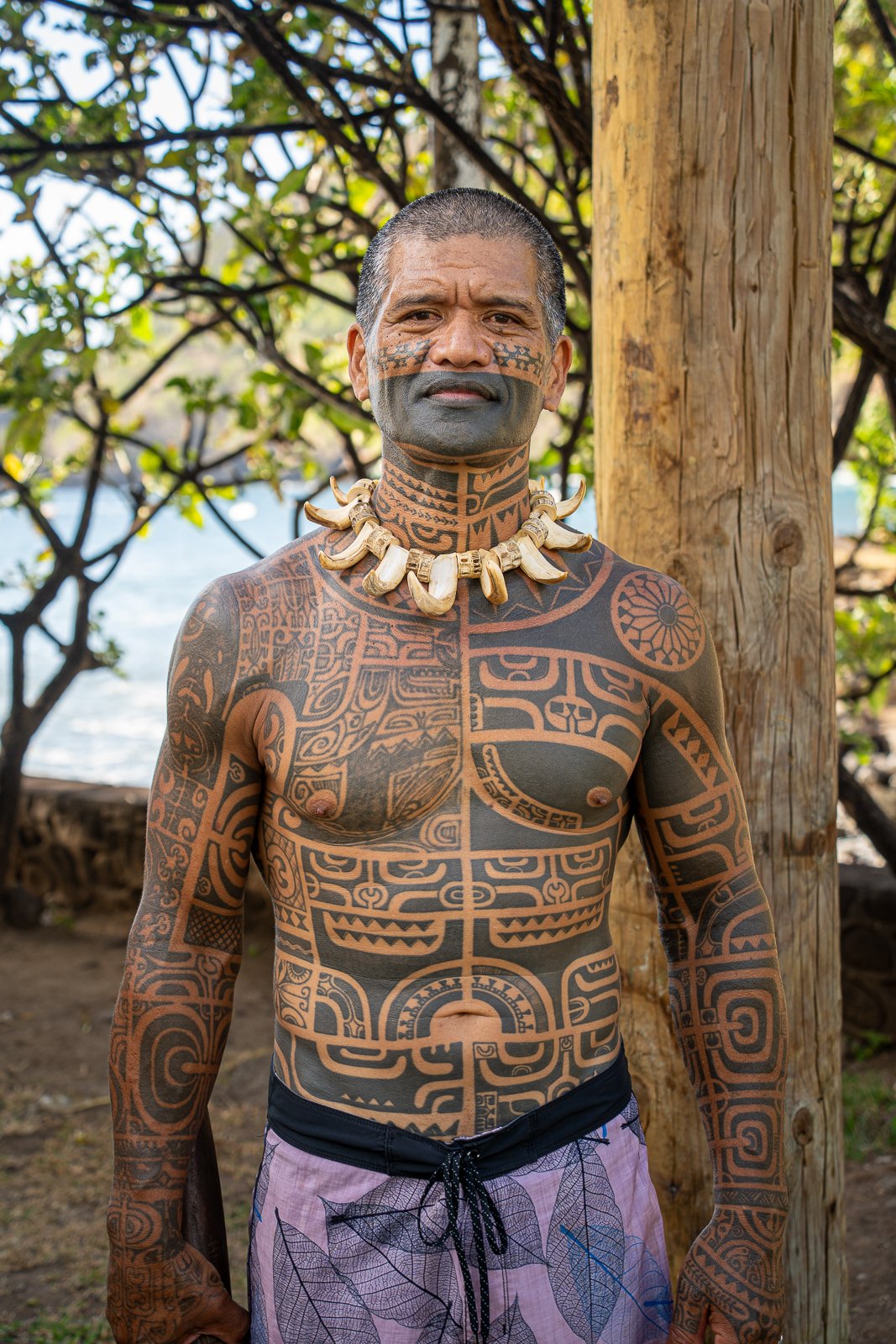
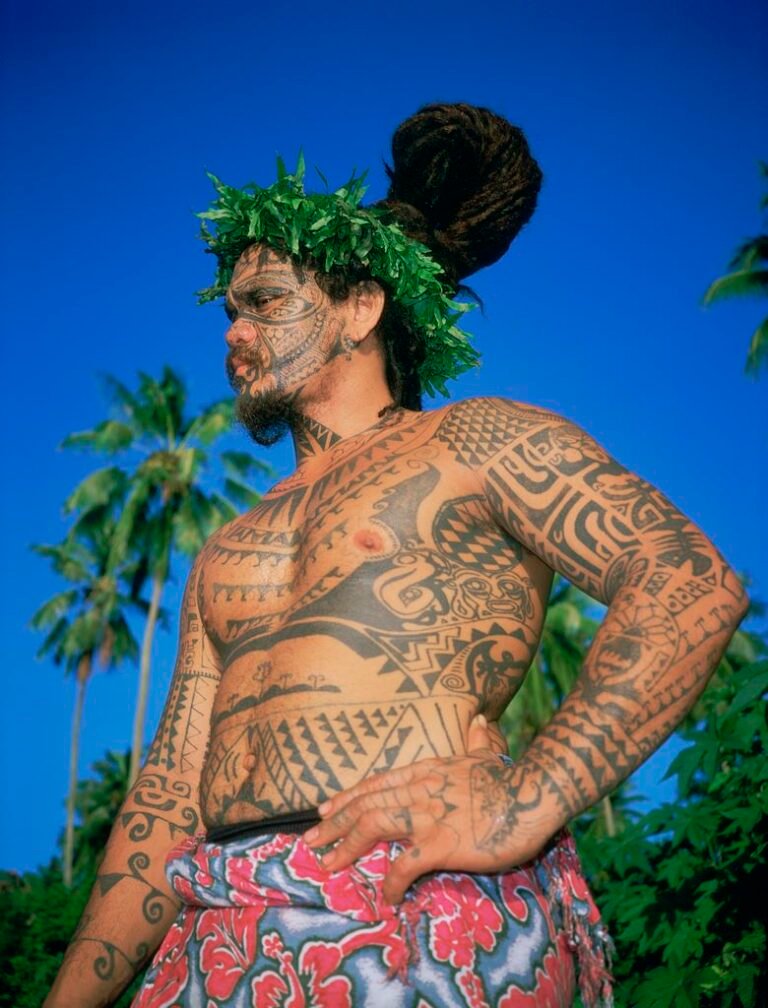
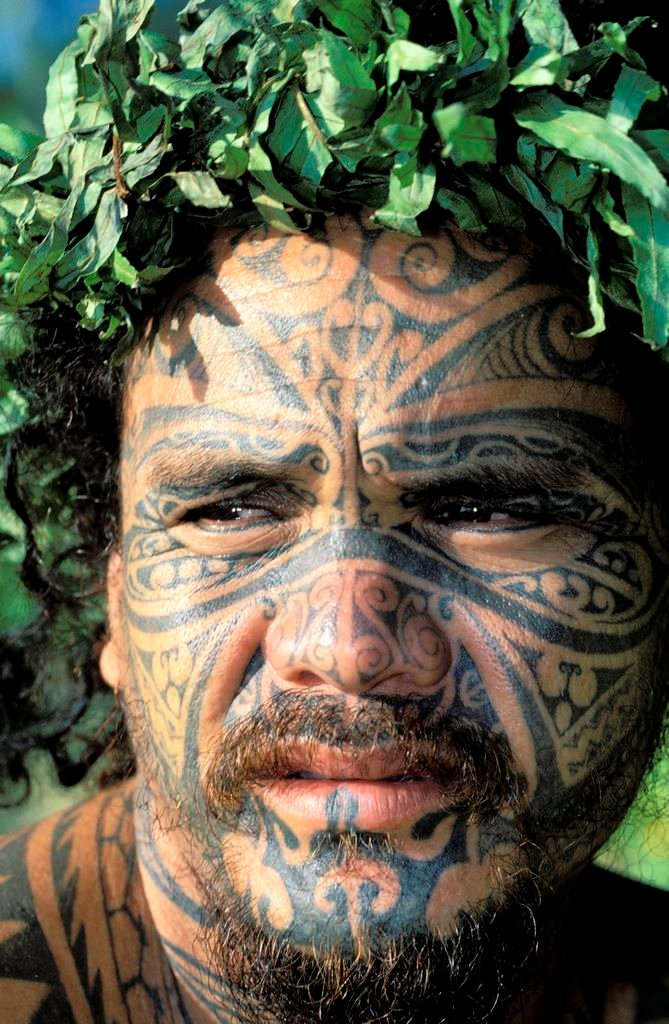
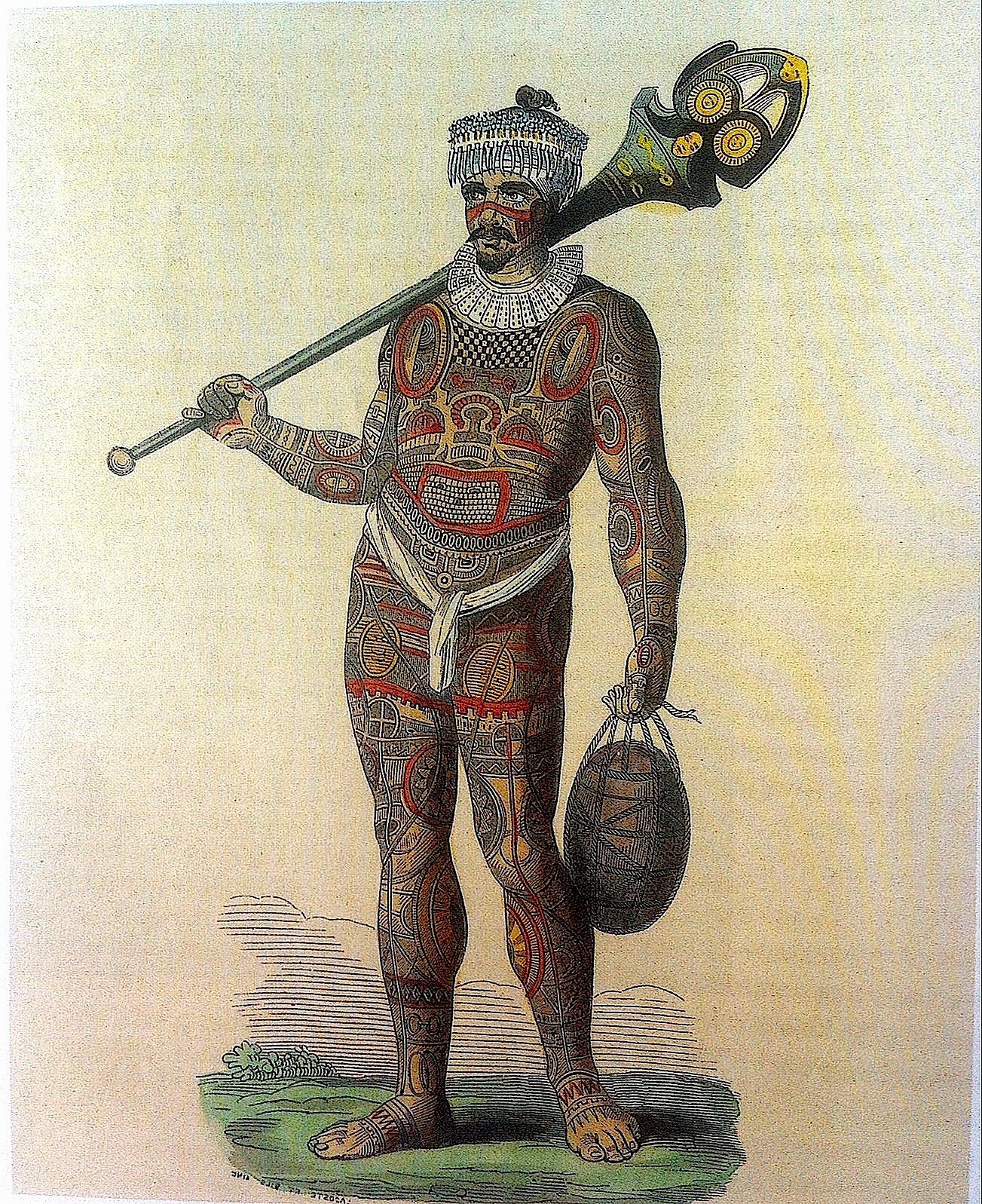
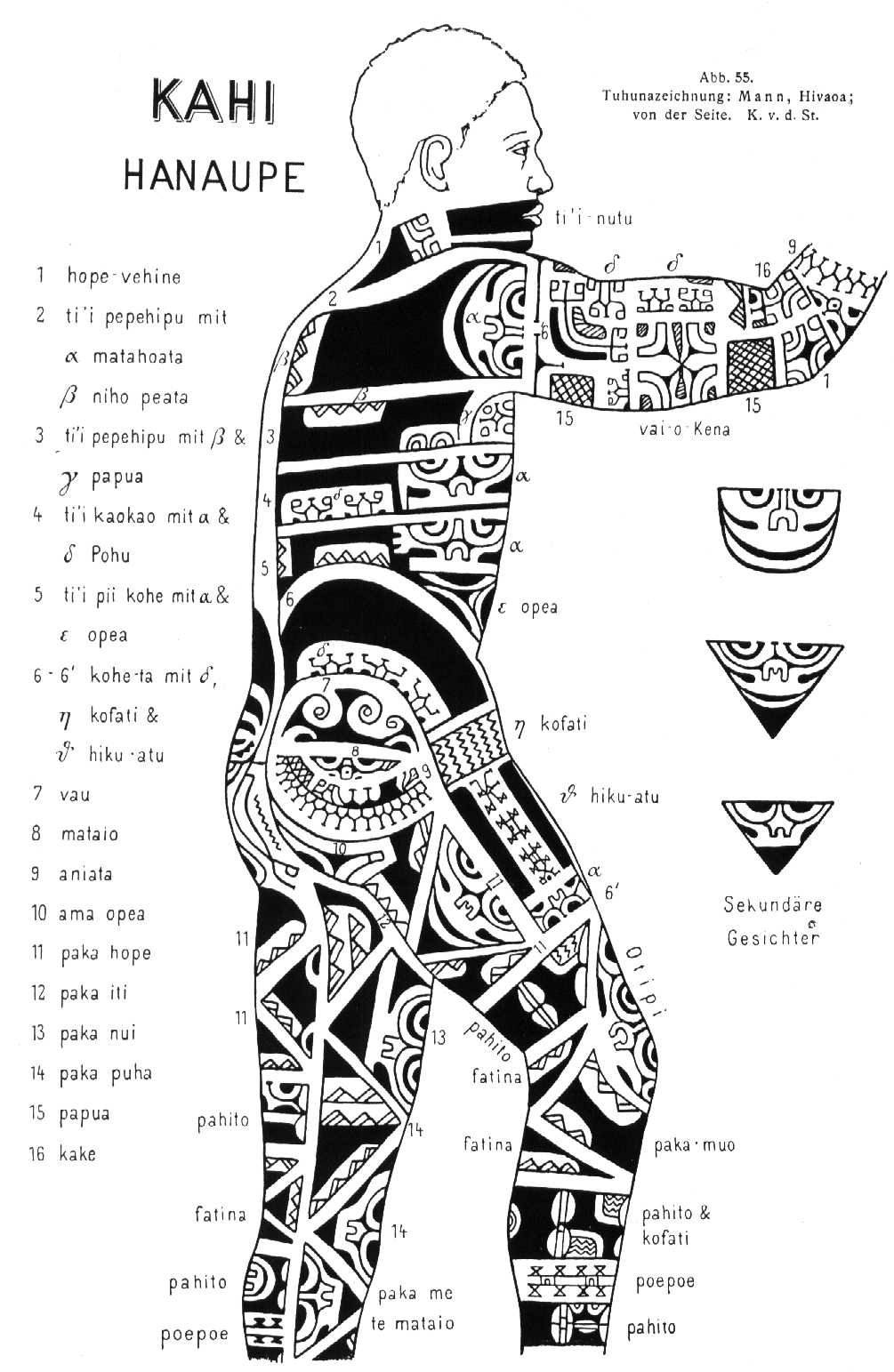
Both men and women were tattooed, but men received more extensive coverage. A boy’s first tattoos were applied in his early teens, in a ritual setting with family and community present. The tattooing continued in stages throughout his life. By old age, a high-status man might have tattoos covering every surface of his body — including the face, the scalp, the eyelids, the tongue, the gums, and the palms of the hands. A fully tattooed Marquesan man was a living composition of extraordinary visual density.
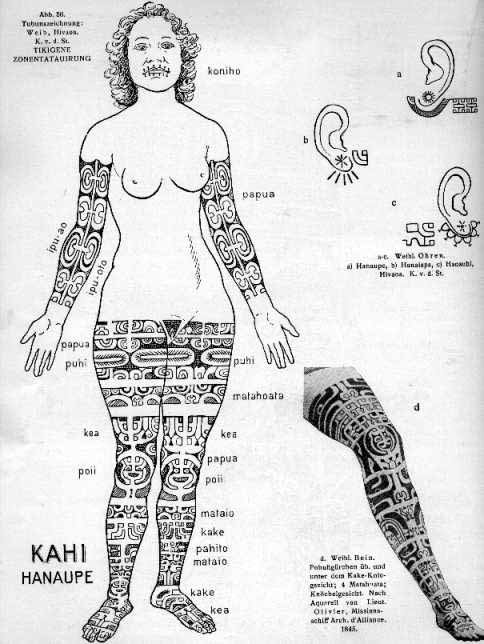
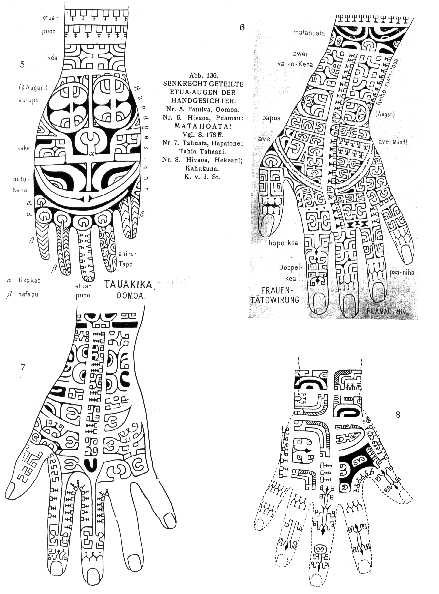
Women were tattooed on the hands, arms, feet, lips, and behind the ears. The designs were typically lighter and less extensive than those for men, but they were applied using the same technique and within the same cultural framework.
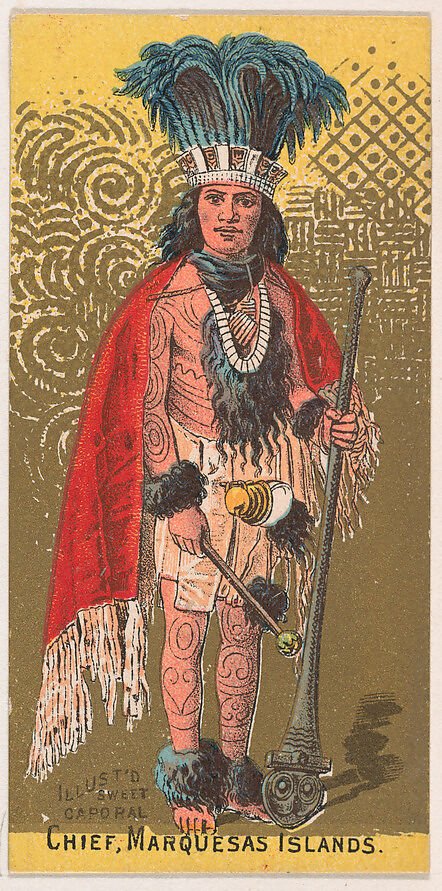
The extent of a person’s tattooing reflected their social position. Chiefs and warriors received the most elaborate coverage. Priests and tuhuka (master craftspeople) were extensively tattooed. Commoners were tattooed less extensively, though tattooing was widespread across all social levels. A person’s tattoos marked their genealogy, rank, achievements, spiritual affiliations, and stage of life — a readable biography inscribed permanently on the body.
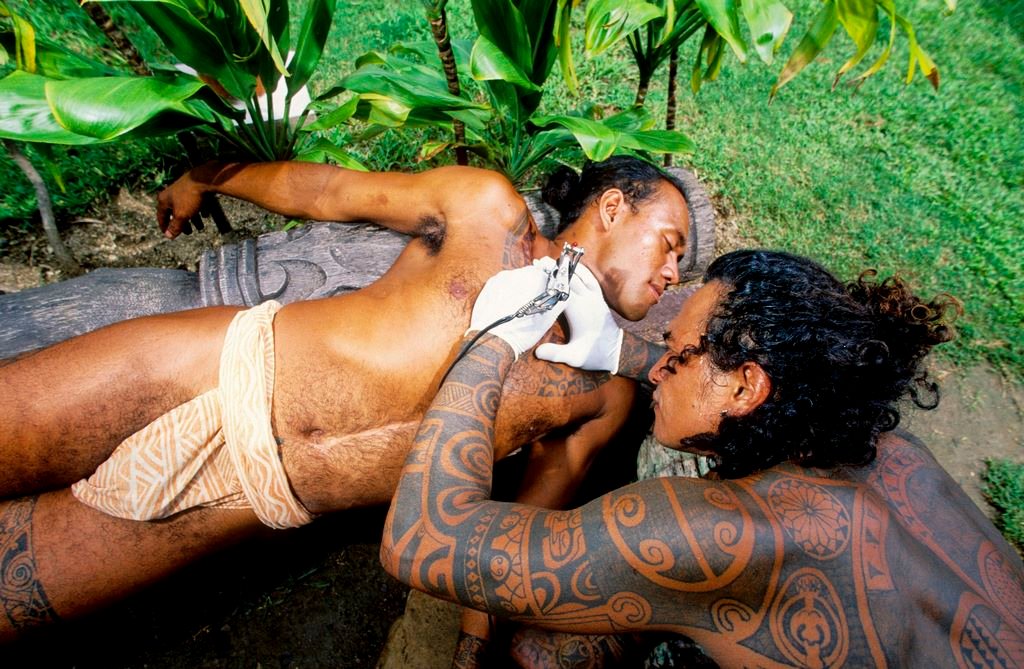
The tattooing process was painful, ritualised, and expensive. The tuhuka patu tiki was paid in food, goods, and social obligations for his work. The sessions could last days, and the recipient was attended by family members and supported through the ordeal. The tattooing of a chief’s son was a communal event, witnessed and celebrated by the community.
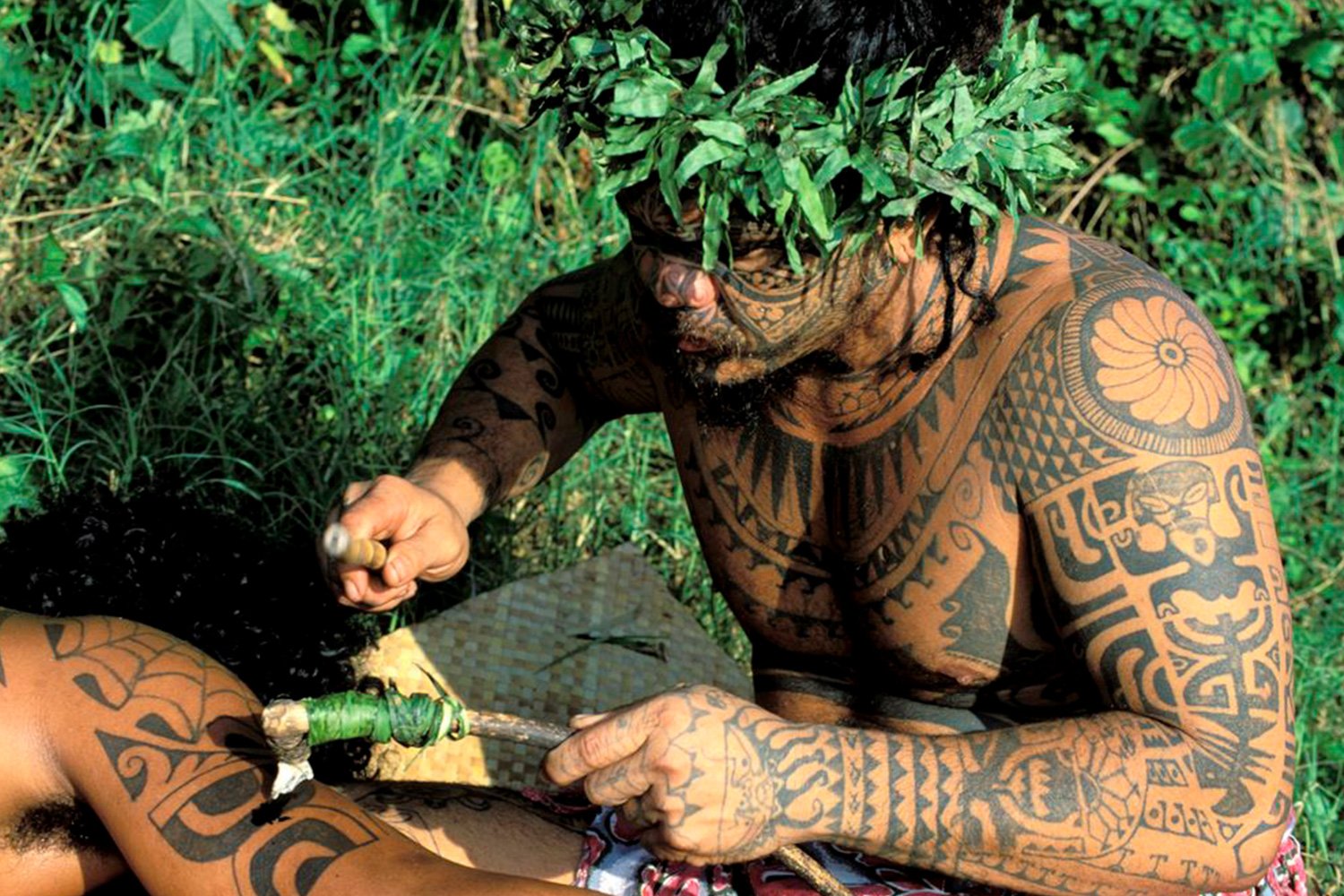
The technique
Comb — a row of sharp teeth made from bone (human bone, in some accounts), sharpened boar’s tusk, or fishbone, set into a piece of tortoise shell and bound to a wooden handle. Different combs had different widths for different applications: narrow combs for fine lines, wider combs for broad strokes and fill.
Mallet — a short wooden or bamboo stick used to strike the comb handle, driving the teeth into the skin.
Pigment — prepared from the soot of burned candlenut (tiairi in Marquesan, kukui or lama in other Polynesian languages), mixed with water. The resulting ink was rich, dark, and stable.
The tuhuka patu tiki worked with the recipient lying on a mat, the skin stretched by an assistant, the comb dipped in pigment and tapped into the skin with rhythmic, controlled strikes. The technique produced dense, even coverage suited to the solid fills and detailed geometric compositions that characterised the tradition.
Marquesan motifs
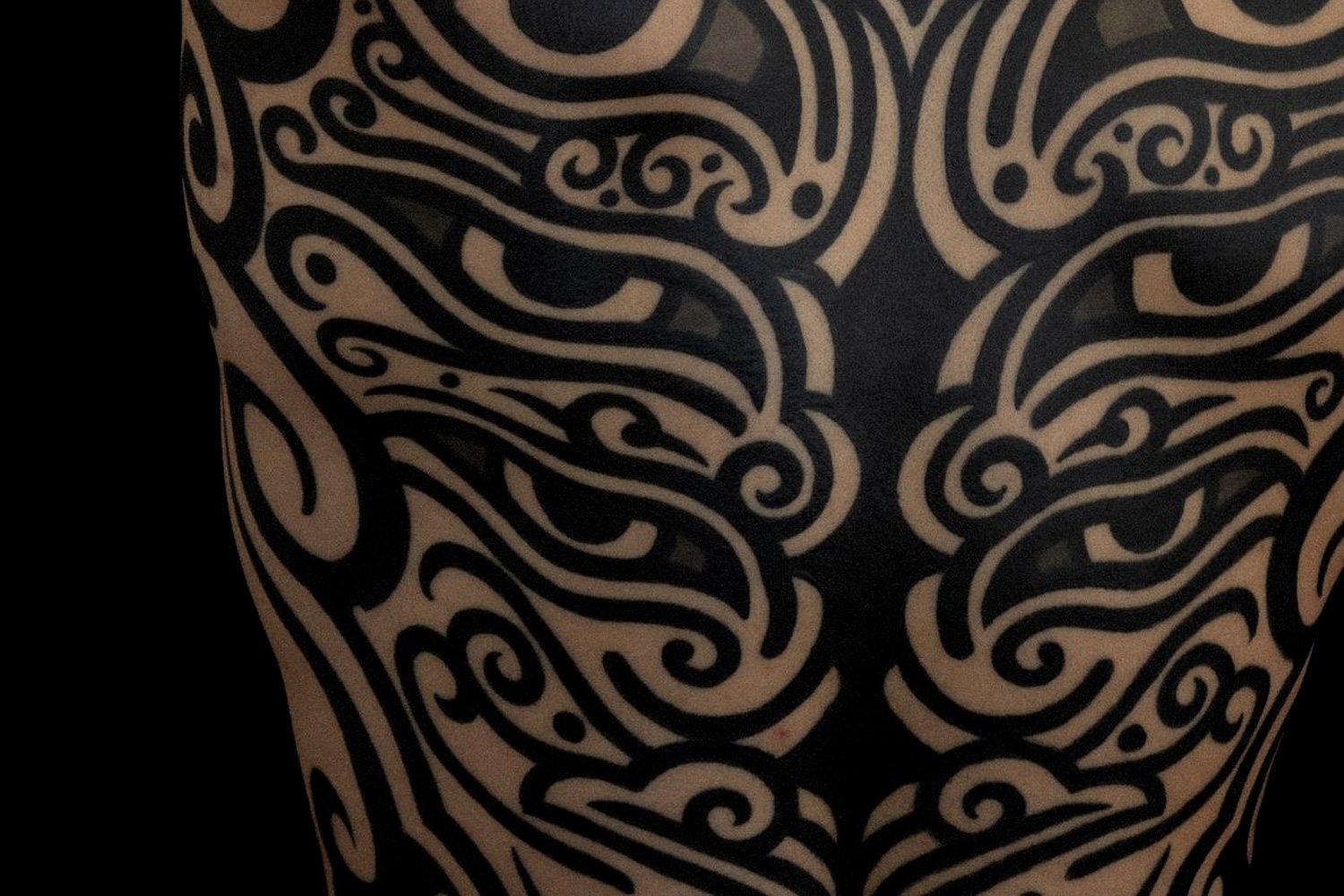
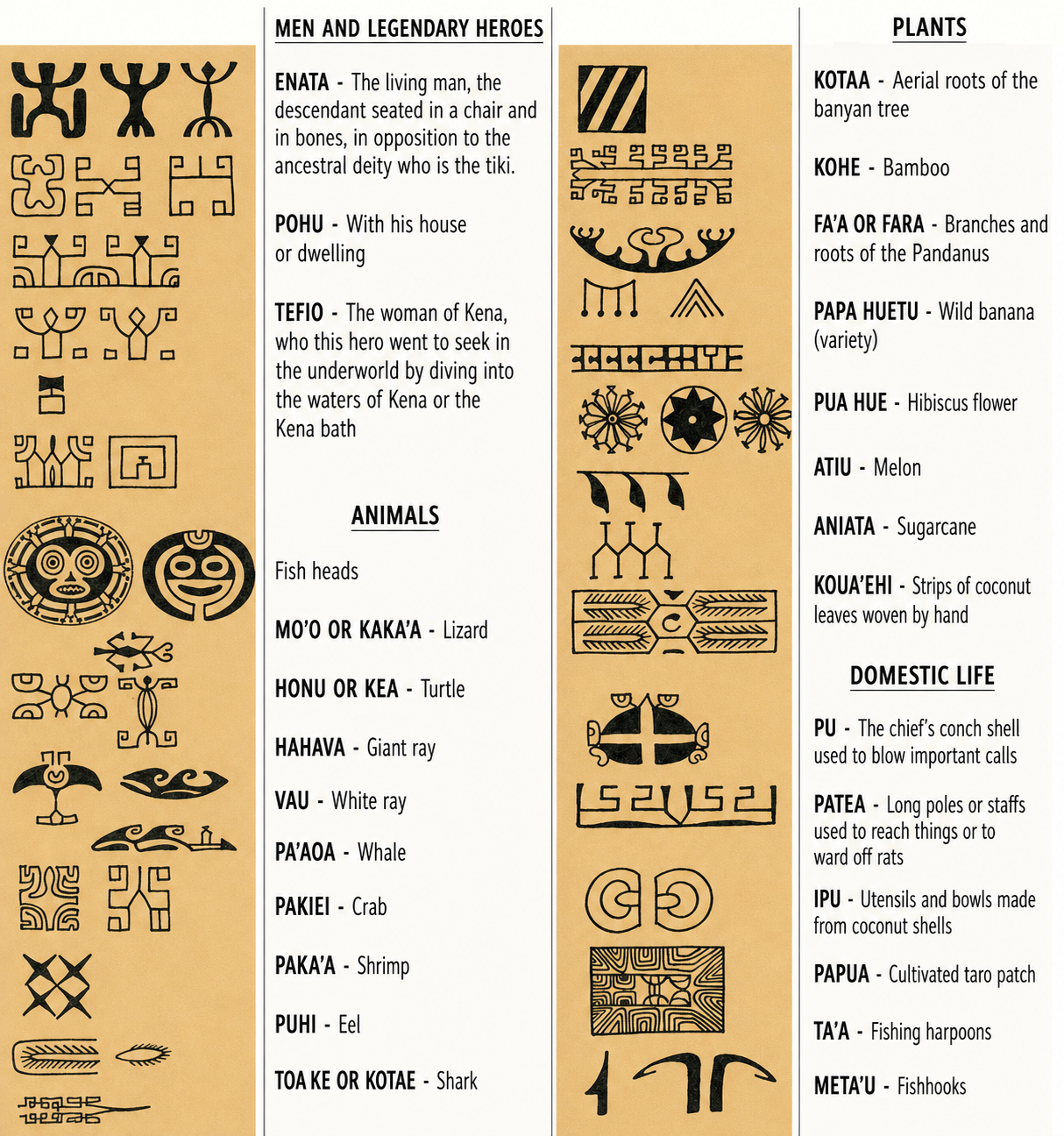
Marquesan tattoo design is built from a vocabulary of geometric and stylised figurative motifs. The motifs were not randomly selected or freely combined — they formed a structured visual language in which specific forms carried specific meanings, and their arrangement on the body followed compositional rules that the tuhuka understood and transmitted. Karl von den Steinen, the German ethnographer who spent six months documenting the islands in 1897–1898, described the system as complex enough to constitute a visual language — a system of signs linking the individual to clan, ancestors, gods, and social order.
The major motifs, as documented by von den Steinen, Willowdean Chatterson Handy, and contemporary practitioners, including Teiki Huukena, include:
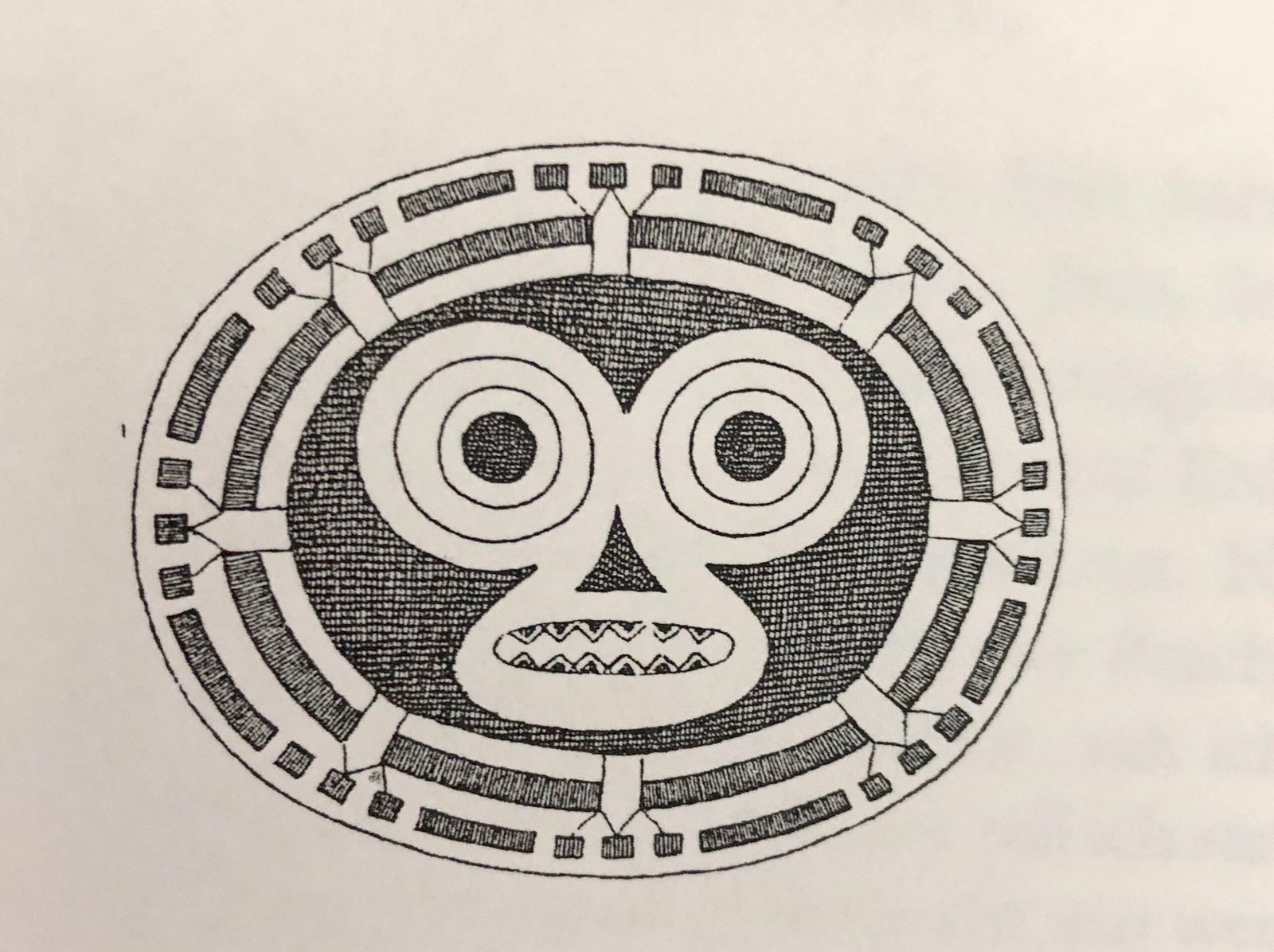
Tiki / Ti’i / Etua. The most important motif in Marquesan art. The tiki is a stylised human figure representing an ancestor, a deity, or a spiritual guardian. In Marquesan cosmology, Tiki is the first man — the progenitor of the human race. Tiki figures appear in tattooing, in stone and wood carving, and in architectural ornament, and they are the visual signature of the Marquesas. In tattoo form, the tiki is typically abstracted into a face — two eyes (often represented as concentric circles or ovals), a nose, and a mouth — which can be elaborated or simplified depending on its position and function in the composition. The etua — a more abstract representation of a divine or ancestral figure — appears throughout Marquesan tattoo compositions as a recurring structural element.
Mata komoe (death’s head). One of the most distinctive and enigmatic Marquesan motifs — a face or mask with closed or inverted eyes, representing death, the ancestor in the afterlife, or the transition between the worlds of the living and the dead. The mata komoe was documented by von Langsdorff in the early nineteenth century, but had become rare or forgotten by the time von den Steinen visited a century later. The motif’s placement — often on the back of warriors — connects it to combat, to death in battle, and to the spiritual power of the deceased.
Ipu Ani (celestial sphere). A spherical or circular motif representing the dome of the sky, within which the tiki is found. The stars within the sphere are the eyes of the ancestor — the spirit of the dead watching from the heavens.
Kake / Kaake. The Ipu Ani cut in half — representing the spirit of a deceased person returning to the stars. A motif of transition and ascent.
Mata Hoata (brilliant eyes). A face motif whose shimmering eyes represent the third day of the moon, considered the best day for planting and fishing. The nose of Mata Hoata represents the female generative power. The motif is used to summon fertility and abundance through the gods. Mata Hoata is identified in some accounts as the wife of Tiki.
The Marquesan Cross. A distinctive cross-shaped motif — unrelated to Christian imagery — that appears throughout Marquesan art and is one of the most recognisable design elements of the tradition. The motif represents balance, the four cardinal directions, and the intersection of earthly and divine realms.
Centipede (atua vau). Rows of spine-like elements representing tenacity, many-legged persistence, and spiritual power. The centipede motif appears in tattooing across multiple Polynesian traditions, but the Marquesan version is particularly dense and prominent.
Gecko / lizard. A stylised reptilian form representing communication with the spirit world. Geckos were considered messengers between the living and the divine.
Fan / banana leaf patterns. Stylised plant forms representing abundance, growth, and the natural world.
Ocean and wave motifs. Geometric representations of the sea — the central fact of Marquesan existence, surrounded as the islands are by thousands of miles of open water.
These motifs were combined into compositions of extraordinary density and visual coherence. A single tattoo zone — the back, for example — might contain dozens of motifs arranged in bands, fields, and clusters, each carrying its own meaning while contributing to the overall visual and symbolic effect. The compositional skill of the tuhuka patu tiki lay in integrating these elements into a coherent whole that read correctly on the specific body it occupied.
Von den Steinen’s observation is important and frequently cited:
“We shouldn’t conclude that this custom has no history simply because the wearer no longer knows anything about it.”
By the time of his visit in 1897, much of the specific symbolic knowledge had already been lost — the wearers of the tattoos could not always explain the meanings of the motifs they carried. The knowledge was held by the tuhuka, and the tuhuka were disappearing.
Destruction of the Marquesan tattooing tradition
Demographic collapse
The Marquesan population was devastated by contact with Europeans. Diseases brought by explorers, whalers, traders, and missionaries — smallpox, syphilis, tuberculosis, influenza — killed Marquesans at a catastrophic rate. The population fell from an estimated 75,000 at the time of European contact to roughly 2,000 by 1920. This is a decline of more than ninety per cent. The collapse was not gradual; it was a catastrophe that unfolded over a century, destroying the social fabric that sustained every cultural practice, including tattooing. When ninety per cent of a population dies, the specialists die with them — the tuhuka patu tiki, the carvers, the chanters, the navigators, the people who held the knowledge.
Missionary prohibition
Catholic missionaries arrived in the Marquesas in the 1830s. In 1838, the Church banned tattooing, declaring it pagan worship and — incorrectly — attributing illness to the practice. (The real causes of illness were the European diseases the missionaries themselves had carried to the islands.) The colonial authorities in French Polynesia enforced the ban from 1884 onward. By the time Willowdean Chatterson Handy conducted her survey of Marquesan tattooing in 1921, she found only a single surviving tattoo artist — and a dwindling number of living examples of the tradition he represented.
Colonial administration
The French colonial administration that governed the Marquesas as part of French Polynesia actively discouraged Indigenous cultural practices. The combination of missionary pressure, colonial authority, and demographic collapse produced a near-total interruption of the tradition within a single century.
The documentation
Georg Heinrich von Langsdorff (1803–1805). The naturalist on the Krusenstern expedition produced detailed engravings of tattooed Marquesans. These engravings, published in Langsdorff’s account of the voyage, are among the earliest and most detailed European visual records of the tradition.
Karl von den Steinen (1897–1898). The German ethnographer spent six months in the Marquesas, systematically documenting the tattoo tradition through drawings (see above), descriptions, and analysis. His three-volume work Die Marquesaner und ihre Kunst (The Marquesans and Their Art), first published in 1925–1928, remains the foundational reference. The first volume is devoted entirely to tattooing. Von den Steinen’s work is described by the Antinoë publishing house, which issued the French translation in 2005, as “a remarkable and unequalled body of knowledge on the art of tattooing in Polynesia.” The work not only describes the ornamental figures but also attempts to understand their origin and meaning and to determine styles and their evolution.
Willowdean Chatterson Handy (1921). The American anthropologist conducted what may be the last firsthand survey of living Marquesan tattooing, finding — as noted above — a single surviving practitioner. Her monograph Tattooing in the Marquesas (published 1922) includes thirty-eight plates of drawings and photographs that provide an unusually complete record of the tradition at the moment of its near-extinction. The 1884 colonial ban had been in effect for thirty-seven years by the time of Handy’s survey.
These three bodies of work — Langsdorff’s engravings, von den Steinen’s systematic analysis, and Handy’s final survey — are the documentary basis for every contemporary reconstruction of the Marquesan tradition. Without them, the motifs and their arrangements would be lost.
The revival of Marquesan tattooing tradition
The revival of Marquesan tattooing, which began in the 1980s as part of the broader Polynesian cultural renaissance, is a reconstruction. Unlike Samoan tattooing, which survived continuously and can be practised from unbroken transmission, Marquesan tattooing must be rebuilt from the documentary record, from the motifs preserved in other media (carving, tapa cloth, and architectural ornament), from the oral traditions that survived within the community, and from the living knowledge of Samoan tufuga ta tatau, who have played a crucial role in teaching the hand-tapping technique to a new generation of Marquesan practitioners.
Teiki Huukena, a master tattooist from Nuku Hiva, is the most prominent contemporary practitioner. He has been tattooing since 1990 and has published the definitive reference work on Marquesan tattoo symbolism: Hamani Haa Tuhuka Te Patutiki (Polynesian Tattoo Dictionary: Marquesas Islands), which won the Prix Sciences at the 2011 Island Book Fair in Ouessant. The work, now in two volumes with over 10,000 copies sold, catalogues and explains the meanings of traditional Marquesan symbols. Huukena is president of the MATATIKI Association, dedicated to the protection and promotion of Marquesan iconographic art, and a member of the Marquesan Academy.
Eddy Tata, born in the Marquesas, is the resident traditional tattoo artist on the Aranui 5 — the passenger ship that serves the Marquesas Islands. Tata practises traditional Marquesan tattooing using the hand-tapping method and serves both local and visiting clients.
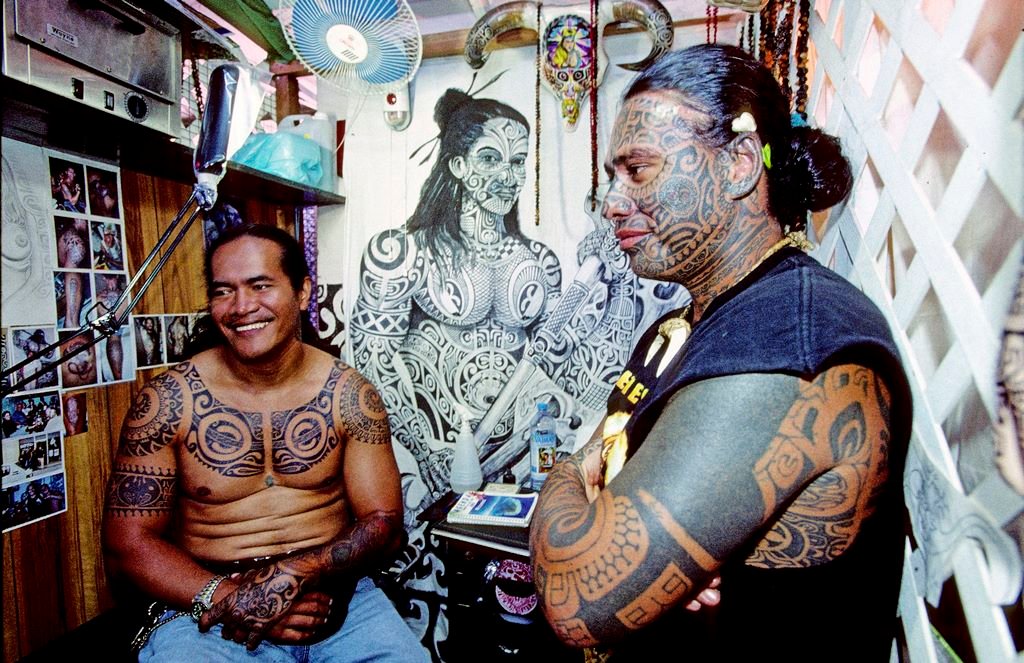
Contemporary Marquesan tattooing is practised in Nuku Hiva, Hiva Oa, and other inhabited islands of the archipelago, and by Marquesan practitioners working in Tahiti and in diaspora communities. Tattoo artists from the Marquesas also attend international conventions and festivals, sharing the tradition with the wider Pacific and global tattoo communities.
The revival is explicitly understood as a reconstruction. Contemporary practitioners study von den Steinen, Handy, and the broader ethnographic record alongside the oral traditions and material culture that survived within the community. They are transparent about what has been recovered and what has been lost. As Teiki Huukena has noted, symbols can have significant variants depending on the island, the artist, and the lineage — the tradition was never a fixed, uniform system, and its contemporary reconstruction reflects this diversity.
The distinction from other Polynesian styles
Marquesan tattooing is frequently confused with — or merged into — the broader category of “Polynesian tattoo” in commercial tattoo practice. The confusion is understandable (the traditions share a common ancestry and a common visual grammar), but inaccurate. Several features distinguish Marquesan patutiki from the tattoo traditions of Samoa, Tonga, Tahiti, Hawai’i, and Aotearoa.
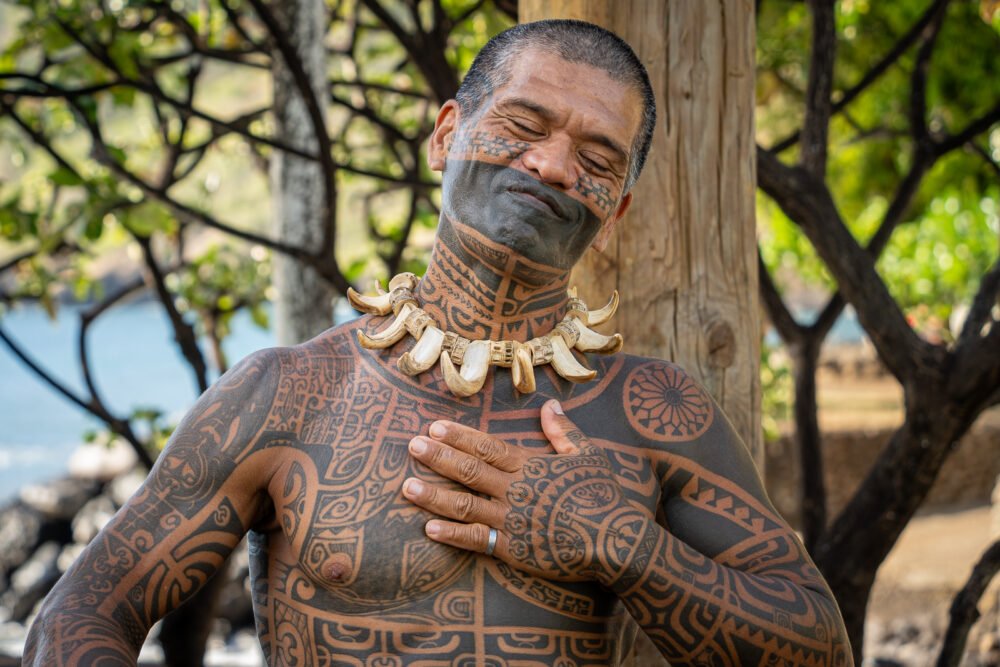
Total body coverage. No other Polynesian tradition routinely covered the entire body, including the face, head, hands, and feet, with the density and completeness of Marquesan practice. Samoan pe’a covers the waist to the knees; Māori tā moko focuses on the face; Hawaiian and Tahitian tattoos are extensive but typically less dense. Marquesan tattooing at its fullest left almost no skin unmarked.
The tiki as a central motif. The stylised human figure — the tiki or etua — is the most prominent visual element in Marquesan tattooing and the single motif most associated with Marquesan art worldwide. While tiki figures appear across Polynesian art, they are more central to the Marquesan design system than to any other.
Facial tattooing. Marquesans tattooed the face extensively — men could receive full facial coverage, including the forehead, cheeks, chin, nose, and around the eyes. Tahitian tattooing, by contrast, never included the face.
Density and complexity. The sheer visual density of Marquesan tattoo work — the number of motifs per unit of body surface, the complexity of the compositions, the layering of elements — was consistently noted by European observers as exceeding anything they saw elsewhere in Polynesia.
The practical consequence for non-Marquesan tattoo artists and clients: is that Marquesan motifs (tiki, mata komoe, ipu ani, mata hoata, the Marquesan Cross) carry distinct Marquesan cultural meaning. Using them without understanding what they mean and where they come from risks the same conflation and appropriation that has affected Polynesian tattoo culture more broadly. Teiki Huukena’s published dictionaries exist in part to address this problem — to ensure that the motifs are used with knowledge rather than ignorance.
Marquesan tattooing is alive
It is a reconstruction — built from documents, from surviving oral traditions, from the material culture of the islands, and from the work of dedicated practitioners who have spent decades recovering what the colonial period destroyed — but it is alive. Young Marquesans are being tattooed. Practitioners are training apprentices. The motifs that von den Steinen documented in 1897 are being applied to skin again, more than a century after the missionary ban nearly ended the practice.
The Marquesas Festival of Arts — held every four years, alternating between different islands of the archipelago — includes tattooing as a central component, alongside carving, dance, song, and other traditional arts. The festival is one of the most important venues for the living tradition, bringing together practitioners from across the archipelago and from the diaspora.
The population of the Marquesas has recovered from its catastrophic low of roughly 2,000 to approximately 9,000 today. The tradition has recovered alongside it. What was nearly lost — the most elaborate tattoo tradition in the Pacific, and one of the most elaborate in the world — is being rebuilt by the people whose ancestors created it.
Sources & further reading
- Brigitte Postel, photos by Sylvain Grandadam, The Marquesan tattoo: a memory in the skin, Univers Voyage, 2026.
- Tanja Neumann, Marquesas-Tattoos: Ein Selbstexperiment auf See, Reisegenuss Magazin, 2026.
- Karl von den Steinen, Die Marquesaner und ihre Kunst (The Marquesans and Their Art). Three volumes, Dietrich Reimer, Berlin, 1925–1928.
- Willowdean Chatterson Handy, Tattooing in the Marquesas. Bernice P. Bishop Museum Bulletin 1, Honolulu, 1922.
- Teiki Huukena, Hamani Haa Tuhuka Te Patutiki: Polynesian Tattoo Dictionary — Marquesas Islands. V. 1-2. Winner of the Prix Sciences, Island Book Fair, Ouessant, 2011.
- Georg Heinrich von Langsdorff, Voyages and Travels in Various Parts of the World During the Years 1803, 1804, 1805, 1806, and 1807. Henry Colburn, London, 1813–14.
- Culture of the Marquesas Islands, Wikipedia, The Free Encyclopedia.
- Hole in the Donut, Tattooed from Head to Toe in the Marquesas Islands. Published November 2018, updated July 2021.
- Tahiti Tourisme, Polynesian tattooing. Published March 2024.
- Aranui Cruises, Māori tattoo: History and origins of an ancestral Polynesian art.
- Alfred Gell, Wrapping in Images: Tattooing in Polynesia. Clarendon Press, 1993.
- Sean Mallon and Sébastien Galliot, Tatau: Sāmoan Tattoo, New Zealand Art, Global Culture. Te Papa Press, 2018.