Related Posts
Japanese traditional
Traditional Japanese tattoos: the body as a single composition
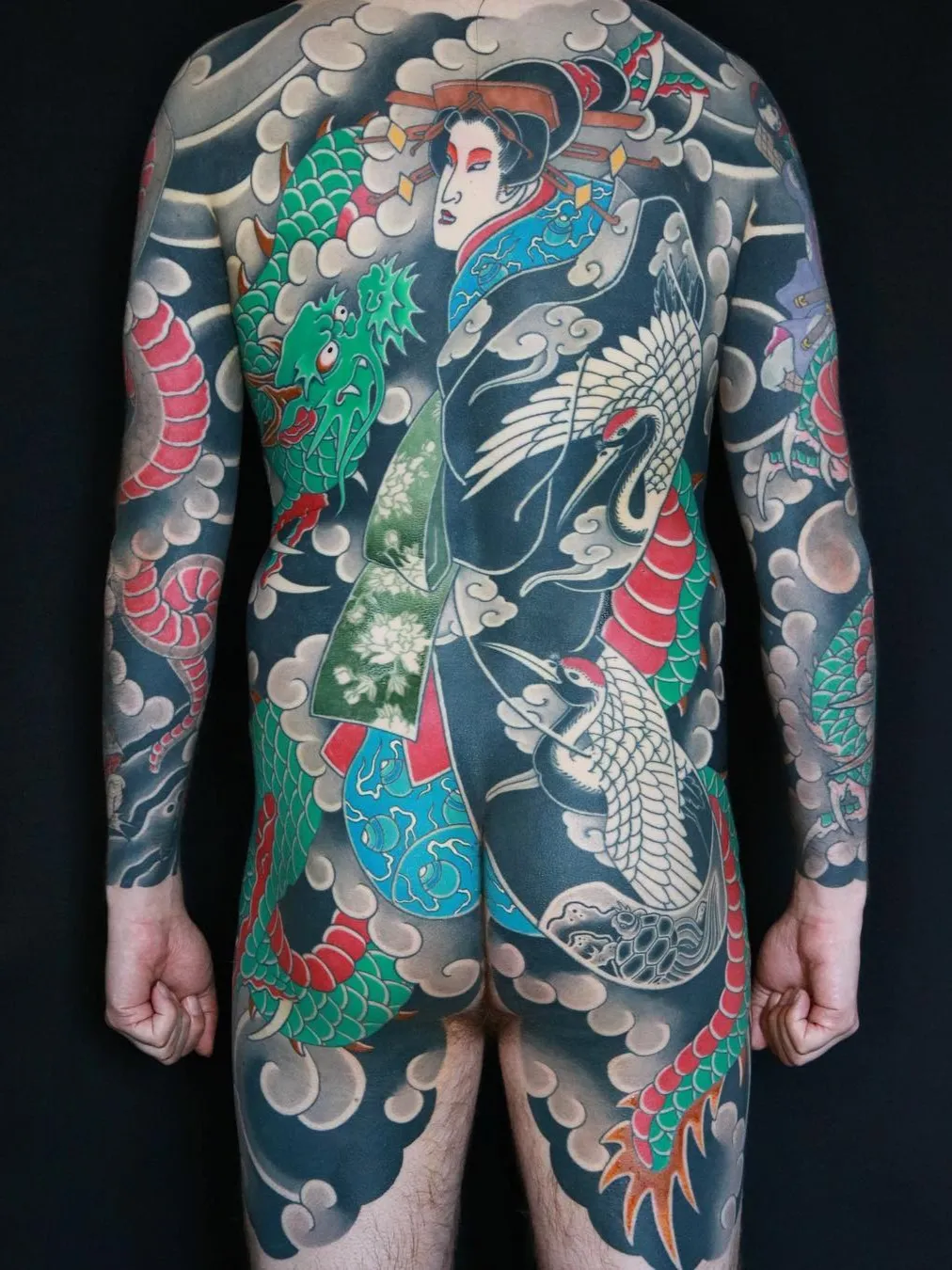
Traditional Japanese tattooing — irezumi or horimono — is arguably the most developed tattoo tradition in the world. No other culture has produced a tattoo system of comparable compositional ambition, iconographic depth, or technical sophistication. A full Japanese bodysuit — covering the back, the chest, the arms to the wrists, and the thighs to the knees, with a bare channel down the centre of the torso — can take five years or more of weekly sessions and cost upwards of thirty thousand dollars. The result is not a collection of images but a single composition: a unified artwork in which every element is related to every other, governed by rules of seasonal coherence, iconographic logic, and compositional flow that have been refined over more than two centuries.
The tradition has its roots in the woodblock print culture of Edo-period Japan (1603–1868), its subject matter in the literature and mythology of East Asia, its technique in the hand-tattooing method called tebori, and its social history in the intersection of working-class pride, criminal punishment, and organised crime that has made Japanese tattooing simultaneously revered and stigmatised within its own culture. Understanding the tradition requires engaging with all of these dimensions — the art, the craft, the imagery, and the social reality.
Terminology
The Japanese language has multiple words for tattooing, and the distinctions between them carry meaning.
Irezumi (入れ墨, literally “inserting ink”) is the most general term and is used in English to refer to the Japanese tattoo tradition as a whole. In Japanese usage, irezumi can refer to any tattoo, including punitive tattoos and Western-style work.
Horimono (彫り物, literally “carved thing”) refers specifically to decorative, artistic tattooing — the full bodysuits and large-scale compositions that define the tradition. The word distinguishes the art form from punitive or functional tattooing. When Japanese practitioners speak of their work as an art, they tend to use horimono.
Tebori (手彫り, “carving by hand”) refers to the traditional hand-tattooing technique — the method by which the ink is applied.
Horishi (彫り師) is the term for a tattoo master — the practitioner of horimono.
The distinction between irezumi (broad, sometimes carrying punitive associations) and horimono (specifically the decorative art form) is important within the tradition. In English-language usage, irezumi is the standard term for the tradition as a whole.
The history of Japanese tattooing
Pre-Edo
Tattooing in Japan predates written records. Archaeological evidence suggests body marking in Japan during the Jōmon period (roughly 14,000–300 BCE) — clay figurines (dogū) from this era bear incised patterns on their faces and bodies that many scholars interpret as representations of tattoos or body painting. Chinese chronicles from the third century CE describe the inhabitants of the Japanese islands (Wa) as tattooed people, marked for fishing or as indicators of social status.
The Ainu people of Hokkaido and the Ryukyuan people of Okinawa both practised tattooing as part of their cultural traditions — the Ainu primarily on women’s faces (lip tattoos marking maturity and marriage readiness) and the Ryukyuan women on their hands. Both traditions were suppressed during the Meiji period and are distinct from the irezumi tradition of the Japanese mainland.
As Chinese cultural influence grew in Japan — particularly the arrival of Buddhism and Confucian ethics — tattooing acquired negative associations. Confucian teaching held that modifying the body was an offence against one’s parents, and tattooing came to be viewed as a mark of the uncivilised.
The Edo period and the birth of horimono
The transformation of tattooing from stigma to art happened during the Edo period (1603–1868), the long era of stability under the Tokugawa shogunate.
Punitive tattooing (irezumi kei)
From 1720, tattooing replaced physical mutilation (nose and ear amputation) as a form of criminal punishment. Convicted criminals were tattooed with marks whose design and placement indicated the nature and location of their offence — ring tattoos on the arm for theft, characters on the forehead for murder. The system was abolished in 1870 during the Meiji period, but its legacy was lasting: the association between tattoos and criminality in Japanese culture traces directly to the irezumi kei system. Some criminals, seeking to cover or disguise their punitive marks, commissioned decorative tattoos to conceal them — an early form of cover-up work.
The floating world (ukiyo)
The Edo period also produced the ukiyo (“floating world”) — the pleasure quarters of Edo (now Tokyo) and other major cities, where courtesans, kabuki actors, merchants, and artists created a culture of visual display, sensory pleasure, and urban sophistication. Courtesans (yūjo) sometimes tattooed the names of favoured clients on their skin as pledges of loyalty — irebokuro (literally “inserted beauty marks”). The practice of pledging love through body marking extended to the underworld figures and gamblers who frequented the pleasure quarters.
Ukiyo-e and the Suikoden
The decisive catalyst was literary and visual. In 1757, the first Japanese edition of the Chinese novel Shuǐhǔ Zhuàn (known in Japanese as Suikoden, translated as Water Margin) was published. The novel tells the story of 108 outlaw heroes who rebel against a corrupt government — a narrative that resonated with the working classes of Edo, themselves chafing under the rigid social hierarchy of the Tokugawa regime.
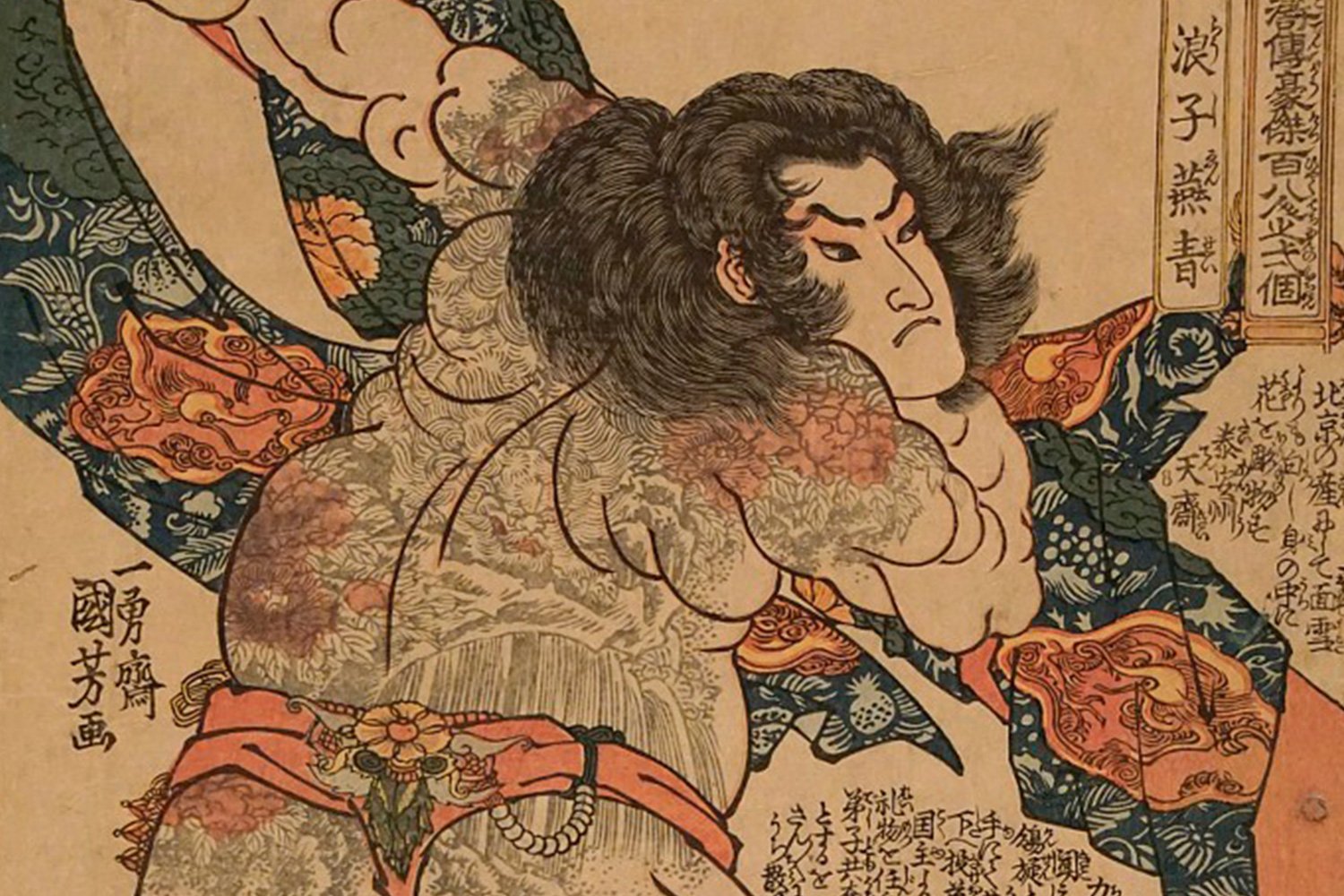
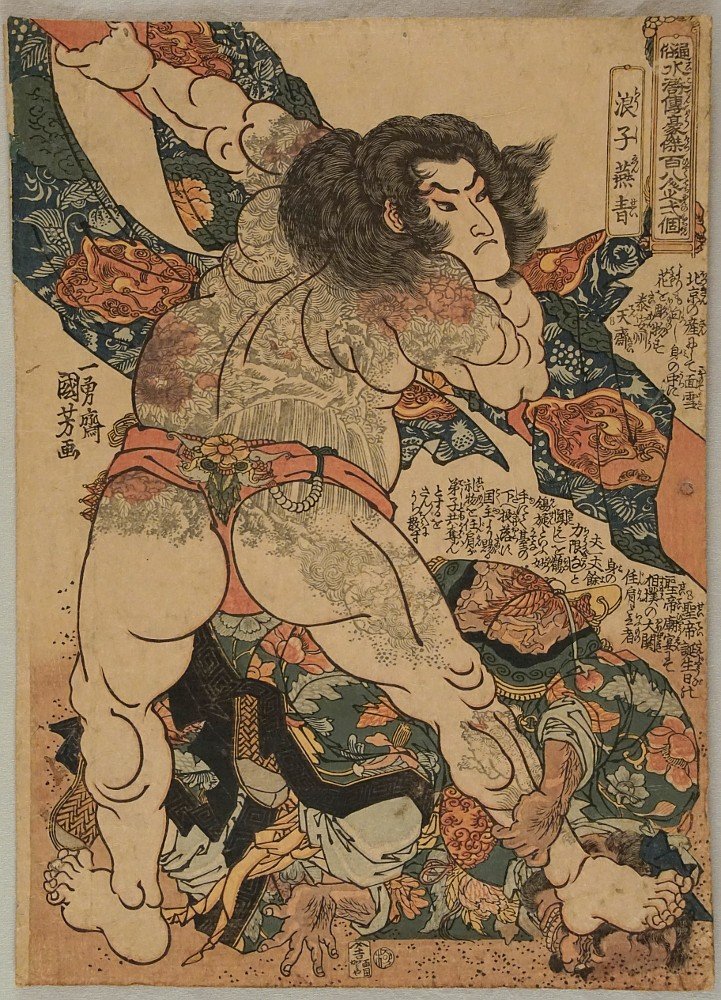
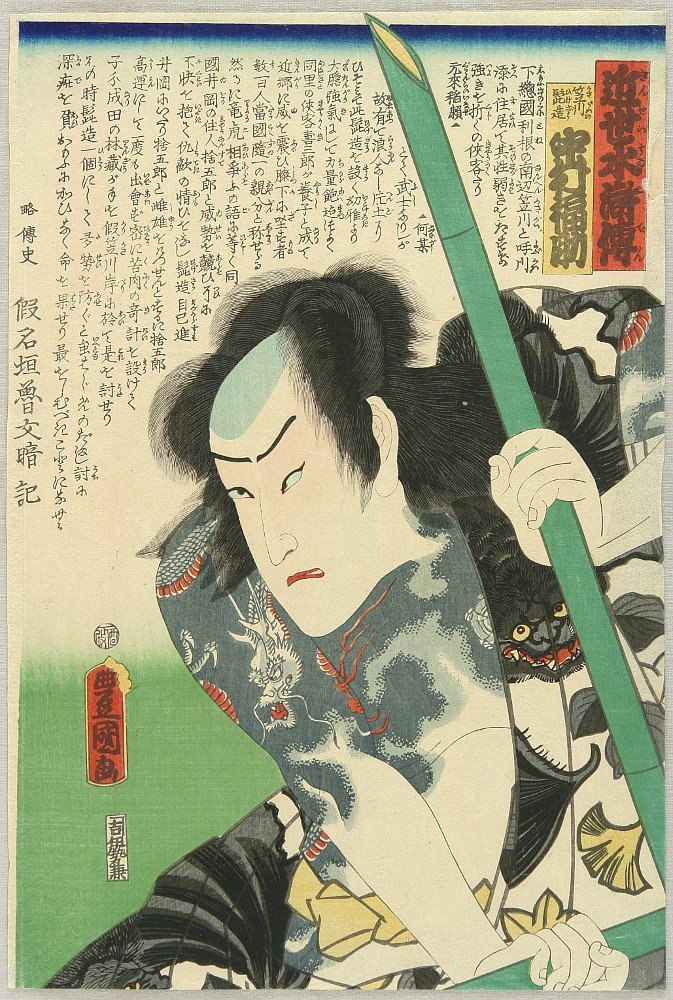
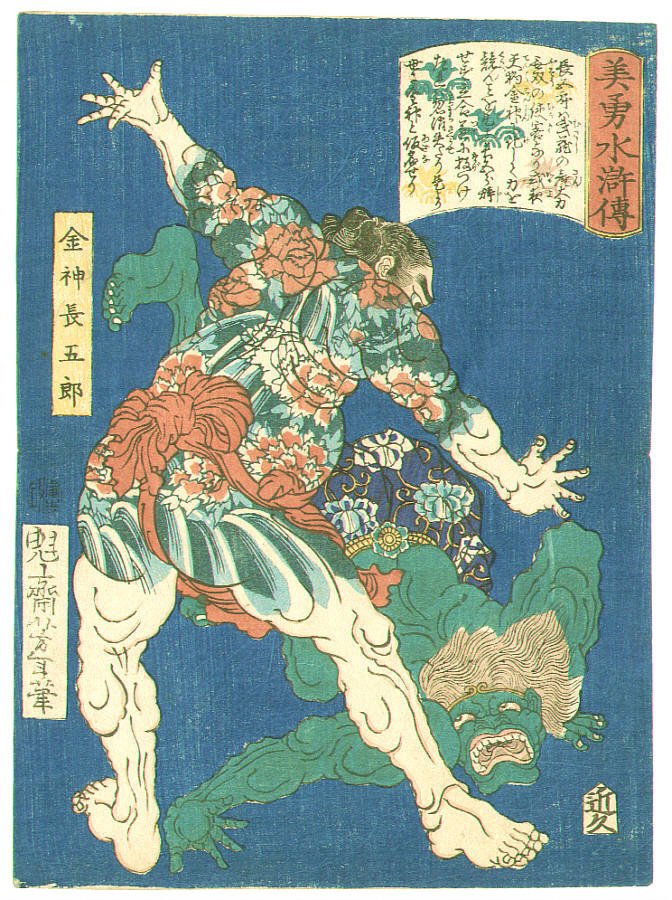
In the late 1820s, the ukiyo-e master Utagawa Kuniyoshi published his print series Tsūzoku Suikoden Gōketsu Hyakuhachinin no Hitori (“One of the 108 Heroes of the Popular Water Margin”) — a set of lavishly illustrated portraits of the Suikoden heroes, several of whom are depicted with elaborate full-body tattoos of dragons, tigers, and mythological creatures. The prints were enormously popular. The public — particularly the firefighters, labourers, couriers, and artisans of Edo’s working classes — wanted the same imagery on their own bodies.
The connection between woodblock printing and tattooing is direct and technical. Many early horishi were woodblock carvers (horishi in both crafts — the word means “carver”) who applied their knowledge of line, colour, and composition to both skin and wood. The prefix hori- (“to carve”) in horimono reflects this shared origin. The design vocabulary of Japanese tattooing was born from the design vocabulary of the woodblock print, and the two art forms share a visual DNA that is still visible today.
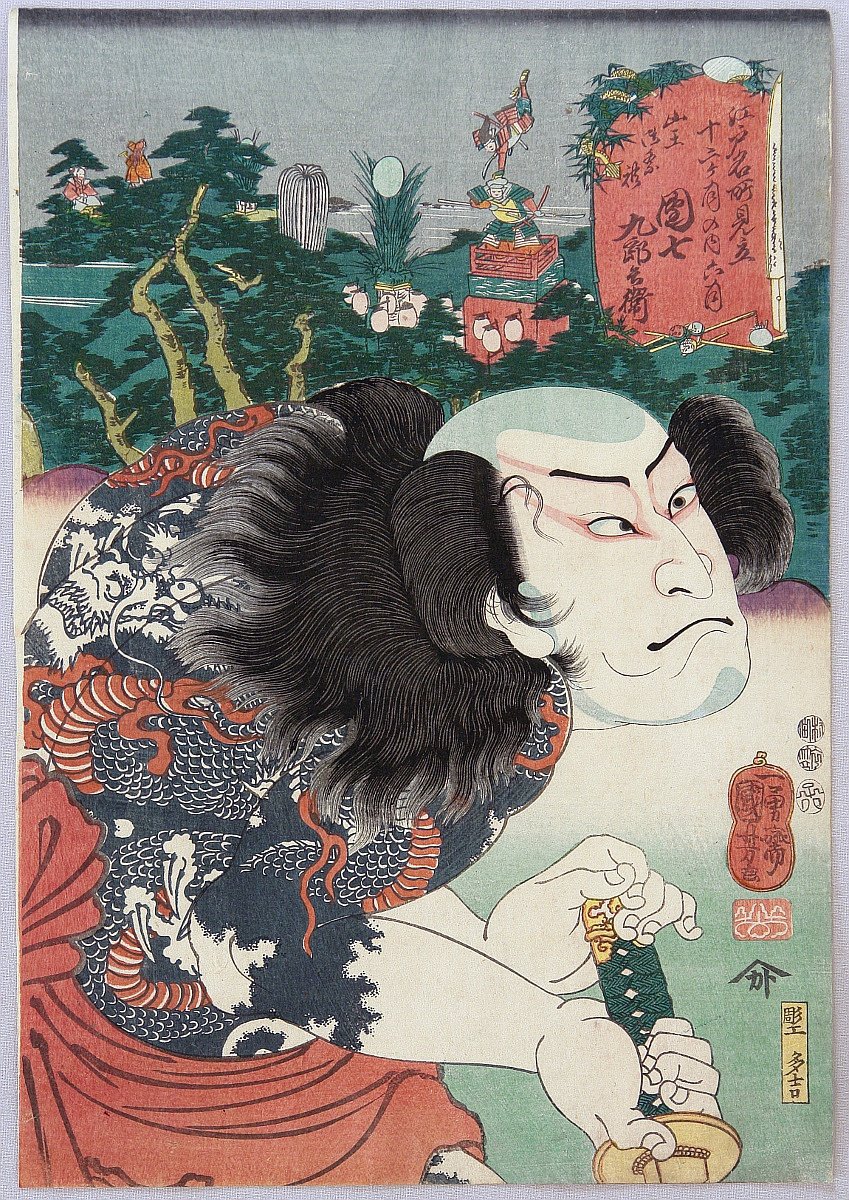
Other ukiyo-e artists followed Kuniyoshi’s lead. Utagawa Kunisada depicted kabuki actors displaying tattoos. Tsukioka Yoshitoshi produced dramatic narrative prints that became source material for tattoo compositions. The kabuki theatre itself incorporated tattoo imagery — actors appeared in costume patterns that mimicked tattooed bodysuits, and plays featured tattooed characters as heroes. The cultural feedback loop between print, theatre, and skin produced the visual language of horimono as we know it.
Who was tattooed
The primary adopters of decorative tattooing in the Edo period were the working classes of the cities — firefighters (hikeshi), who wore tattoos as spiritual protection and as markers of bravery; steeplejacks (tobi), couriers (hikyaku), and labourers whose physically demanding work meant they frequently stripped to the waist, making their tattooed bodies publicly visible. These men wore their tattoos as marks of professional identity, fraternal belonging, and personal courage. Firefighters in particular were celebrated figures in Edo culture — the iki (understated cool, toughness, masculine style) of the tattooed firefighter was admired as an expression of the urban working-class aesthetic.
There is scholarly debate about the extent to which wealthier merchants also adopted tattooing. One argument holds that merchants, forbidden by sumptuary laws from displaying their wealth through clothing, wore expensive tattoos beneath their garments as a hidden luxury. The evidence for this is suggestive but not conclusive.
The Meiji ban
In 1868, the Tokugawa shogunate fell, and the Meiji government came to power, opening Japan to the West after more than two centuries of relative isolation. The new government, anxious about how Japan would be perceived by Western powers, banned decorative tattooing in 1872. The ban was motivated by the fear that tattooing would reinforce Western perceptions of Japan as a “backward” or “uncivilised” nation.
The ban did not end tattooing. It drove the practice underground, into the private studios of horishi who continued to work discreetly. The illegality may have strengthened the mystique of irezumi — the hidden tattoo, concealed beneath clothing, visible only in the bathhouse or the bedroom, became a marker of a world that existed beneath the surface of respectable society.
Ironically, during the same period, foreign visitors — including European royalty — travelled to Japan specifically to be tattooed by Japanese masters, whose skill was internationally recognised. The ban applied to Japanese subjects; foreigners could be tattooed legally.
The ban remained in effect until 1948, when the Allied occupation authorities lifted it.
The yakuza association
The association between Japanese tattooing and the yakuza (organised crime syndicates) is the most politically charged aspect of the tradition and the primary reason for the continuing stigma against tattoos in Japanese society.
The connection is real. The yakuza adopted full-body tattooing as a marker of loyalty, endurance, and permanent commitment to the organisation. The pain of the tattooing process — years of sessions, using the slow tebori method — demonstrated the wearer’s willingness to suffer. The permanence of the tattoo demonstrated an irreversible commitment — once fully tattooed, the wearer was visually marked as someone who had chosen a life outside mainstream society. The voluntary exclusion from public bathhouses, swimming pools, and other spaces that prohibit tattoos was part of the social contract: the tattoo announced that the wearer had stepped outside the norms of respectable life.
The iconography of yakuza tattooing follows the same design system as all horimono — the same dragons, the same koi, the same Suikoden heroes — but the social meaning is specific to the criminal context. A full bodysuit on a yakuza member is simultaneously a work of art and a badge of organisational membership.
The yakuza association has produced the most visible consequence for tattooed people in Japan today: the widespread ban on tattoos in public bathhouses (onsen and sentō), swimming pools, gymnasiums, and some beaches and hotels. These bans affect all tattooed people, not only yakuza members, and they are the primary way in which the stigma manifests in daily life. A 2020 Supreme Court ruling reclassified tattooing as decoration rather than a medical procedure, easing some legal restrictions on tattoo practitioners, but social stigma and public-space bans persist.
The design system
Traditional Japanese tattooing is governed by a compositional system with specific rules.

Full bodysuit
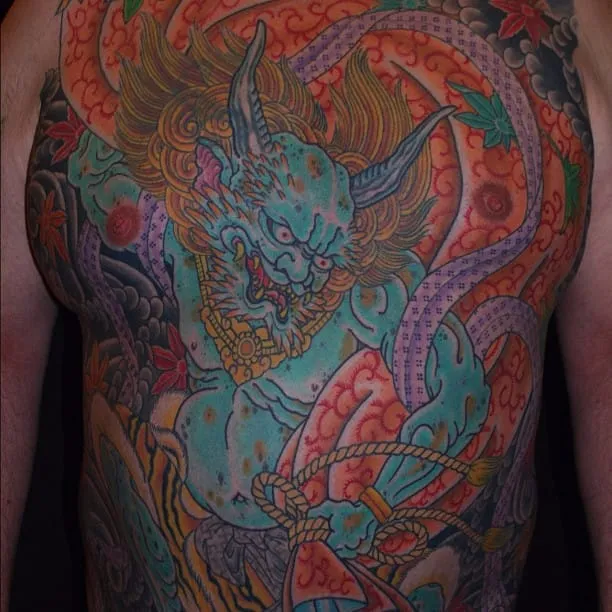
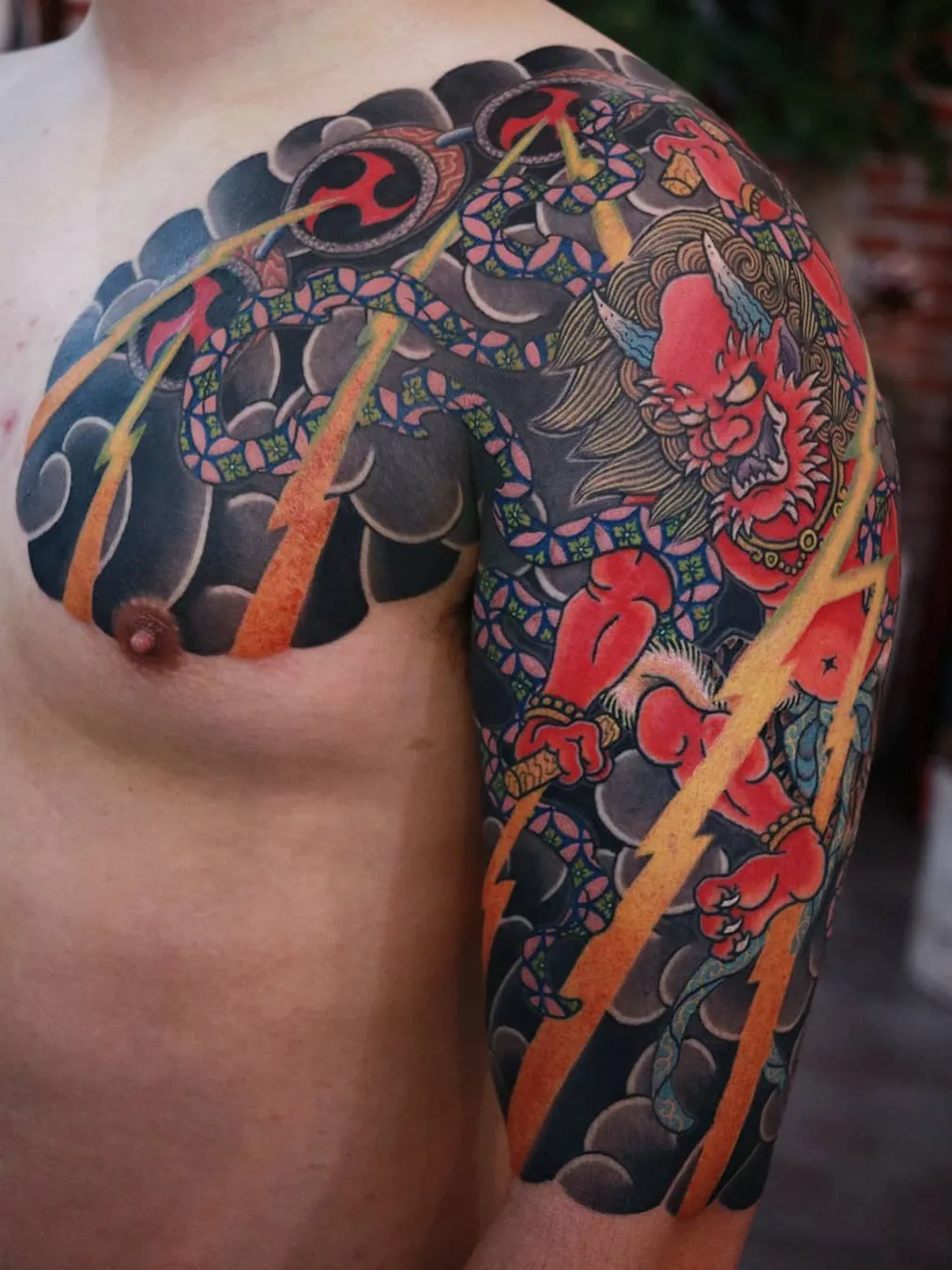
The full bodysuit is the highest expression of horimono. It covers the back (the central and most important canvas), the chest, the upper arms (typically to the wrists or just above the wrists), and the thighs (typically to the knees). A channel of bare skin — called munewari (“chest split”) — runs down the centre of the torso from the collar to the groin, allowing the wearer to leave their shirt unbuttoned without revealing the tattoo. The design is composed so that the munewari is a deliberate compositional element, not an interruption.
Several named bodysuit formats exist:
- Soushinbori — full body tattoo from neck to ankles.
- Munewari — the suit with an open channel down the centre chest.
- Donburi soushinbori — “rice bowl” style, covering the torso, arms, and thighs as a continuous garment-like composition without the chest split.
- Nagasode — full sleeve (to the wrist).
- Shichibu — seven-tenths sleeve (to below the elbow).
- Gobu — half sleeve (to just above the elbow).

Seasonal and thematic coherence
A bodysuit is composed as a unified narrative. If the back piece depicts a subject associated with spring — cherry blossoms, for instance — then the rest of the bodysuit follows the same seasonal setting. A spring-back piece is accompanied by spring imagery on the chest, arms, and thighs. The wind, water, and cloud backgrounds that connect the major elements maintain the same seasonal character throughout.
This seasonal coherence extends to the pairing of subjects. Certain images are traditionally associated with specific seasons, and mixing seasons in a single bodysuit disrupts the compositional logic. A dragon (associated with autumn and winter) does not share a bodysuit with cherry blossoms (spring) unless the composition is deliberately playing with or subverting the convention.
The back piece

Background elements
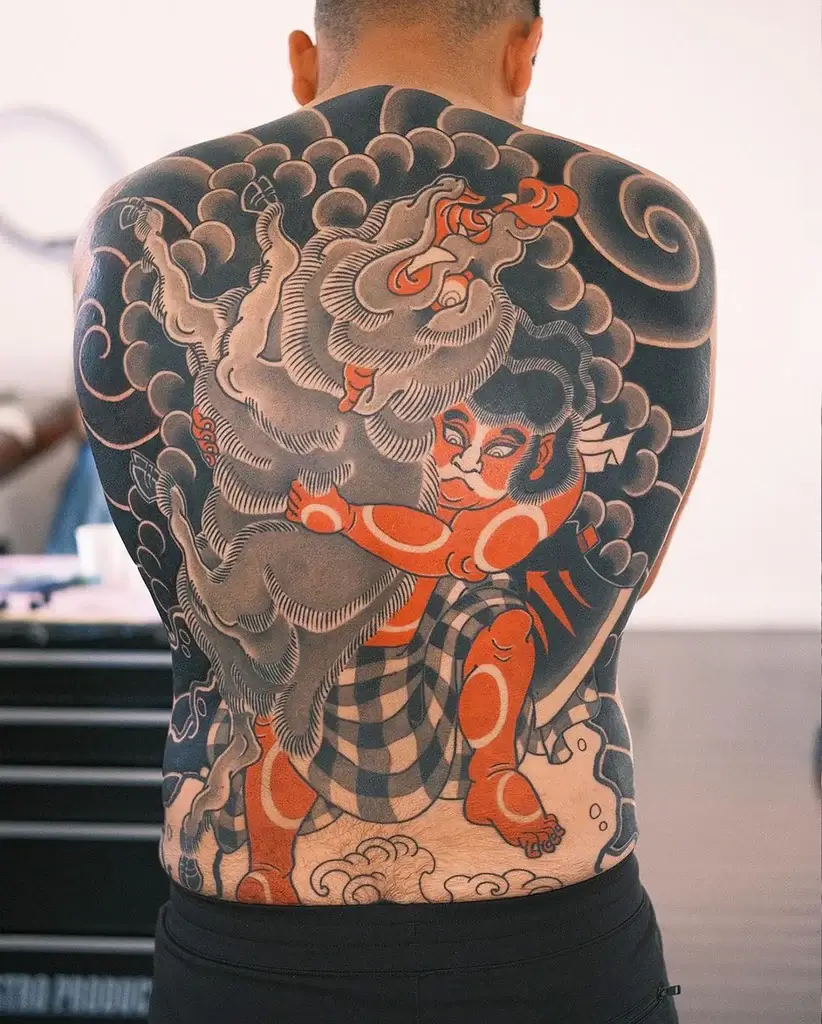
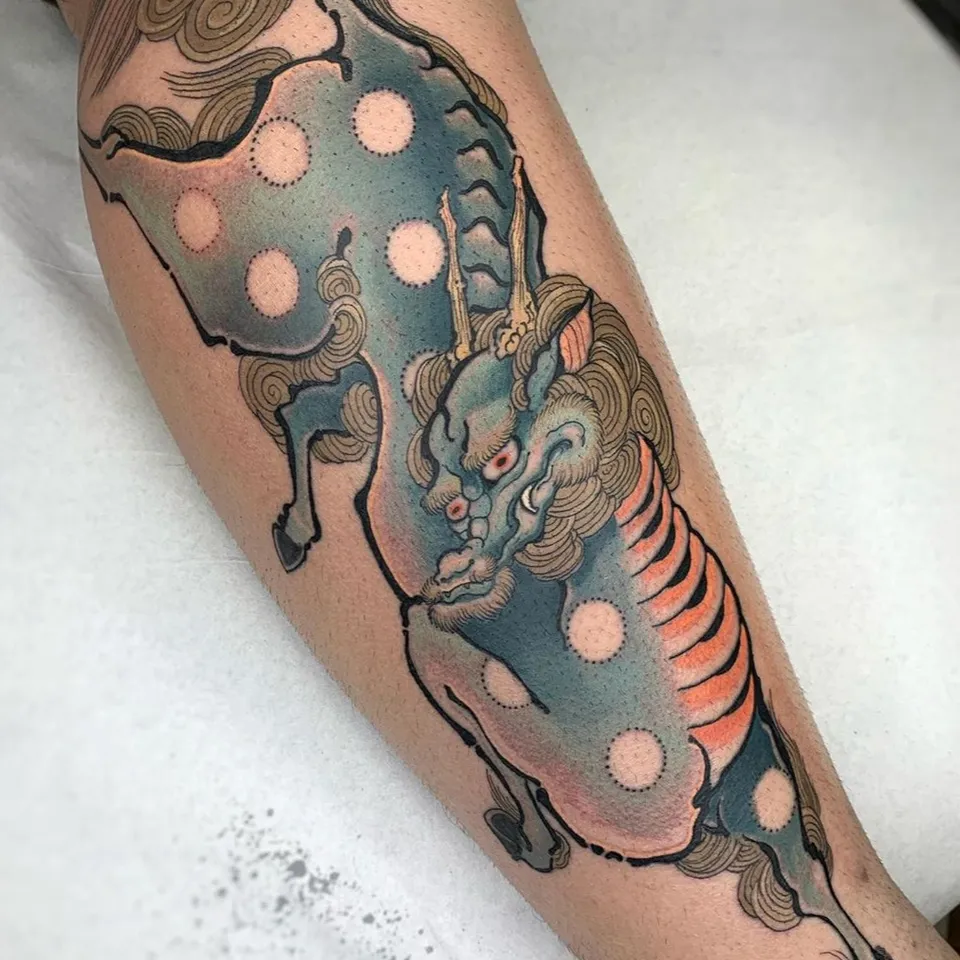
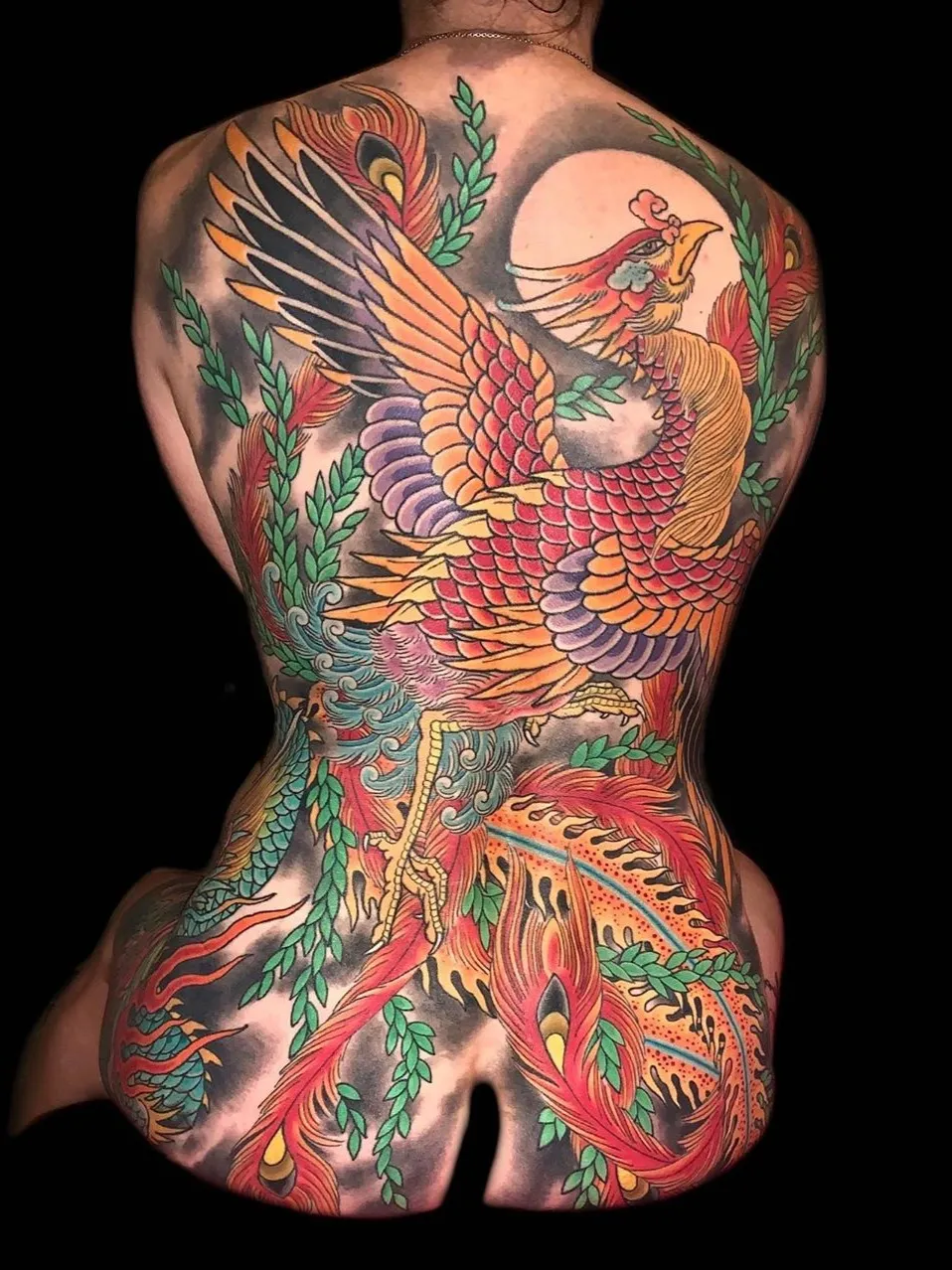
The background — gakubori (frame-style) or nukibori (without frame) — is as much a part of the design as the foreground subjects. Wind bars (kazebori), clouds (kumobori), waves (namikumo), rocks, and gradient washes connect the individual elements into a continuous composition. The background flows through the entire bodysuit, wrapping around limbs and connecting front and back, creating the visual continuity that distinguishes horimono from a collection of separate images.
The iconography
Japanese tattooing draws its imagery from a defined set of sources: mythology, religion, literature, natural history, and the ukiyo-e print tradition. The major subjects carry specific meanings, and a knowledgeable viewer can read a tattoo’s symbolic content.

Dragons
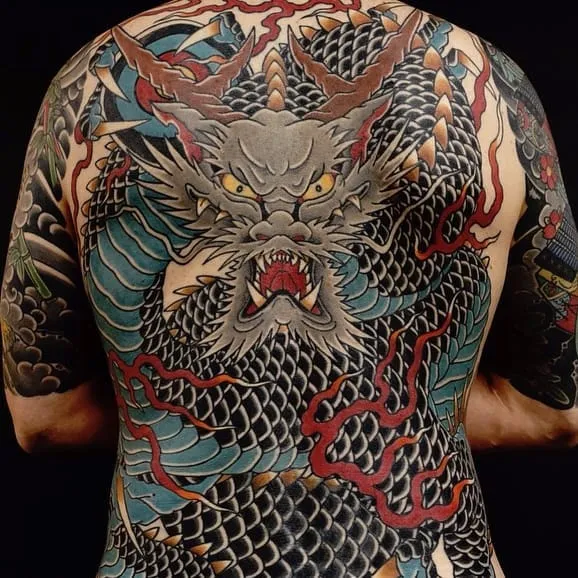
Dragons (ryū) are the most important and most requested subject in Japanese tattooing. The Japanese dragon is a water deity associated with rain, storms, the sea, and the harvest. Unlike the Western dragon (a fire-breathing adversary to be slain), the Japanese dragon is generally benevolent: a guardian, a bringer of fortune, and a symbol of strength and wisdom. Dragons are associated with autumn and winter and are traditionally paired with tigers (which represent spring and earthly power, creating a complementary opposition of heaven and earth).

Koi
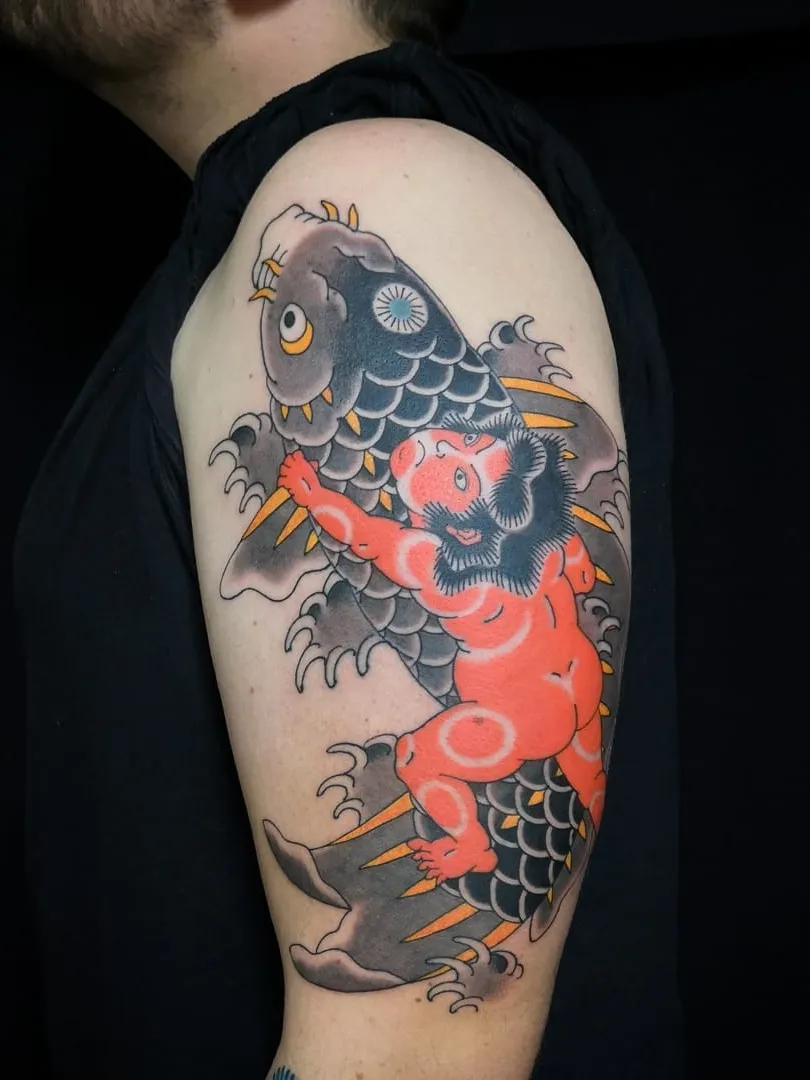
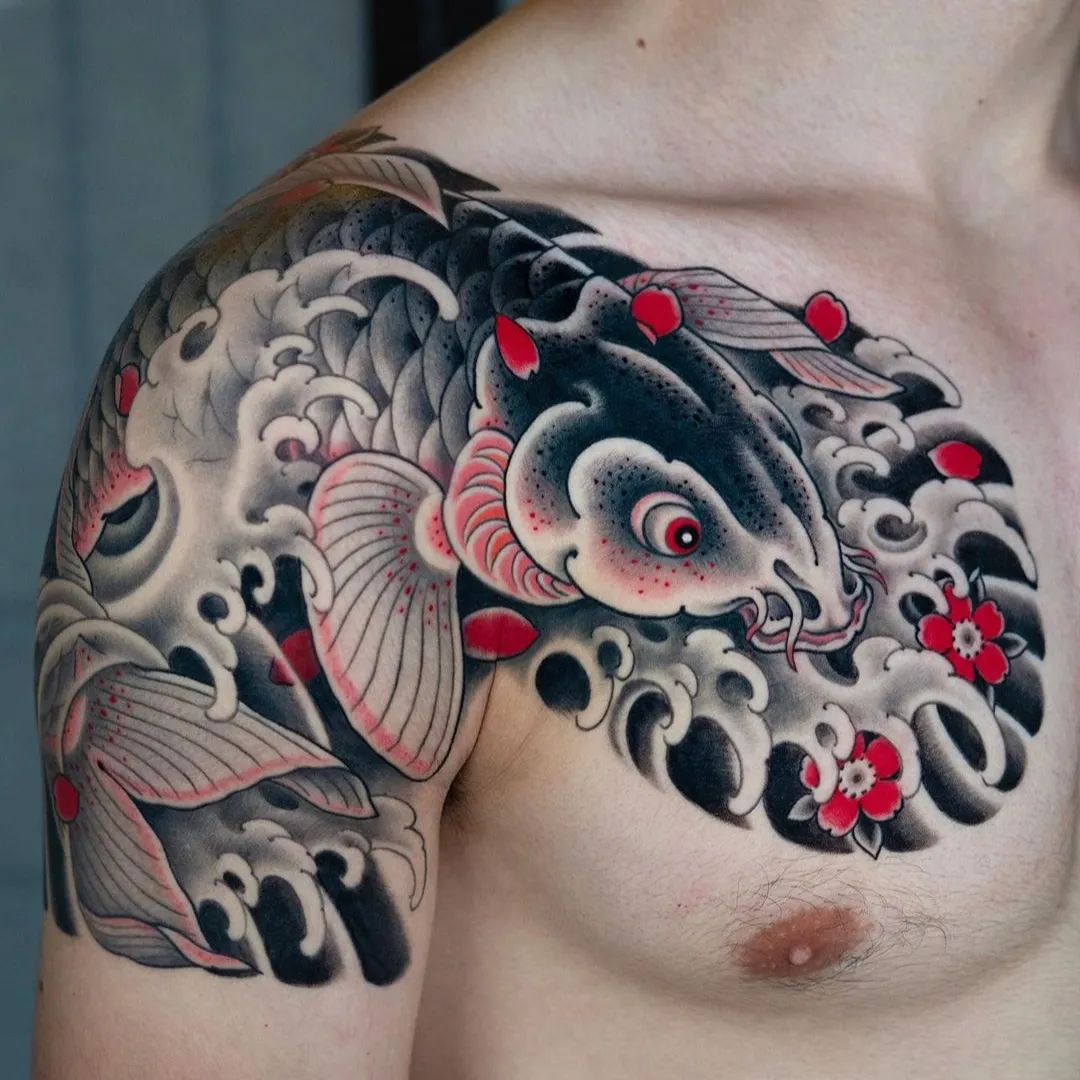
Koi (koi), the carp that swims upstream, is a symbol of perseverance, determination, and the overcoming of adversity. The legend holds that a koi that successfully swims up the waterfall at Dragon Gate on the Yellow River is transformed into a dragon. Koi are associated with spring and summer.

Tigers
Tigers (tora) are symbols of strength, courage, and earthly power. Tigers are traditionally paired with dragons (the tiger represents the wind, the earth, the physical; the dragon represents the water, the sky, the spiritual). In Japanese tattoo iconography, the tiger is also associated with the Suikoden hero Busshō (Wu Song), who kills a man-eating tiger with his bare hands.

Phoenix
Phoenix (hōō) is a symbol of rebirth, renewal, and the imperial house. The phoenix is associated with summer and with fire.
Foo dogs / lion dogs
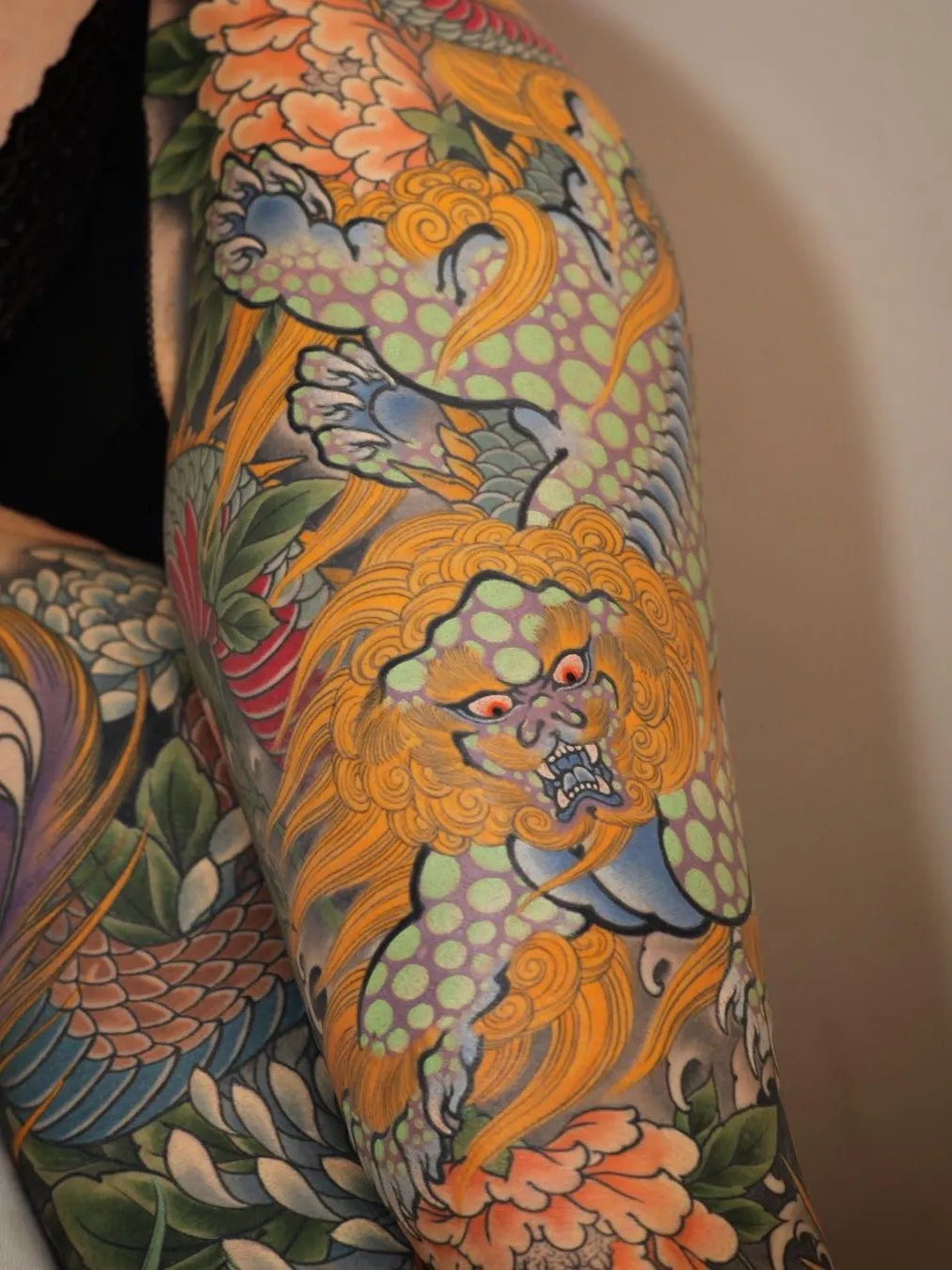
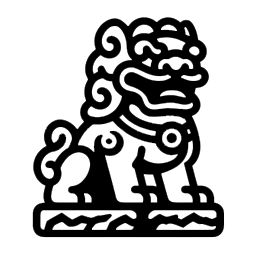
Foo dogs/lion dogs (shishi or komainu) are guardians — the lion-dog figures that stand at the entrances of Shinto shrines, protecting sacred spaces from malevolent forces.

Suikoden heroes
The 108 outlaws of the Water Margin — the literary figures whose depiction in Kuniyoshi’s prints catalysed the horimono tradition. Each hero has specific attributes, weapons, and associated imagery. Tattooing a Suikoden hero is a statement of alignment with the outlaw values the characters represent: courage, loyalty, and resistance to injustice.

Buddhist deities
Fudō Myō-ō (the Immovable Wisdom King, depicted surrounded by flames, holding a sword and a rope — a protector and a destroyer of evil), Kannon (the bodhisattva of compassion), and other Buddhist figures appear frequently. These are protective images — spiritual guardians tattooed on the body to provide divine protection.

Hannya mask
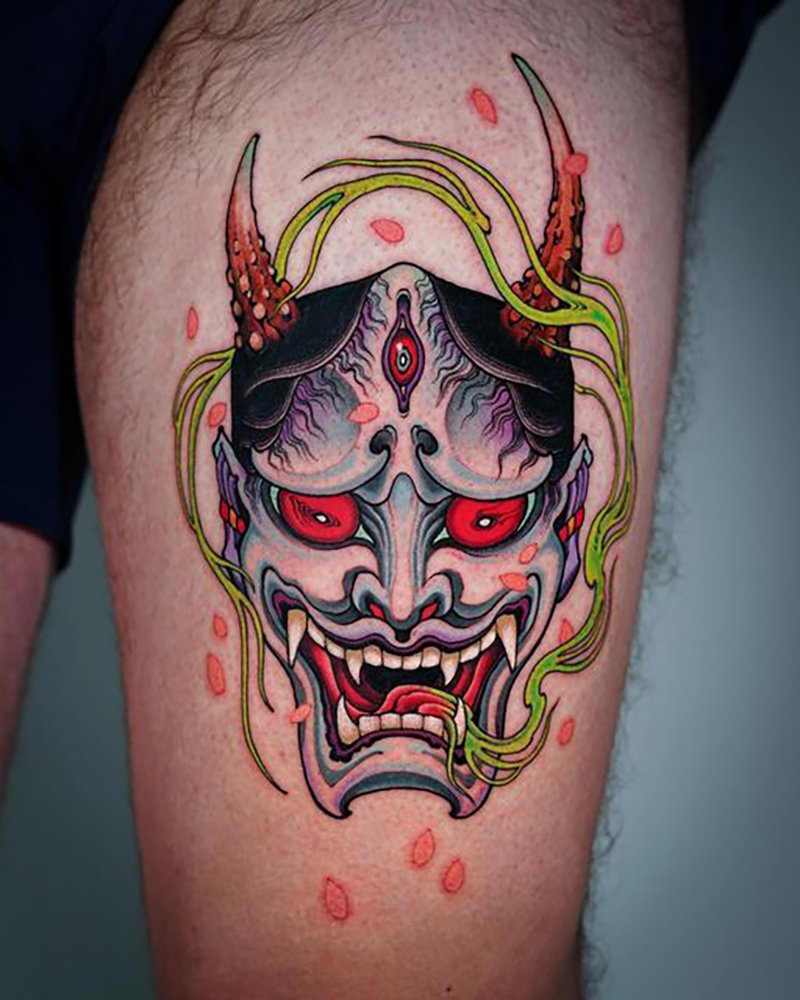
The mask of a woman transformed by jealousy and rage into a demon — a figure from noh theatre that represents the destructive power of obsessive passion. The hannya is one of the most visually striking subjects in Japanese tattooing: the horned, fanged face is both terrifying and pitiable.

Cherry blossoms
Cherry blossoms (sakura) are the flower of spring, and the most culturally loaded natural symbol in Japanese visual culture. Cherry blossoms represent the beauty and brevity of life — they bloom brilliantly and fall quickly. In tattooing, cherry blossoms are associated with the samurai ethos of accepting death, and they are used as background elements in spring-themed compositions.

Peonies
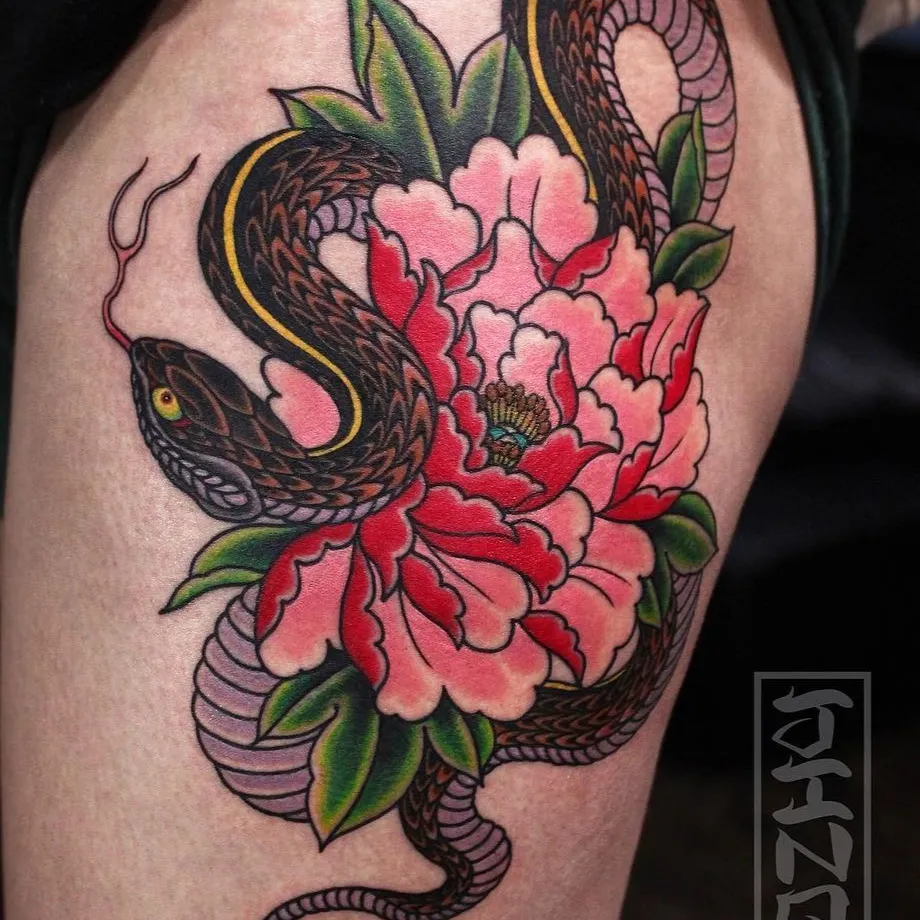
Peonies (botan). The “king of flowers” in Japanese art is a symbol of wealth, honour, and good fortune. Peonies are used as foreground subjects and as supporting elements in compositions featuring dragons, lions, or other powerful figures.

Chrysanthemums
Chrysanthemums (kiku) are the imperial flower of Japan — associated with autumn, longevity, and the emperor. Chrysanthemums are used as floating elements in water-themed compositions and as standalone subjects.
Waves and water
Water is the most common background element in Japanese tattooing. The curling, cresting waves of the Kanagawa-style (derived from Katsushika Hokusai’s iconic print, though the wave tradition in Japanese art predates Hokusai) appear in virtually every bodysuit with a maritime or aquatic theme.

Maple leaves
Maple leaves (momiji) are the emblem of autumn. Maple leaves falling through wind and water represent the passing of time and the beauty of impermanence.

Snakes
Snakes (hebi) are symbols of protection, wisdom, and good fortune. White snakes are considered particularly auspicious.
The technique: tebori
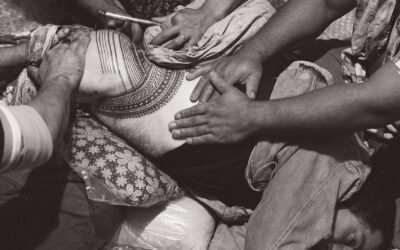
Traditional horimono is applied by tebori, the hand-tattooing method in which a bundle of needles (historically made of steel, mounted on a wooden or bamboo handle and secured with silk thread) is pushed into the skin by hand.
The horishi holds the handle in one hand and uses a pushing or raking motion to drive the needles into the dermis, working with a rhythm that experienced practitioners maintain for hours. The technique requires a different set of muscles and a different kind of endurance from machine tattooing: the horishi‘s arm, wrist, and fingers do all the work that a motor does in a machine.
Tebori produces a visual quality that practitioners and collectors describe as distinct from machine work: softer gradients, more luminous colour saturation, and a particular transparency in the lighter tones that machine tattooing handles differently. The colour is sometimes described as appearing to glow from within the skin rather than sitting on top of it. Whether this is a real optical phenomenon or a perceptual one is debated, but the visual difference between tebori and machine work is acknowledged by practitioners of both methods.
The ink traditionally used is Nara ink (zumi) — a carbon-based black ink. Modern horishi use a wider range of pigments, including commercial tattoo inks, while maintaining the tebori method.
Many contemporary Japanese tattoo artists work with machines — either exclusively or alongside tebori. The use of machines for outlines (which some practitioners consider more efficient and cleaner), combined with tebori for shading and colour, is a common hybrid approach. A minority of practitioners work exclusively by tebori, and these artists are increasingly rare. In 2012, Gifu Horihide estimated that only five or six masters in Japan could still perform traditional black-and-white tebori at the highest level.
The apprenticeship
The traditional horishi apprenticeship follows the Japanese master-apprentice (shishō-deshi) system that governs training in many traditional Japanese arts — calligraphy, pottery, swordsmanship, and noh theatre.
The apprentice lives with or near the master and serves in every capacity: cleaning the studio, preparing materials, running errands, and observing the master at work. The apprentice does not tattoo for a substantial period — the early years are devoted to drawing, learning the iconography, and developing the design skills the tradition requires. When the apprentice is eventually permitted to tattoo, they work under the master’s direct supervision, initially on simple elements and progressing to more complex work over the years.
The apprenticeship can last a decade or longer. The master controls the pace, and the apprentice does not challenge the timeline. Upon completion, the apprentice receives a professional name — typically incorporating a syllable from the master’s name, prefixed by hori– (“carver”). The name identifies the apprentice’s lineage — which master they trained under, and through that master, the chain of transmission reaching back through generations.
This naming system creates traceable artistic lineages. Horiyoshi III trained under Horiyoshi I. Gifu Horihide trained under Tokyo Horihide. The names are a living record of who learned from whom. Apprentice names like Horikashi, Horikitsune, Horisumi, and Horikichi all indicate a hori– lineage and can be traced to specific masters.
The social reality in Japan
The stigma is real
The legal situation
In 2015, an Osaka tattoo artist was convicted of violating the Medical Practitioners Act — the authorities argued that tattooing constituted a medical procedure requiring a medical licence. The conviction was overturned on appeal in 2017, and the Supreme Court of Japan upheld the acquittal in 2020, ruling that tattooing is a form of decoration, not a medical act. This ruling clarified the legal status of tattoo practitioners but did not address the social stigma or the public-space bans.
The generational shift
Younger Japanese people are increasingly accepting of tattoos — influenced by Western culture, by fashion, by social media, and by the growing international visibility of Japanese tattoo art. A new generation of Japanese tattoo artists operates openly, maintains social media presences, and serves a clientele that includes young Japanese people getting their first tattoos. The generational shift is real but slow, and the older cultural attitudes remain powerful.
The international position
Japanese tattooing is revered internationally. Japanese masters are among the most sought-after tattoo artists in the world, and the Japanese design system has been adopted and adapted by tattoo artists across every continent. The style’s compositional principles — the unified bodysuit, the flowing backgrounds, the seasonal coherence, the iconographic depth — have become foundational to serious tattooing worldwide, largely through the influence of Ed Hardy and the generation of Western artists who studied Japanese methods.
Choosing a Japanese-style tattoo artist
Understand the difference between Japanese-style and traditional Japanese tattooing. Many Western tattoo artists offer “Japanese-style” work — compositions using Japanese iconography (dragons, koi, cherry blossoms) executed with Western machines and Western design sensibilities. This work can be excellent, but it is not the same as traditional horimono executed by a trained horishi using the design system and (in some cases) the tebori method. The distinction is one of tradition, training, and compositional system, not of quality.
Look for compositional coherence. The test of serious Japanese tattoo work — whether by a traditional horishi or a Western artist trained in the system — is compositional coherence: do the elements relate to each other? Is the seasonal logic consistent? Do the backgrounds flow? Is the body treated as a single canvas? A portfolio of disconnected Japanese-themed images placed without compositional logic is decorative work using Japanese motifs, not Japanese tattooing in the traditional sense.
Consider the commitment. A traditional Japanese piece — particularly a bodysuit or a large-scale composition — is a years-long commitment. Sessions are typically long (three to five hours), the healing periods between sessions must be respected, and the financial investment is substantial. Understanding this commitment before beginning is part of approaching the tradition with the seriousness it deserves.
For traditional tebori work: the number of practitioners who work exclusively or primarily by hand is small and diminishing. Seeking out a traditional horishi — whether in Japan or among the small number of non-Japanese artists who have trained in the tebori method under a Japanese master — is a specific decision that requires research, patience, and willingness to travel.
Sources & further reading
- Irezumi, Wikipedia, The Free Encyclopedia. Updated December 2025.
- Yamamoto Yoshimi, ‘Irezumi’: The Japanese Tattoo Unveiled. Nippon.com, published January 2026.
- JSTOR Daily, Ed Hardy Changed Tattooing Forever. Published August 2019.
- Luca Ortis, The history of traditional Japanese tattoos, Irezumi and Horimono. Published April 2025 at lucaortis.com.
- Artelino, Japanese Tattoo Art — History, Ukiyo-e Influence and Cultural Background. Published November 2025.
- Fordham University Japanese Visual Culture Project, Irezumi: Tradition and Criminality.
- Kenshō / japanesetattoo.com, Irezumi: Japanese Tattoo Meaning. Published August 2025.
- Daiyokai, Irezumi: The Secret History of Japanese Tattoos. Published January 2026.
- The Imperial Ink, Irezumi: A Dive into Traditional Japanese Tattoos. Published March 2024.
- Cloak and Dagger Tattoo London, Ukiyo-e & Kabuki: Origins of the Irezumi Japanese Tattoo Style. Published October 2022.
- W. R. van Gulik, Irezumi: The Pattern of Dermatography in Japan. Brill, 1982.
- Takahiro Kitamura and Katie M. Kitamura, Bushido: Legacies of the Japanese Tattoo. Schiffer Publishing, 2001.
- Takahiro Kitamura and Katie M. Kitamura, Tattoos of the Floating World: Ukiyo-e Motifs in the Japanese Tattoo. KIT, 2003.
- Donald Richie and Ian Buruma, The Japanese Tattoo. Weatherhill, 1980.
- Brian Ashcraft with Hori Benny, Japanese Tattoos: History, Culture, Design. Tuttle, 2016.
- Margo DeMello, Bodies of Inscription: A Cultural History of the Modern Tattoo Community. Duke University Press, 2000.