Related Posts
Hawaiian tattooing (kākau)
Hawaiian tattooing: The tradition brought back by one man
At two in the morning on O’ahu’s Wai’anae coast, a man walks into the shore break carrying a bundle of handmade tools — bone combs, a wooden mallet, and containers of ink. He performs a prayer and dips the tools into the ocean water, waking them for Kahekili, the Hawaiian god of tattooing and thunder. The ceremony is simple and embedded in a thousand years of culture. The man is Sulu’ape Keone Nunes, and for three decades, he has been the central figure in the revival of kākau — traditional Hawaiian tattooing — an art form that was nearly destroyed by missionaries, forgotten by colonialism, and brought back from the edge of extinction by a single practitioner who had to leave Hawai’i to learn how to do it.
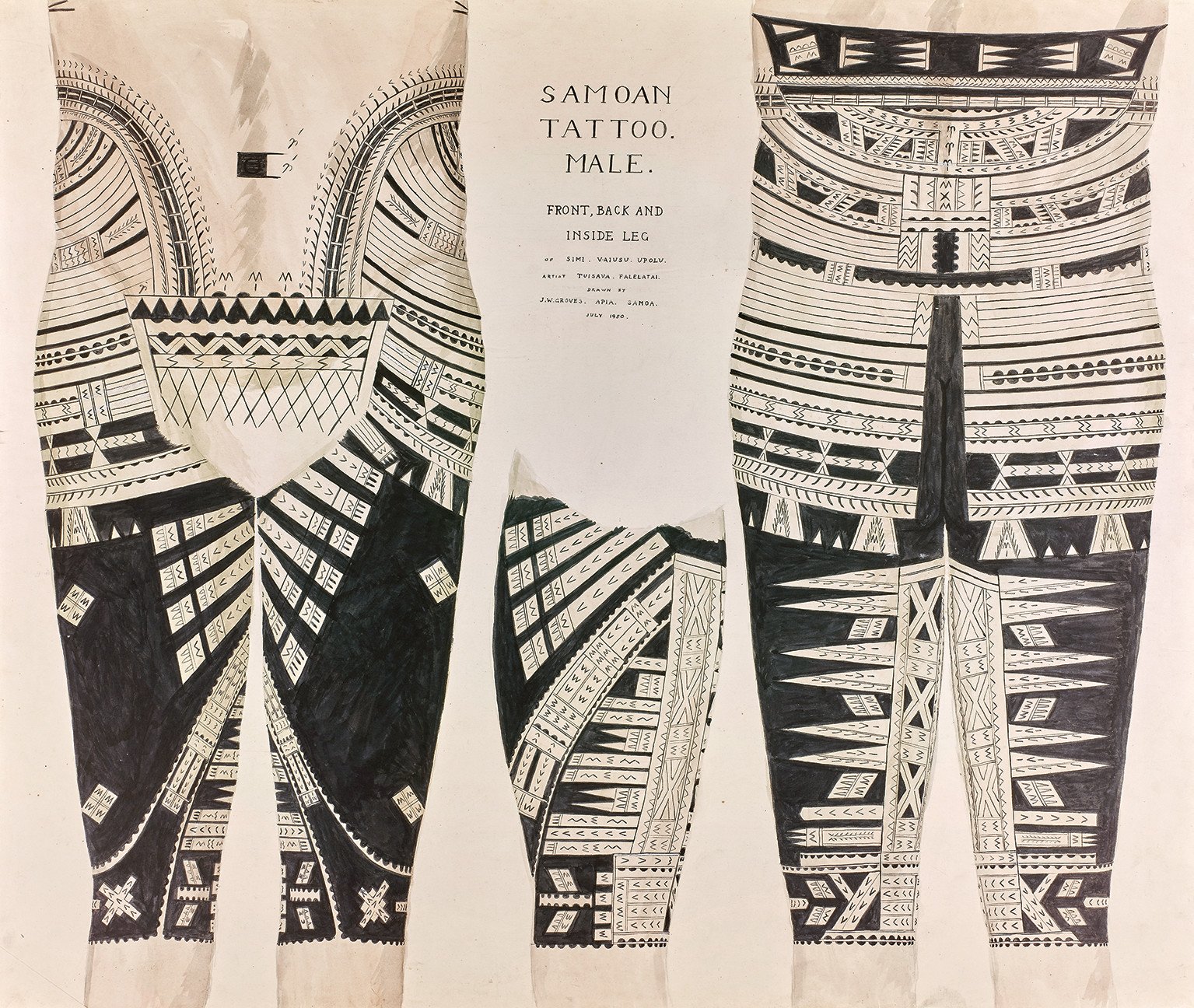
Hawaiian tattooing is among the least documented of the major Polynesian traditions. The University of Hawai’i’s research guide on the subject notes that European voyagers “did not regard Hawaiian tattooing as the most detailed or artistic of the tattoo practitioners” in the Pacific — the Marquesans, the Samoans, and the Māori all received more extensive written and visual documentation. But what was documented reveals a practice that was distinctive, culturally embedded, and — in its visual characteristics — unlike any other Polynesian tradition. Hawaiian kākau was bold, where Marquesan patutiki was dense. It was asymmetrical, whereas Samoan tatau was symmetrical. It used large geometric fields and heavy, solid-black coverage in compositions that treated the body as a sculptural surface.
The tradition was suppressed so effectively that by the mid-twentieth century, no living Hawaiian practitioner knew the traditional tapping method. The revival that has occurred since the 1990s — led by Nunes, supported by Samoan tufuga, documented by scholars including Tricia Allen — is a reconstruction from fragments: from the journals of European voyagers, from the sketches of Cook’s artists, from the collections of the Bishop Museum, from the oral histories of kūpuna (elders), and from the living Polynesian tattoo traditions — especially Samoan — that maintained the hand-tapping technique through the centuries when Hawai’i lost it.
Hawaiian people and the word
The Hawaiian Islands were settled roughly 800 years ago by Polynesian voyagers from the Marquesas Islands and, in a later wave, from the Society Islands (Tahiti). The settlers brought with them the cultural practices of their homelands, including tattooing.
The Hawaiian word for tattooing is kākau. The full term for the traditional hand-tapping method is kākau uhi — kākau meaning “to tattoo” or “to write” (the word carries both meanings) and uhi referring to the tools and the tapping technique. The connection between writing and tattooing in the Hawaiian language is significant: in a culture that had no written language before Western contact, kākau on the body was a form of inscription — a permanent record of identity, genealogy, and social position, legible to those who understood the visual system.
The practitioner was a kahuna kā uhi — a priest-expert in the art of tattooing. The word kahuna designates a specialist with deep knowledge and spiritual authority; the kahuna kā uhi was a figure of high social standing, comparable to the kahuna who served other essential functions in Hawaiian society.
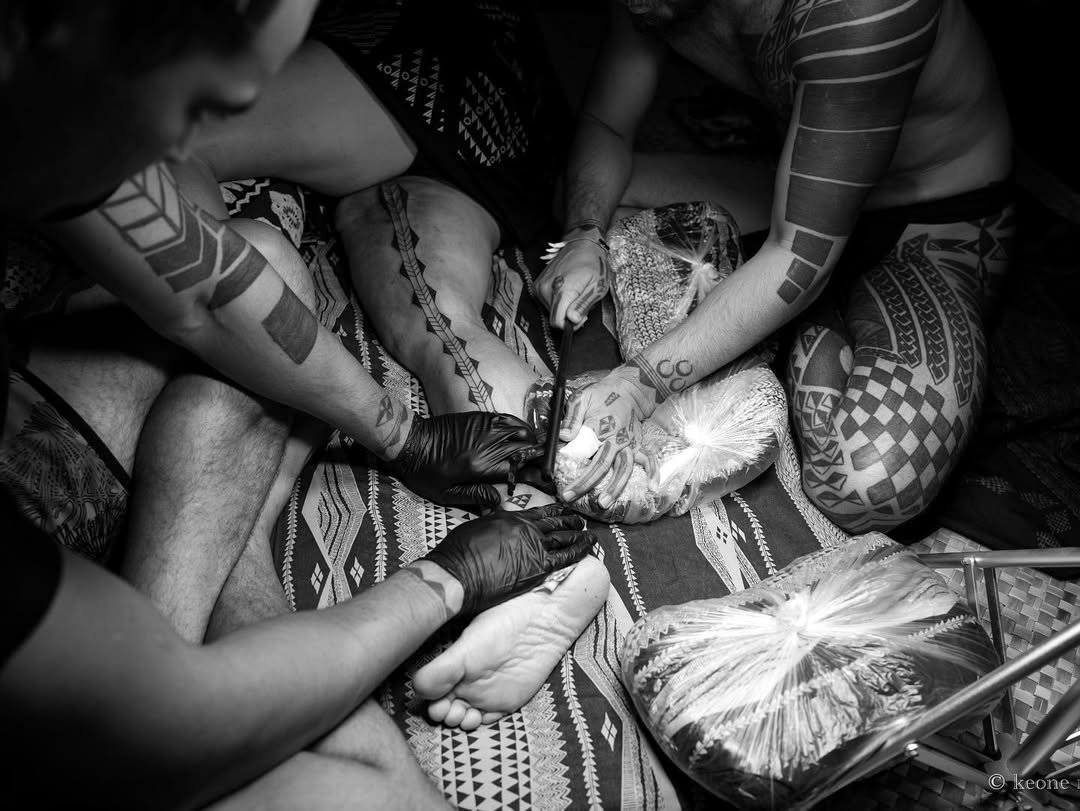
What Hawaiian kākau looks like
Hawaiian tattoo designs are distinctive within the Polynesian family, and the differences from other Pacific traditions were noted by European observers and remain visible in contemporary practice.
Asymmetry
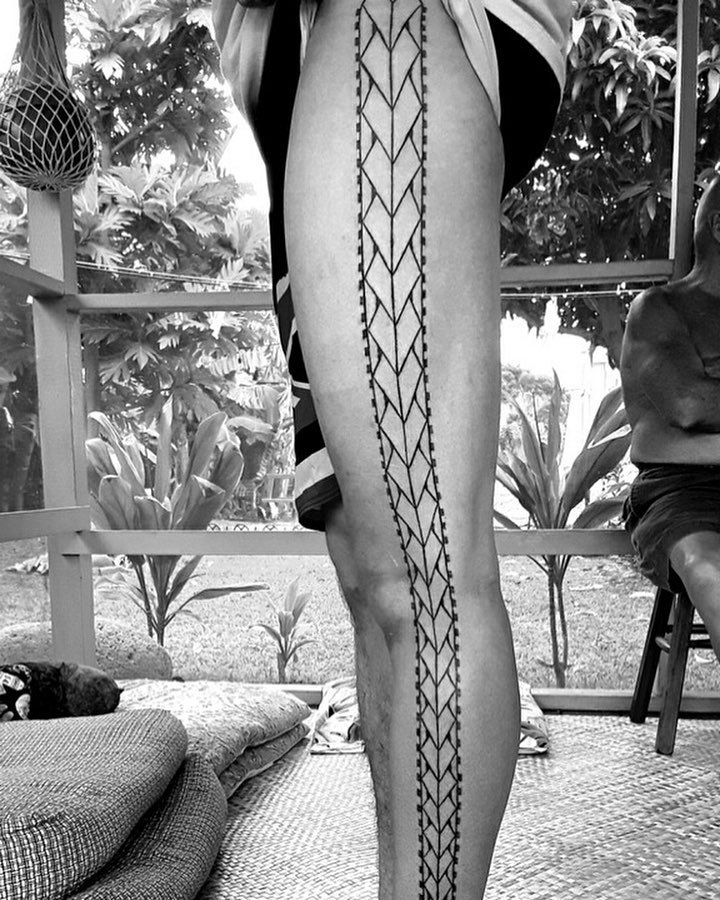
Where Samoan tatau is bilaterally symmetrical, and Māori tā moko follows the body’s midline, Hawaiian kākau is characteristically asymmetric — the right side of the body can carry a completely different design from the left. In traditional practice, the right side of the body received solid black designs intended for spiritual protection — a practice called kākau i ka uhi. The left side might carry different motifs or remain unmarked. The asymmetry gives Hawaiian tattooing a visual character that is immediately distinguishable from other Polynesian traditions.
Bold, large-scale geometric forms
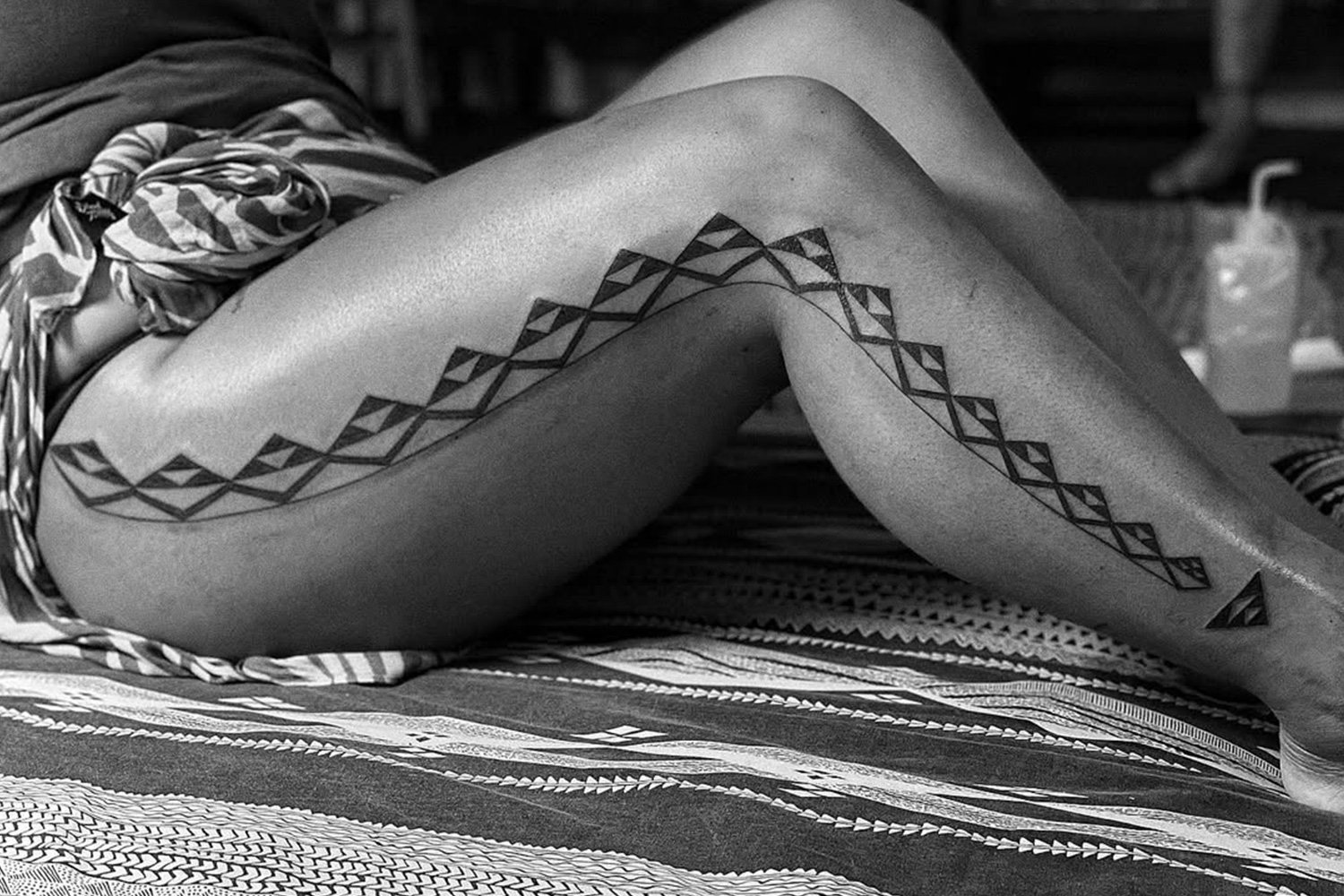
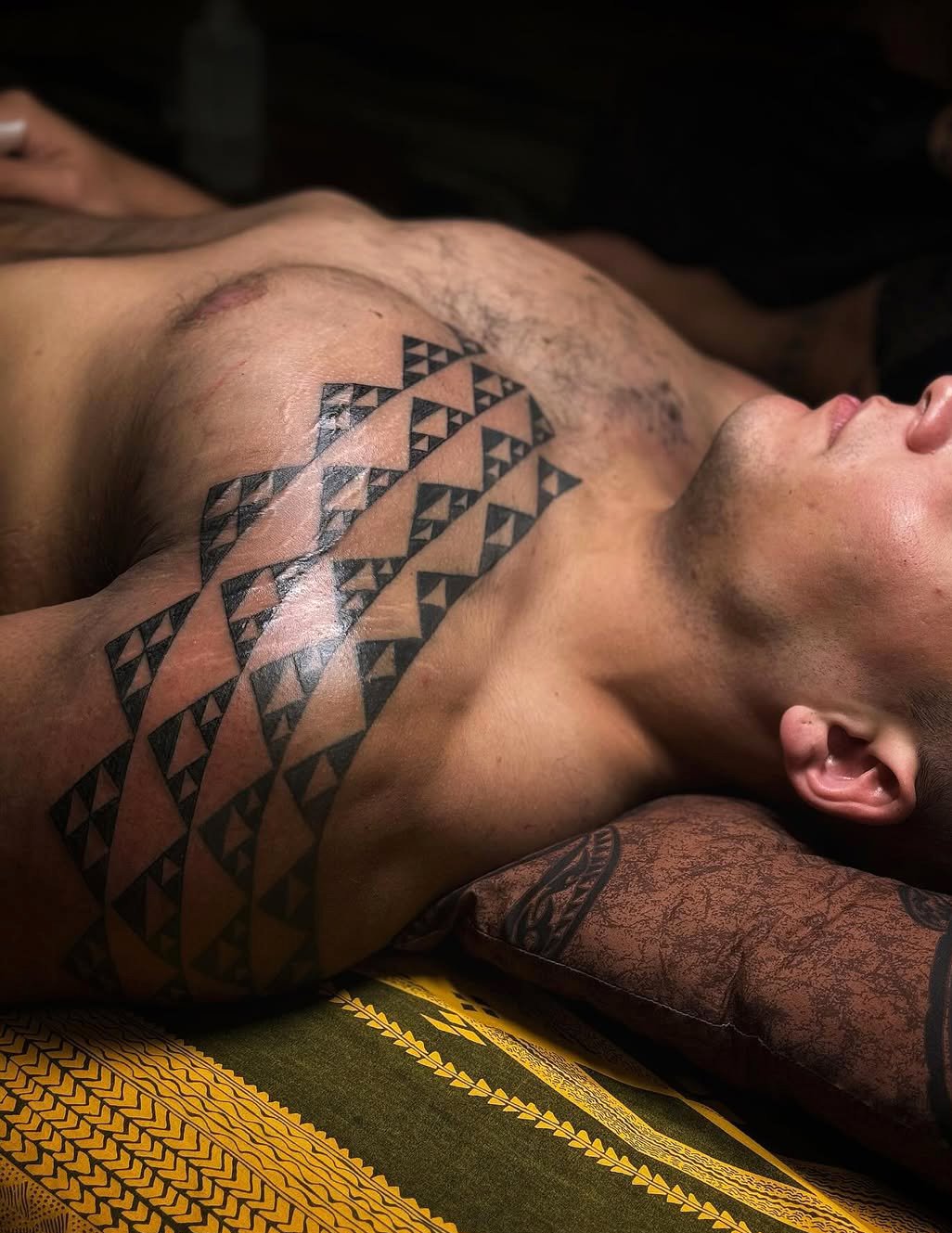
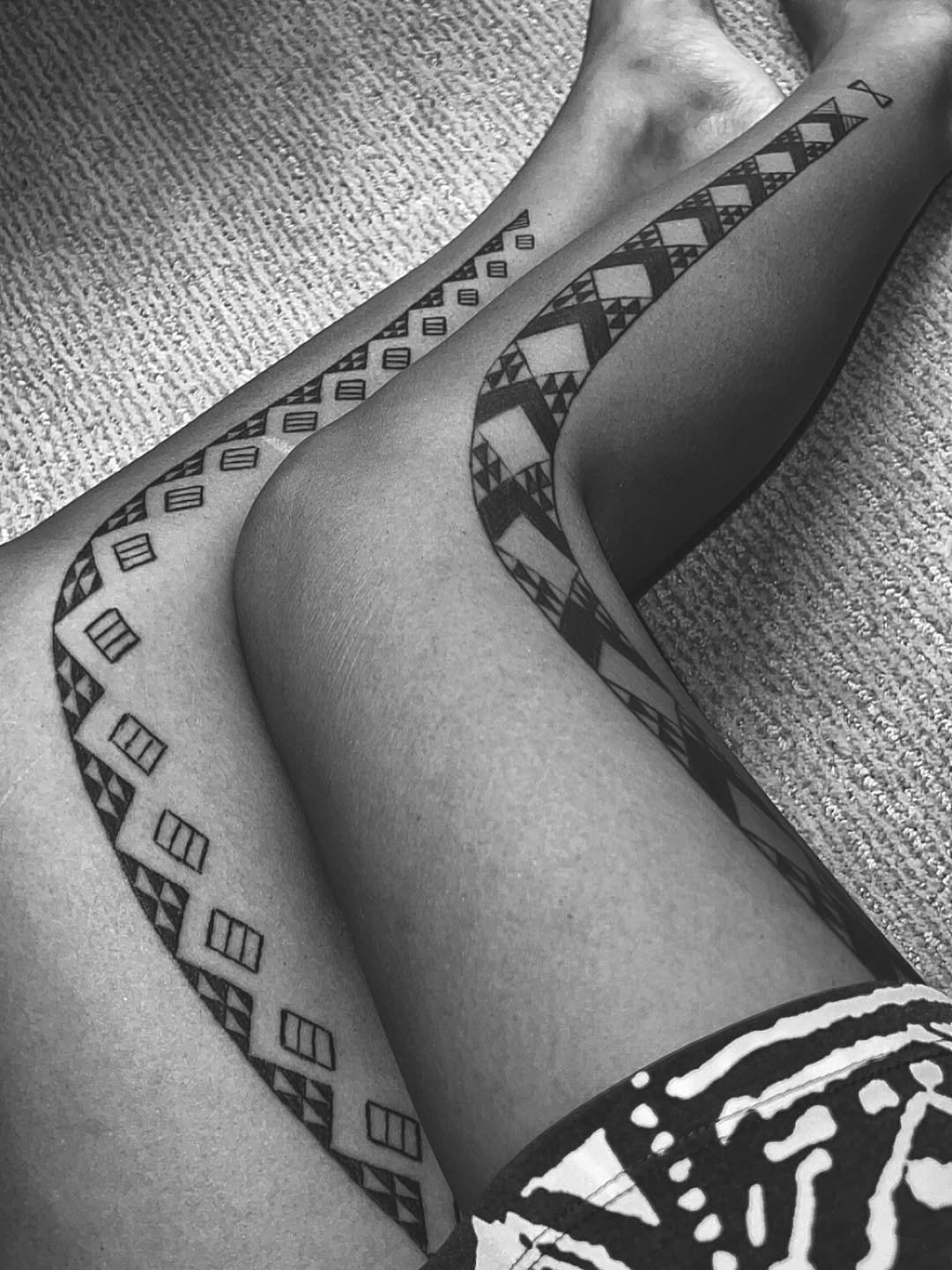
Hawaiian designs use larger shapes and heavier black coverage than the fine, dense patterning of the Marquesas or the curvilinear spirals of the Māori. The visual vocabulary includes broad bands, solid triangular fields, heavy line work, and large geometric blocks arranged in compositions that cover substantial areas of the body. The effect is graphic and sculptural — the tattoos visually reshape the body’s silhouette rather than just decorating its surface.
Layered composition
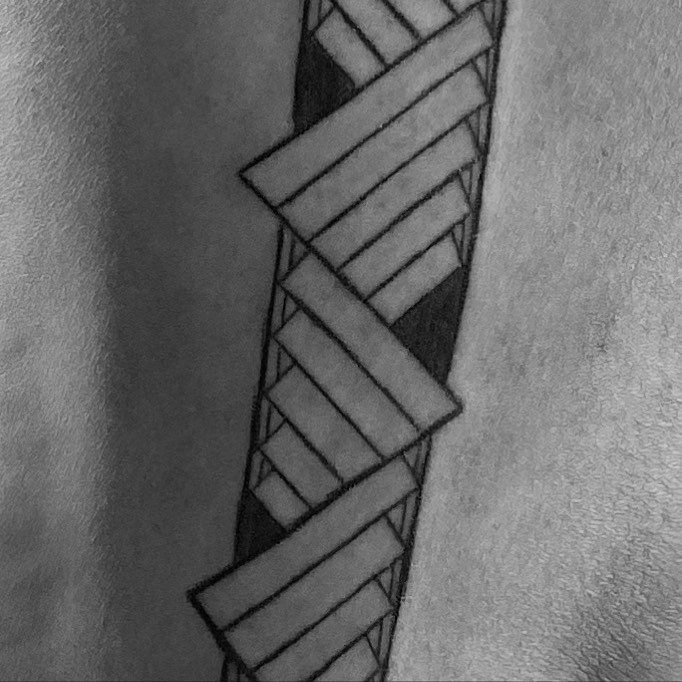
Hawaiian kākau uses overlapping symbols and patterns that combine into a larger piece — a layering technique that builds visual complexity from the interaction of multiple geometric elements. The approach is architectural: separate motifs are arranged and overlaid to create a composition in which the parts are individually legible but contribute to a unified whole.
Full body coverage for high-status individuals
Historically, chiefs and warriors received kākau covering the entire body — face, torso, arms, and legs — with designs that took years to complete. The Bishop Museum’s collections document elaborate full-body designs on chiefs and warriors. For men, the primary purpose of extensive tattooing was to project power and instil fear in opponents in battle. For women, the designs were typically lighter and focused on the hands, wrists, and lower body.
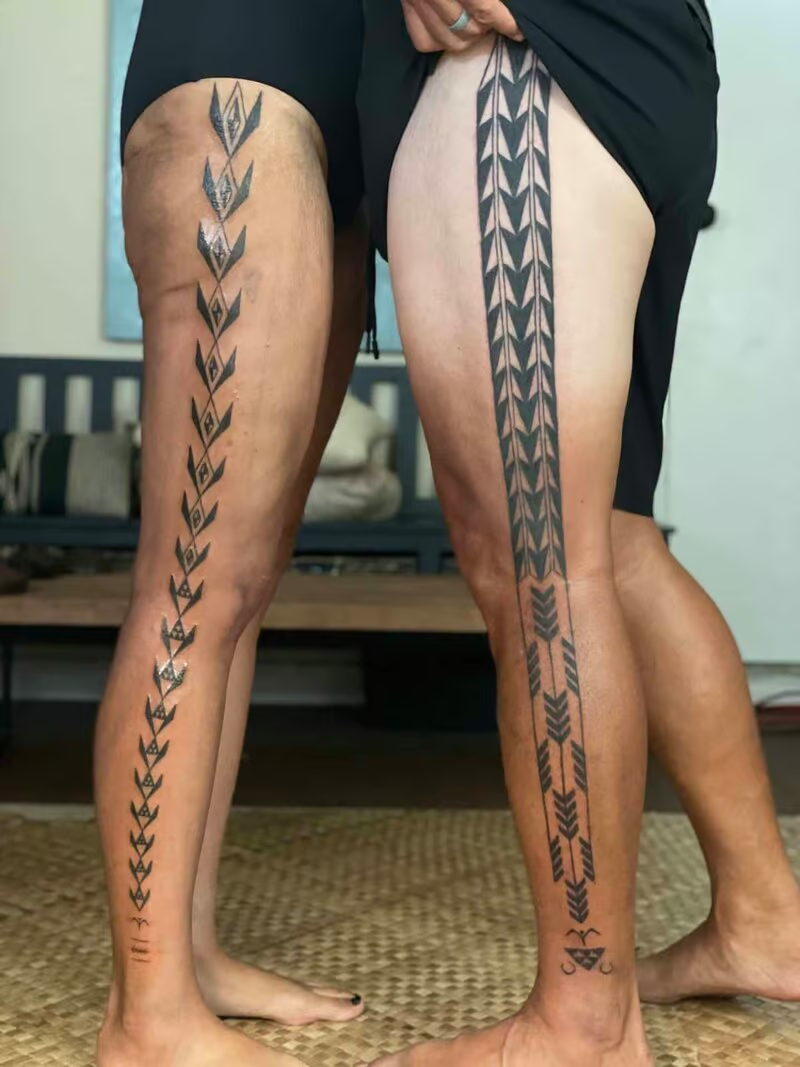
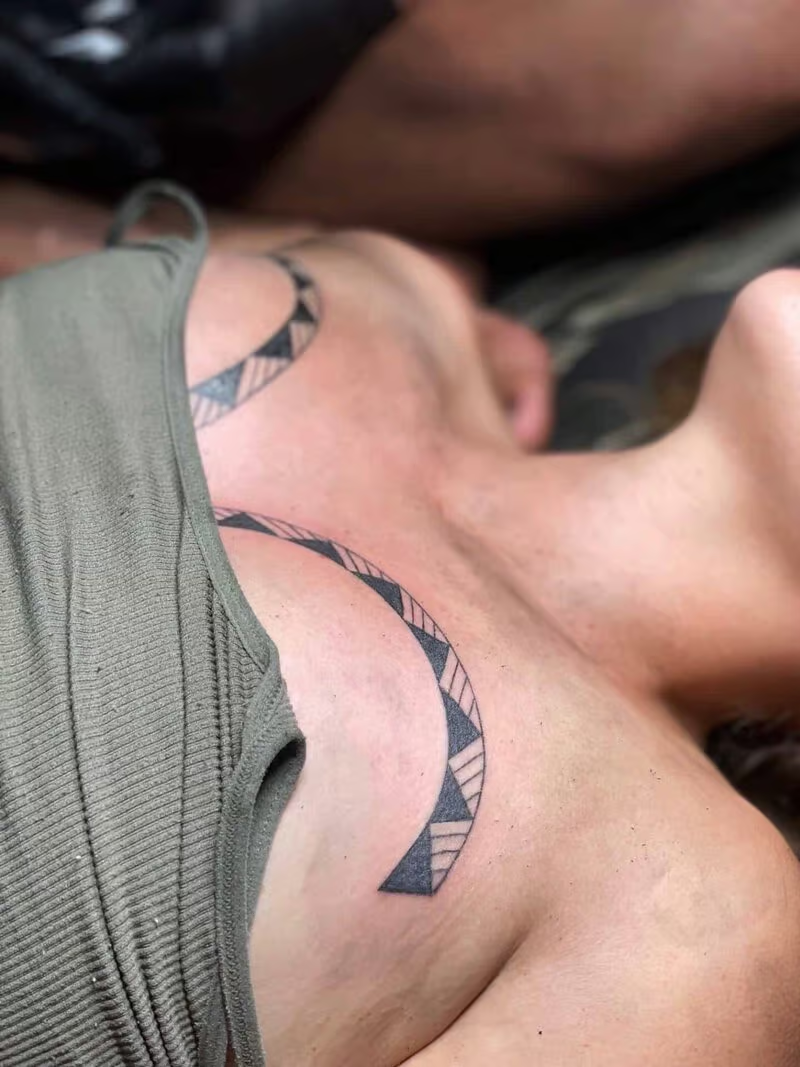
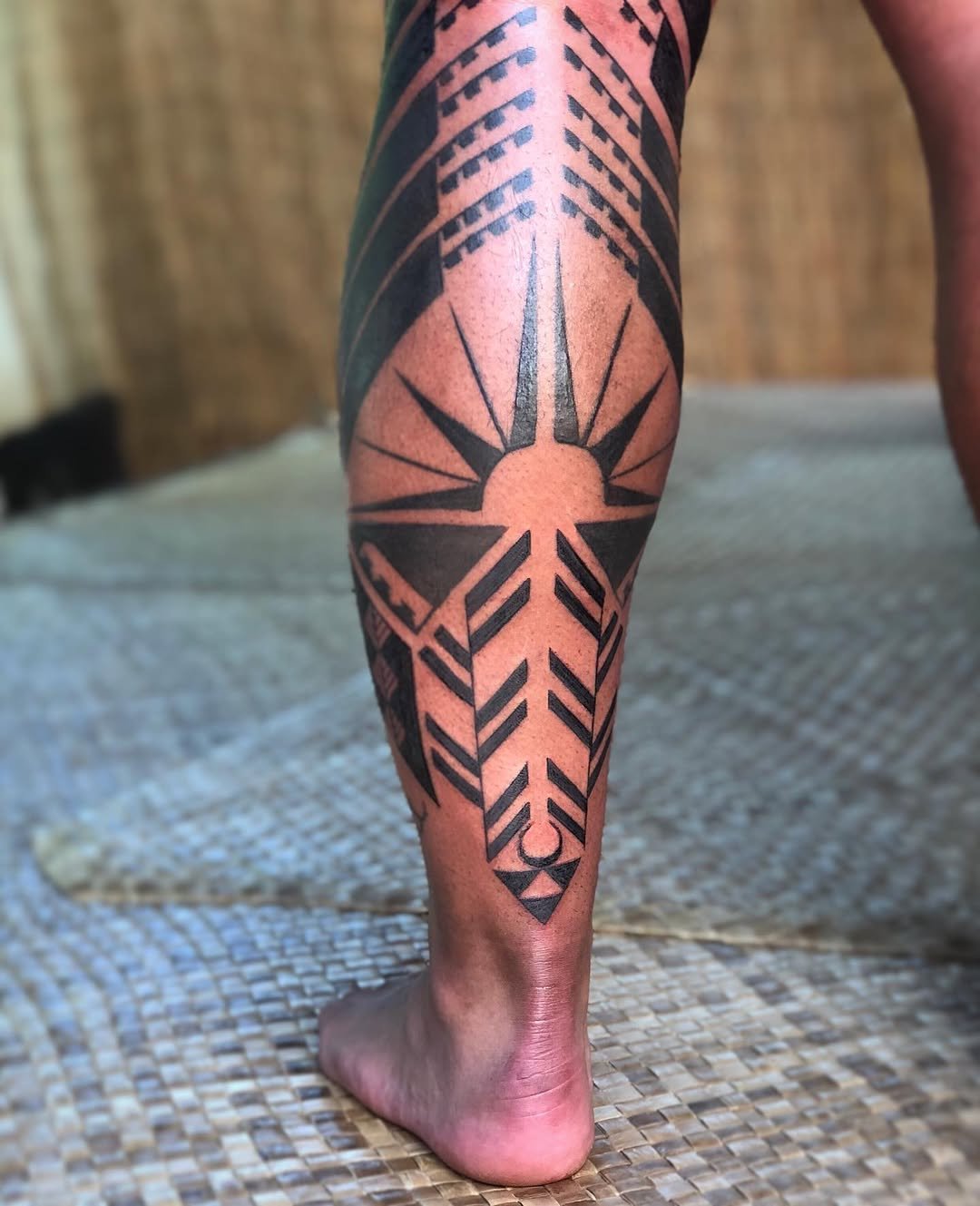
Hawaiian tattoo motifs
Niho mano (shark teeth) are triangular patterns representing protection, strength, and guidance. The shark is a sacred animal in Hawaiian culture — many families had an ‘aumākua (ancestral guardian spirit) in shark form, and the shark-tooth motif connected the wearer to that protective power.
Nalu (ocean waves) are patterns representing the sea — the source of sustenance, the medium of navigation, and the constant presence that defines island life. Wave motifs symbolise adaptability, persistence, and the connection between the physical and spiritual worlds.
‘Oka (spearheads) are triangular motifs representing courage, protection, and the warrior spirit.
Honu (turtle) represents longevity, wisdom, navigation, and the ability to move between worlds (land and sea). The green sea turtle (honu) is a sacred animal in Hawaiian culture.
Taro (kalo), the staple crop of Hawaiian agriculture and a plant of deep cultural significance — according to Hawaiian cosmology, the taro plant is the elder brother of humanity, born from the body of the god Hāloa. Taro motifs represent sustenance, family, and the connection between people and the land.
Maile (vine) is a plant used in lei-making and in sacred ceremonies, representing peace, protection, and spiritual connection.
The sun and moon — celestial motifs representing cycles of time, fertility, and the relationship between the human and divine worlds.
The technique
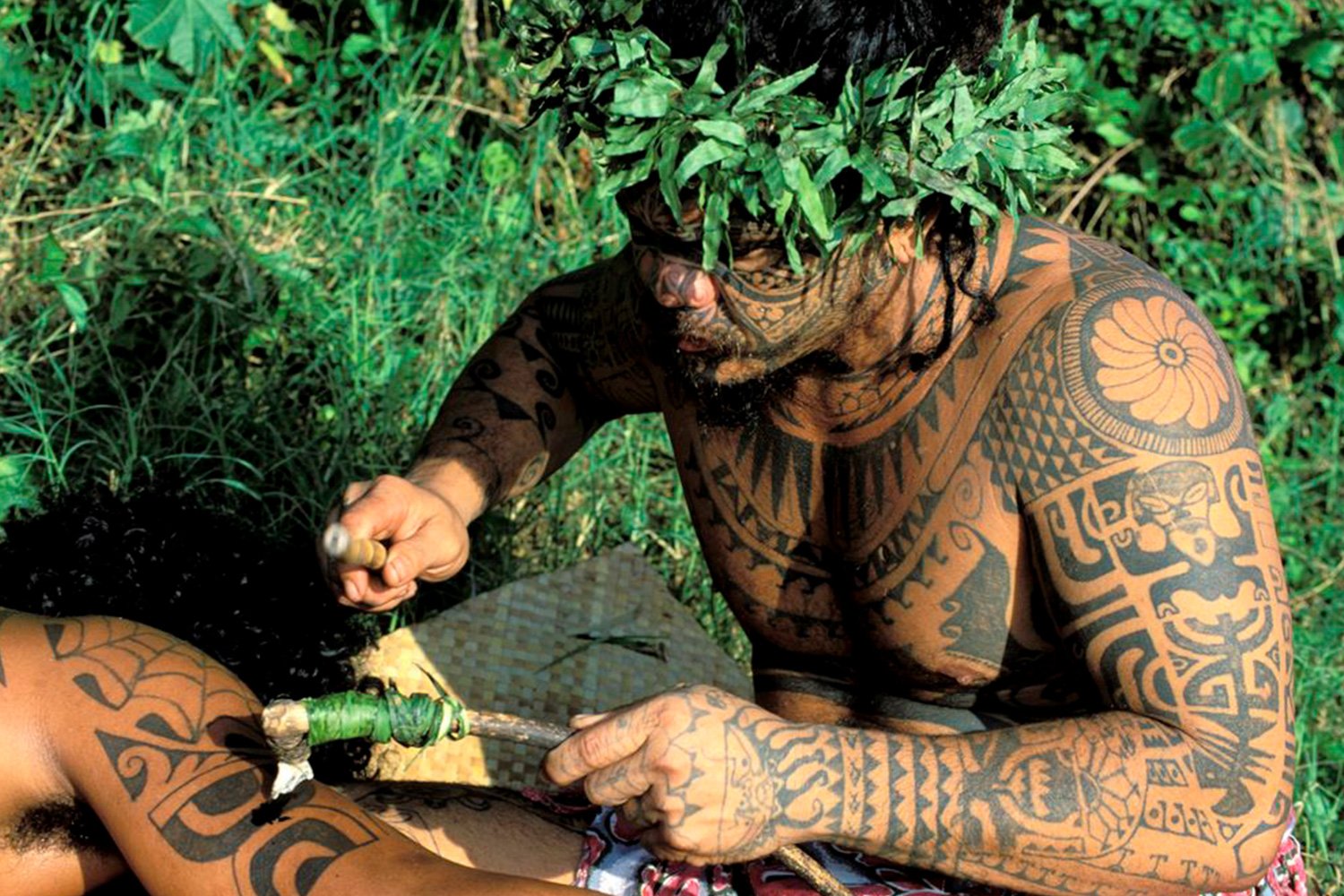
Hawaiian tattooing uses the hand-tapping method shared across Polynesia.
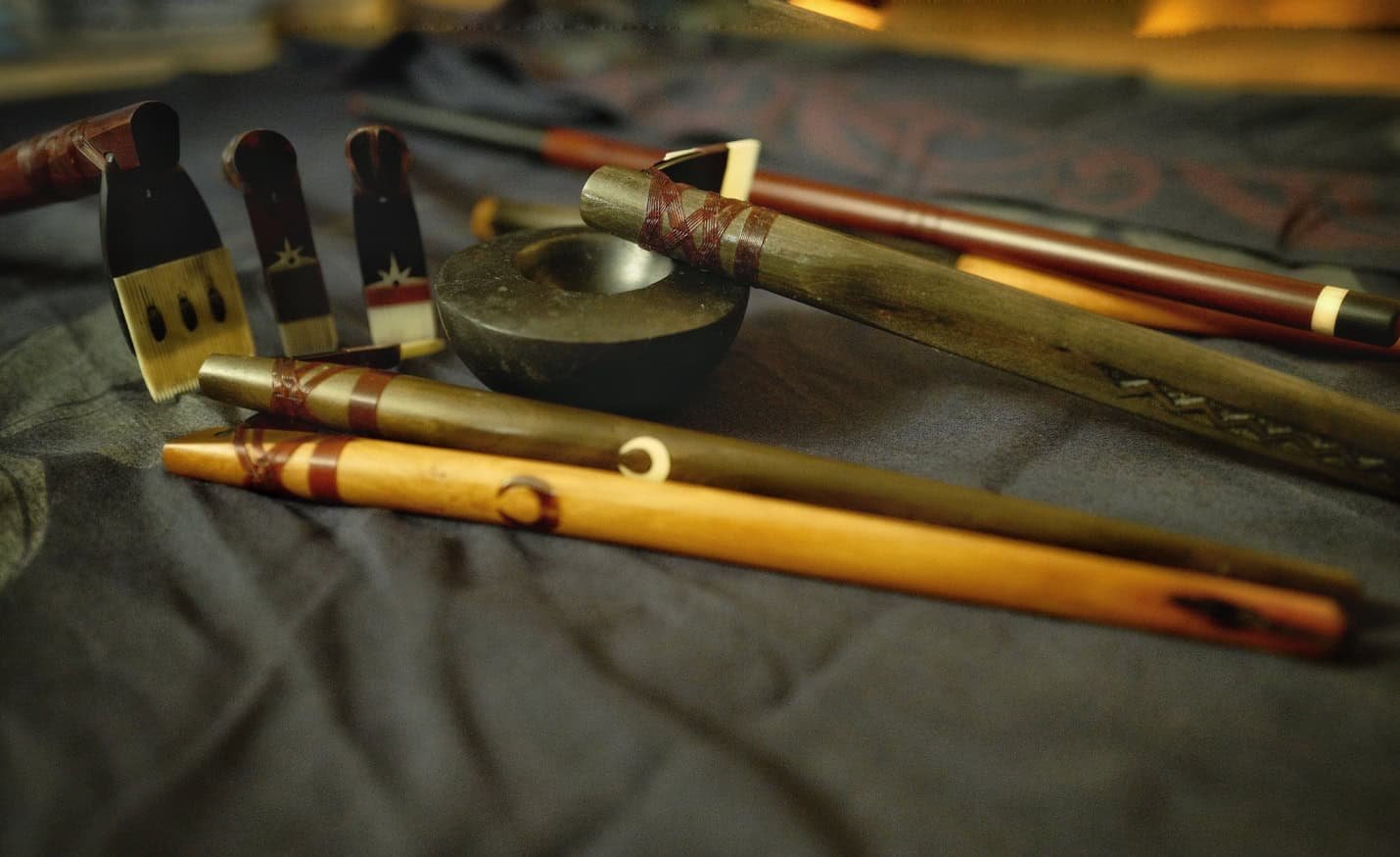
The mōlī — the tattooing comb — is made from bone, typically from the mōlī (Laysan albatross), whose bone is hard and dense. The bone is sharpened to fine points and mounted in a handle. Different widths of comb serve different functions: narrow combs for fine lines, wider combs for broad coverage.
The hahau — the mallet — is a short wooden stick used to strike the comb handle, driving the teeth into the skin.
The pa’u— the ink — is traditionally made from the soot of burned kukui (candlenut) kernels, producing the rich, stable black pigment shared across Polynesian traditions. Contemporary practitioners sometimes use commercial tattoo ink for its longevity and consistency, while maintaining the traditional tools and method.
The practitioner works with assistants who stretch the skin taut during the process. The recipient lies on a mat, surrounded by family. The practitioner begins with a pule (prayer), and prayers and chants continue through the session — connecting the physical act of tattooing to the spiritual world and honouring both the wearer and the ancestors whose identity is being inscribed.
The designs are not selected from pre-made patterns. The practitioner learns the recipient’s genealogy, their family history, their social position, and their personal story, and composes a unique design from this information. The recipient often does not see the final design until it is permanently marked on their skin. The act requires trust in the practitioner and surrender to the tradition.
The destruction of Hawaiian tattooing
The destruction of Hawaiian tattooing, when it happened, was rapid and comprehensive.
Captain James Cook reached the Hawaiian Islands in 1778. Within decades, American Protestant missionaries arrived — the first group, from New England, landed in 1820. The missionaries viewed Hawaiian cultural practices — tattooing, hula, the traditional religious system — as pagan and incompatible with Christianity. They pressured the Hawaiian monarchy to ban these practices, and the monarchy, seeking Western legitimacy and navigating the power dynamics of colonial contact, complied.
Tattooing was discouraged, then suppressed, then abandoned. The process was not instantaneous — tattooed Hawaiians were still documented into the late nineteenth century — but the cultural infrastructure that supported the practice (the kahuna kā uhi, the apprenticeship system, the ceremonial protocols, the design knowledge) was dismantled within a few generations. By the early twentieth century, the practice had effectively ceased.
The suppression of kākau was part of the broader erasure of Hawaiian cultural identity that accompanied colonisation — the same process that suppressed the Hawaiian language (banned in schools from 1896), overthrew the Hawaiian monarchy (1893), and ultimately led to the annexation of Hawai’i by the United States (1898). The loss of tattooing was one element in a systematic destruction of Indigenous cultural practice.
Machine tattooing arrived in Hawai’i in the twentieth century, and Honolulu became a major centre for commercial tattooing — particularly for the military personnel stationed at Pearl Harbour and throughout the islands. But this was Western commercial tattooing, not kākau. The traditional practice — the hand-tapping, the bone tools, the genealogical encoding, the kahuna’s prayers — was gone.
Keone Nunes and the revival of kākau uhi
The revival of kākau uhi is, more than any other Polynesian tattoo revival, the story of a single person.
Sulu’ape Keone Nunes was born in 1957 in Iwate-ken, Japan (his father was stationed there with the military), and grew up on O’ahu’s west side in Wai’anae. His education in Hawaiian culture came not through formal schooling but through the practice of “talking story” with kūpuna (elders) in his family and community — the oral tradition that carried Hawaiian knowledge through the generations when written and material records had been lost or suppressed.
Nunes became interested in tattooing and in the specifically Hawaiian tradition of kākau. He studied the historical record — the early European accounts, the Bishop Museum collections, the published scholarship — and he wanted to practise. The problem was absolute: no living Hawaiian practitioner knew the traditional tapping method. The lineage of kahuna kā uhi had been broken. There was no one to teach him.
He began tattooing using Western machines, applying traditional Hawaiian designs — the motifs and patterns he had studied from historical sources — with modern equipment. The designs were authentic; the method was not. The compromise was necessary but unsatisfying. Nunes wanted the traditional hand-tapping method — the same technique that had been used across Polynesia for a thousand years.
The breakthrough came through the tattoo world’s international network. Henk Schiffmacher, the Dutch tattoo artist, collector, and historian, encountered Nunes’s work and was impressed by his dedication to reviving the Hawaiian tradition. Schiffmacher was producing a film about global tattooing and included Nunes. More importantly, Schiffmacher introduced Nunes to Su’a Sulu’ape Paulo II — the Samoan tufuga ta tatau who was, at that time, widely regarded as the finest traditional tattooist in the world.
Nunes met Paulo in 1996 in New Zealand. Paulo invited him to study the Samoan hand-tapping technique — the same technique that had once been shared across Polynesia, maintained by the Samoans through the centuries when every other Pacific tradition had lost it. Nunes travelled to New Zealand and Samoa to learn from Paulo, studying the tools, the method, and the cultural protocols that governed the practice.
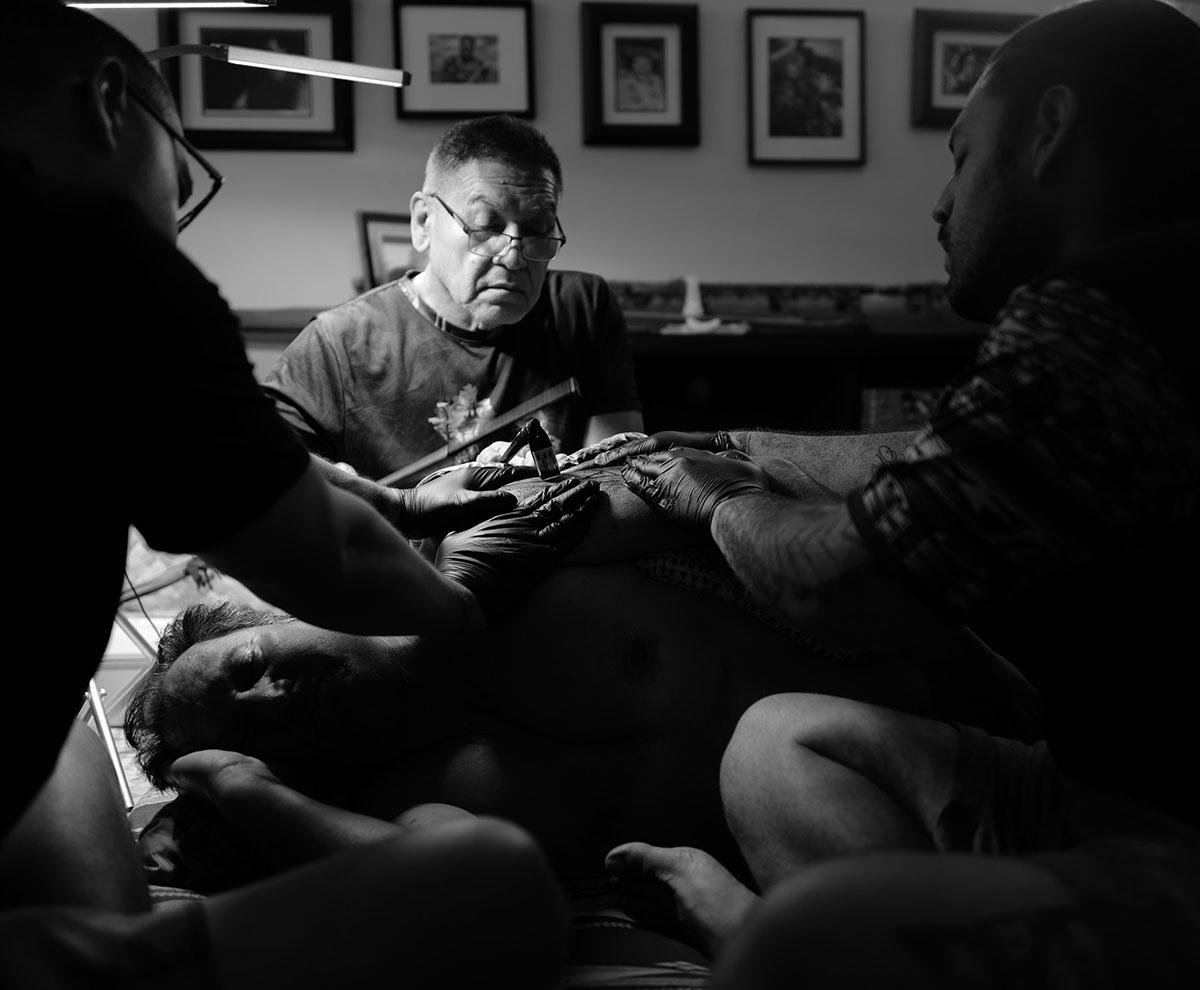
From 1999 onward, Nunes worked exclusively with traditional hand-tapping tools — handmade mōlī (bone combs), hahau (mallet), and pa’u (ink). He applied Hawaiian designs using the Polynesian technique that had been recovered through the Samoan connection. He had, in effect, rebuilt the Hawaiian tradition from two sources: the Hawaiian designs (recovered from the historical record and oral tradition) and the Polynesian tapping method (learned from the Samoans who had kept it alive).
In 2001, following Paulo’s death in 1999, the Sulu’ape family honoured Nunes with the title Sulu’ape — making him the first Hawaiian and the first non-Samoan to receive this prestigious designation. The title acknowledged his mastery of the technique and his role in extending the Samoan tradition’s reach into the Hawaiian context.
Nunes has described his philosophy in terms that emphasise the cultural weight of the work:
“I’ve allowed the tools to teach me. There are very few things in this world that we can say we are doing exactly the same way they were done 100, 200, 500 years ago. When a person lays down on the mat to get a tattoo, they are feeling the same emotions and feelings as their ancestors. It’s very powerful.”
His approach to clients follows the traditional protocol. He does not accept walk-ins or casual requests. The process begins with an interview — a deep conversation in which Nunes assesses the person’s motivations, their understanding of their genealogy (mo’okū’auhau), and their readiness to carry the kuleana (responsibility) that comes with wearing kākau. The recipient does not choose their design. They entrust themselves to the practitioner, who composes the design based on the person’s story, their lineage, and their spiritual readiness. The recipient often does not see the completed design until it is permanently on their skin.
Nunes was named number twenty-two on the list of the 101 Most Influential People in Tattooing. His work is held in the collections of the Smithsonian Institution, the Honolulu Museum of Art, the Oakland Museum of California, and the Museum of New Zealand Te Papa Tongarewa.
He taught on O’ahu for thirty years before relocating to Thailand in 2020. He returns to the islands for workshops and visits.
The next generation
Nunes established Pāuhi (Keoneʻula) — a traditional tattoo school — to train apprentices. Only a select few have been invited to sit, observe, and learn. Kamali’ikūpono Hanohano (@pokikane) began his apprenticeship at the age of twenty and trained under Nunes for a decade. He completed an ‘ūniki (formal passing of knowledge) — one of only two students to have done so in many generations — and now sits at the helm of Pāuhi in Nunes’s stead, following Nunes’s move to Thailand in 2020. Hanohano describes himself as a mea kākau uhi — a cultural practitioner of traditional Hawaiian tattoos — and his mission through Pāuhi is specific:
“to lift the stain of kākau uhi in its own community in order to uplift and transform the indigenous identity of Kanaka Hawai’i.”
Hanohano’s LIFT project, Garden of Tradition, addresses a dimension of kākau uhi that has no parallel in commercial tattooing: the harvesting of the plants and materials used to make the tools. A kākau uhi practitioner cannot order supplies online. The mōlī is carved from bone. The handle is shaped from wood. The ink is made from soot. Each tool begins with the harvesting of raw material from the land — a process that connects the practice to the ‘āina (land) and extends the preparation for a single tattoo from hours to months. Hanohano travels to the outer islands for presentations and community workshops, building the knowledge base that will sustain the practice for the next generation.
Keli’iokalani Mākua (known as Keli’i Makua, @kelii_makua) apprenticed under Nunes for twenty-seven years — making tools, stretching skin, and learning every dimension of the practice. In December 2016, Nunes conducted a five-day ‘ūniki ceremony — the first such ceremony performed in Hawai’i in over two hundred years — in which Makua was titled Kahuna Kā Uhi (priest of tattooing) and given the ceremonial name Keoneʻulaokamakauhi. He is the first Hawaiian to hold the title in over two centuries. Makua now runs his own pāuhi (traditional school) called Ka Pā ʻO Hūnōhūnōhōlani, named after his sixth-generation great-grandfather, where he trains the next generation of kākau students. He travels between islands to offer workshops and perform kākau uhi, and he maintains the same protocols Nunes taught him: extensive interviews with recipients, prayers to Kāne, designs composed from genealogy rather than chosen from a catalogue. He once said:
“If we were the only ones that drew the blood of the ali’i and the other kahuna nui without being put to death, that’s not to be taken lightly, so this practice is not to be taken lightly.”
Samoan and other Polynesian tufuga working in Hawai’i — including Su’ape Aisea Toetu’u and other members of the Sulu’ape family — have also contributed to the broader resurgence of traditional tattooing in the islands.
Tricia Allen (@triciaspacificart) — an anthropologist and tattooist who has tattooed over 11,000 people, including more than 8,000 members of the Polynesian community — has contributed to the revival through both practice and scholarship. Her book Tattoo Traditions of Hawai’i (Mutual Publishing, 2006) is the most comprehensive published reference on the subject, covering motifs, meanings, placements, tools, and techniques, as well as personal accounts from 36 tattoo wearers and artists. The book sold out its first printing in seven months and won the Reader’s Choice award from the Hawai’i Book Publishers’ Association. Her second book, The Polynesian Tattoo Today, won two first-place awards.
P.F. Kwiatkowski, the author of The Hawaiian Tattoo, has also contributed to the documentation and public understanding of the tradition.
The cultural boundary
Traditional kākau uhi is not a commercial service. The practitioners who work in the traditional method — using bone tools, the hand-tapping technique, and the cultural protocols of genealogical interview and spiritual preparation — do not tattoo tourists. The Hawaii Guide states it directly:
“Authentic kākau practitioners — the ones using bone tools and the hand-tap method — generally do not tattoo visitors at all, or only after extensive cultural conversation and only with patterns that have meaning.”
The reasoning is the same as in every other Indigenous tattoo tradition covered in this series: the patterns encode specific genealogical and spiritual information, and applying someone’s family lineage on a stranger violates the foundation of the practice. Generic “tribal” designs drawn from Hawaiian sources without cultural connection are appropriation.
The boundary is clear, and it is maintained by the practitioners and the community. For non-Hawaiian visitors to Hawai’i who want a tattoo, the islands have no shortage of excellent commercial tattoo studios offering a wide range of styles. What they do not offer — and should not be expected to offer — is kākau uhi to people who have not earned the right to wear it.
Sources & further reading
- Tricia Allen, Tattoo Traditions of Hawai’i. Mutual Publishing, 2006.
- Tricia Allen, The Polynesian Tattoo Today. Mutual Publishing, 2010.
- P.F. Kwiatkowski (with Tom O’o Mehau, artist), The Hawaiian Tattoo. Bess Press, 1996.
- University of Hawai’i at Mānoa Library, Traditional Hawaiian Tattooing Research Guide.
- National Museum of the American Indian (NMAI) Magazine, Tapping Into Ancestral Wisdom: Reviving the Nearly Lost Art of Native Hawaiian Tattooing. Published 2023.
- Go Hawai’i (official state tourism site), Transformation Through Tattoo.
- First Peoples Fund, Keone Nunes — Community Spirit Award Honoree.
- Native Arts and Cultures Foundation, Kamali’ikūpono Hanohano.
- Nā Koa, Tricia Allen.
- CVLT Nation, Kakau, The Art of Traditional Tattoo in Hawai’i. Published March 2015.
- Just Living 808, Kākau: Traditional Art of Hawaiian Tattooing. Published February 2018.
- Hawaii.com, The Deeper Meaning of Hawaiian Tattoos: Culture, Kuleana, and Craft. Published October 2025.
- PBS, Skin Stories: The Art and Culture of Polynesian Tattoo. 2003.
- Lars Krutak, Spiritual Skin: Magical Tattoos and Scarification. Edition Reuss, 2012.
- Anna Felicity Friedman, The World Atlas of Tattoo. Yale University Press, 2015.
- Matt Lodder, Painted People: Humanity in 21 Tattoos. Harper, 2024.
- Sean Mallon and Sébastien Galliot, Tatau: Sāmoan Tattoo, New Zealand Art, Global Culture. Te Papa Press, 2018.
- Alfred Gell, Wrapping in Images: Tattooing in Polynesia. Clarendon Press, 1993.