Related Posts

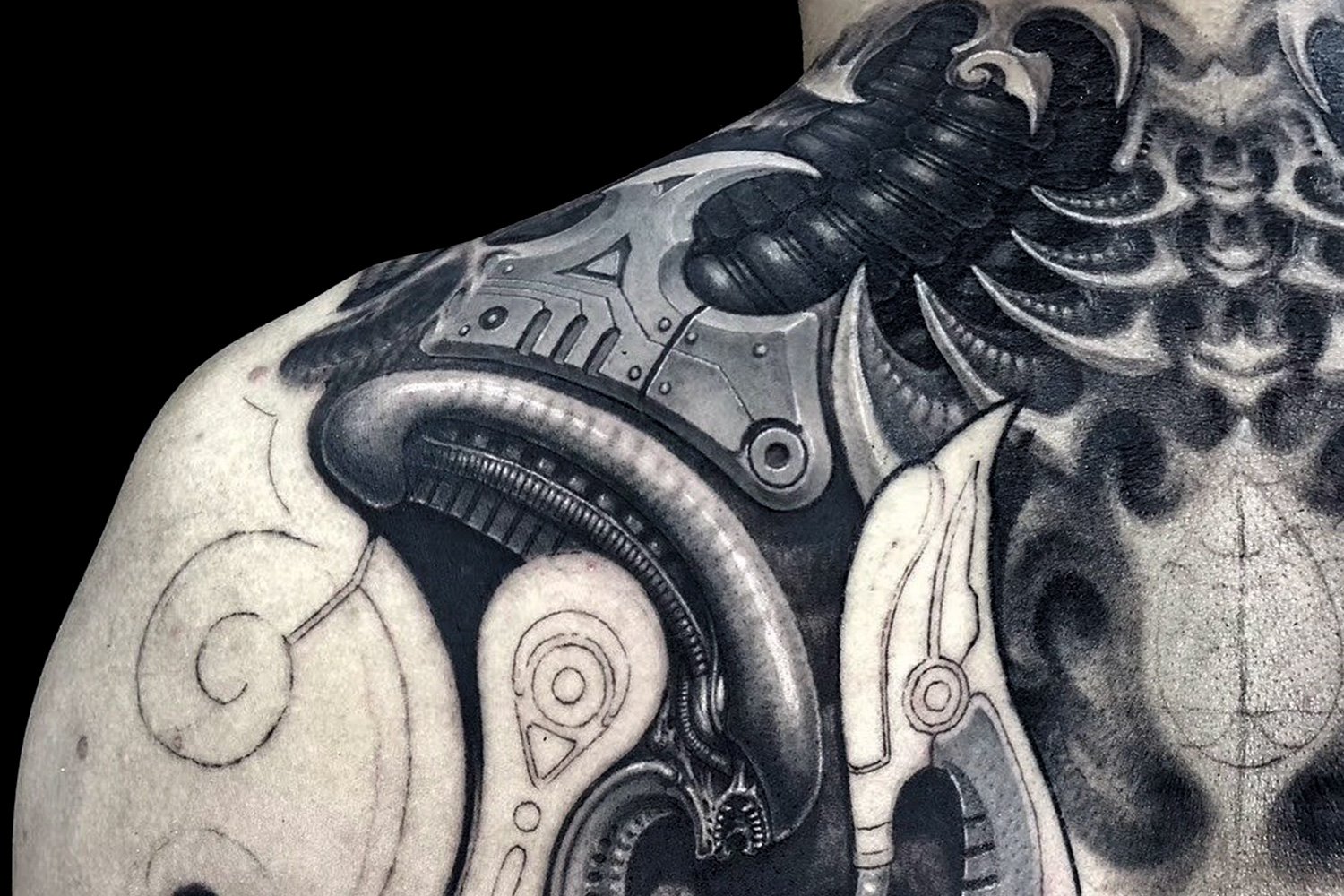
Biomechanical
Biomechanical tattoos: machinery under the skin
Biomechanical tattooing creates the illusion that the body contains machinery. The skin is treated as a surface that can be opened, peeled back, or made transparent, revealing an interior that is part biological and part technological. The style fuses organic anatomy — bone, muscle, tendon, vascular tissue — with mechanical components — gears, pistons, cables, tubing, plating, circuitry — into a single coherent system. The result is a body that appears to be a hybrid organism: human on the outside, something else underneath.
The style has a specific and traceable origin. It begins with one artist, one film, and one book.
Hans Rudolf Giger, Necronomicon and the alien
Hans Rudolf Giger was born in Chur, Switzerland, in 1940. He studied architecture and industrial design at the Zurich School of Applied Arts, and he spent the rest of his career producing paintings, sculptures, and designs that fused organic and mechanical forms into images of disturbing, alien beauty. His medium was the airbrush — he worked primarily in monochrome, building up layers of fine tonal detail to produce surfaces that were simultaneously slick and organic, hard and visceral. The visual quality of his work has been described as “greasy, visceral forms with hard, metal-like structures” — an accurate summary of the aesthetic.
Giger published Necronomicon in 1977 — a large-format art book collecting his paintings and drawings. The book was a landmark. The imagery was unprecedented: humanoid figures merged with tubing and mechanical parts, landscapes built from ossified machinery, creatures that were part insect, part machine, part something reproductive and anatomical. The visual language Giger established in Necronomicon — the fusion of the biological and the industrial, the sexual and the mechanical, the architectural and the anatomical — became the foundation for the biomechanical aesthetic in every medium that followed.
In 1979, Ridley Scott hired Giger to design the alien creature and its environment for the film Alien. Giger designed the adult Xenomorph, the egg, the facehugger, the derelict spacecraft, and the Space Jockey — every element of the film’s alien biology and technology. The designs won the Academy Award for Best Visual Effects. The film made Giger’s visual language internationally visible, and the biomechanical aesthetic entered popular culture permanently.
Giger was not a tattoo artist. He worked in painting, sculpture, and film design. But the imagery he created — and specifically its publication in Necronomicon and its visibility through Alien — is the direct source for biomechanical tattooing. The tattoo style exists because tattooers saw Giger’s work and wanted to put it on skin.
Giger died in 2014 at the age of seventy-four. The H.R. Giger Museum, housed in a medieval château in Gruyères, Switzerland, holds the largest collection of his work.
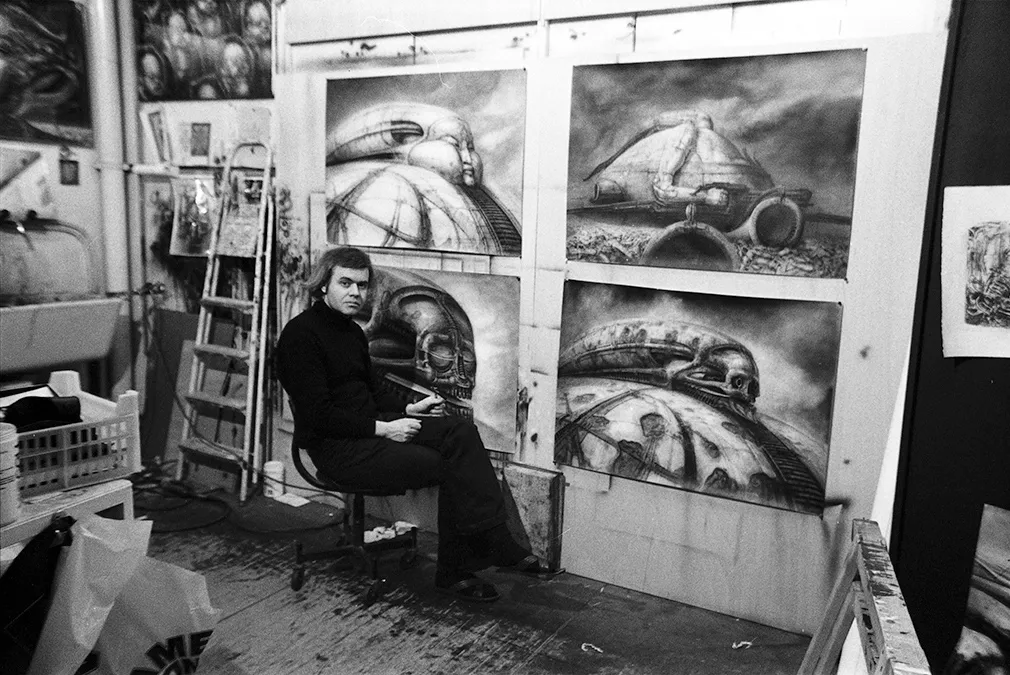
From H. R. Giger to tattoo
The style became a distinct tattoo genre in the late 1980s and 1990s through the work of two artists in particular.
Guy Aitchison
Guy Aitchison began tattooing in 1988 and quickly became one of the most prominent biomechanical artists in the United States. Aitchison’s contribution was to push the style beyond Giger’s dark monochrome into colour — vibrant, saturated hues that gave the mechanical and organic elements a luminous, almost bioluminescent quality. His compositions introduced a sense of movement and dynamism that Giger’s more static, architectural imagery did not emphasise. Aitchison also developed what he called “Organica” — a substyle within biomechanical that shifts the emphasis from mechanical hardware toward organic, alien biological forms: flowing shapes that look grown rather than built, structures that suggest genetic engineering or extraterrestrial anatomy rather than earthly machinery.
Aitchison is also the author of Reinventing the Tattoo (self-published, multiple editions), the most comprehensive technical manual on modern tattooing, and The Biomech Encyclopedia (2014), a 486-page large-format book documenting biomechanical tattoo design theory and featuring collaborative work by dozens of artists, including Aaron Cain, Nick Baxter, Dan Hazelton, Marco Velazquez, and many others. The Biomech Encyclopedia is the closest thing the style has to a definitive reference text.
Aaron Cain
Eddie Deutsche
Together, these artists transformed biomechanical from a category of Giger fan-art into an independent tattoo style with its own design principles, its own technical demands, and its own vocabulary.
@hengyue_newassassin_tattoo.jpg)
@hengyue_newassassin_tattoo.jpg)
Style characteristics
The torn-skin illusion
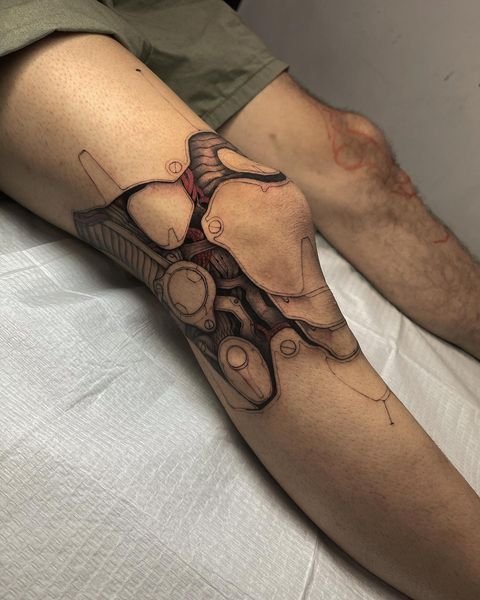
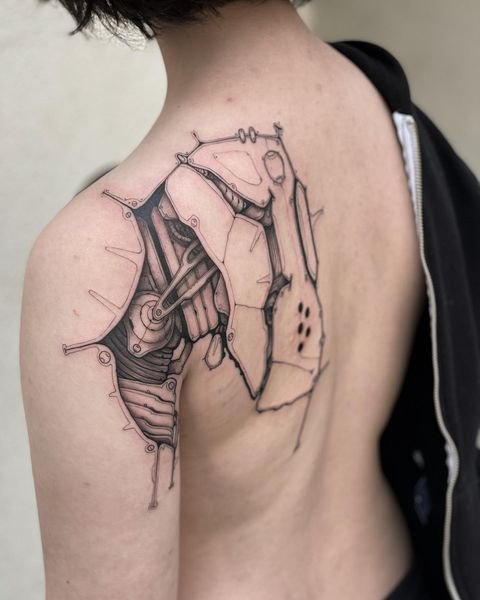
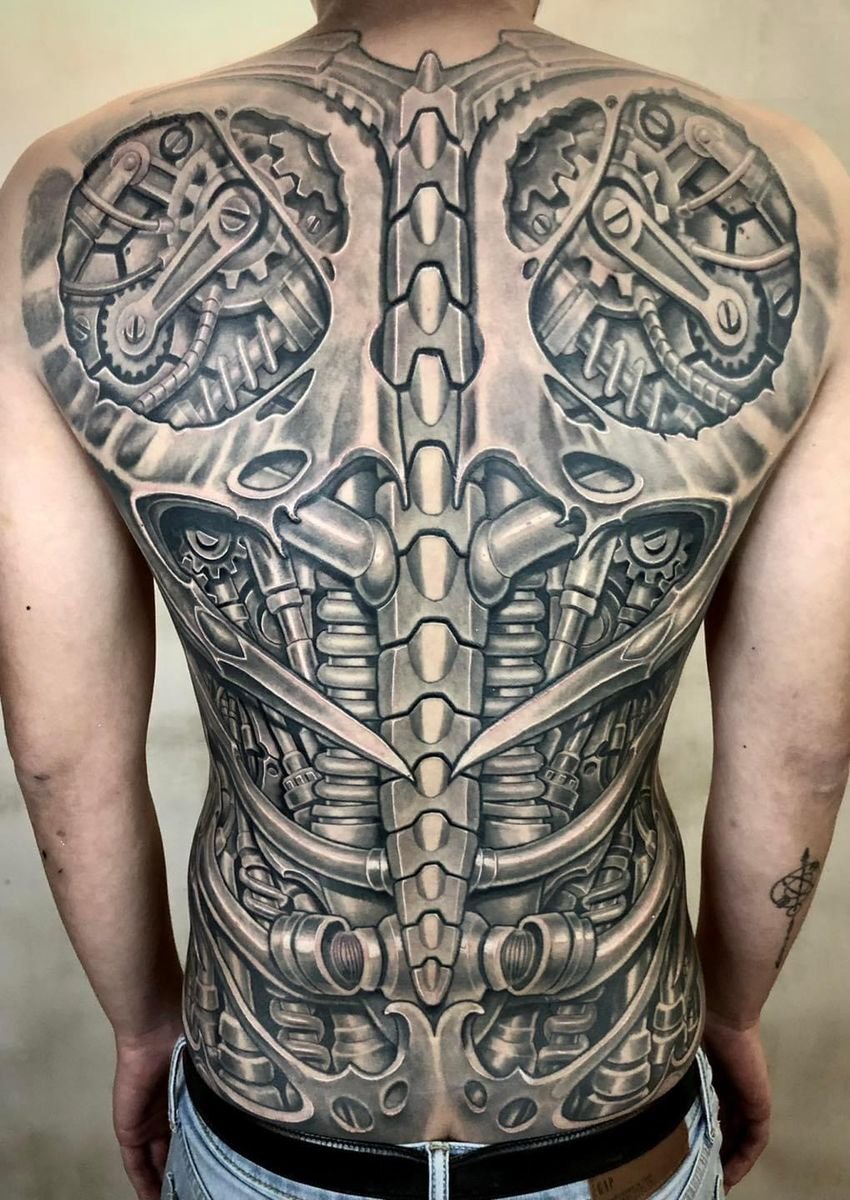
The most common compositional device: the skin appears to be ripped, peeled, or cut away, revealing mechanical or bio-organic structures beneath. The torn edges of the “skin” are rendered realistically — ragged, fleshy, with visible dermal layers — and the interior is filled with the biomechanical content. The illusion depends on a convincing rendering of both the organic surface and the mechanical interior, and on the seamless transition between the two.
Fusion of organic and mechanical elements
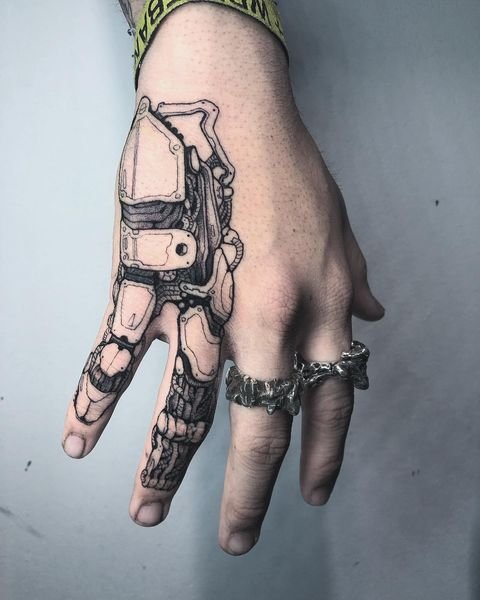
Bones merge with metal shafts. Muscles wrap around cables. Tendons attach to gears. Vascular tissue threads between circuit boards. The fusion is the defining visual principle of the style — the body is presented as a hybrid system in which the biological and the technological have become inseparable.
Three-dimensional rendering
Biomechanical work uses shading, highlights, and shadows to create the illusion of depth — the machinery recedes beneath the skin’s surface, and the components have volume, weight, and spatial relationships to each other. The three-dimensionality distinguishes biomechanical from graphic or illustrative styles that remain visually flat.
Body-following composition
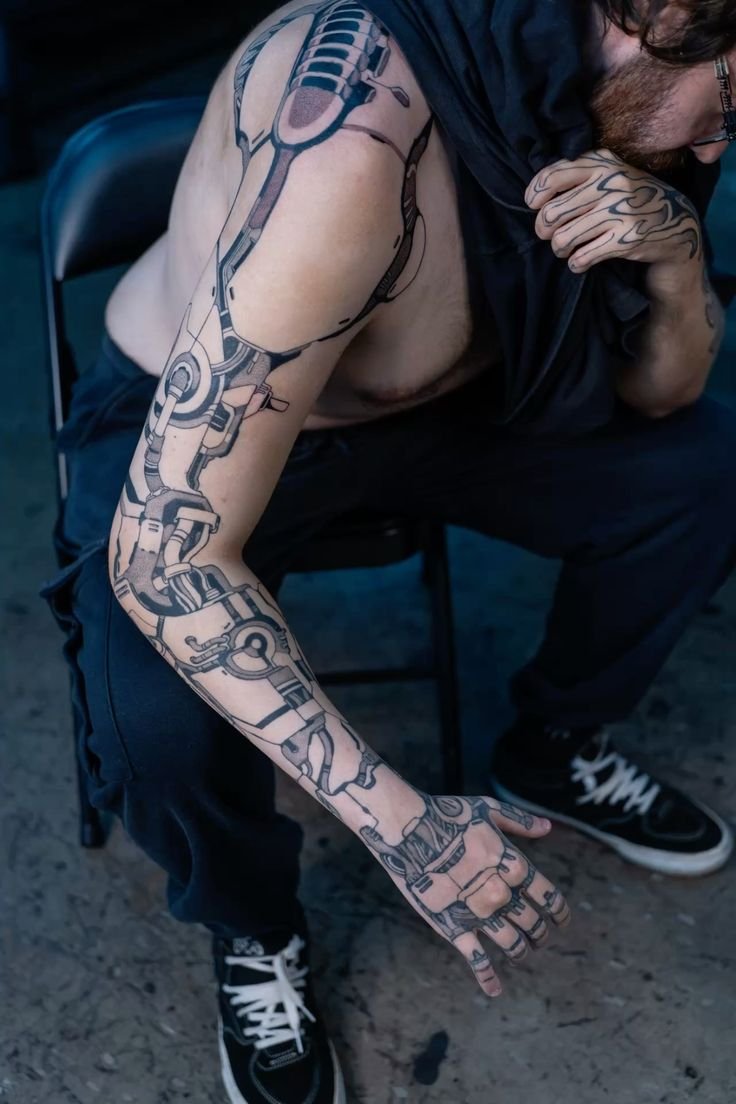
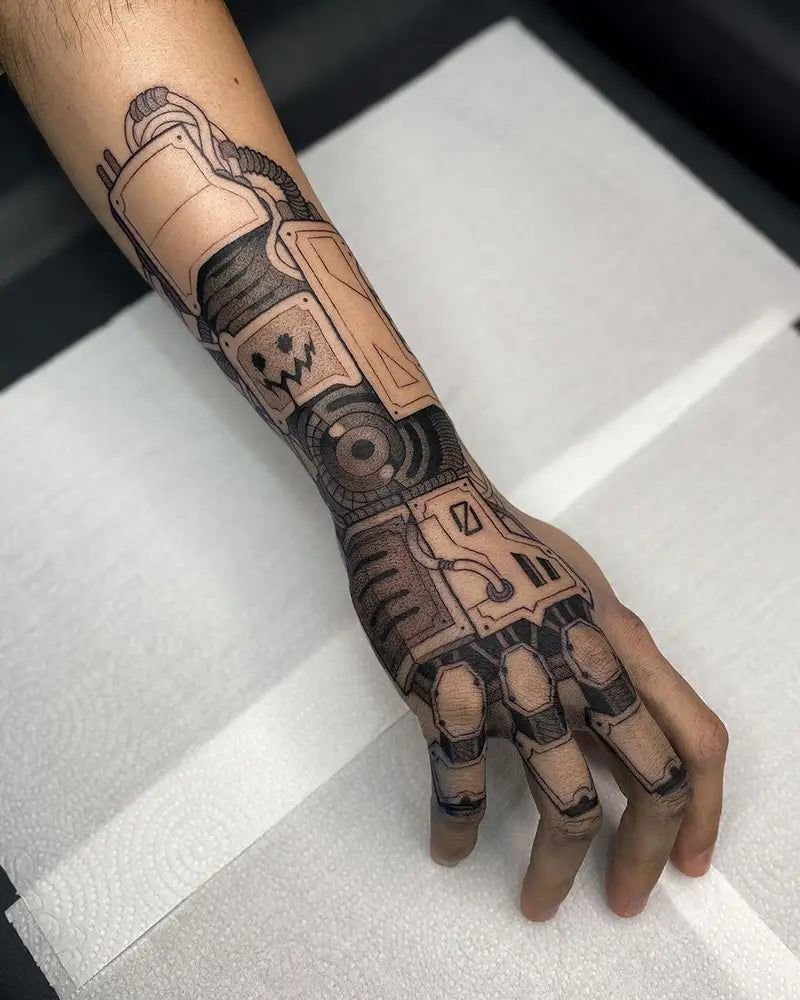
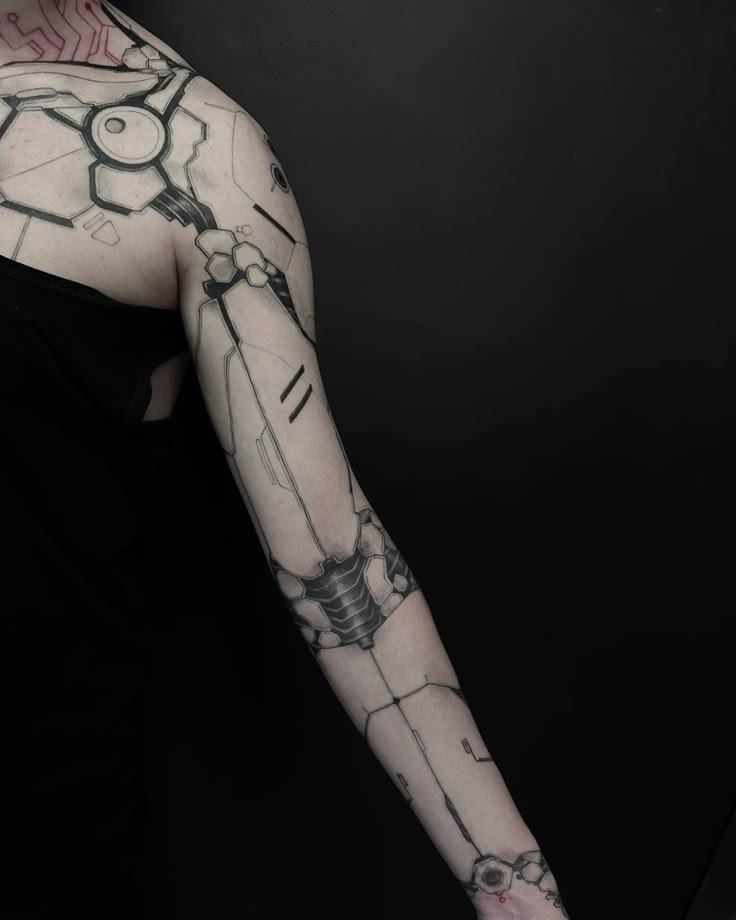
The mechanical elements are designed to follow the body’s anatomy — gears sit where joints are, tubes run along the lines of tendons, and plating follows the planes of muscle groups. The best biomechanical work looks as though the machinery was designed for the specific body it occupies, as though the arm or leg was engineered this way from the start.
Predominantly large scale
Biomechanical compositions are typically large — half-sleeves, full sleeves, chest panels, back pieces, leg sleeves. The style’s reliance on internal detail, three-dimensional rendering, and the torn-skin framing device means that it needs space. Small biomechanical pieces exist but rarely achieve the visual impact for which the style is built.
@hengyue_newassassin_tattoo.jpg)
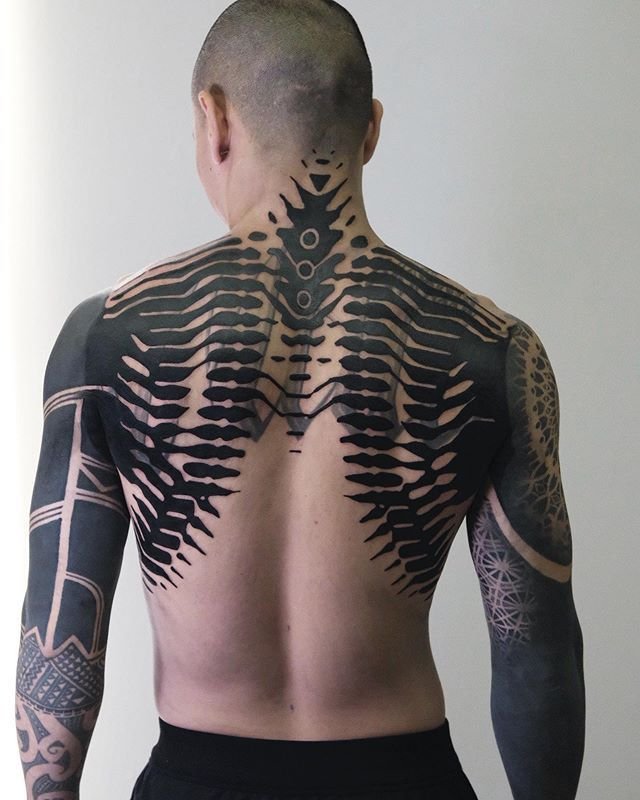
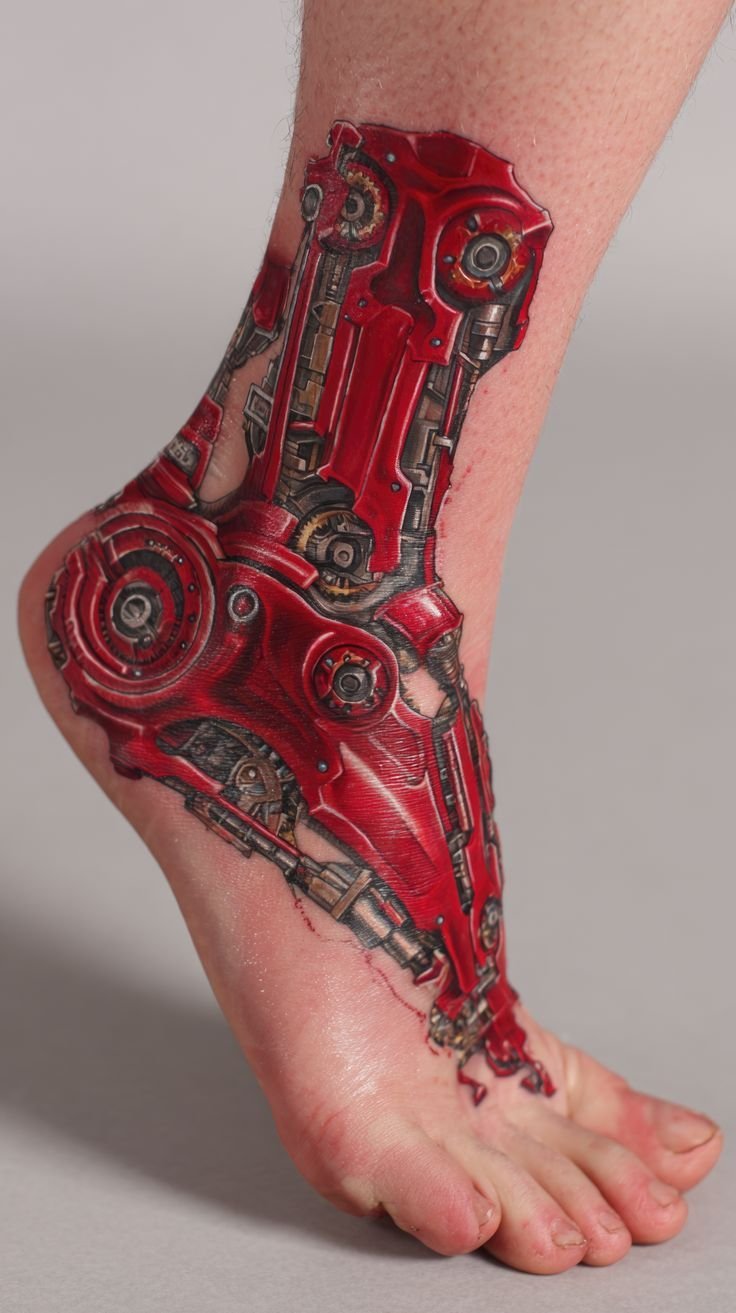
The substyles
Biomechanical tattooing has branched into several recognisable variations.
Classic biomechanical
The original Giger-derived style: monochrome or near-monochrome, dark, textural, with an emphasis on mechanical hardware (gears, pistons, cables, vertebral structures) visible beneath torn skin. This is the version closest to Giger’s paintings and to the first generation of biomechanical tattoos in the 1980s.
Colour biomechanical
The Aitchison-influenced branch: the same fusion of organic and mechanical, but rendered in a full colour palette — greens, blues, oranges, purples, reds — with a luminous, almost neon quality. Colour biomechanical can look radically different from the dark Giger original while maintaining the same compositional and conceptual structure.
Bio-organic (Organica)
The substyle Aitchison developed, which shifts the emphasis from mechanical components toward alien biological forms. Bio-organic work features flowing, grown-looking structures — tentacles, membranes, bioluminescent surfaces, forms that suggest deep-sea organisms or extraterrestrial anatomy. The mechanical elements are reduced or absent; the aesthetic is biological rather than industrial.
Biomechanical realism
Dark biomechanical
Cyberpunk and tech-influenced
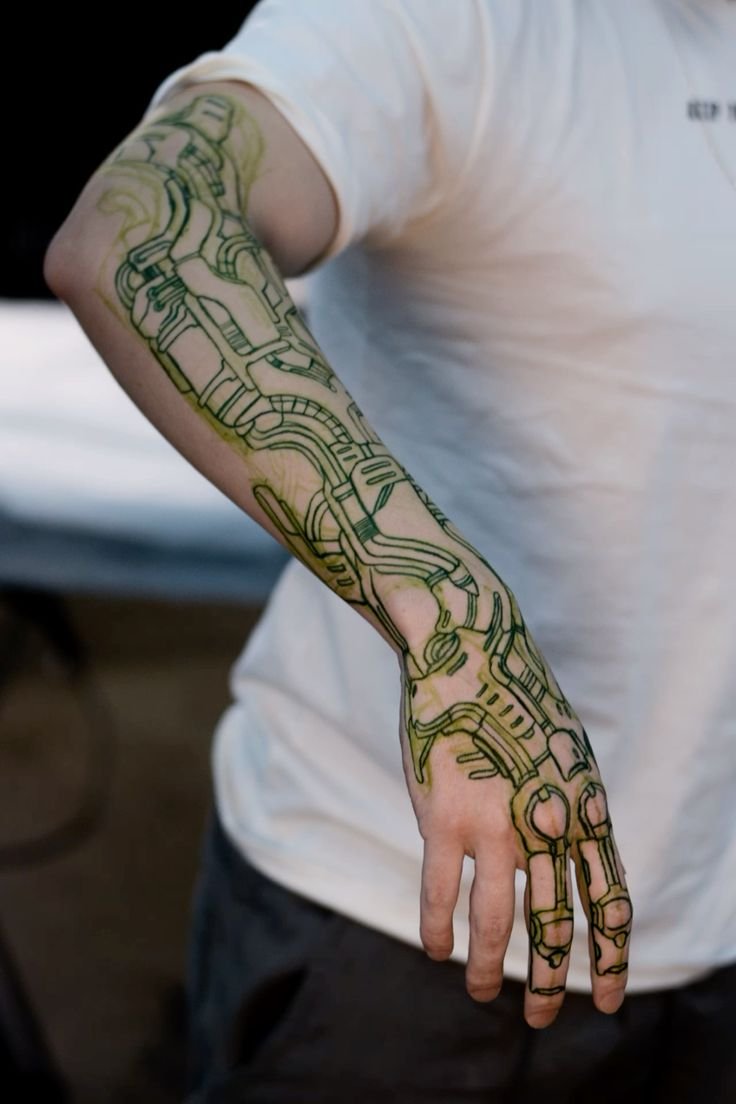
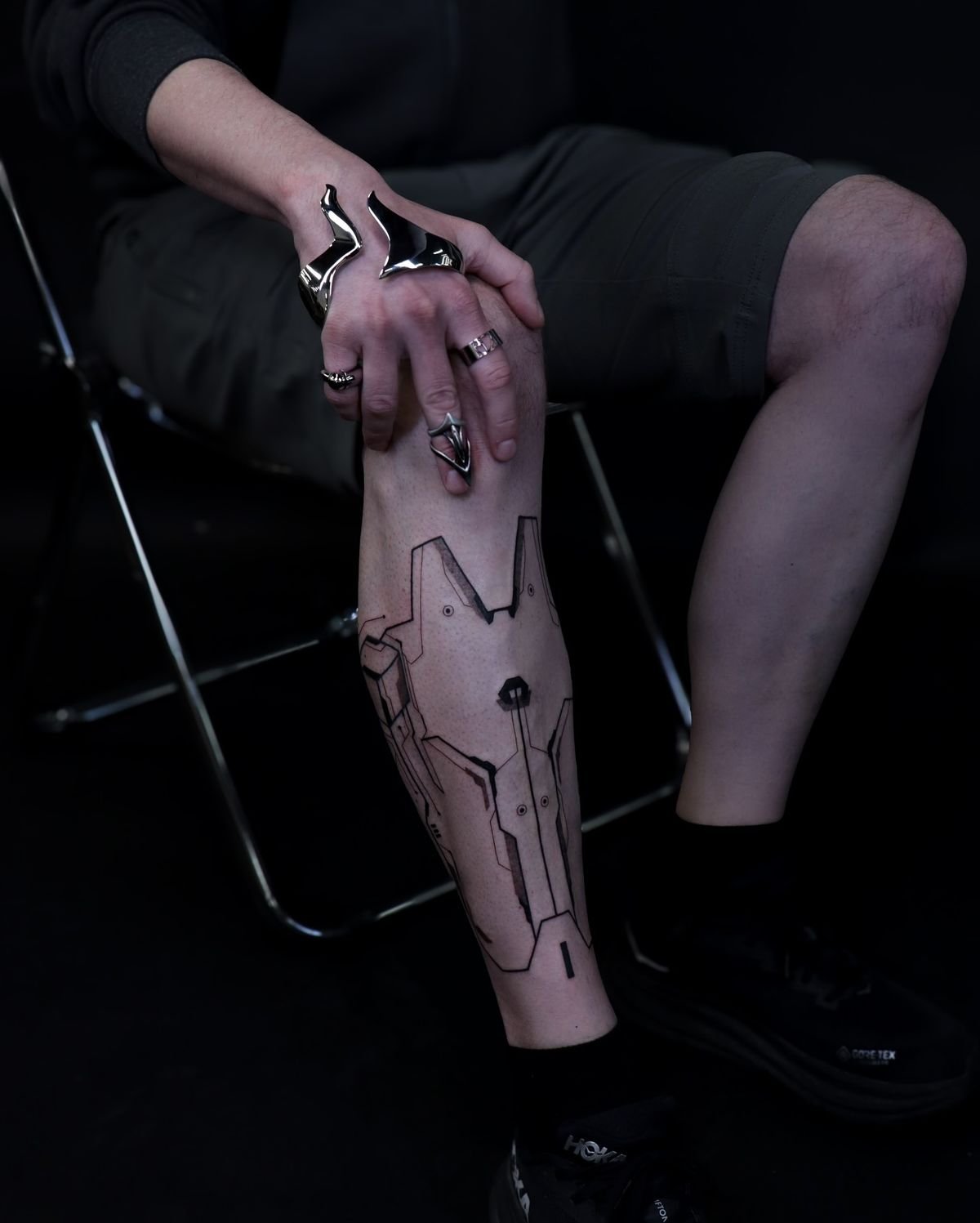
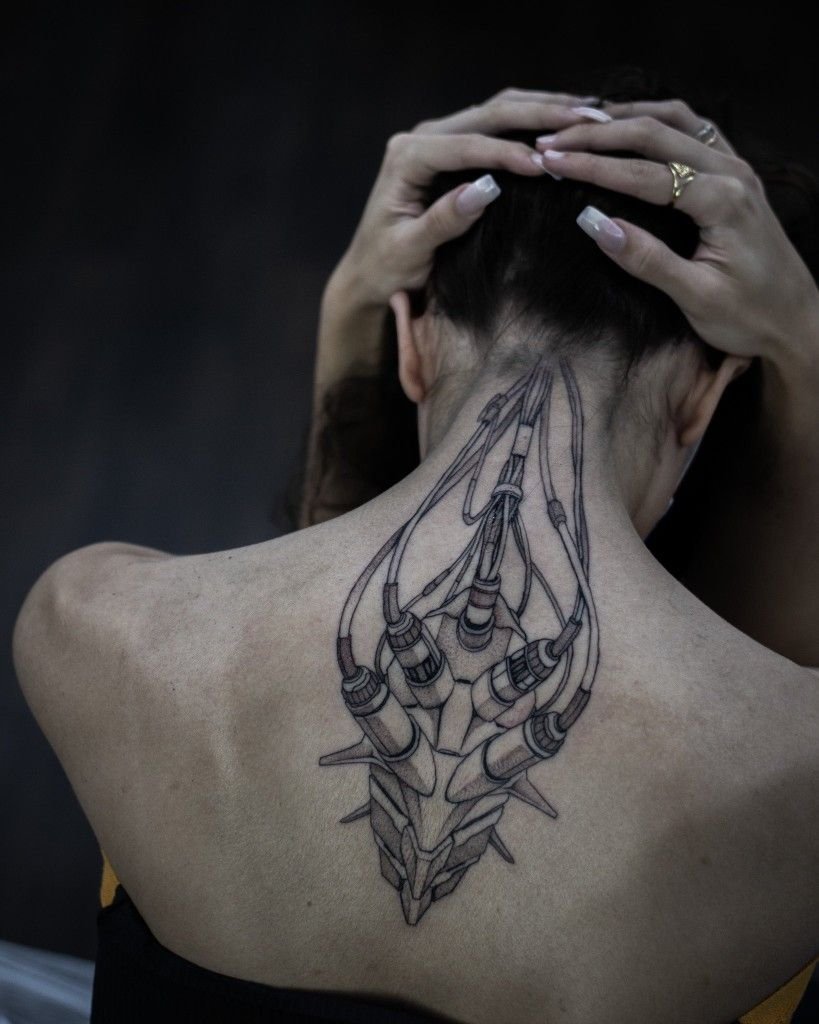
A more recent branch that draws on cyberpunk aesthetics — circuit board patterns, digital interfaces, holographic elements, designs that reference contemporary and near-future technology rather than the industrial machinery of the classic style. This branch connects biomechanical to the broader tech-influenced tattoo culture, including cybersigilism.
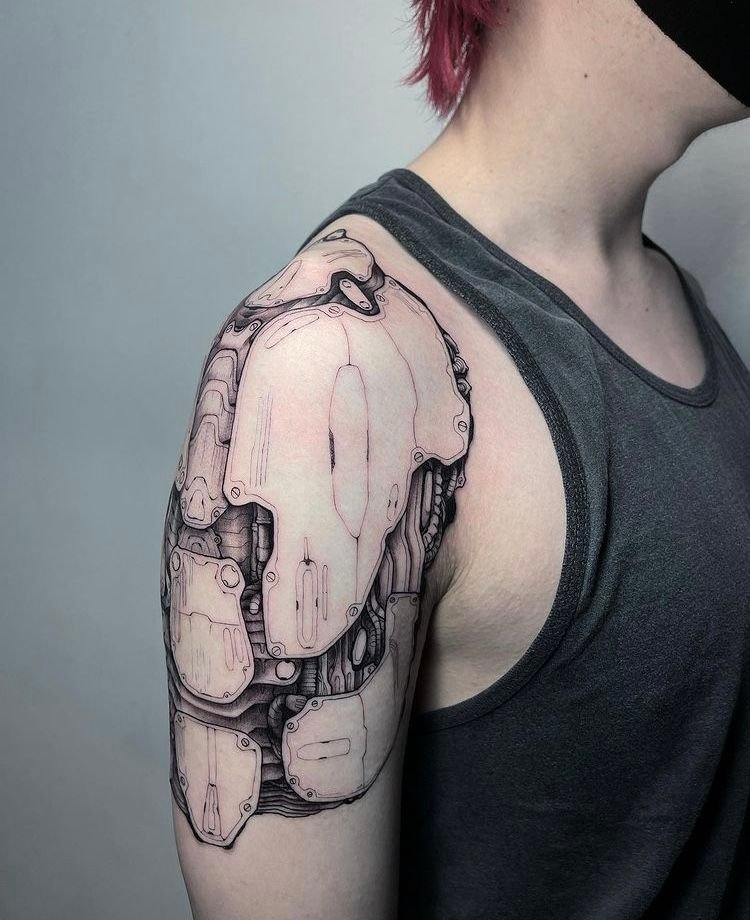
Technical demands of biomechanical tattooing
Anatomical knowledge
The artist must understand human anatomy — the positions of muscles, tendons, bones, and joints beneath the skin — because the biomechanical elements are designed to integrate with the real anatomy of the body. A gear placed where no joint exists, or a cable running against the grain of the underlying musculature, breaks the illusion.
Three-dimensional rendering
Creating the illusion of depth — of machinery receding below the skin surface — requires advanced shading skills: precise control of value, consistent light-source logic (shadows falling consistently from one direction), and the ability to render reflective surfaces (metal), transparent surfaces (tubing, membrane), and matte surfaces (bone, muscle) with distinct visual qualities. This is a drawing and painting skill that most artists develop through years of observational practice.
Compositional design
Biomechanical compositions must flow with the body, wrap around limbs, and handle transitions between different anatomical zones (the forearm to the upper arm across the elbow, for example). The design must also manage the interior complexity — dozens of individual components (gears, cables, bones, tissue) arranged in a coherent three-dimensional space. This requires spatial thinking that goes beyond flat composition.
Freehand skills
Many biomechanical artists work partly or entirely freehand — drawing the design directly on the body before tattooing, because the body-following aspect of the composition cannot be fully achieved with a flat stencil. Freehand biomechanical work demands strong drawing ability, confidence, and the capacity to visualise three-dimensional forms on a curved surface in real time.
Colour theory (for colour biomechanical)
The vibrant palette of colour biomechanical requires an understanding of how colours interact on skin — complementary contrasts, warm-cool relationships, and the behaviour of different pigments over time. The luminous quality of the best colour biomechanical work depends on strategic use of light and dark values alongside saturated hues.
Ageing
Biomechanical tattoos age according to the same principles as any large-scale detailed work.
Pieces with strong contrast — deep blacks, committed darks, well-placed highlights — hold up well. The structural elements of the composition (the outlines of the torn skin, the darkest shadows, the major contour lines of the mechanical parts) remain legible as the finer details soften.
The finest internal detail — very thin cables, subtle reflections on metallic surfaces, fine cross-hatching in shadow areas — softens over time. This is consistent with how all fine detail ages on skin, and biomechanical artists who understand the medium build their compositions with enough structural redundancy that the loss of the finest detail does not compromise the overall image.
Colour biomechanical faces the additional challenge of differential colour fading — some pigments fade faster than others, and the colour relationships that give a piece its luminous quality can shift over time. Red and orange tones tend to be warm and sometimes brown; blues and greens are more stable. A colour biomechanical piece designed with this in mind — using the most stable pigments for the largest areas and reserving the most fugitive pigments for small accents — will age more evenly.
Black-and-grey biomechanical, being built from the most stable pigment, ages better than colour work in the same style. The classic Giger-derived monochrome approach is, from a longevity standpoint, the safest version of the style.
Choosing a cybersigilism artist
Check for specialisation. Biomechanical requires a specific skill set — three-dimensional rendering, anatomical understanding, compositional design for the body, and (usually) strong freehand ability. Artists who specialise in the style produce consistently stronger work than generalists who offer it as one option among many. A portfolio in which biomechanical work is the dominant body of work is a better starting point than one in which one or two biomechanical pieces sit among twenty other styles.
Identify the substyle. Classic monochrome, colour, bio-organic, dark, or realism-influenced — each requires different skills and produces different results. Matching the artist’s substyle to the client’s intention produces better outcomes than expecting any biomechanical artist to work in any branch.
Look at the three-dimensionality in healed work. Does the machinery look like it occupies real space beneath the skin? Do the shadows fall consistently? Do reflective surfaces look reflective, and matte surfaces look matte? The illusion of depth is the hardest element to achieve and the most visible marker of skill in the style. Healed photographs — not fresh — are the honest test.
Discuss the design process. Biomechanical compositions are typically custom—designed for the client’s body, incorporating their specific anatomy into the design. An artist who wants to discuss the body’s structure, draw the body freehand, or create a detailed digital mock-up before tattooing is demonstrating the compositional seriousness the style demands. A generic biomechanical design applied without body-specific adaptation will look generic.
Expect multiple sessions. Large biomechanical pieces — sleeves, chest panels, back pieces — are built over many sessions, sometimes spanning months or years. The layered rendering, the density of detail, and the need to manage skin trauma all require patience from both the artist and the client. Pricing reflects the time and skill involved.
Sources & further reading
- H.R. Giger, Necronomicon. Sphinx/Morpheus, 1977.
- H.R. Giger, Necronomicon II. Edition C, 1985.
- H.R. Giger, HR Giger ARh+. Taschen, 1991.
- Guy Aitchison, Reinventing the Tattoo. Self-published, multiple editions.
- Guy Aitchison, The Biomech Encyclopedia. Self-published, 2014.
- Biomechanical art, Wikipedia. The Free Encyclopedia.
- H.R. Giger Museum, Gruyères, Switzerland. Website: hrgigermuseum.com.
- Anna Felicity Friedman, The World Atlas of Tattoo. Yale University Press, 2015.
- Matt Lodder, Painted People: Humanity in 21 Tattoos. Harper, 2024.
- Margo DeMello, Bodies of Inscription: A Cultural History of the Modern Tattoo Community. Duke University Press, 2000.
- Nick Schonberger and Rob Kingston, Forever: The New Tattoo. Gestalten, 2012.
- Steve Gilbert, Tattoo History: A Source Book. Juno Books, 2000.