The Story of the First Tattoo Machine
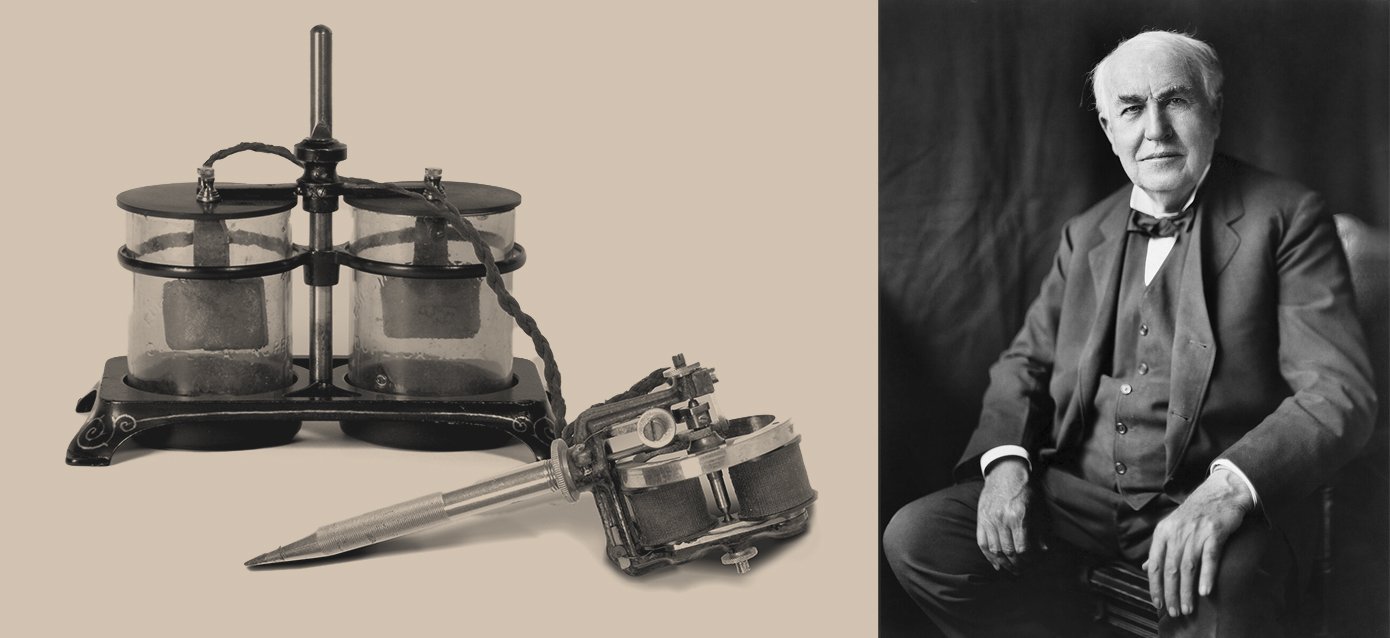
Edison and the autographic printing pen
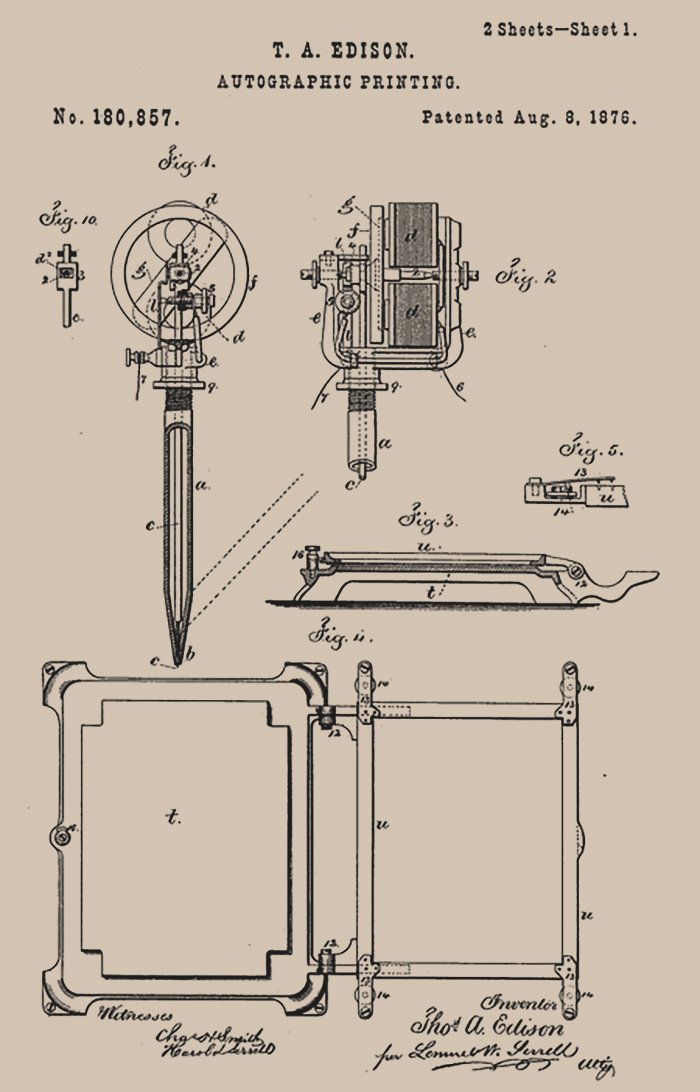
In 1876, Thomas Edison patented a device called the autographic printing pen. It was a hand-held electric stylus powered by a wet-cell battery, with a small motor mounted on top that drove a needle up and down at roughly fifty punctures per second. The purpose was duplicating documents: you wrote or drew on a sheet of paper, the needle perforated the paper into a stencil, and then a flatbed press rolled ink through the holes to produce copies. Edison claimed the system could make over five thousand copies from a single stencil.
The electric pen won a bronze medal at the 1876 Centennial Exhibition in Philadelphia. Then it failed. Competing mechanical stencil pens that didn’t require batteries undercut it. By the mid-1880s, Edison had sold the rights to the A.B. Dick Company, which reworked the technology into the mimeograph. This office copying machine would dominate workplaces for the next eighty years. It would be fifteen years before anyone found a use for it that Edison had never imagined.
Edison himself, however, had already moved beyond the rotary motor. In 1877, he patented an improved stencil pen (US Patent No. 196,747) that replaced the motor with two electromagnetic coils — tightly wound copper wire around soft iron cores — using springs and contact bars to vibrate a reed that drove the needle. The improved version was lighter and more manageable than the original. Edison marketed both designs, but neither proved commercially viable. The coil-based pen is significant because Edison independently arrived at both mechanical principles — rotary and electromagnetic — that would later define the two main lineages of tattoo machines.
Samuel O'Reilly
The man who repurposed Edison’s failure was born in Waterbury, Connecticut, in May 1854, the eldest of five children of Irish immigrants Thomas O’Reilly and Mary Ann Hurley. Waterbury was known as “The Brass City,” and by sixteen, O’Reilly was working in a local clock shop, likely in brass production. In 1873, at nineteen, he and two accomplices burglarised a general store and were sentenced to two years of hard labour in the Wethersfield State Prison. After his release, he enlisted in the military — sources conflict on whether it was the Navy or the Marine Corps — and deserted within months. A second arrest and prison sentence followed. By the mid-1880s, he had resurfaced in New York City as a tattoo artist.
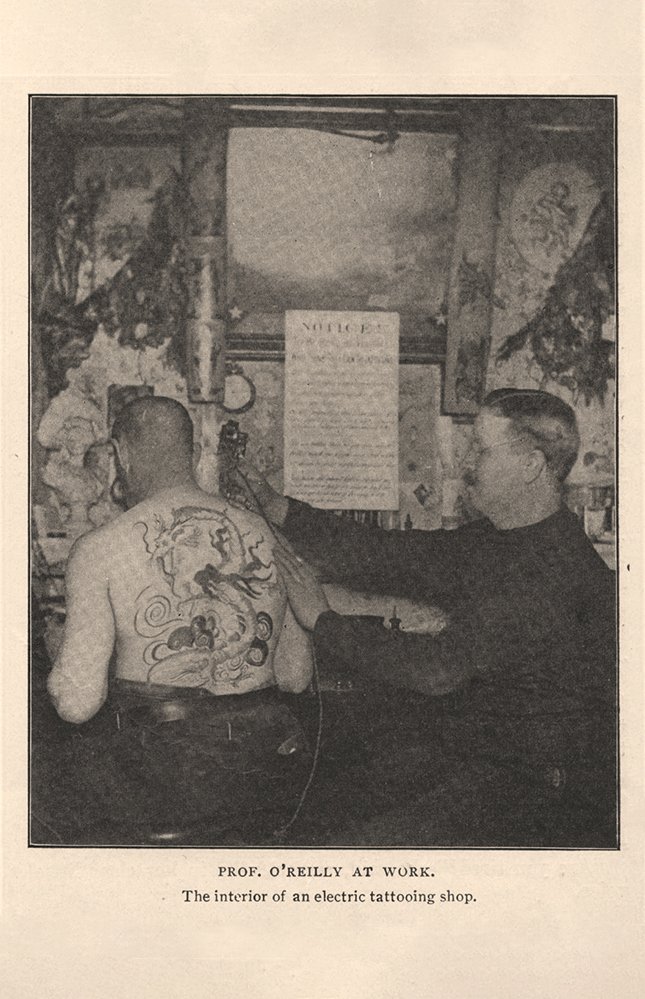
How O’Reilly learned to tattoo is unclear. He claimed he picked it up during his brief military service, where tattooing was widespread among enlisted men. Several sources describe him as a probable protégé of Martin Hildebrandt, a German-born tattooist who had been working in New York since the Civil War era. By the late 1880s, O’Reilly was operating out of Chatham Square, in the Bowery district of lower Manhattan — a neighbourhood of gambling dens, bare-knuckle fighting venues, and dime museums.
By 1890, newspaper coverage was calling him:
“Professor O’Reilly, the best tattooer in the world and a perfect gentleman.”
He was both a skilled craftsman and a showman operating in a world of sideshow attractions and sailor-town commerce. His clients included circus performers who needed full-body coverage for exhibition, socialites who summoned him to their homes rather than visit the Bowery, and the steady trade of military men passing through New York’s port.
The Machine
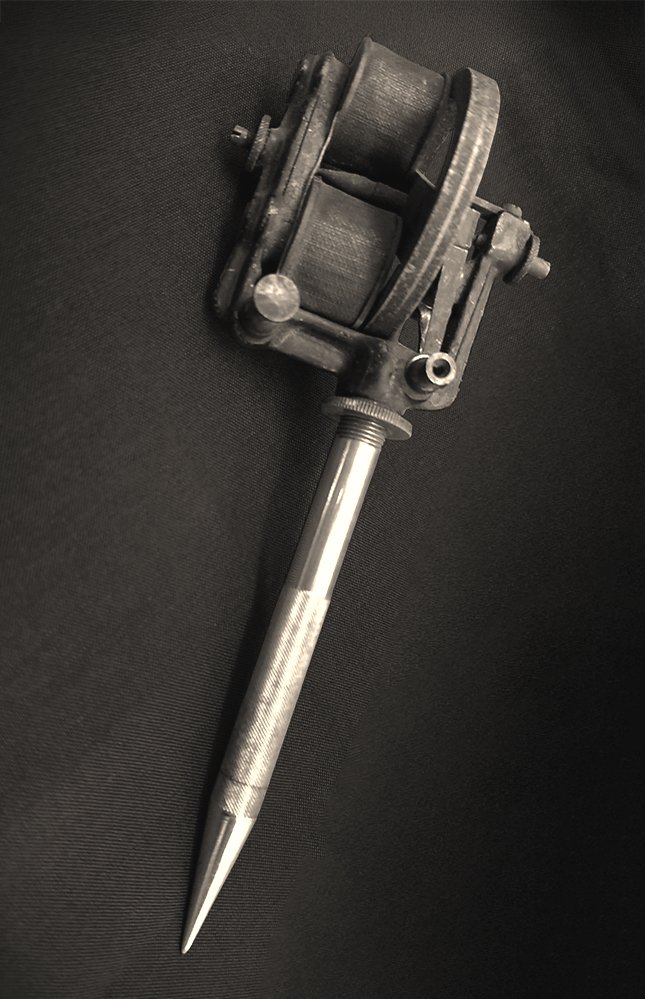
O’Reilly was not working from a single flash of inspiration when he built his tattoo machine. In a 1898 interview with the New York Sun, he described trying a dental plugger first — an electromagnetic device invented by William Bonwill for filling teeth — and then an Edison pen, but found each “too weak.” After what he described as many trials, he built a machine of his own design and hired a skilled mechanic to construct it.
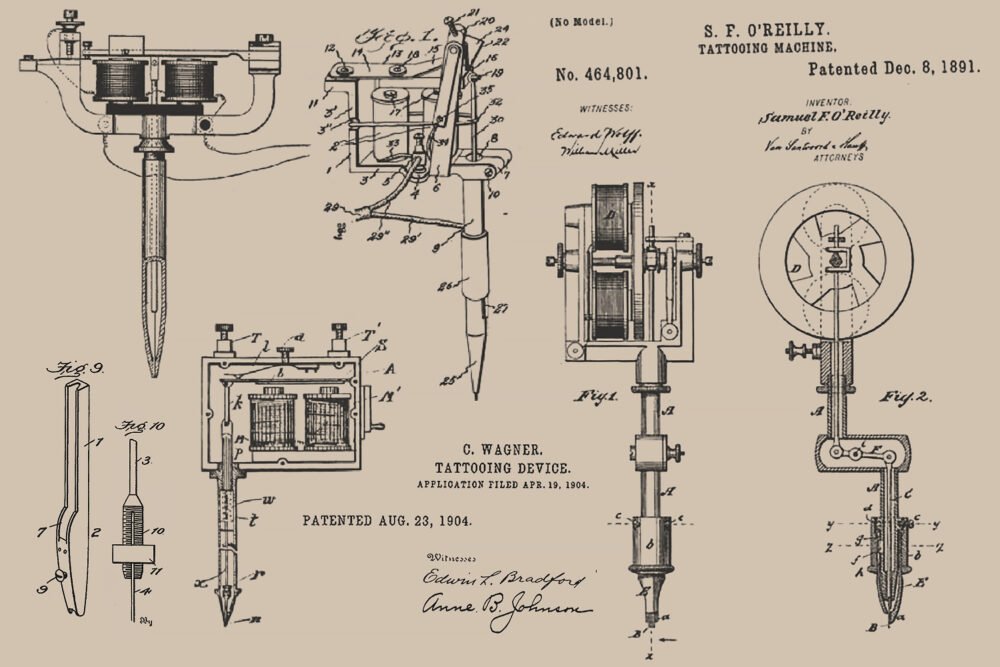
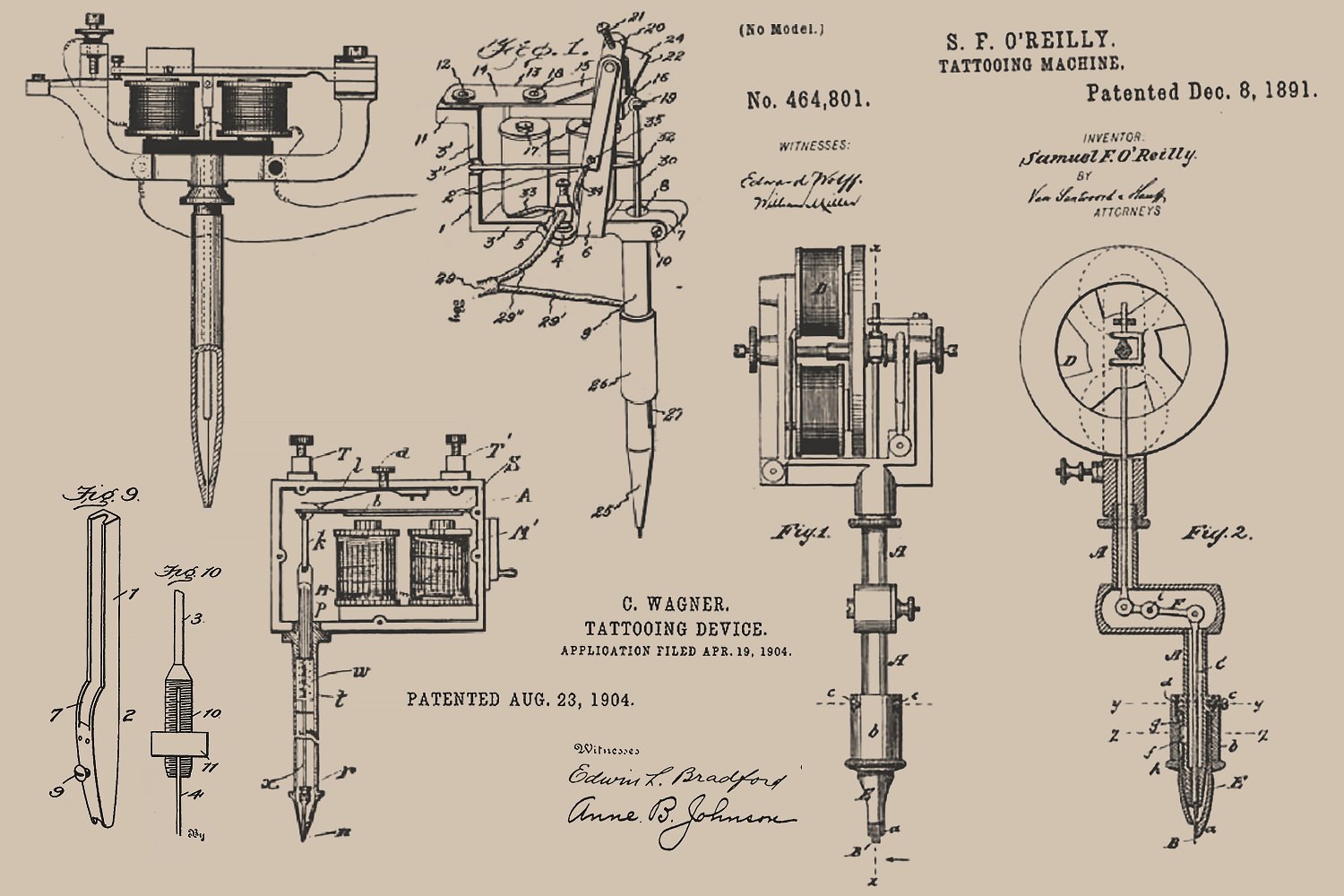
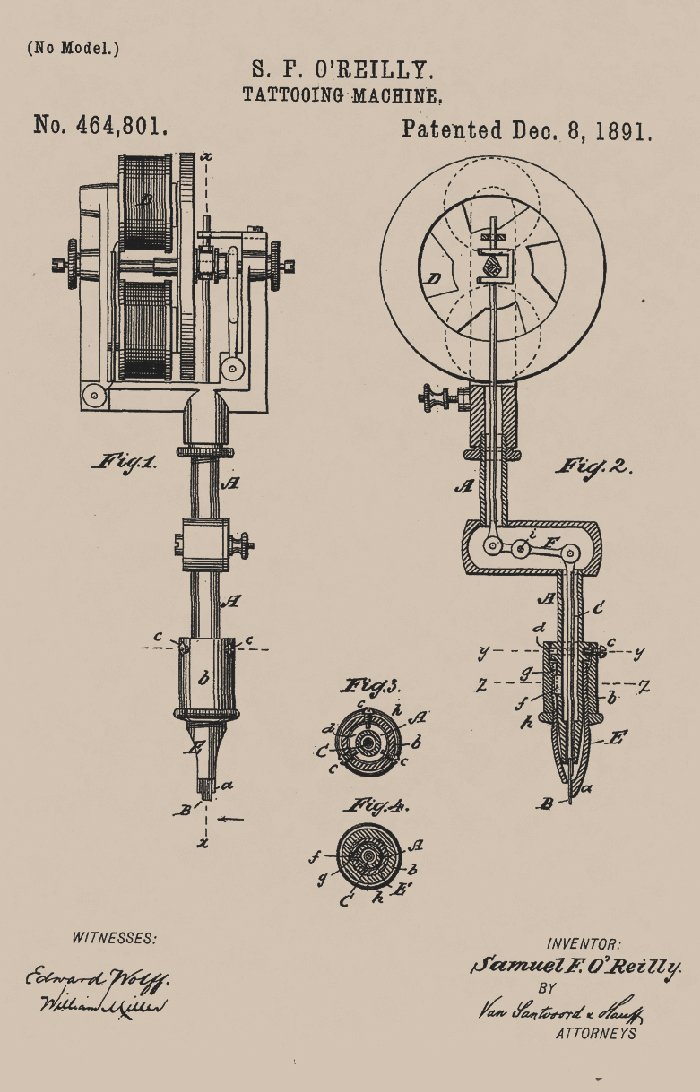
The patent application was filed on July 16, 1891. US Patent No. 464,801 was granted on December 8 of that year.
The key innovation was a tube-and-needle system with an integrated ink reservoir. Edison’s pen had punched holes in paper; O’Reilly’s machine punched ink into skin. He modified the original straight barrel to include right-angle bends that shifted the motor’s weight back over the operator’s hand, reducing fatigue during long sessions. The needle assembly could accommodate multiple needles. The mechanism was still rotary — a motor driving an armature bar that moved the needles up and down — faithful in its basic mechanics to Edison’s original design.
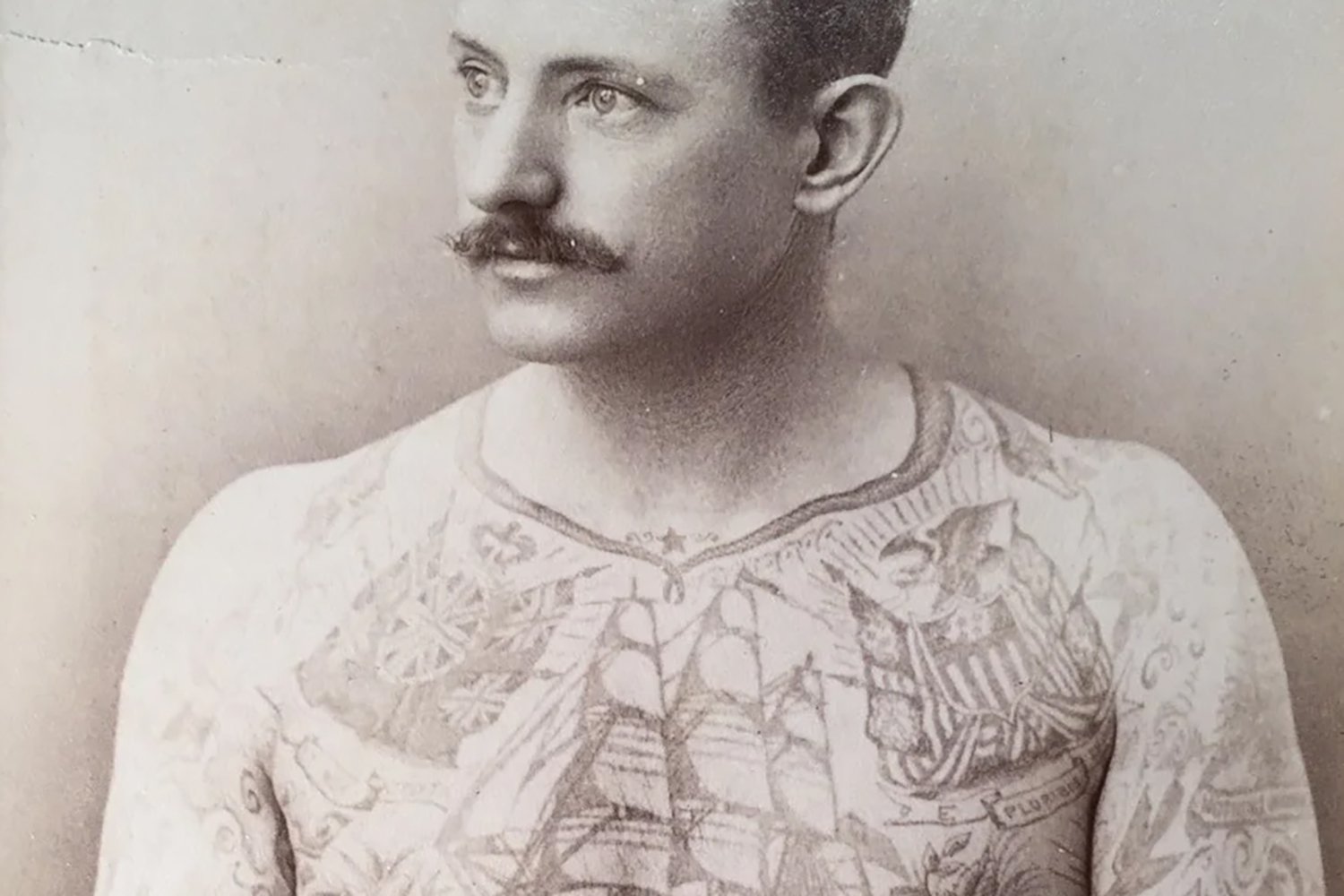
Even before the patent was granted, O’Reilly had been using earlier prototype machines to tattoo sideshow performers between 1889 and 1891. Among them were Tom Sidonia, a former tightrope walker and trick bicycle rider billed as “the most tattooed man in the world,” and George Karlavagn, whose back bore the words “Tattooed by O’Reilly.” These were, as far as the historical record shows, the first people tattooed by an electric machine.
The Dispute
O’Reilly’s patent did not go unchallenged. Elmer Getchell, a fellow New York tattooist who had worked with O’Reilly before falling out with him, began manufacturing and selling tattoo machines that O’Reilly claimed infringed on his patent. In 1899, O’Reilly filed suit in the Southern District of New York. The feud was public enough to make the New York Times on February 6, 1900, under the headline:
“Tattoo Artist at War.”
The 1901 New York City directory shows the two men working within sight of each other: O’Reilly at 5 Chatham Square, Getchell at number 11. Both lived in Brooklyn. The court case reached no clear resolution, and there is no record of O’Reilly ever establishing a supply business to sell his machines commercially. Only one example of his original patented machine is known to survive, and it is missing the distinctive tube assembly.
Twenty Days Later: London
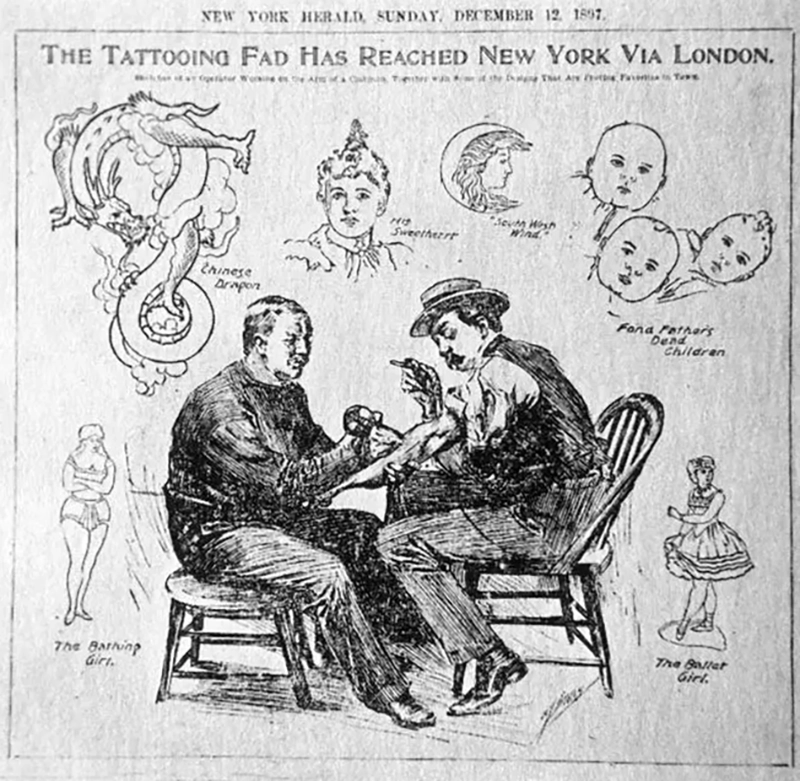
The electric tattoo machine was not solely an American development. Just twenty days after O’Reilly’s patent was filed, Tom Riley — a tattooist in London who had learned his trade in the British Army and built a reputation working in Liverpool and Glasgow before opening a shop on the Strand — produced an electromagnetic coil machine based on an entirely different principle.
Where O’Reilly had adapted Edison’s rotary motor, Riley adapted the electric doorbell. His machine placed a single electromagnetic coil inside a brass box. Current flowing through the coil magnetised a metal bar, pulling it toward the coil; the circuit then broke, the bar sprang back, and the cycle repeated. Each cycle drove the needle. The mechanism is called a make-and-break circuit, and it is the same oscillating principle that makes a doorbell ring continuously when you press the button.
Whether Riley actually received a British patent for this machine is uncertain. The claim originates with George Burchett, another prominent London tattooist, who stated that Riley had patented it in December 1891. However, at least one tattoo historian has searched British patent records and found no trace of it. A 1903 interviewer noted that Riley was using a single-coil machine and described it as co-invented with O’Reilly, further complicating the attribution.
Regardless of patent status, the electromagnetic coil approach — as distinct from O’Reilly’s rotary approach — emerged in London in the same period and became the foundation for most tattoo machines built in the twentieth century.
The Coil Machine Evolves
Riley’s single-coil design had an obvious limitation: power. A single coil produced a relatively weak magnetic pull.
The first confirmed British patent for an electric tattoo machine was granted to another London tattooist, Sutherland Macdonald (British Patent No. 3035), on February 12, 1894. Macdonald was already established as one of the most respected tattoo artists in England, operating from 76 Jermyn Street — a fashionable address above a Turkish bath — where his clients included royalty and European aristocracy. His patent described a cylindrical electromagnetic coil through the centre of which the needle bar passed. The design was compact and self-contained, but its complexity limited its practicality; a Strand Magazine article from 1897 noted that Macdonald still preferred Japanese hand tools with ivory handles for shading and heavy work. Macdonald’s patent is significant as documentation: where Riley’s British patent has never been located in the archives, Macdonald’s is a confirmed, dated record.
Alfred Charles South, also working in London, addressed the power problem by building a dual-coil machine. He was granted a patent for it around 1899. The two coils, placed side by side in a steel frame, delivered more force to the needle — but at a cost. South’s machines were so heavy that tattooists had to hang them from the ceiling on a spring to take the weight off their working hand.
George Burchett, who had seen or used Riley’s original, added a switch that allowed the artist to stop the machine when changing pigments — meaning the operator no longer had to disconnect or re-engage the power source between colours.
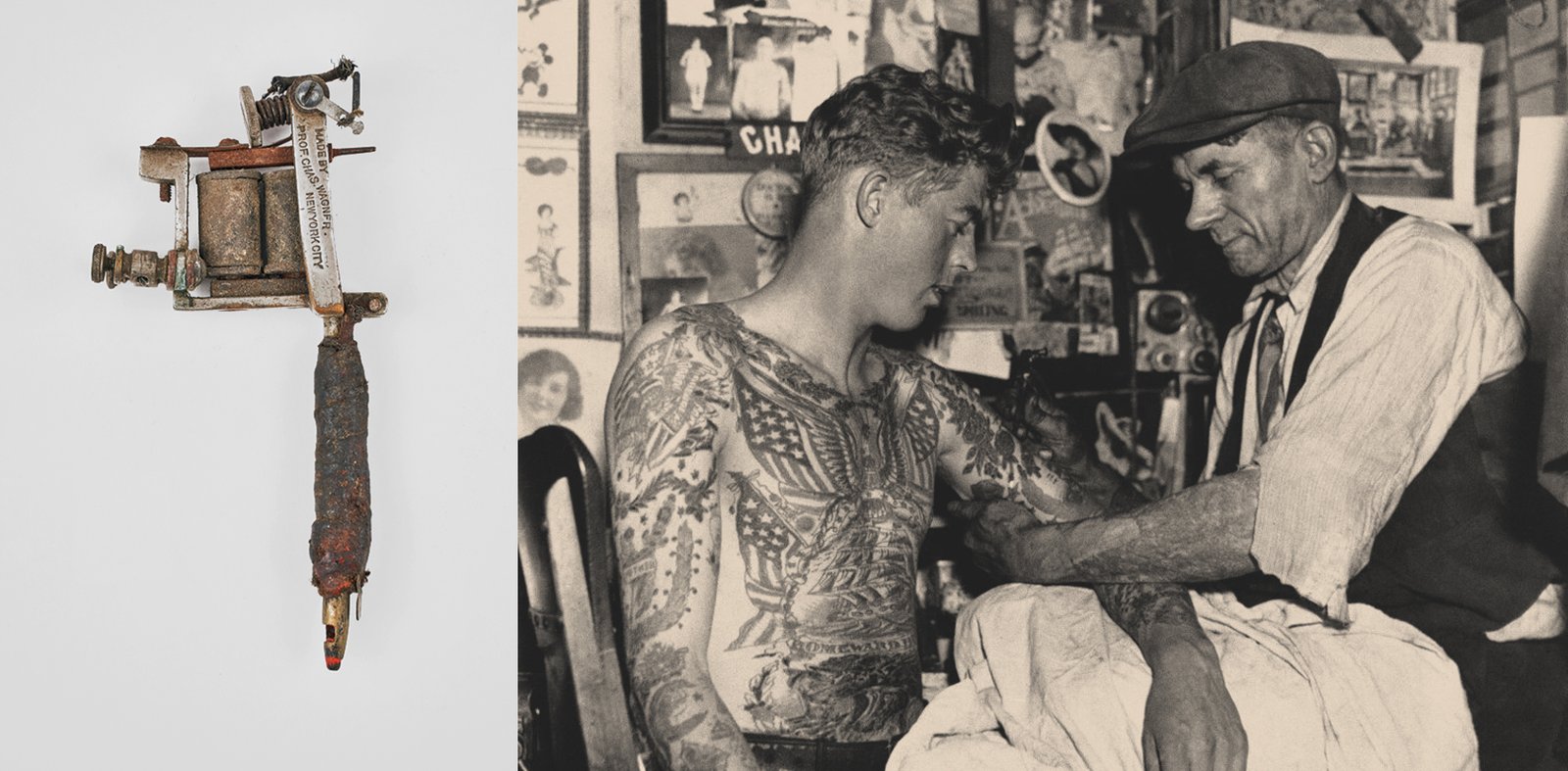
The next major step came in New York. Charlie Wagner — a tattooist who took over O’Reilly’s Chatham Square shop after O’Reilly’s death — filed his own patent in 1904 (US Patent No. 768,413, filed April 19, granted August 23). Wagner’s machine was the first American dual-coil design. His coils were set side by side, transverse to the frame, and required a cross-shaped armature bar to drive the needles. The coil placement and contact bars closely resembled Edison’s 1877 improved stencil pen, suggesting Wagner drew on Edison’s coil-based patent as well as O’Reilly’s rotary one. The machine was complex to manufacture but sold well to both professional tattooists and amateurs, and Wagner ran a supply business from Chatham Square alongside his tattoo practice.
Whether Wagner was formally O’Reilly’s apprentice is debated. Wagner himself claimed this in an interview for Albert Parry’s 1933 book Tattoo: Secrets of a Strange Art, but no documentation has been found to confirm that the two men shared a workspace. Wagner’s machine was built directly on O’Reilly’s work, and Wagner took over the 11 Chatham Square location — originally Getchell’s — after O’Reilly moved there in 1904. When O’Reilly died on April 29, 1909, after a fall while painting his house, Wagner continued operating from the same address until his own death in 1953.
Percy Waters and the Modern Machine
Up to 1929, the design considerations for tattoo machines were limited to weight, power source, coil size, coil orientation, and fabrication material. No one had systematically addressed what is now called frame geometry — the relationship between the angles and distances of a machine’s components and its performance in the skin.
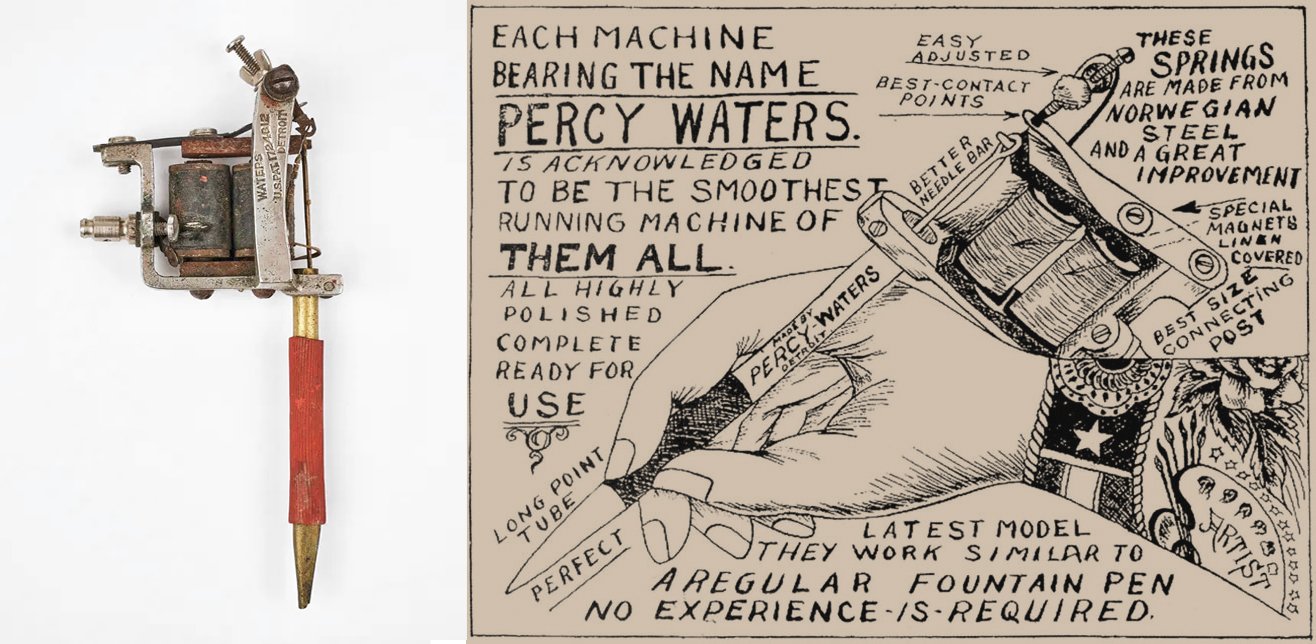
Percy Waters of Detroit changed that. He designed and manufactured fourteen different frame styles, and on August 13, 1929, he was granted a US patent for a machine that set the coils in line with the frame rather than transverse to it. The coils were parallel with the tube assembly, creating a more compact and balanced configuration. His design also included a fingertip on/off switch mounted on the tube grip, a spark shield, and an adjustable needle stroke. By varying the angle of the contact screw — which determines the depth and force of the needle stroke — Waters could configure machines to perform differently for lining versus shading. This was the first time a tattoo machine had been designed around the principle that different tasks require different mechanical behaviour.
Waters ran what was probably the largest tattoo supply company in the world through the 1920s and 1930s, advertising in men’s magazines, the Police Gazette, and Billboard. He sold machines through magazine ads with instructions, inks, and books of designs. The tattoo supply kit, as a commercial product category, largely originates with him. He returned to his home in Anniston, Alabama, in 1939 and ran his supply business from there until his death in 1952. The Henry Ford Museum in Dearborn holds his original flash portfolio — approximately 277 full-colour watercolour paintings.
No new tattoo machine patent was granted by the US Patent and Trademark Office for 50 years after Waters. In that time, tattooing legends — Paul Rogers, Norman “Sailor Jerry” Collins, Milton Zeis, Owen Jensen, Bill Jones — took Waters’ basic designs and made them their own. Most of those configurations are still in production.
After Waters
Manfred Kohrs of Hannover reintroduced rotary technology in the late 1970s, returning to the basic principle Edison had used in 1876 but with modern motors. Carson Hill patented a pneumatic machine powered by compressed air in 2000 — a design that traces back to yet another Edison patent, the Pneumatic Stencil Pen of 1878. More recently, pen-style rotary machines with brushless motors have gained wide adoption for their lighter weight, quieter operation, and portability.
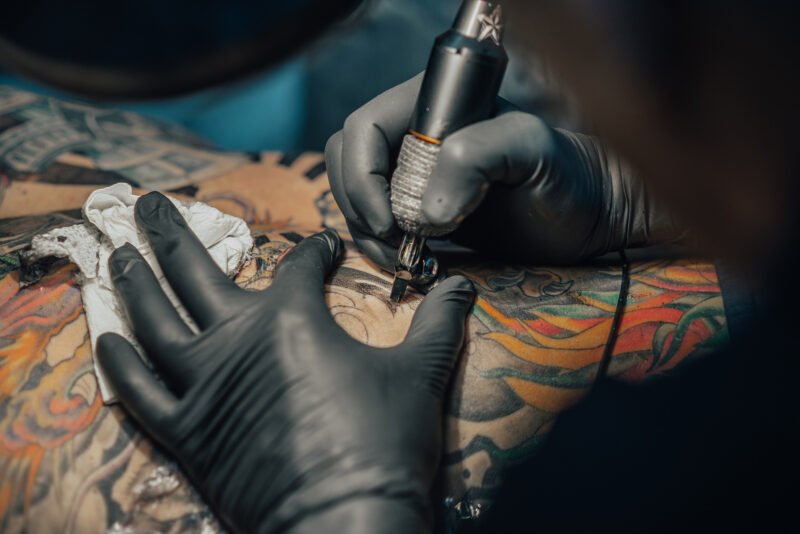
All of them still use a power source to drive a needle in and out of the skin at a speed no human hand can match — the core mechanical idea that O’Reilly patented in 1891.
Sources & further reading
- Samuel O’Reilly, Charlie Wagner, Sutherland Macdonald, Percy Waters, Tattoo Machines pages in the Tattoo Archive.
- A Revolution in Tattooing. Smithsonian Institution, National Museum of American History (si.edu).
- What’s Edison Got to Do with Tattoos? Lemelson Center for the Study of Invention and Innovation, Smithsonian Institution.
- Thomas Edison’s Electric Pen. Science Museum Blog, 2021.
- Original Model of Edison’s Patent Electric Pen, 1875–1876. Science Museum Group Collection.
- Tom Riley (tattoo artist) and Sutherland Macdonald on Wikipedia, The Free Encyclopedia.
- Albert Parry. Tattoo: Secrets of a Strange Art. Simon & Schuster, 1933.
- Samuel O’Reilly, interview. New York Sun, 1898.
- Emily Glynn-Farrell. The Irish-American Who Invented the Modern Tattoo Machine. The Irish Times, 2018.
- Tattoo Machine History. The James Street Parlour.
- History of the Tattoo Machine. Wild Bill’s Tattoo.
Patents referenced:
- Thomas Edison. “Autographic Printing.” US Patent No. 180,857, 1876.
- Thomas Edison. “Improvement in Stencil-Pens.” US Patent No. 196,747, 1877.
- Sutherland Macdonald. “Electrically Operated Instrument for Tattooing the Skin.” British Patent No. 3035, 1894.
- Samuel O’Reilly. “Tattooing Machine.” US Patent No. 464,801, 1891.
- Charles Wagner. “Tattooing Device.” US Patent No. 768,413, 1904.
- Percy Waters. Tattoo machine patent, 1929.