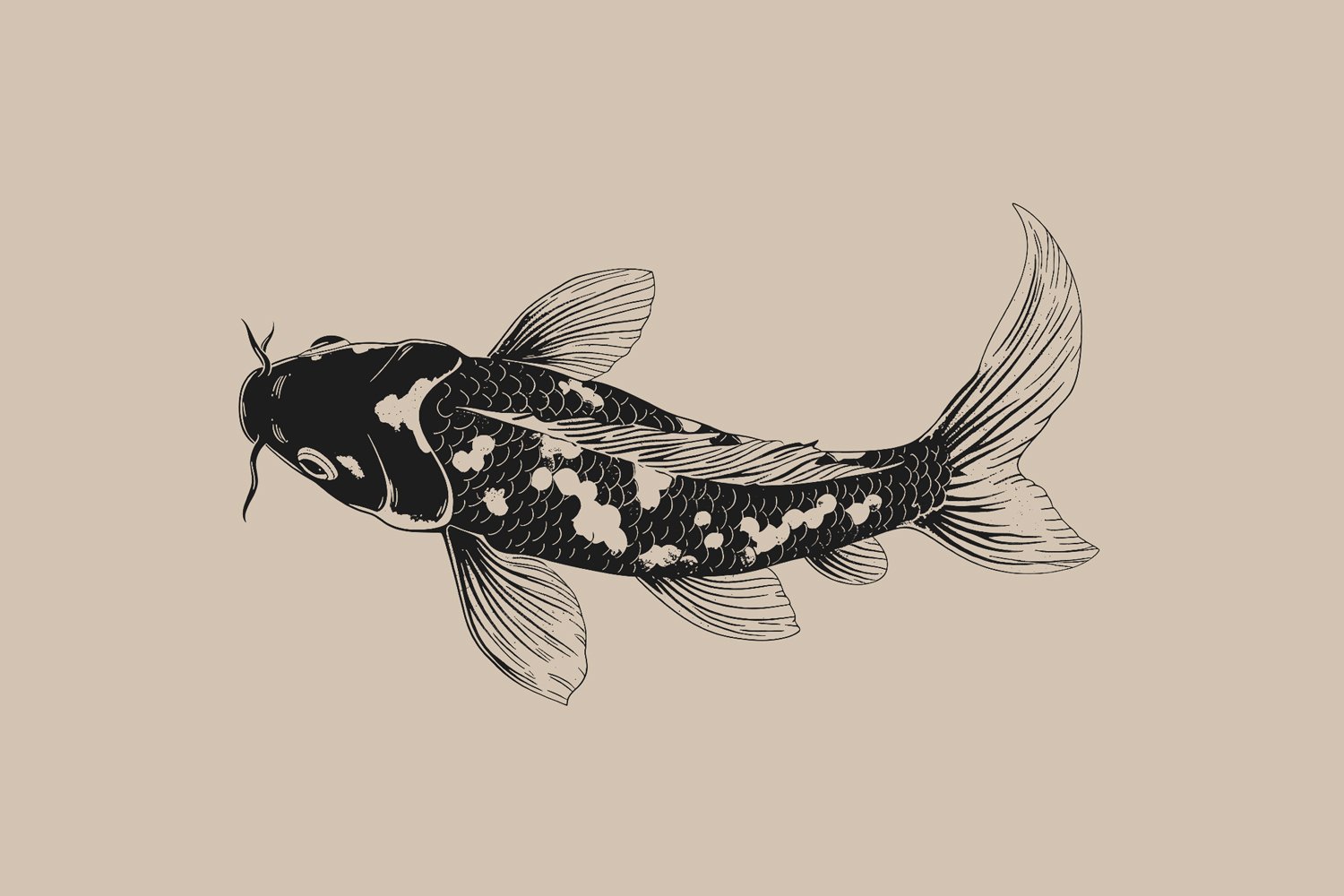
Koi fish tattoo
Koi fish: An animal that became a symbol, that became a system
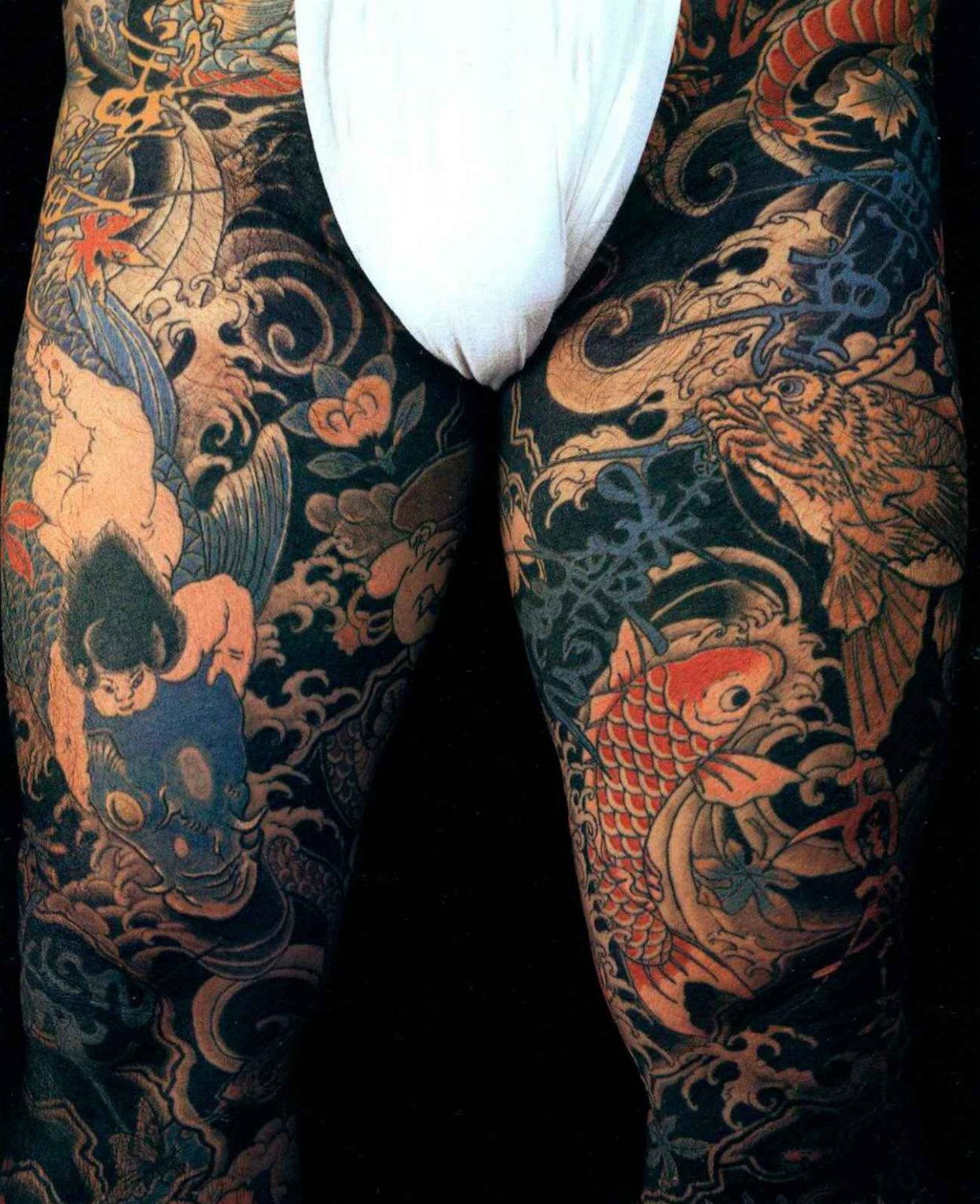
The koi is one of the most tattooed animals in the world, and one of the few where every variable in the design — colour, direction, number, pose, and accompanying elements — carries specific, codified meaning within the tradition that produced it. A red koi swimming upstream through waves means something different from a black koi swimming downstream through calm water, which means something different from a gold koi leaping over a waterfall, which means something different from two koi circling each other. These are specific readings within a visual system developed and refined over centuries of Japanese and Chinese art, and they translate directly into tattooing — particularly into irezumi, the Japanese tattoo tradition in which the koi is a core subject.
This level of symbolic precision is unusual among tattoo subjects. Most animals carry a general set of associations (the eagle represents freedom, the wolf represents loyalty) that the wearer interprets freely. The koi carries a system — a vocabulary of specific meanings that the artist and the wearer can use to say something particular. Understanding that system is the difference between getting a koi tattoo and getting the right koi tattoo.
The species
The ornamental fish commonly called “koi” are selectively bred varieties of the Amur carp (Cyprinus rubrofuscus), originally native to Central Asia. In Japanese, the precise term is nishikigoi — literally “brocaded carp” — referring to the vivid colour patterns produced through centuries of selective breeding. The word “koi” in Japanese means “carp,” including wild, uncoloured varieties. In English, “koi” has come to mean the ornamental fish specifically.
Carp were first bred for food in China over two thousand years ago and were introduced to Japan through Chinese trade. Japanese rice farmers in the Niigata region began noticing natural colour mutations among the carp in their rice paddies in the early 1800s and started selectively breeding them for their appearance. This practice produced more than 120 recognised varieties of nishikigoi that exist today, classified by scale type, colour, and pattern — Kohaku (red and white), Sanke (red, white, and black), Showa (black, red, and white), Ogon (solid metallic gold), Asagi (blue-grey with red belly), and many others.
Koi are long-lived. Under good conditions, they can survive 25 to 35 years. Exceptional specimens live much longer — Hanako, the most famous individual koi in history, was reportedly 226 years old at the time of her death in 1977, her age verified by microscopic analysis of her scales, though some scholars dispute the methodology.
The biological qualities that matter for the koi’s symbolic weight are specific. Koi swim against currents. In rivers, they move upstream, and this behaviour — observable, consistent, and demanding — is the biological foundation of the koi’s association with perseverance, determination, and the refusal to yield to opposing force. Koi are also hardy and adaptable, surviving in a range of water temperatures and conditions. And when caught, koi are reported in Japanese tradition to lie still and accept death calmly — a behaviour compared to the composure of a samurai facing the sword.
China: The legend of koi at the Dragon Gate
The central myth behind the koi’s symbolic meaning originated in China and was later adopted by Japan. The legend, known as the Dragon Gate (Longmen), has been retold in many versions across centuries, but the core narrative is consistent.
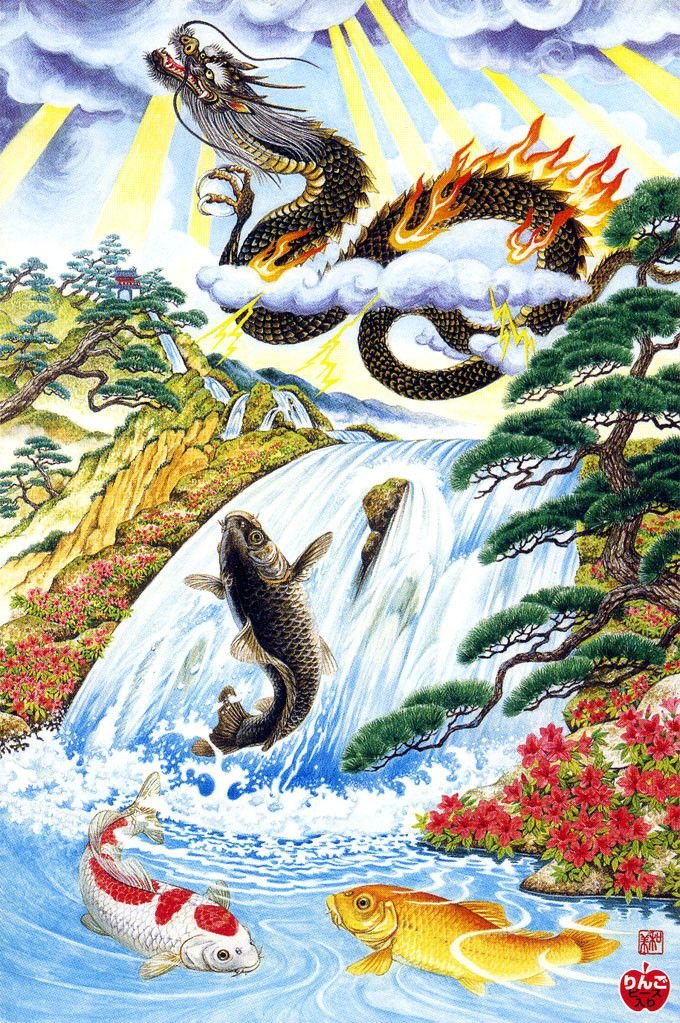
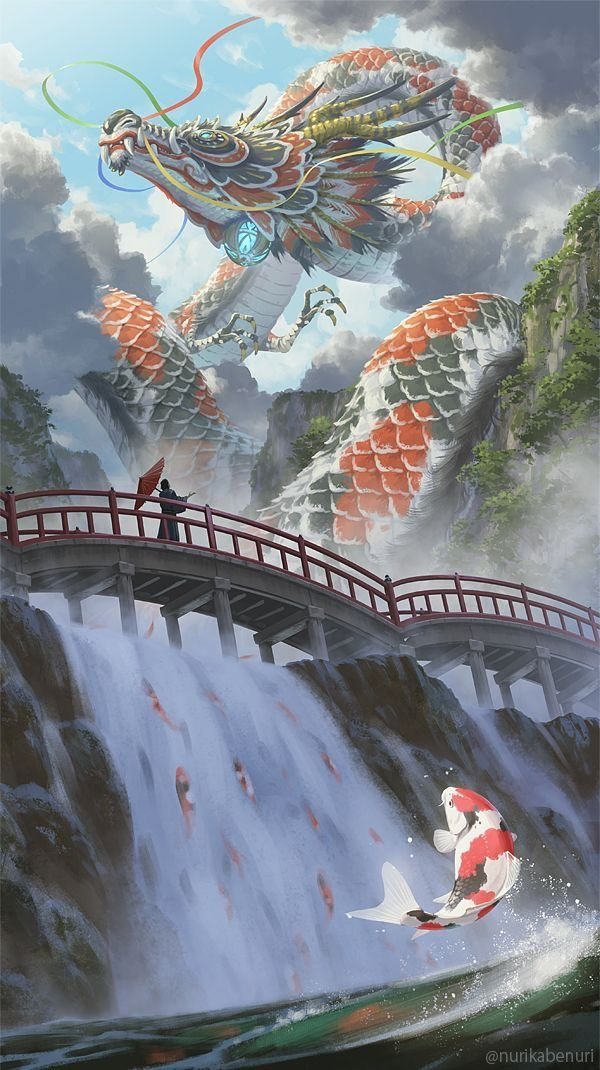
In the Yellow River, a great school of golden koi swam upstream against the powerful current. The journey was long and arduous. Most of the fish turned back. Those that persisted eventually reached a massive waterfall — the Dragon Gate, traditionally associated with the rapids and falls on the Yellow River. The remaining koi gathered at the pool below the falls and attempted to leap over them. The effort spanned years. Demons, amused by the spectacle, raised the height of the waterfall to make the task harder. One by one, the koi failed and fell back. Finally, after a hundred years of attempts, a single koi succeeded — leaping over the top of the falls. The gods, recognising its perseverance, transformed it into a golden dragon. Thunder sounded, lightning flashed, rain fell, and the dragon ascended into the sky.
The legend became a metaphor for the Chinese imperial examination system — the gruelling civil service exams that were the primary path to status, wealth, and power in imperial China. Passing the exams was known as “climbing the Dragon Gate” (denglong men), particularly for candidates from humble or rural backgrounds, for whom success represented a transformation as dramatic as carp becoming dragon. The acceptance rate could be less than one per cent, and many candidates did not pass until their forties. The koi’s hundred-year struggle was not abstract — it mapped directly onto the lived experience of generations of Chinese scholars.
The Dragon Gate legend is the source of the koi’s core symbolic meanings: perseverance through adversity, determination in the face of overwhelming odds, transformation as the reward for sustained effort, and the understanding that the struggle itself — the years of swimming upstream — is what produces the strength needed for the final leap.
Japan: samurai, seasons, and the koinobori
Japan adopted the Dragon Gate legend from China and made it central to its own cultural identity. The koi became associated with the samurai warrior class — the determination to swim upstream was compared to the samurai’s resolve to face any obstacle, and the koi’s reported calmness when caught echoed the bushido ideal of meeting death with composure.
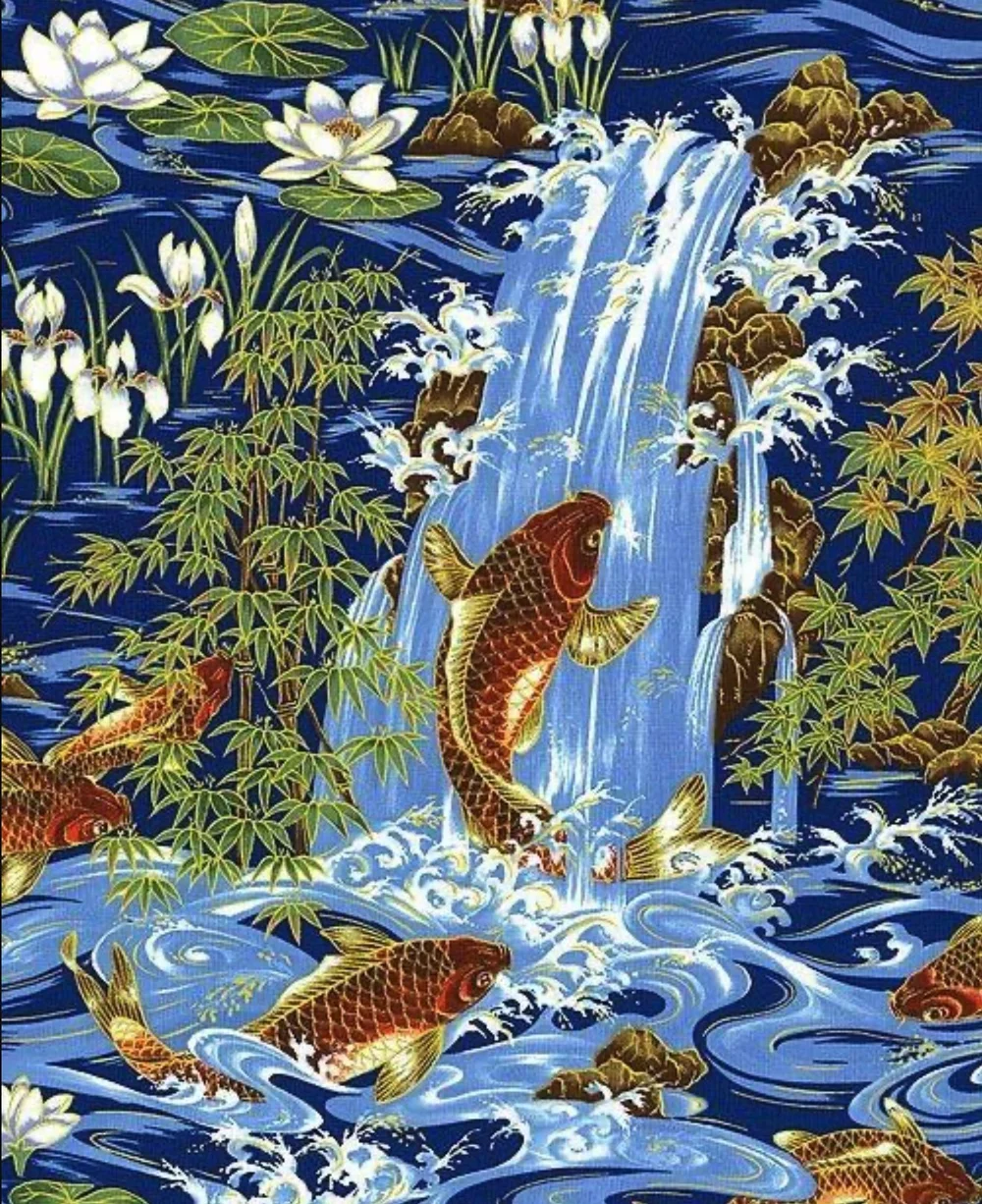
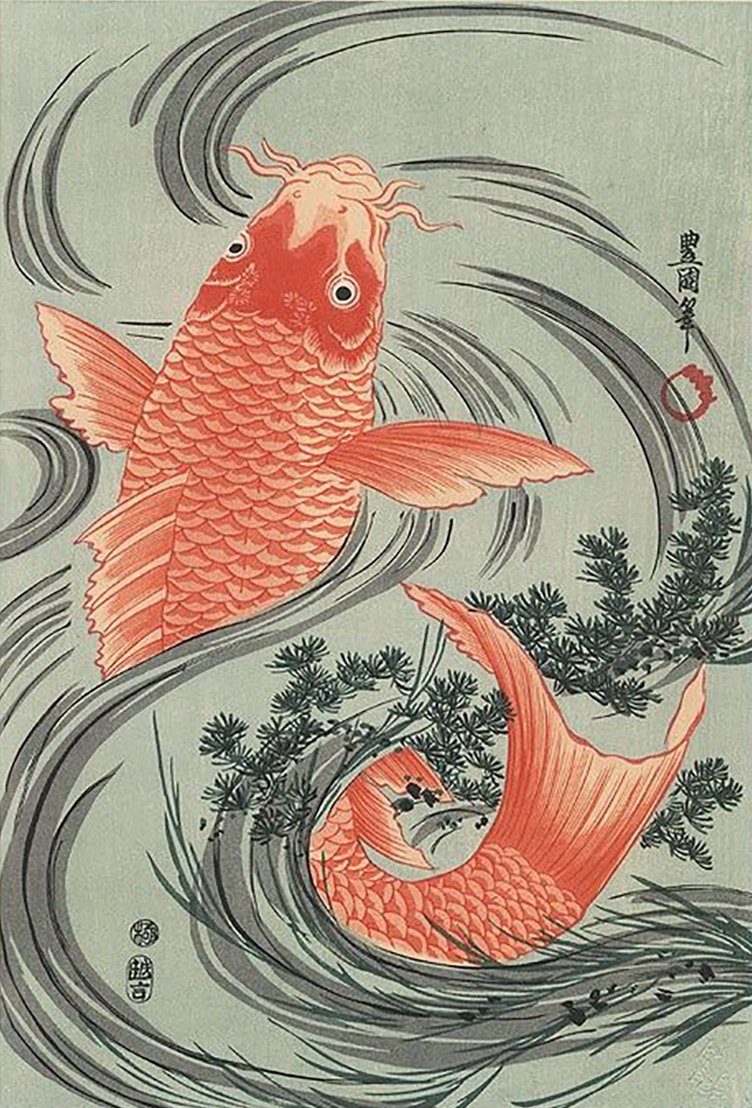
The phrase koi no taki-nobori — “koi climbing the waterfall” — became a proverb for ambition, determination, and the beauty of sustained effort. The image of a koi leaping against cascading water became one of the most iconic compositions in Japanese visual art, appearing on screens, scrolls, woodblock prints, and decorative objects from the Edo period onward.
On Children’s Day (Kodomo no Hi, celebrated May 5th), families fly carp-shaped windsock streamers called koinobori outside their homes. Each streamer represents a family member — the largest, typically black, represents the father; a red or orange streamer represents the mother; smaller streamers in various colours represent the children. The streamers fly in the wind, appearing to swim upstream against the air current — a visual expression of the parents’ hope that their children will grow up with the koi’s spirit: resilient, determined, and capable of overcoming whatever they face.
In Japanese art, the koi is seasonally associated with late spring and early summer — the period when carp are most active in rivers and when Children’s Day falls. This seasonal association carries over into irezumi, where the choice of accompanying elements should follow the tradition’s seasonal logic. A koi paired with cherry blossoms (spring) or peonies (late spring to early summer) is seasonally coherent. A koi paired with chrysanthemums (autumn) or snow-covered branches (winter) breaks the seasonal convention, which can be done intentionally, but should be a conscious decision.
The koi in irezumi
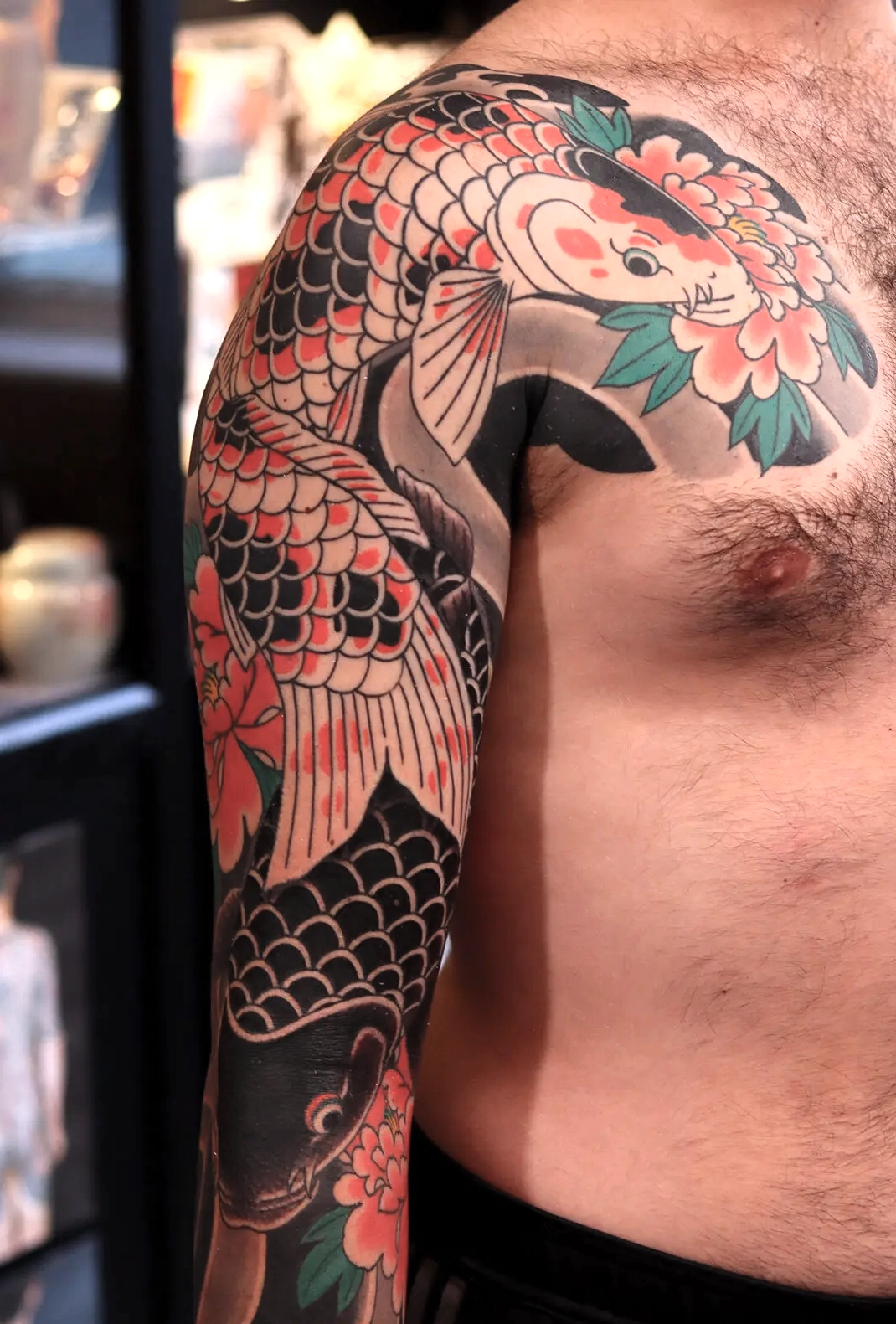
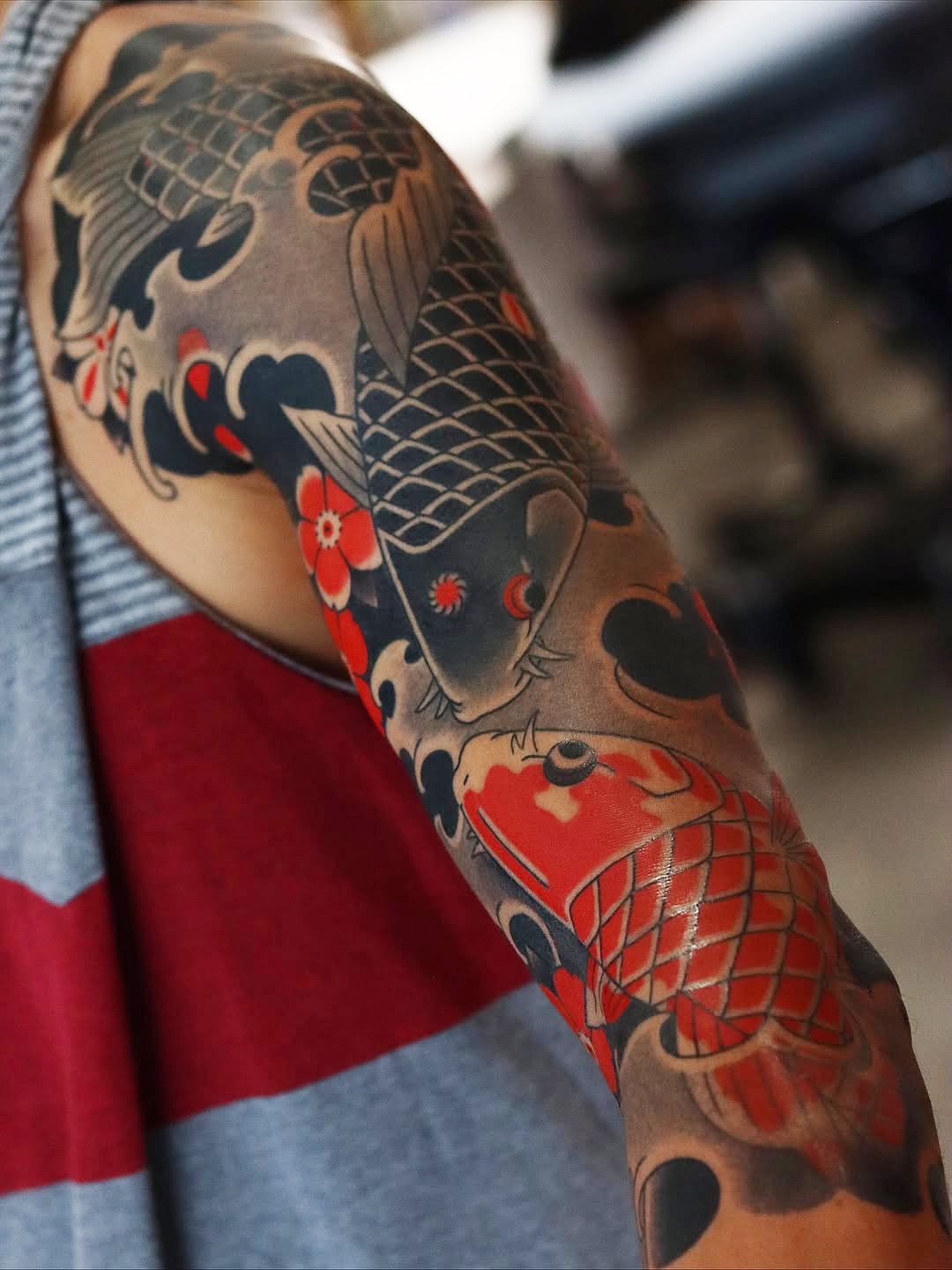
The koi in irezumi is a dynamic subject. It is almost always depicted in motion — swimming, leaping, twisting through water. The body of the koi curves and bends, following the flow of current and the contours of the wearer’s anatomy. This physical dynamism makes the koi one of the most compositionally versatile subjects in Japanese tattooing — it wraps naturally around arms, follows the curve of ribs, descends legs, and fills backs with flowing, continuous movement.
Direction
The direction the koi swims is the most symbolically significant variable in the design.
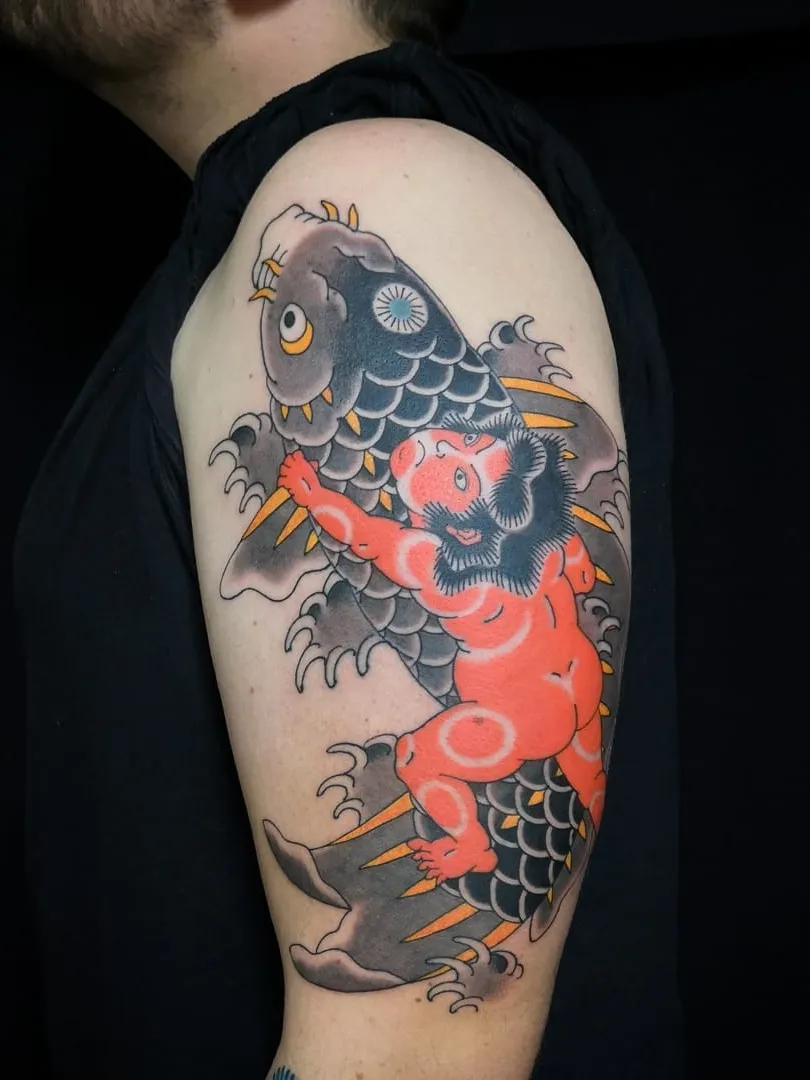
Upstream — swimming against the current, head pointed upward or into flowing water. This is the most commonly chosen direction and directly references the Dragon Gate legend. An upstream koi represents a struggle in progress — the wearer is still fighting, still climbing, still pushing against the current. It communicates determination, ambition, and the refusal to yield. In irezumi tradition, the upstream koi is associated with masculine energy (yang) and an active, forward-driving force.
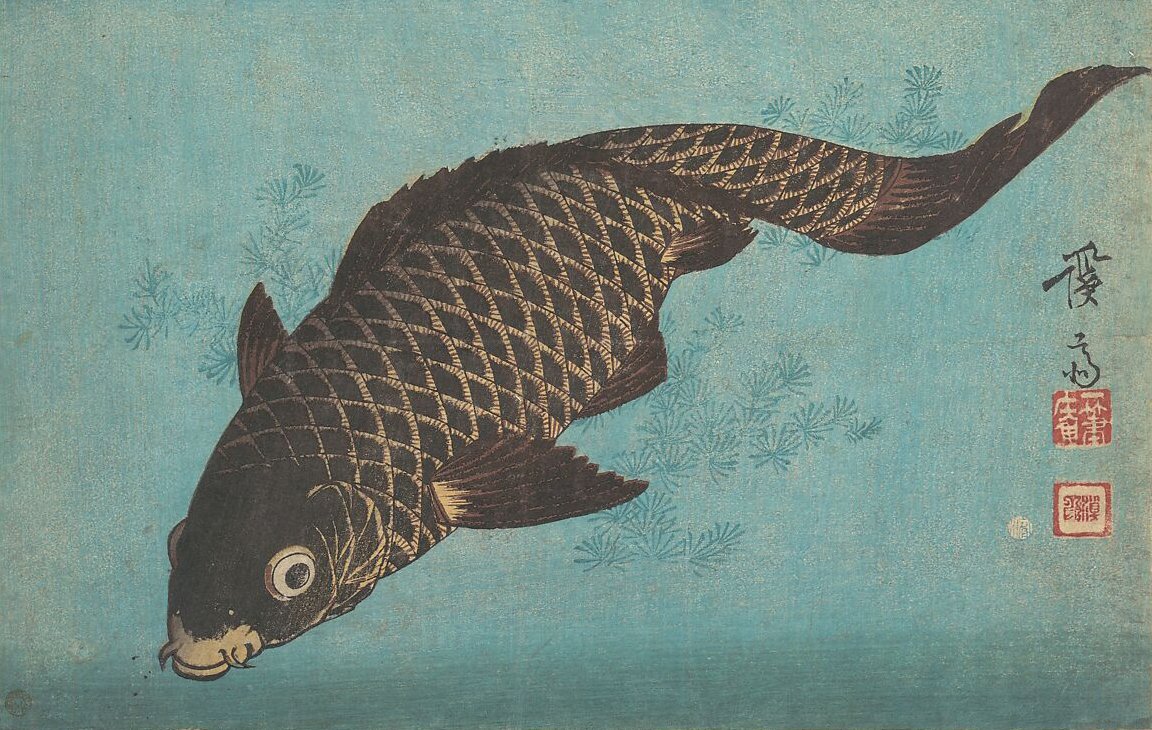
Downstream — swimming with the current, head pointed downward or in the direction of water flow. In Western tattoo culture, the downstream koi is sometimes misread as representing defeat or surrender. In the traditional reading, it means the opposite: the koi has already conquered the waterfall. The struggle is over. The downstream koi represents a person who has achieved their goal, overcome their challenge, and now moves with the current rather than against it. It communicates quiet strength, wisdom earned through hardship, and the peace that follows resolution.
Leaping — the koi in mid-air, clearing the waterfall or breaking the water’s surface. This is the moment of transformation — the instant before the koi becomes a dragon. A leaping koi represents the climax of the struggle, the threshold between what was and what will be.
Some compositions place an upstream koi and a downstream koi together — one on each side of the body, or both within a single composition. This pairing represents both aspects of the journey: the struggle and its resolution, the fight and the peace that follows. The combination is an honest depiction of a complete experience rather than an aspirational snapshot of one part of it.
Colour
In Japanese tradition, the colour of the koi carries specific associations. These are rooted in the koinobori tradition (where family members are represented by differently coloured carp) and in broader Japanese colour symbolism.
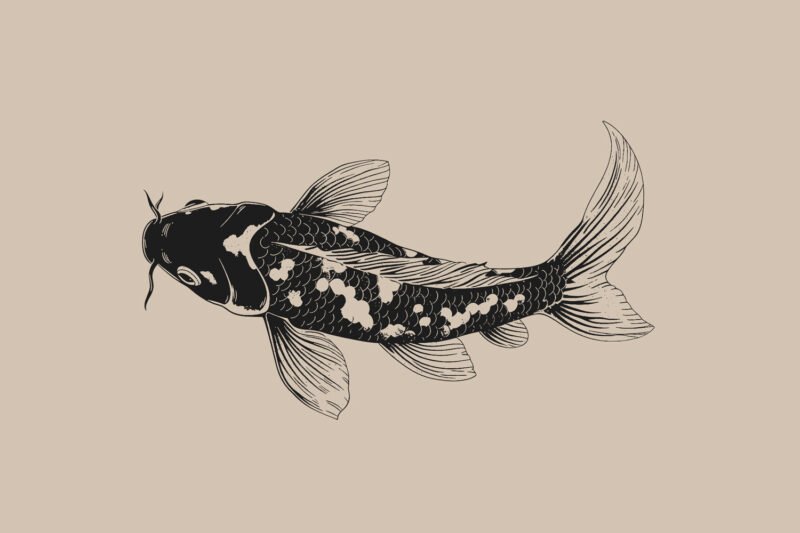
Black (Kumonryu, Karasu). Represents overcoming adversity — specifically, adversity that has already been conquered. The black koi carries weight and gravity. In the koinobori tradition, the black carp represents the father — the family’s protector and provider. A black koi tattoo is often chosen by people who have been through significant hardship and want to mark their survival and the strength they gained from it.
Red (Kohaku, Benigoi). Represents intense love, passion, bravery, and energy. The red koi is bold and commanding — the most visually aggressive of the colour options. In the koinobori tradition, a red or orange carp represents the mother. Red koi tattoos carry associations with fierce love, emotional intensity, and the courage that comes from caring deeply.
Gold / Yellow (Yamabuki Ogon, Hariwake). Represents wealth, prosperity, and success. The gold koi is the one in the Dragon Gate legend — the carp that transforms into a golden dragon. A gold koi tattoo carries the most direct connection to the legend’s themes of transformation and the rewards of perseverance.
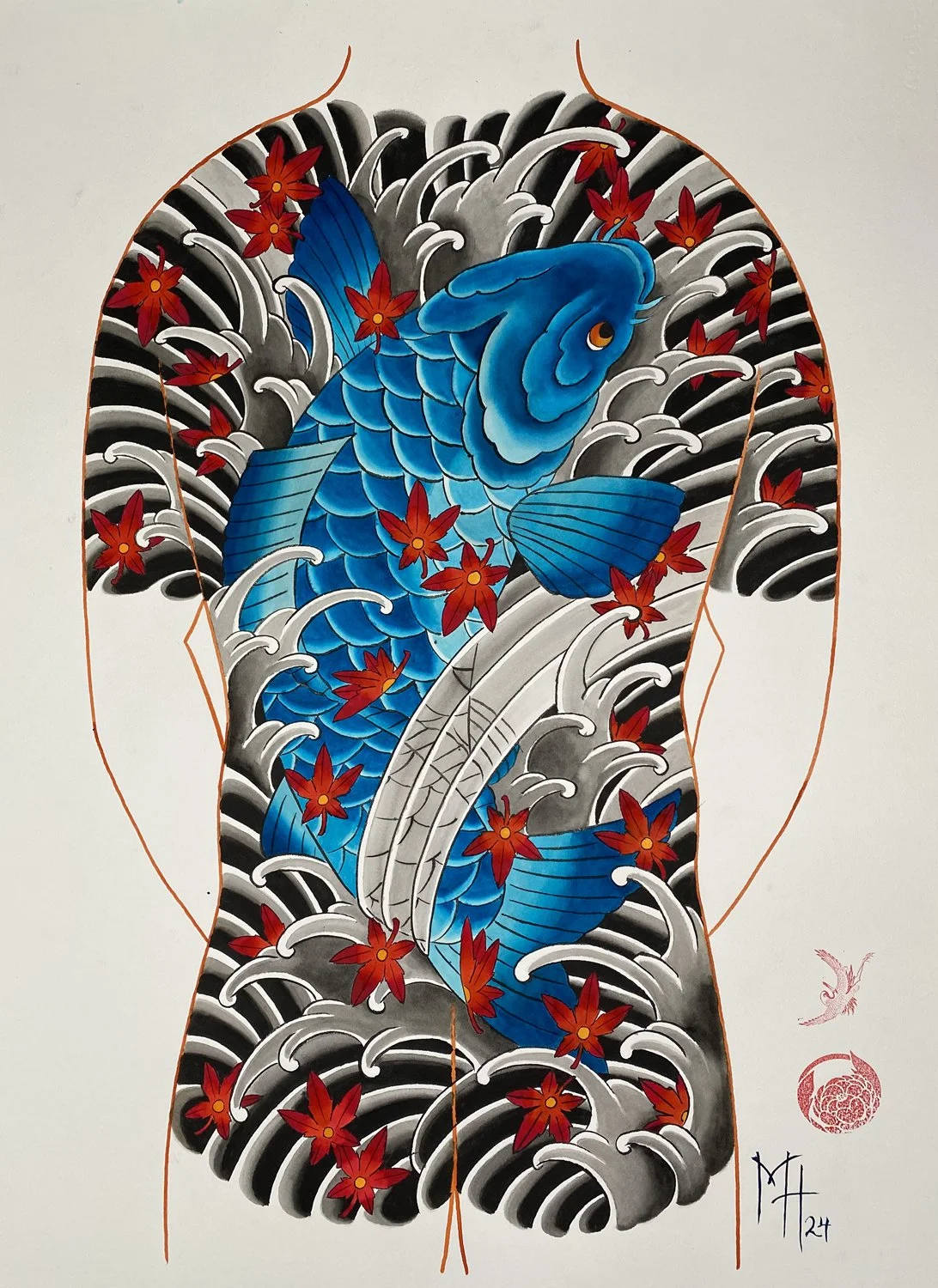
Blue (Asagi, Shusui). Represents masculinity, calm strength, tranquillity, and — in the koinobori tradition — the son. Blue is the most understated of the standard koi colours, carrying a quieter energy than red or gold.
White (Platinum Ogon, Gin Matsuba). Represents career advancement, success in professional life, and — when combined with red in the Kohaku pattern — love and relationship harmony. White also carries associations with purity and spiritual progress.
Pink / Light red. Represents the daughter in the koinobori family system, as well as femininity, grace, and gentleness.
Number
The number of koi in a composition also carries meaning in Japanese and Chinese tradition.
One koi represents individual perseverance, personal struggle, or a solitary achievement. It emphasises the self and the personal journey.
Two koi — particularly two koi swimming in a circle — represent duality, balance, and partnership. This composition directly references the yin-yang principle: two forces in a dynamic opposition and complementary relationship. Two koi circling each other represent a meaningful relationship — romantic, familial, or otherwise — in which both parties support and balance the other. Two koi swimming in the same direction represent shared purpose and moving through life together.
Multiple koi (three or more) can represent family (following the koinobori tradition, with each fish representing a family member), community, or collective effort. A composition with many koi swimming upstream references the Dragon Gate legend’s school of carp — most of which turned back, some of which persisted.
Accompanying elements
In irezumi, the koi is rarely depicted alone. It is composed with background elements that provide context, atmosphere, and additional symbolic layers. The choice of accompanying elements is governed by the seasonal and symbolic conventions of the tradition.
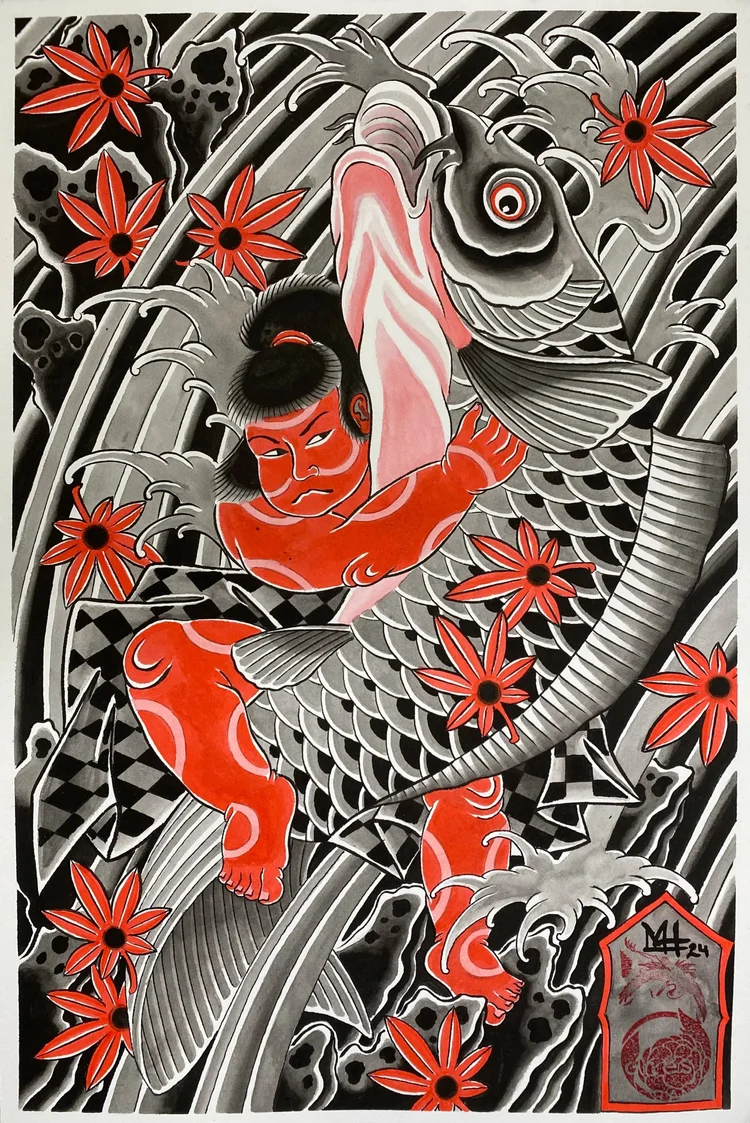
Water and waves. The most fundamental pairing. The treatment of the water affects the reading: churning, violent waves represent a fierce struggle; calm, flowing water represents peace or a journey in progress; a waterfall represents the Dragon Gate itself. Water in irezumi is rendered with specific conventions — wave patterns, spray, foam, current lines — that are themselves an art form.
Lotus flowers. The most classic pairing with koi. The lotus grows from mud at the bottom of a pond, rising through murky water to bloom on the surface — a metaphor for beauty and enlightenment emerging from suffering and difficulty. Koi and lotus together represent the complete arc: the struggle through dark water and the bloom that follows.
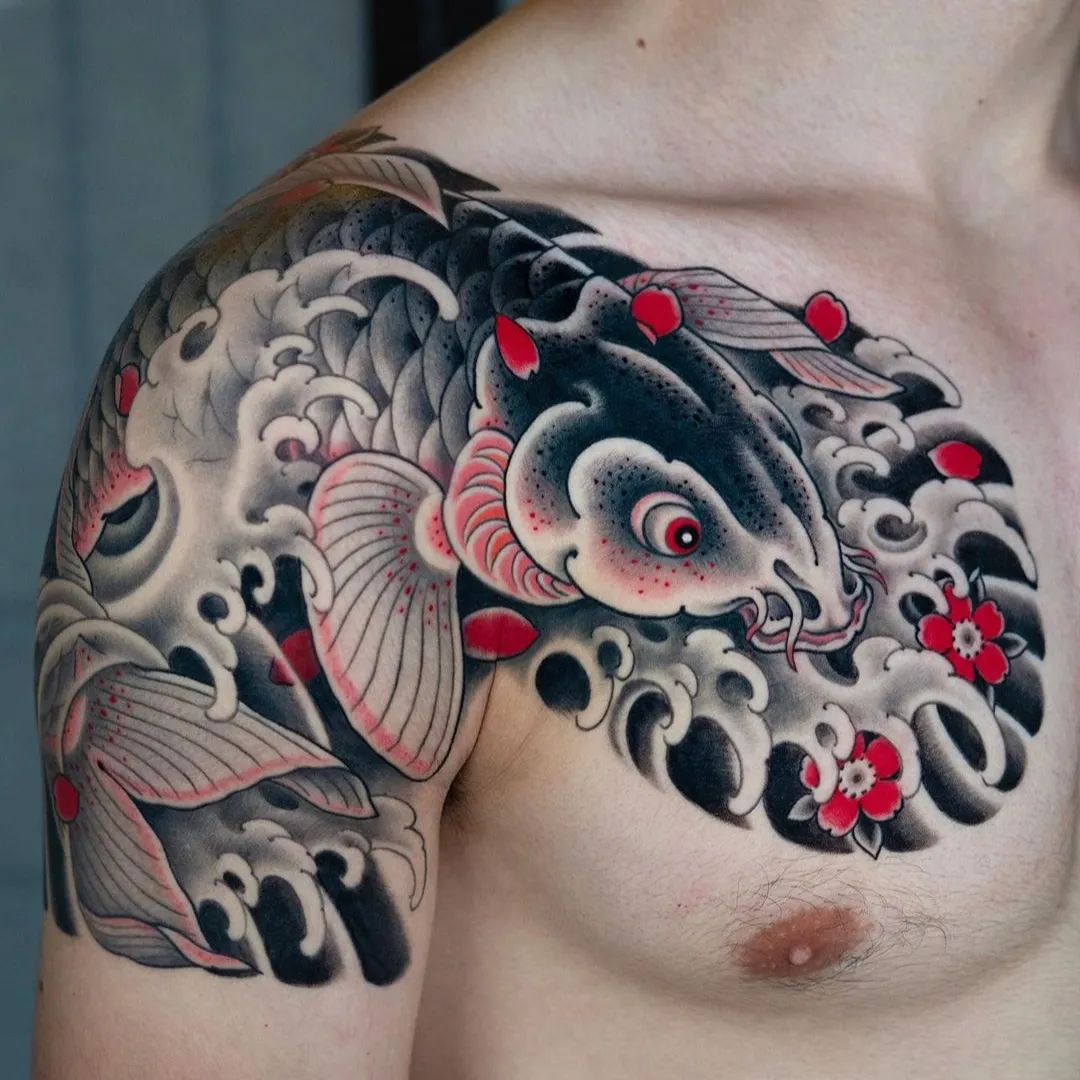
Cherry blossoms (sakura). Represent the transience of life and the beauty of impermanence. Paired with a koi, they balance the koi’s themes of endurance and strength with a reminder that life, beauty, and the present moment are fleeting. Cherry blossoms tie the composition to spring.
Peonies (botan). Known as the “King of Flowers” in Japanese art, the peony represents wealth, honour, good fortune, and boldness. Koi and peony together create an assertive, prosperous composition. Peonies tie the piece to late spring and early summer.
Chrysanthemums (kiku). Represent longevity, perfection, and royalty. Paired with koi, they suggest a long, determined life. Chrysanthemums are associated with autumn — pairing them with koi breaks the seasonal convention (koi are a spring/summer subject), which can be done intentionally to create a composition about endurance across seasons.
Maple leaves (momiji). Associated with autumn, the passage of time, and graceful change. Paired with koi, they represent reflection on a journey, the beauty of ageing, and the acceptance of life’s transitions.
Dragon. The most direct reference to the Dragon Gate legend. A composition showing a koi transforming into a dragon — half fish, half dragon — depicts the moment of transformation itself. This is one of the most powerful compositions in irezumi: the koi that has conquered the waterfall, caught in the act of becoming something greater.
Skull (namakubi / dokuro). A koi paired with a skull — particularly a severed head (namakubi) — creates a composition about mortality and the cycle of life and death. This is a darker pairing, drawing on the Japanese tradition of depicting death with directness and without sentimentality.
Waves and rocks. Rocks represent stability and endurance — the fixed point against which the water flows and the koi swims. Koi, water, and rock together form a complete composition: the moving force, the medium, and the immovable obstacle.
The koi tattoo across styles
The koi has also been adopted across virtually every other tattoo style, though the level of symbolic specificity varies.
American traditional. Koi appear in traditional flash with bold outlines, simplified anatomy, and a limited colour palette. The traditional treatment retains the flowing, dynamic quality of the fish but does not typically engage with the full system of directional and colour meaning from irezumi. It reads as an East Asian-influenced motif within a Western tattoo vocabulary.
Neo-traditional. Gains more colour range, anatomical detail, and decorative framing. Neo-traditional koi can incorporate Art Nouveau curves, jewel tones, and ornamental borders while retaining the bold graphic structure that keeps the image readable. The Japanese symbolic conventions can be preserved or adapted depending on the artist and the wearer’s intent.
Realism and photorealism. The koi becomes a study in underwater light, scale texture, and the translucency of fins. Realistic koi tattoos often depict specific nishikigoi varieties identifiable by their colour patterns — Kohaku, Showa, Sanke — making the colour choice both aesthetically specific and symbolically readable. The challenge is rendering the fish’s movement convincingly: a realistic koi should look alive and in motion, not like a mounted specimen.
Black-and-grey. Strips the koi of its colour symbolism and emphasises form, movement, and tonal range. Black-and-grey koi work leans toward mood and drama — underwater scenes, storm conditions, the play of light through water. The loss of colour removes one symbolic layer but can intensify the emotional register.
Blackwork. Reduces the koi to line, silhouette, and graphic contrast. Blackwork koi — particularly in woodcut or ukiyo-e-influenced treatments — connect the image to its printmaking origins.
Watercolour. Uses soft colour washes, bleeds, and splashes to render the koi with a lightness and fluidity that no other style achieves. The koi’s natural association with water makes the watercolour aesthetic a conceptually fitting choice, though the aging concerns that apply to all watercolour tattoos (soft edges fading, light colours losing definition) apply here too.
Fine line and minimalist. A koi rendered in fine line can be surprisingly effective — the flowing form of the fish translates well to minimal mark-making. A single continuous line can describe a koi’s body, tail, and fins in a compact composition suited to the wrist, forearm, or behind the ear.
Koi fish in the pond of many meanings
The koi is an animal that became a symbol, that became a system. The Dragon Gate legend gave it meaning. Japanese art and tattooing codified that meaning into a visual language where direction, colour, number, and composition each communicate something specific. The system is deep enough to say something precise — “I am still fighting” (upstream, black), “I have overcome” (downstream, black), “I carry fierce love” (upstream, red), “I aspire to transformation” (leaping, gold) — and flexible enough to accommodate personal interpretation when the wearer chooses to step outside the traditional framework.
The koi’s enduring popularity in tattooing — across cultures, across styles, across decades — comes from this combination of depth and accessibility. A person who knows nothing about the Dragon Gate legend can appreciate a koi tattoo for its visual beauty: the flowing form, the vivid colour, the sense of movement through water. A person who knows the full symbolic system can read the same tattoo as a specific statement about the wearer’s life and journey. Both readings are present in the same image. The koi accommodates both without contradiction.
What the koi consistently communicates, across every reading and every style, is movement through resistance. The koi swims against the current. It persists. Whether it has reached the waterfall or is still climbing, the direction is forward, and the effort is sustained. For many wearers, that is the entire meaning. For others, the meaning goes further — into family, into colour, into the specific composition that tells their specific story. The koi holds all of it.
Sources & further reading
- Koi, Nishiki-goi, Longmen (mythology), Kintaro on Wikipedia, The Free Encyclopedia.
- Yori Moriarty. Japanese Tattoos – Meanings, shapes and motifs. Promopress, 2018
- Takahiro Kitamura and Katie M. Kitamura, Bushido: Legacies of the Japanese Tattoo. Schiffer Publishing, 2001.
- Takahiro Kitamura and Katie M. Kitamura, Tattoos of the Floating World: Ukiyo-e Motifs in the Japanese Tattoo. KIT, 2003.
- Donald Richie and Ian Buruma, The Japanese Tattoo. Weatherhill, 1980.
- Brian Ashcraft with Hori Benny, Japanese Tattoos: History, Culture, Design. Tuttle, 2016.
- Margo DeMello, Bodies of Inscription: A Cultural History of the Modern Tattoo Community. Duke University Press, 2000.