
Nautical star tattoo
Nautical star: one of the oldest Western tattoo motifs
The nautical star is a five-pointed star rendered in alternating dark and light segments — typically black and white, or black and a second colour — producing a faceted, three-dimensional appearance that resembles the star on a compass rose. It is one of the oldest and most recognisable motifs in Western tattoo culture, and one of the few whose meaning has split and multiplied as it moved between communities. The same image has been worn by 18th-century sailors navigating by Polaris, by U.S. Navy veterans marking their service, by butch lesbians in 1950s Buffalo as a covert signal of sexual orientation, by punk musicians as a badge of countercultural identity, and by millions of contemporary wearers who connect with some combination of these lineages or none of them. The nautical star carries more distinct historical meanings per square centimetre of ink than almost any other tattoo motif.
Understanding which meaning applies — or whether the wearer carries multiple meanings simultaneously — requires knowing where the star originated and who adopted it along the way.

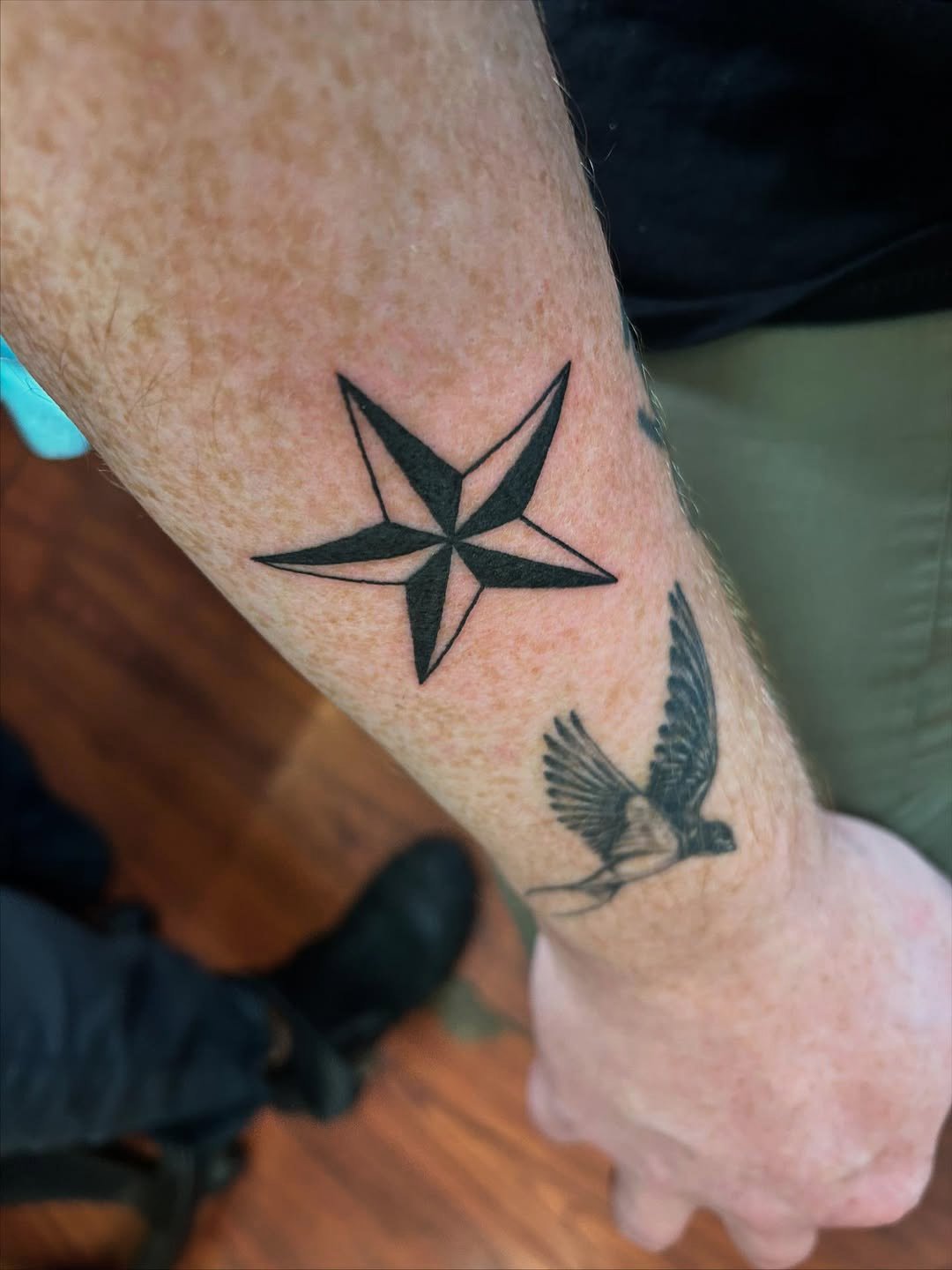
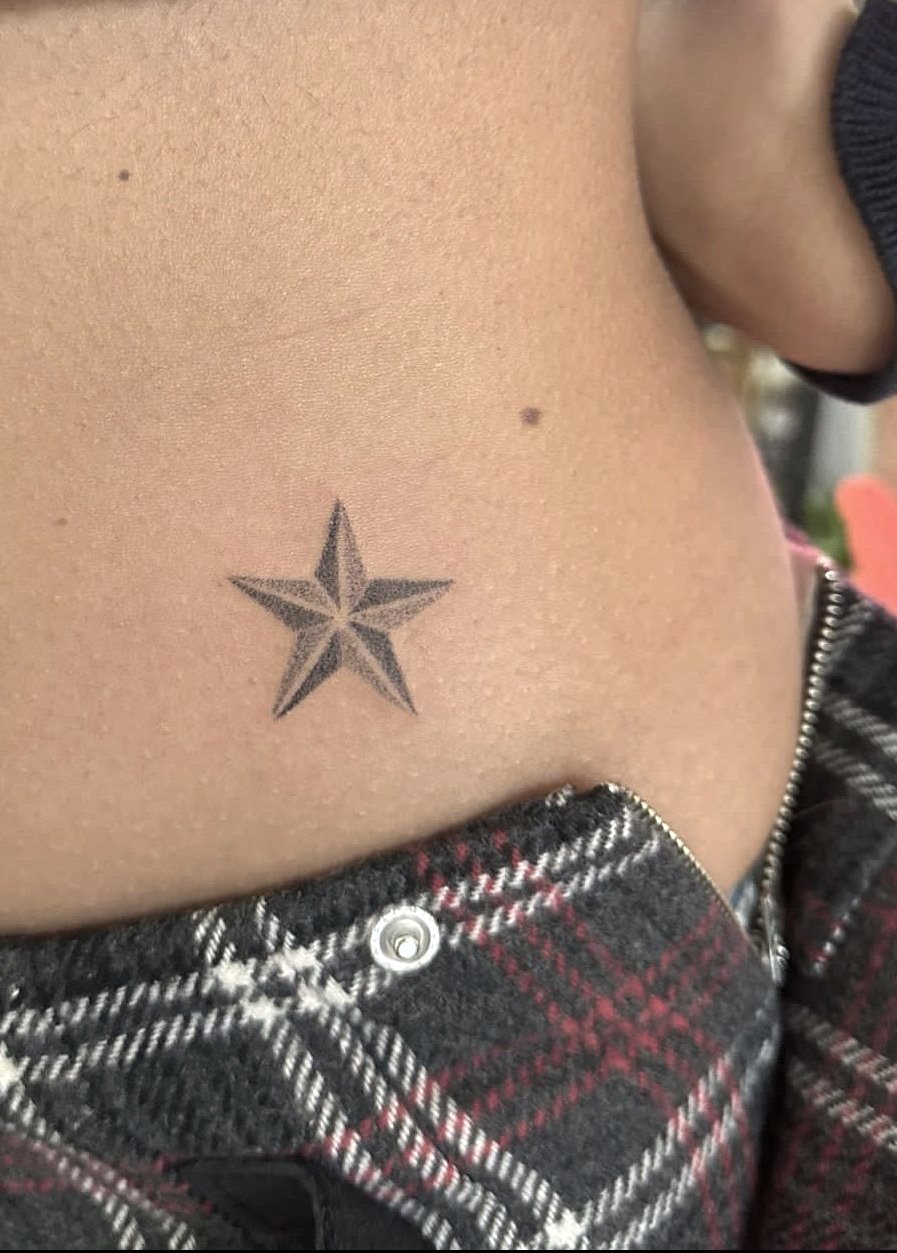
The star
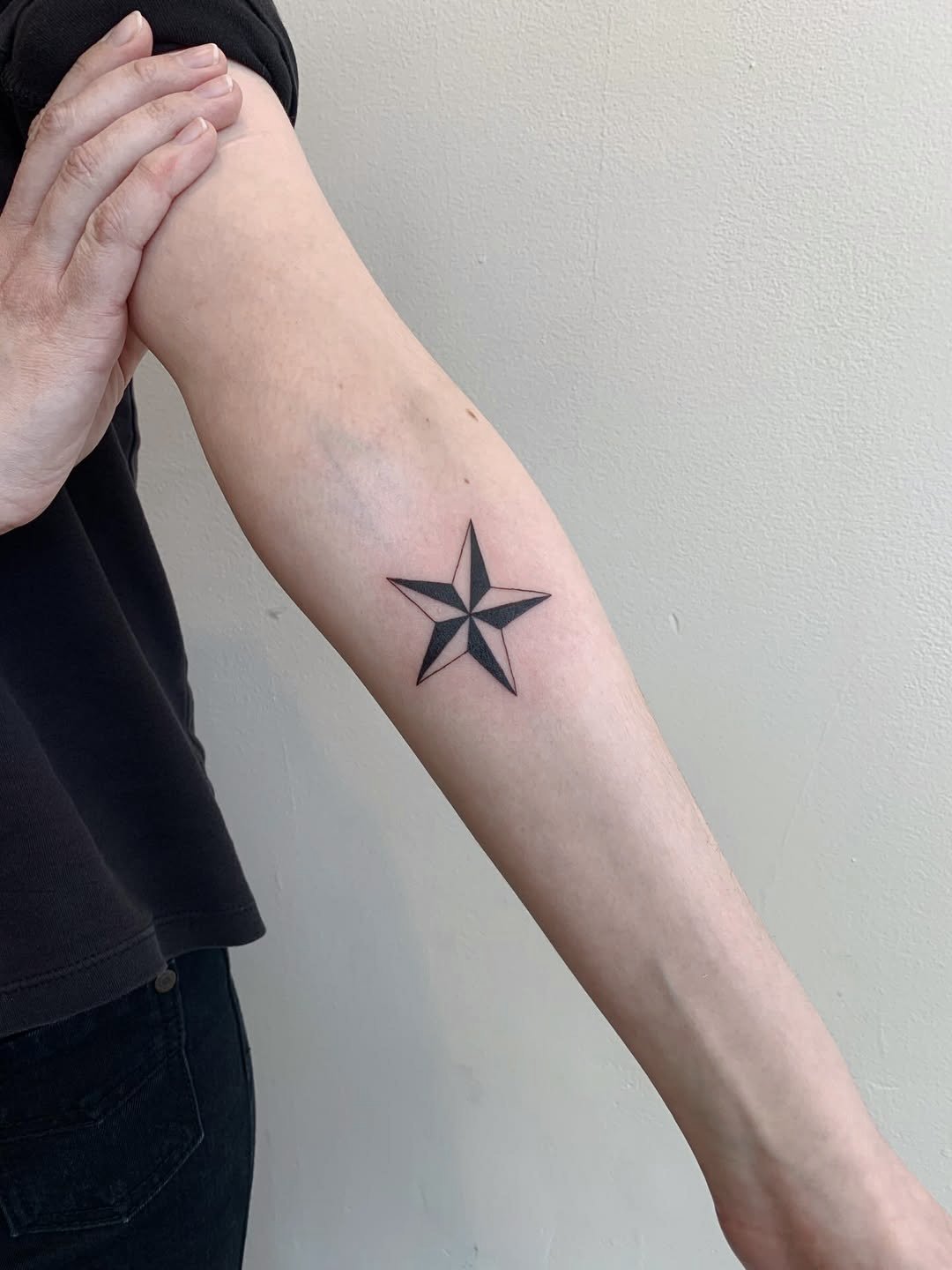
The nautical star is a specific visual form: a five-pointed star divided into ten sections (two per point), with alternating dark and light fills that create the illusion of a faceted, three-dimensional surface. Each point of the star is bisected by a line running from its tip to the centre, and the two halves of each point are filled in contrasting tones — one dark, one light. The result is a star that appears to have depth and dimension, as if carved from two different materials.
This design is derived from the compass rose — the directional indicator found on nautical charts and compasses. The compass rose uses a similar counterchanged star to mark the cardinal and intercardinal directions, with the most prominent point indicating north. The United States Coast and Geodetic Survey began using a five-pointed counterchanged star in the outer ring of its compass roses around 1900 to indicate true north, formalising a visual convention that had existed informally for longer.
The connection between the nautical star and the North Star (Polaris) is the foundation of all its meanings. Polaris sits almost directly above the Earth’s North Pole, making it the one star in the northern sky that appears to remain fixed while all other stars rotate around it. For centuries, Polaris was the primary navigational reference for sailors in the Northern Hemisphere — the star that told you which way was north when nothing else could. A sailor who could find Polaris could find his direction. A sailor who lost it was lost.

Maritime origins
Before electronic navigation — before GPS, before radar, before even reliable chronometers — sailors navigated by the stars. Celestial navigation, the practice of determining position and direction by observing the positions of celestial bodies, was the primary method of open-ocean wayfinding from antiquity through the nineteenth century. Polaris was the keystone of this system in the Northern Hemisphere: a fixed point in a moving sky, the one star that always indicated north.
The nautical star tattoo grew from this dependency. Sailors tattooed the star on their bodies as a talisman — a symbolic invocation of the guiding star that they depended on for survival. The tattoo was both:
- a superstitious charm (the hope that the star’s protection would extend to the wearer)
- a declaration of identity (the wearer was a person who navigated by stars, a person of the sea).
In this original context, the nautical star was part of the broader system of maritime milestone and talisman tattoos — alongside the anchor, the swallow, the fully rigged ship, the compass rose, “Hold Fast” across the knuckles, and the pig and rooster on the feet. Each mark carried a specific meaning within the seafaring community, and the nautical star’s meaning was guidance and safe return.
The U.S. Naval History and Heritage Command lists the compass rose or nautical star among the traditional tattoos of American sailors, noting that it was “worn so that a Sailor will always find his/her way back to port.” The star could also indicate specific navigational achievements: crossing the North Sea, or — in some accounts — rounding Cape Horn, though the fully rigged ship was the more established mark for that passage.
The nautical star became a standard element in American traditional tattoo flash during the early to mid-twentieth century. Sailor Jerry Collins and other foundational flash artists included the star in their repertoires, rendering it in the bold outline and limited palette that characterised the style. The placement conventions were specific: the forearm (visible, connected to the hand that gripped the rigging), the wrist, or the chest (close to the heart, close to the centre).
Military adoption
For military wearers, the nautical star carried a meaning close to its original maritime function: guidance, direction, and the hope of safe return. Service members deployed overseas tattooed the star as a mark of their service and as a talisman for getting home. The tradition persisted through both World Wars, the Korean War, and the Vietnam War, and into the present day. The star does not indicate a specific rank, rating, or achievement in the way that crossed anchors (boatswain’s mate) or a shellback turtle (crossing the Equator) do — it is a general symbol of maritime service and the aspiration to return safely.
The star on the wrist: lesbian communities in the 1950s
In the late 1940s and 1950s, the nautical star acquired a meaning entirely unconnected to the sea. In the butch lesbian communities of Buffalo, New York — and, evidence suggests, in other American cities — women began tattooing small nautical stars on the inside of their wrists as a covert signal of sexual orientation.
The practice is documented in Madeline D. Davis and Elizabeth Lapovsky Kennedy’s 1993 book Boots of Leather, Slippers of Gold: The History of a Lesbian Community, a foundational oral history of the Buffalo lesbian community from the 1930s to the 1960s. According to their research, a group of butch lesbians decided one night to go to a tattoo parlour together and get nautical stars on their inner wrists. The placement was deliberate: the wrist could be covered by a watch during the day — at work, in public, in any situation where exposure carried risk — and revealed at night in bars, at social gatherings, and in spaces where recognition was desired.
The tattoo functioned as what Davis and Kennedy described as “the first symbol of community identity that did not rely on butch-fem imagery.” It was a mark that could be shown or hidden at will, legible to those who knew what to look for and invisible to those who did not. In an era when homosexuality was criminalised and pathologised, this discretion was a survival strategy.
The risk was real. Davis and Kennedy note that the Buffalo police department identified the star tattoo as a marker of lesbianism and began collecting names of women who wore it. The symbol that was designed for safety became, once decoded by authorities, a source of danger. The star tattoo placed its wearers at risk of harassment, arrest, and social exposure — and they chose to wear it anyway. Later, some femmes in the community adopted the star as well, and a revival occurred in the 1970s.
This history means that the nautical star, for some wearers, is a queer symbol — a mark of belonging to a community that was forced underground and chose to identify itself at personal risk. The specific meaning — a small star on the inner wrist — carries this history regardless of whether the individual wearer is aware of it.
Punk and counterculture
The nautical star was adopted by the punk and hardcore scenes beginning in the late 1970s and accelerating through the 1980s and 1990s. The connection traces through Sailor Jerry and the broader revival of American traditional tattooing among countercultural communities.
Punk’s adoption of the nautical star drew on the same core symbolism — finding your own way — but reframed it. Where the sailor needed the star to navigate the physical ocean, and the lesbian needed it to navigate a hostile society, the punk used it to signal a commitment to navigating life outside mainstream culture. The star became a symbol of self-direction, individualism, and the refusal to follow conventional paths. The elbow became a particularly popular placement in punk and hardcore communities — visible, bold, and occupying a body location associated with toughness (elbows are painful to tattoo and the placement signals commitment).
The star’s adoption across punk, hardcore, and related scenes was widespread enough that by the 2000s, the nautical star had become one of the most commonly tattooed motifs in the Western world — a development that, paradoxically, eroded the countercultural specificity it had carried. A symbol of outsider identity loses some of its force when it appears on millions of people.
Nautical star in contemporary tattooing
The nautical star’s current position in tattoo culture is shaped by all of these histories simultaneously. For some wearers, it is a maritime talisman. For others, a military marker. For others, a queer symbol. For others, a punk badge. For many, it is a general symbol of guidance, direction, and the aspiration to find one’s way — detached from any specific community but drawing on the accumulated weight of all of them.
The star has also acquired a simpler, more personal set of meanings: a reminder to stay on course during a difficult period, a mark of a personal transition or turning point, a memorial for someone who served as a guiding presence in the wearer’s life, or a commitment to a specific direction or decision. These readings are broad but legitimate — they draw on the star’s deepest layer of meaning (Polaris as the fixed point in a moving sky) without requiring membership in any specific tradition.
The nautical star’s ubiquity in the 2000s and 2010s led to a degree of backlash — the symbol became, for a period, associated with trend-following rather than with genuine symbolic intent. Tattoo communities sometimes dismissed it as a “default” choice, the star you got when you did not know what else to get. This reaction has faded as the trend cycle moved on, and the nautical star has settled into a more stable position: a classic motif, always available, carrying as much or as little meaning as the wearer brings to it.




Colour and variation

Classic nautical star (with counterchanging sides) most often symbolises the North Star, so the main point that shows direction, a good charm often meant to protect from getting lost on someone’s individual journey.

Black and red nautical star is the most common coloured variation. Red adds intensity, passion, and — in some readings — a connection to port and starboard navigation lights (red for port, green for starboard), though this association is informal and not universally recognised.

Black and green nautical star connects to the starboard navigation light, which marks a vessel’s starboard (right) side. It is sometimes tattooed, but it’s much less common than its classic black or red version.

Black and blue nautical star is quite rare but not entirely uncommon. It usually carries clear associations with the sea, the Navy, and — in some contexts — law enforcement.

Solid black star (all segments filled, no counterchanging) reduces the star to a silhouette, losing the faceted dimensionality of the traditional design but gaining graphic impact. Solid black stars are common in blackwork and minimalist compositions.

Multiple colours — each segment filled with a different colour — produce a more decorative, less traditional result. This treatment moves the star away from its maritime associations and toward a purely aesthetic or personal reading.
The number of points can also vary. The five-pointed star is standard and carries the specific nautical association. Six-pointed, eight-pointed, and other variations exist but move the image away from the nautical star specifically and into the broader category of star tattoos, which carry their own separate range of meanings.
Composition, placement, and pairing
The inner wrist is the historically loaded placement. It carries the lesbian community’s 1950s tradition — the star hidden by a watch, revealed by choice. Any nautical star on the inner wrist echoes this history, whether the wearer intends it or not.
The forearm is the traditional sailor’s placement — visible, connected to the working hand, part of the body that faces the world.
The elbow is associated with punk and hardcore communities. The star fits the elbow’s circular geometry naturally, and the painful placement signals commitment.
Behind the ear, the ankle, the finger — smaller placements for more discreet, personal readings.
The chest (over the heart) emphasises the protective, guiding symbolism. The shoulder or upper arm integrates the star into a larger composition.
The nautical star pairs naturally with other maritime motifs: anchors, compasses, swallows, ships, ropes, and waves. A star within or beside a compass rose is a reinforcement of the navigational theme. A star alongside an anchor combines guidance with stability. A star above a ship places the guiding light in the sky where it belongs.
The star also works as a standalone design — a single, precisely rendered nautical star with no accompanying elements. Its geometric clarity and self-contained form make it one of the few tattoo motifs that need nothing around it to be complete.
In American traditional style, the star is rendered with bold outlines, solid fills, and the clean counterchanged segments that define the form. In neo-traditional work, it gains decorative detail — shading within the segments, ornamental borders, and colour gradients. In blackwork, it reduces to a high-contrast graphic element. In dotwork, alternating segments can be rendered with varying stippling density, creating a counterchange effect through dot spacing rather than solid fill. In fine line, a small, precisely rendered star becomes a microscale composition suited to the wrist, finger, or the back of the ear.
What a nautical star tattoo carries
At the deepest level, the nautical star is about orientation. Polaris does not move. The sky rotates around it. In a world where everything is in motion — water, wind, current, circumstance — the star is the fixed point by which direction is found. Every community that adopted the nautical star was navigating something: an ocean, a war zone, a hostile society, or a mainstream culture it rejected. The star marked the act of looking for direction and the hope of finding it.
A wearer who knows the star’s full history carries all of these layers. A wearer who knows only one carries that one. A wearer who knows none and chose the star because they liked how it looked is still wearing a symbol that, for over two centuries, has meant the same thing at its core: the search for a way through.
Sources & further reading
- Nautical star on Wikipedia, The Free Encyclopedia.
- Kennedy, Elizabeth Lapovsky; Davis, Madeline D. Boots of Leather, Slippers of Gold: The History of a Lesbian Community. Psychology Press, 1993.
- Keena. I Saw The Sign: LGBT Symbols Then And Now. Autostraddle, 2012.
- Caplan, J. (2000). Written on the Body: The Tattoo in European and American History. Princeton University Press.
- DeMello, M. (2007). Encyclopedia of Body Adornment. ABC-CLIO. Sanders, C. R. (2008). Customising the Body: The Art and Culture of Tattooing. Temple University Press.
- Pitts-Taylor, V. (2003). In the Flesh: The Cultural Politics of Body Modification. Palgrave Macmillan.
- Govenar, A. (2000). The Changing Image of Tattooing in American Culture, 1846–1966. Journal of American Culture, 22(3), 53–62.
- Rubin, A. (1988). Marks of Civilisation: Artistic Transformations of the Human Body. Museum of Cultural History, UCLA.
- Morris, D. (1997). Bodywatching: A Field Guide to the Human Species. Vintage.