Related Posts
Inuit (Kakiniit)
Kakiniit — stripped by the church, brought back by the women
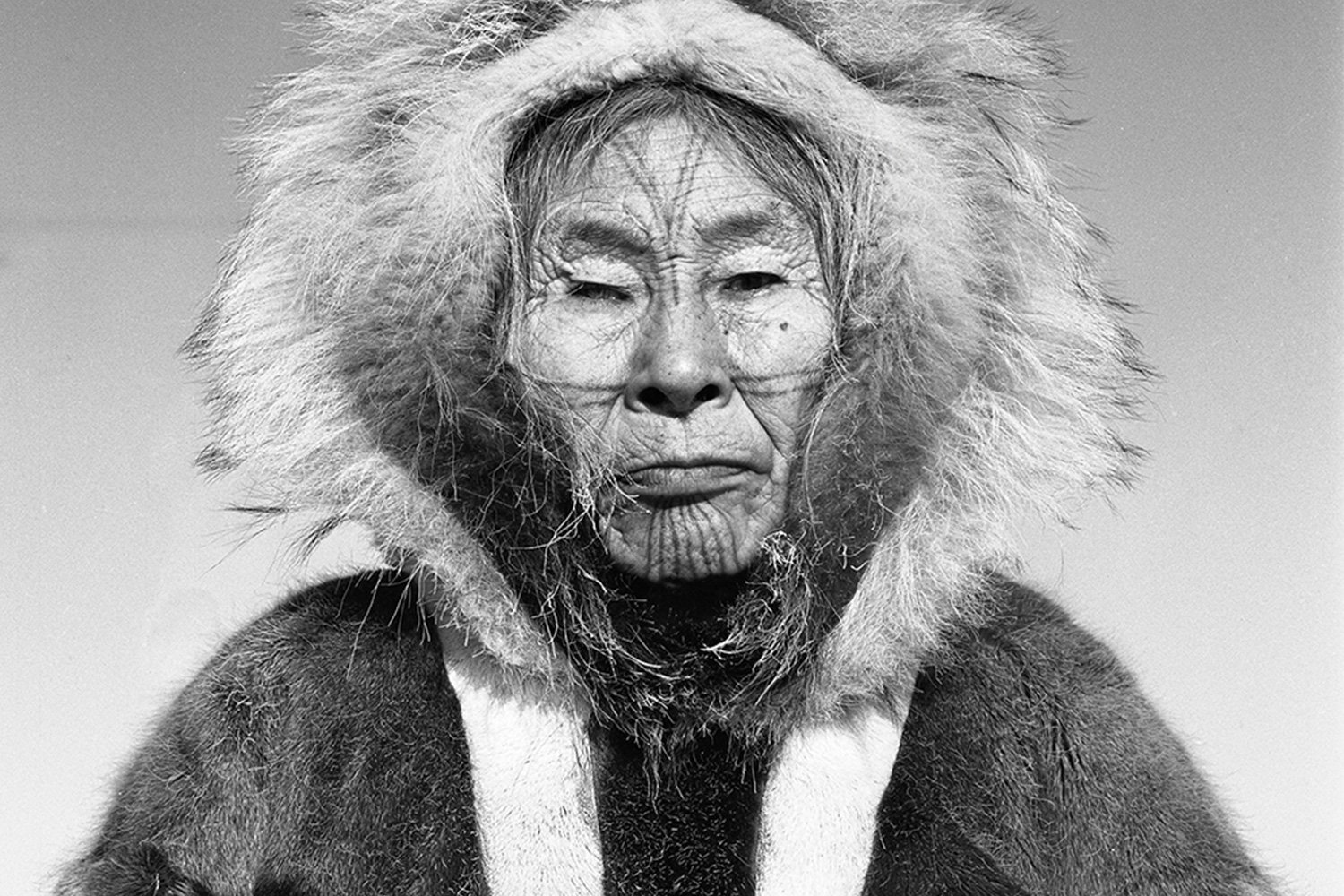
In the collection of the Greenland National Museum in Nuuk, six mummified bodies — five women and a child — lie in the positions they were buried in roughly five hundred years ago at Qilakitsoq, a rocky headland in northwestern Greenland. Five of the six adult women bear visible tattoos: dark blue-green lines across their foreheads, V-shaped marks descending between the eyebrows, lines at the chins, and marks extending from the outer corners of their eyes toward their ears. The tattoos were made with soot-based pigment, stitched or pricked into the skin, and have survived half a millennium of permafrost burial, their geometric patterns still legible.
The Qilakitsoq mummies, dated to approximately 1475 CE, are the most intact prehistoric examples of Inuit tattooing — but the tradition they represent is far older. A carved ivory maskette from the Dorset culture, found on Baffin Island and dated to roughly 3,500 years ago, shows a female face marked with lines across the forehead and chin. It is the oldest known portrait from the Arctic, and it depicts a person wearing tattoos.
The tradition those marks belong to is called kakiniit in Inuktitut (singular kakiniq), and facial tattoos are specifically called tunniit (singular: tunniq). The practice spans the entire Inuit world — from Siberia across Alaska, through Arctic Canada to Greenland — and it was, until missionaries suppressed it in the early twentieth century, one of the most important cultural practices in Inuit life. It is now in active revival, led almost entirely by Inuit women.
The Inuit people
The Inuit are the Indigenous people of the North American Arctic, living across a territory that stretches from the Chukchi Peninsula in Siberia through Alaska, northern Canada (Nunavut, Nunavik, Nunatsiavut, and the Inuvialuit Settlement Region), and Greenland. The total Inuit population is estimated at roughly 180,000 across these regions. Related peoples — the Yupik of western Alaska and Siberia, and the Unangan
(Aleut) of the Aleutian Islands — share some cultural practices, including forms of tattooing.
The word Inuit means “the people” in Inuktitut. It is the preferred self-designation; the older exonym Eskimo, still used in some Alaskan contexts, is considered inappropriate in Canada and Greenland.
Who was tattooed
Kakiniit was overwhelmingly a women’s practice. Women received the tattoos, and women applied them. Men could be tattooed — small marks for therapeutic purposes, hunting luck, or spiritual protection — but their tattoos were much less extensive than women’s. The elaborate facial, hand, arm, chest, and thigh tattoos that define the tradition are women’s marks, carried by women and made by women.
The tattooing began at puberty. A girl received her first tattoo — typically on the chin — when she reached her first menstruation, marking her transition from girlhood to womanhood. The chin tattoo publicly announced that she had entered adult life and was ready to learn the skills she would need: sewing (an essential Arctic skill, since clothing made the difference between life and death), food preparation, and household management. In many communities, a woman could not marry until her face was tattooed. The tattoo was the visible evidence that she had been prepared.
Additional tattoos accumulate across a woman’s life. Childbirth brought new marks — on the chest, symbolising motherhood. Achievement in sewing or other skills was recorded. The hands, arms, wrists, thighs, and sometimes the breasts received tattoos at different stages. By the time a woman reached maturity, her tattoos told her story — where she came from, what she had survived, what she could do, and who she belonged to.
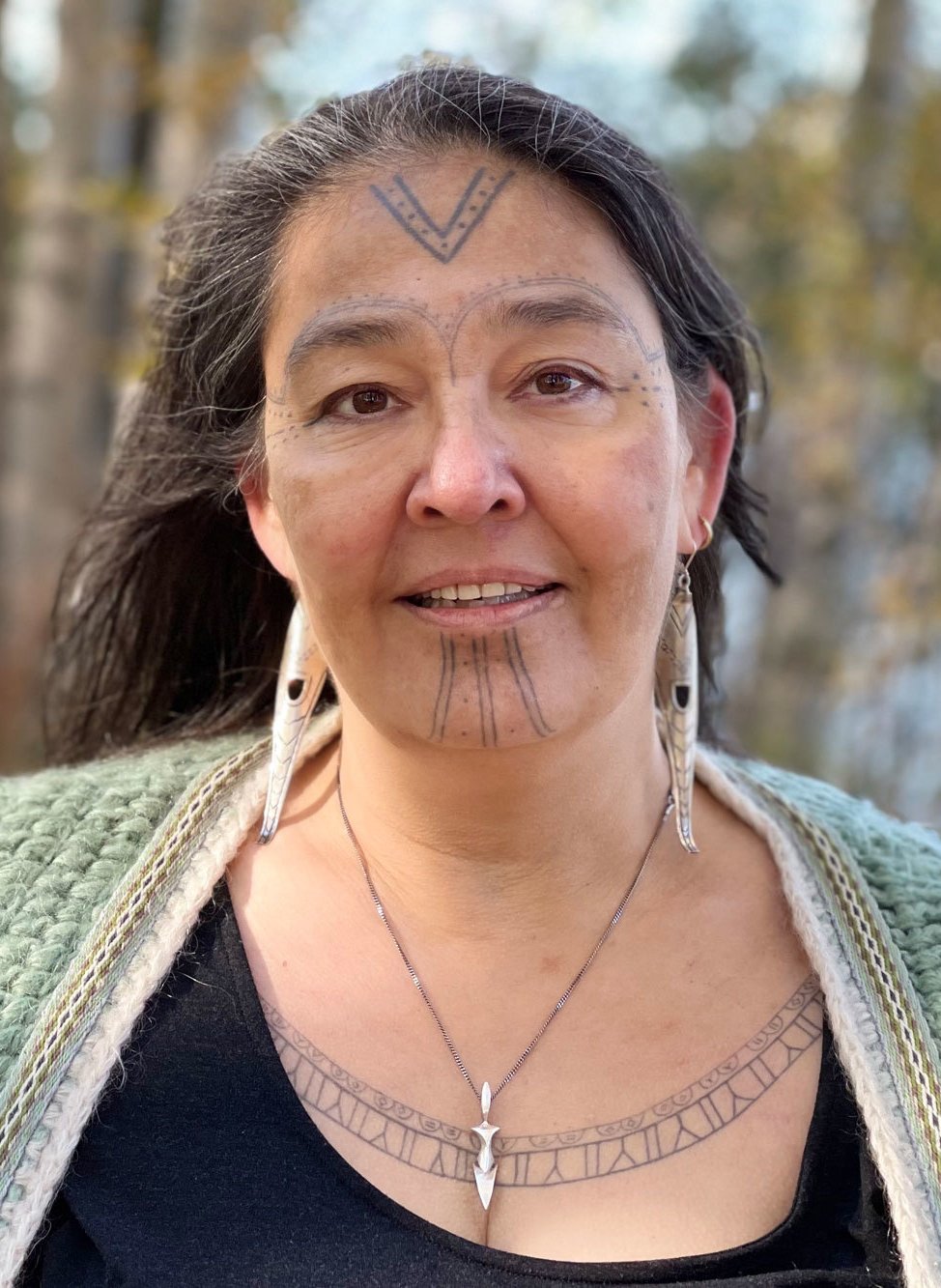
Kakiniit tattooing method
Skin-stitching
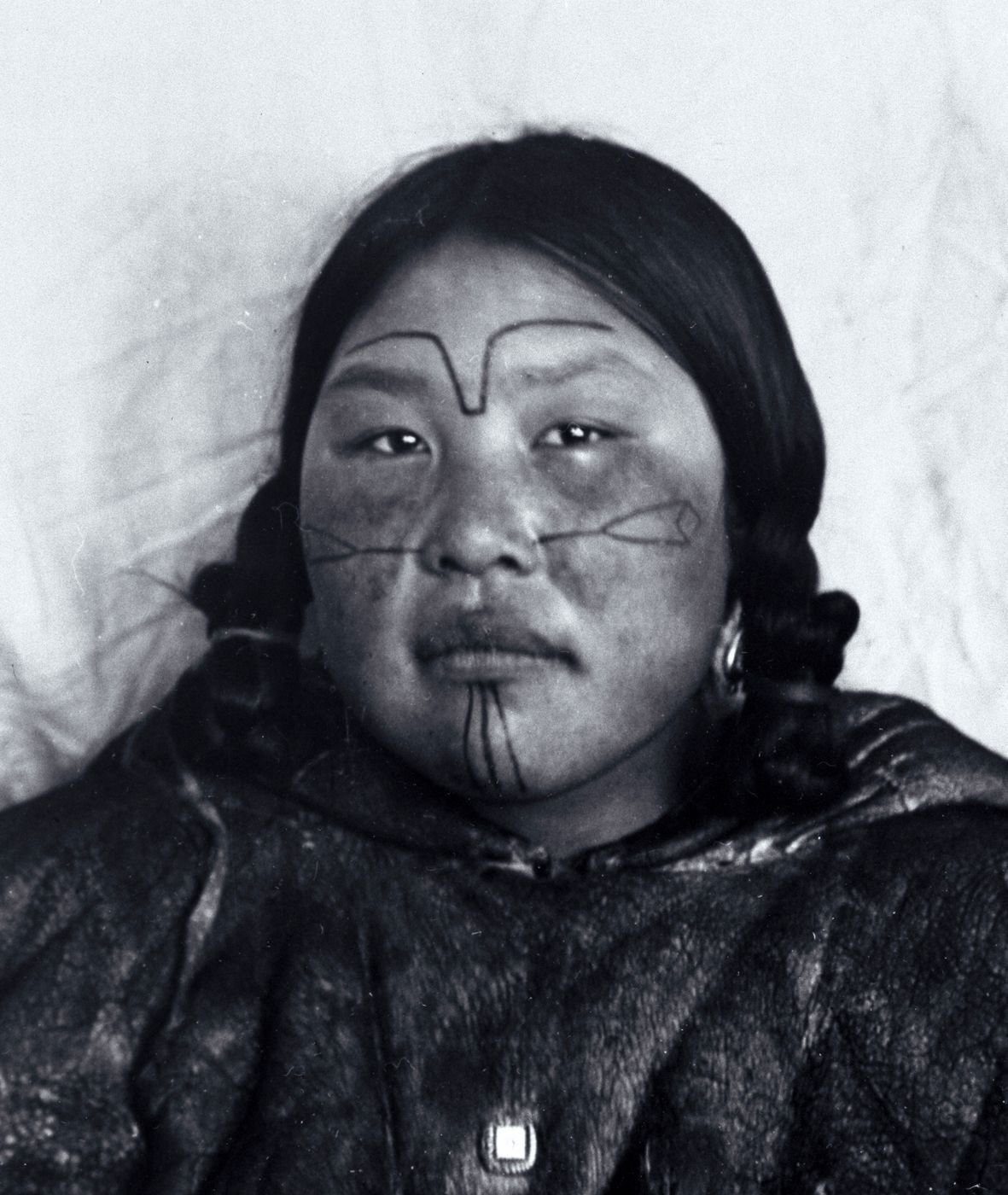
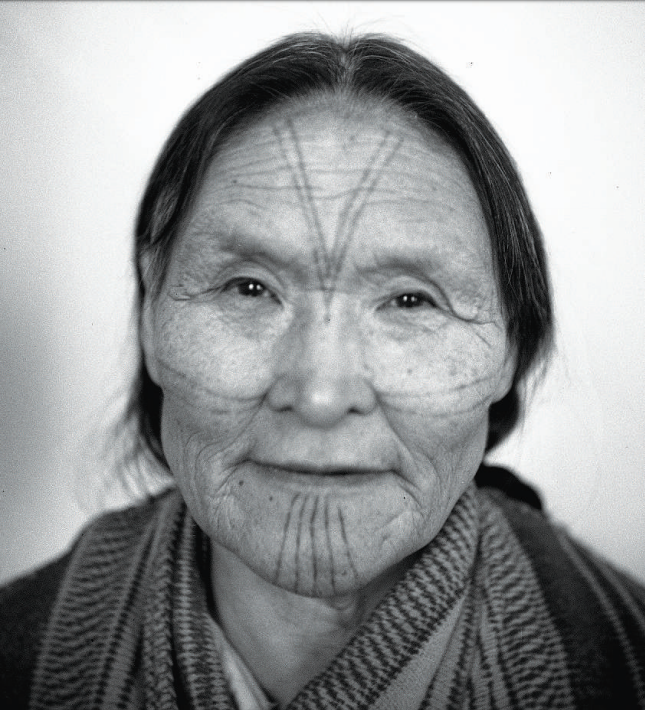
The primary and most distinctive method. The practitioner — always an older woman, usually an experienced seamstress whose skill with needle and sinew was proven through years of sewing clothing, boot covers, and kayak skins — threaded a bone needle with a length of caribou sinew that had been soaked in a mixture of seal-oil soot (lampblack) and liquid (water, urine, or plant juice, depending on the region). She drew the threaded, soot-blackened sinew through the upper layer of the skin in a sewing motion, leaving a line of pigment beneath the surface with each stitch. The thread passed through the skin and was pulled out the other side, depositing soot along the channel. The process was repeated stitch by stitch, building the design from individual lines.
The connection between tattooing and sewing is direct and specific. The same women who made the finest parkas, waterproof boot seams, and hide covers for kayaks were the ones who tattooed. The skills transferred: precision with a needle, understanding of how skin behaves under puncture, and the ability to maintain consistent depth and spacing across a long line. The tattooer’s authority was earned through her proven mastery of needlework in the most consequential contexts — clothing that kept people alive in temperatures that could kill in minutes.
Hand-poke
The second method. A needle dipped in soot was poked into the skin one puncture at a time, in the same manner as hand-poke tattooing everywhere in the world. The hand-poke method was used alongside skin-stitching and sometimes within the same piece — stitching for lines, poking for dots and fill.
The pigment was consistent across the Inuit world: soot from the qulliq (seal-oil lamp), the central heating and lighting device of every Inuit household. The soot was scraped from the lamp or from a surface held above the flame, mixed with a small amount of liquid to create a paste, and applied to the sinew or needle. The resulting tattoo was dark blue-black when fresh, fading over decades to a blue-green or grey-green.
Meaning behind some tattoo designs
Chin lines (tavlugun in Iñupiaq, talloquteq in Greenlandic)
V-shape on the forehead
Y-shapes on the hands and arms
Chest tattoos
Thigh tattoos
Finger and hand tattoos
Dots and dashes on the cheekbones
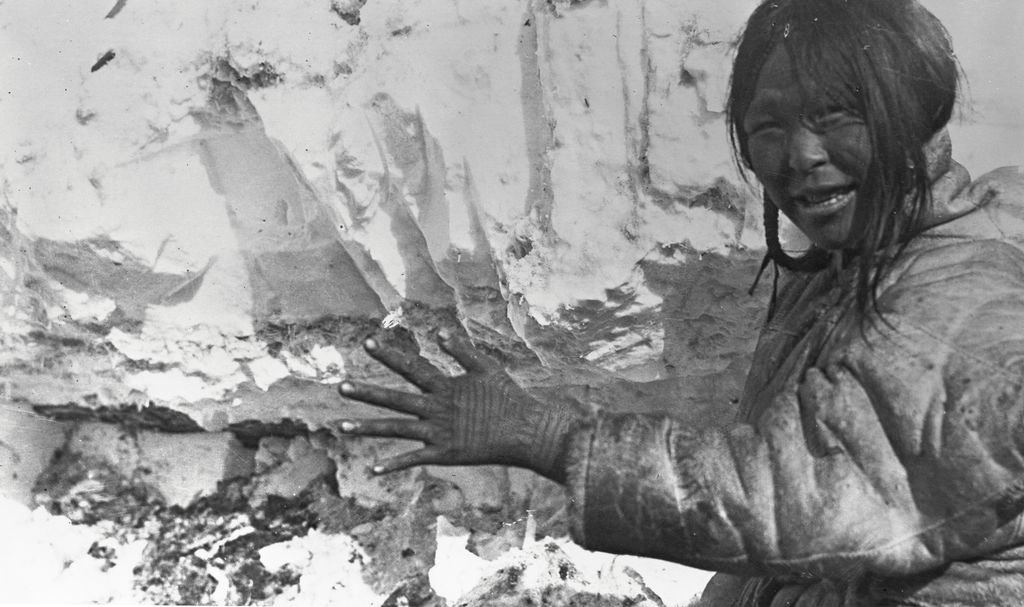
The afterlife connection
Rasmussen recorded that women without proper tattoos — specifically without “handsome” tattoos on their hands — were believed to be unable to enter the realm of the dead. The tattoos served as a kind of spiritual credential, demonstrating that the woman had lived a complete life, had been prepared by her community, and was ready to pass from the world of the living. The markings facilitated safe passage — particularly the chin tattoos, which were linked to Sedna and the cosmological order governing the relationship between humans and the animals they depended on.
The afterlife function gives the tattoos a weight that purely decorative or identity-marking practices do not carry. A woman’s tattoos were part of her preparation for death — a preparation that was undertaken during life, visibly, on the body, and read by everyone who saw her.
The suppression
The practice of kakiniit was suppressed by Christian missionaries in the late nineteenth and early twentieth centuries. The suppression was deliberate, systematic, and effective.
Missionaries — both Catholic and Anglican — viewed Inuit tattooing as a shamanistic practice incompatible with Christianity. The tattoos were associated with Inuit religious belief (which they were — the afterlife function, the Sedna connection, the cosmological meanings were all genuine religious content), and the missionaries sought to replace Inuit religion with Christianity. Tattooing was banned. Biblical passages prohibiting body marking (particularly Leviticus 19:28) were cited to reinforce the prohibition.
The Anglican missionary Edmund Peck, who was fluent in Inuktitut and worked extensively across the eastern Canadian Arctic in the late nineteenth century, was particularly effective in suppressing Inuit cultural and religious practices, including kakiniit. His language fluency gave him access to communities and a persuasive capacity that missionaries who did not speak Inuktitut lacked.
The ban produced shame. Women who had been tattooed — women who had received their marks as rites of passage, as sources of pride, as preparations for the afterlife — were told that their tattoos were evil. Many stopped speaking about them. Many chose not to tattoo their daughters. The transmission of the practice — the knowledge of which marks belonged where, which designs meant what, which methods produced the best results — was broken within a generation in many communities.
By the mid-twentieth century, the practice had gone underground. A few women continued to tattoo and be tattooed in private, but the public, communal practice — the tattooing at puberty witnessed by family and community — had largely ceased.
The revival of kakiniit
Alethea Arnaquq-Baril is an Inuit filmmaker from Iqaluit, Nunavut, who directed Tunniit: Retracing the Lines of Inuit Tattoos (2010), the documentary that brought the history and the suppression of kakiniit to wide public attention. For the film, Arnaquq-Baril interviewed fifty-eight elders from ten Inuit communities, collecting oral testimony about the practice from the last generation of women who remembered it as a living tradition. Arnaquq-Baril wears traditional facial tattoos herself.
Maya Sialuk Jacobsen, a Kalaaleq (West Greenlandic Inuk) tattooer and researcher, founded Inuit Tattoo Traditions in Greenland in 2014 and spearheaded the reintroduction of traditional tattooing methods — including skin-stitching — in Greenland. She played a central role in founding the Tupik Mi traditional tattoo revitalisation project in Alaska the following year.
Angela Hovak Johnston founded the Inuit Tattoo Revitalisation Project in 2017, a nonprofit organisation that raises funds to travel to remote communities across Arctic Canada and provide Inuit women with traditional tattoos using the hand-poke method. Johnston began the project when she learned that the last Inuk woman with traditional facial tattoos in her region was elderly and the practice risked dying with her generation entirely. The project travels to communities where access to tattooing is otherwise limited, and the women who receive tattoos give gifts in return — earrings, a parka, food — replicating the traditional exchange that historically accompanied the practice. Johnston’s cousin Hovak gave her her first facial tattoo in August 2017.
Marjorie Tahbone (Iñupiaq/Kiowa), based in Alaska, learned both skin-stitching and hand-poke techniques and has dedicated her practice to reviving Iñupiaq tattoo traditions, including the tavlugun chin tattoo.
Cora DeVos, the photographer who works with the Inuit Tattoo Revitalisation Project, has documented the faces of women who have received their markings. When the project began, there were only a few women to photograph. Now there are hundreds of Inuit women across Canada who wear kakiniit.
The revival has reached public life. Mumilaaq Qaqqaq, elected as a Member of Parliament for Nunavut in 2019 at the age of twenty-five, wore traditional facial tattoos in Parliament. Shina Nova, an Inuit influencer, received her first face tattoos in 2020 and shared their history on TikTok, reaching millions. Celina Kalluk, Lucie Idlout, Laakkuluk Williamson Bathory, and Nancy Mike are among the growing number of Inuit public figures who openly wear kakiniit.
The book Reawakening Our Ancestors’ Lines: Revitalising Inuit Traditional Tattooing (2017), by Angela Hovak Johnston with Cora DeVos and Meta Antolin, published by Inhabit Media, documents the revival project through photographs and testimony.
The cultural position of Kakiniit
Kakiniit are Inuit. This is stated clearly and consistently by the practitioners and the communities leading the revival.
The markings carry specific cultural meaning tied to specific life events, specific cosmological narratives (Sedna, the afterlife, the sun), and specific community identities. They are given by Inuit women to Inuit women within a cultural framework that non-Inuit people do not share. The revival is still young, still fragile, and the communities leading it have been explicit that kakiniit and tunniit should be worn only by Inuit people.
As Maya Sialuk Jacobsen and others have stated, the designs belong to Inuit culture, and wearing them as a non-Inuit person — as a souvenir, as an aesthetic choice, as a borrowed symbol of “spirituality” — uses them without their proper intention. The revival is an act of cultural reclamation from a specific history of suppression, and the communities undertaking it have the right to define its boundaries.
For non-Inuit readers, the appropriate response is to learn about the tradition, to support Inuit artists and cultural initiatives, and to respect the clearly stated boundary. The designs are not available for borrowing.
Sources & further reading
- Angela Hovak Johnston, Cora DeVos, and Meta Antolin, Reawakening Our Ancestors’ Lines: Revitalizing Inuit Traditional Tattooing. Inhabit Media, 2017.
- Alethea Arnaquq-Baril (dir.), Tunniit: Retracing the Lines of Inuit Tattoos. Unikkaat Studios, 2010.
- Lars Krutak, “Tattoos of the Hunter-Gatherers of the Arctic.” Published at larskrutak.com, 2012.
- Lars Krutak, Tattoo Traditions of Native North America: Ancient and Contemporary Expressions of Identity. LM Publishers, 2014.
- Lars Krutak, Spiritual Skin: Magical Tattoos and Scarification. Edition Reuss, 2012.
- Lars Krutak and Aaron Deter-Wolf (eds.), Ancient Ink: The Archaeology of Tattooing. University of Washington Press, 2017.
- Kakiniit and Tavlugun on Wikipedia, The Free Encyclopedia.
- Inuit Art Quarterly, “The Changing Face of the Inuit Tattoo Movement”, 2023.
- Maya S. Jacobsen, “Inuit Tattoo Traditions and the Complexities of a Revival.” The Vessel Magazine, 7, 2024.
- Jamie Jelinski, “Kakiniit and Other ‘Strange Blue Speckles’: Self-representation and Qallunaat Images of Inuit Tattooing.”(PDF) MA thesis, Concordia University, Montreal, 2015.
- Jamie Jelinski, “‘If Only It Makes Them Pretty’: Tattooing in ‘Prompted’ Inuit Drawings.” Études Inuit Studies 42, 2018, pp. 211–241.
- Kelli Park, “In Ice and Skin: Inuit Kakiniit Birth, Death, and Revival in a Modern Post-Colonial and Politicized Arctic.” COMPASS, University of Alberta, 2024.
- CNN Travel, “Reclaiming Inuit culture, one tattoo at a time.” Published October 2019.
- Canadian Geographic, “Kakiniit: The art of Inuit tattooing.” Published December 2022.
- Knud Rasmussen, Reports from the Fifth Thule Expedition (1921–1924).
- Anna Felicity Friedman, The World Atlas of Tattoo. Yale University Press, 2015.
- Matt Lodder, Painted People: Humanity in 21 Tattoos. Harper, 2024.
- Margo DeMello, Bodies of Inscription: A Cultural History of the Modern Tattoo Community. Duke University Press, 2000.