Related Posts
Apo Whang-Od
Apo Whang-Od: the last mambabatok
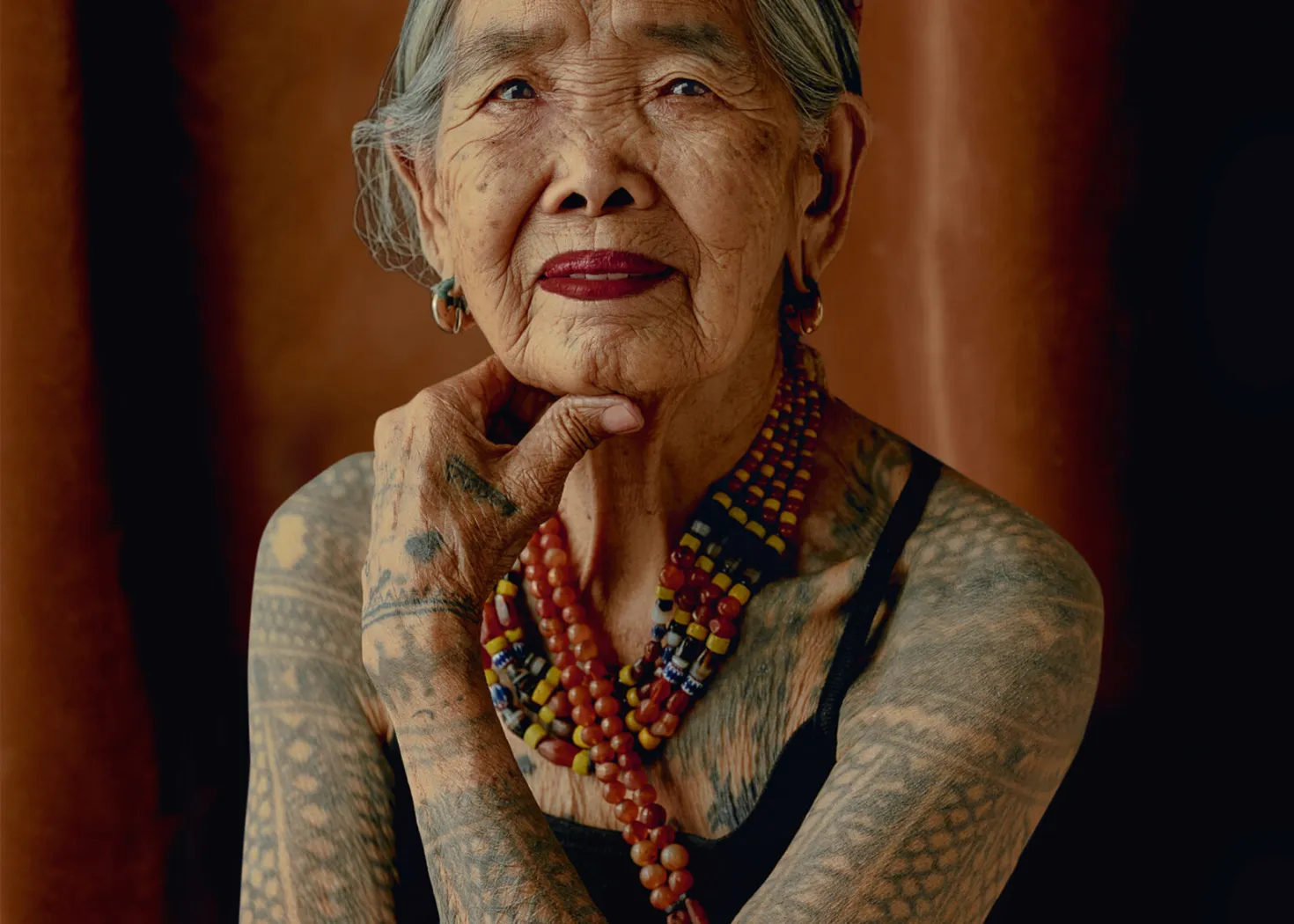
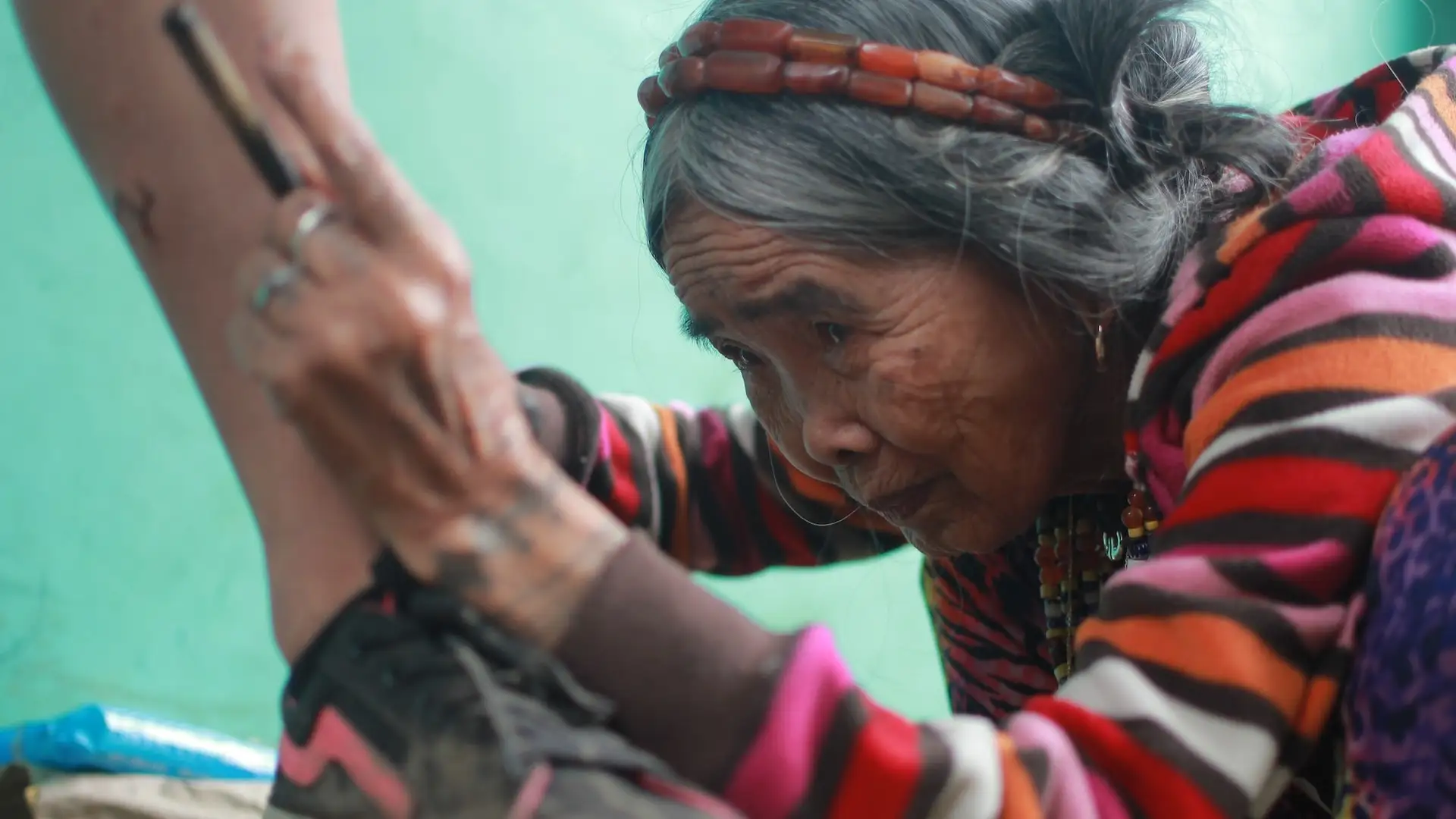
Whang-Od Oggay — also known as Maria Oggay, and addressed by almost everyone who encounters her as Apo Whang-Od, the Kalinga honorific for a respected elder — was born on February 17, 1917, in the village of Buscalan in the municipality of Tinglayan, Kalinga province, in the mountainous north of Luzon. She is the oldest known practitioner of traditional Filipino tattooing still working, and the last mambabatok — master tattooist — of her generation among the Butbut Kalinga. She has been tattooing for over ninety years.
Buscalan
Buscalan sits approximately 420 kilometres north of Manila, at around 1,200 metres above sea level, surrounded by terraced rice paddies and steep mountain slopes. The Butbut people who live there are part of the larger Kalinga ethnic group — one of the highland Cordilleran peoples whose geographic isolation kept them outside effective Spanish colonial control for the entire colonial period. There are no birth records from Buscalan for the early twentieth century; the community had no tradition of paper documentation, and the terrain was kept at a distance from administration. Whang-Od’s birth date of February 17, 1917, was formally recognised by the Philippine government only in June 2017, when she received a postal ID, making her eligible for benefits under the Centenarians Act.
The village has a population of around 800. As recently as the early 2010s, reaching it required a 12- to 14-hour bus journey from Manila, followed by a hike along a dirt path. The road has since been extended and paved closer to the village, reducing the final approach to a steep 30- to 40-minute climb through the rice terraces. There is no mobile phone signal. A handful of residents have wired internet access; some have Starlink. The traditional cogon-roofed wooden houses have largely given way to concrete construction. Almost everything that has changed in Buscalan over the last decade changed because of Whang-Od.

Her life
Whang-Od is the first and only female mambabatok of her generation. In the Butbut Kalinga tradition, the right to tattoo was patrilineal — it passed from father to son, within bloodlines authorised to carry the craft. Whang-Od’s father was a recognised master tattooist, and he trained her because he saw her ability and potential.
She began tattooing at fifteen. (Some accounts say eleven; one source places it at fourteen or sixteen. Wikipedia notes that at eleven she began tattooing headhunters and women, while at fifteen she formally took up the craft under her father’s training. The discrepancy likely reflects the difference between early observation and formal apprenticeship.) From the start she worked on both the tattooing that Butbut men earned through combat — fi-ing, the chest and arm designs that marked proven warriors — and fatok, the tattooing of women for beauty and social status.
In her youth, she had a relationship with a Butbut warrior named Ang-Batang. Elders objected to the match on the grounds that his bloodline was deemed impure. A marriage was arranged between Ang-Batang and Whang-Od’s close friend Hogkajon. When Whang-Od was twenty-five, Ang-Batang died in a logging accident. She did not marry. She has no children and has described her decision to remain unmarried as a vow connected to her loss. She had other relationships with Kalinga warriors after Ang-Batang’s death, but none led to marriage. Her own arms and legs carry tattoos that record her life — including the names of people she has loved.
In the traditional practice, the mambabatok was not only a tattooist. The role included chanting during the tattooing process, reading the designs as indicators of the recipient’s fate, and performing the rituals that — in Kalinga belief — ensured the tattoo’s spiritual protection would carry into the afterlife. The tradition holds that tattoos remain on the soul after death. Whang-Od also travelled between villages, summoned by communities to tattoo individuals at significant life transitions, walking mountain paths to attend ceremonies in other Butbut settlements and, on occasion, in neighbouring Kalinga groups, including the Bontoc, who were traditionally enemies.
The craft: batok
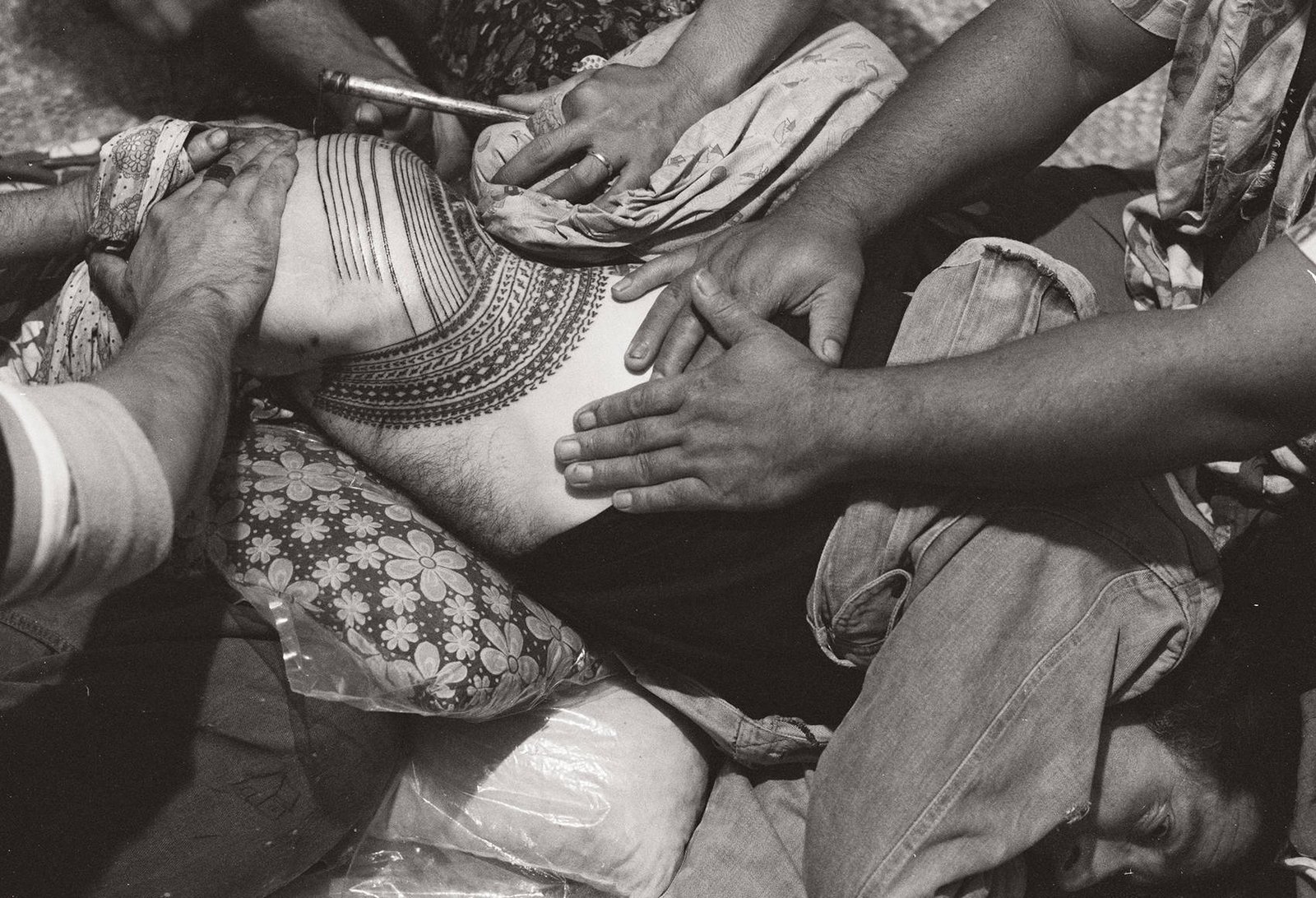
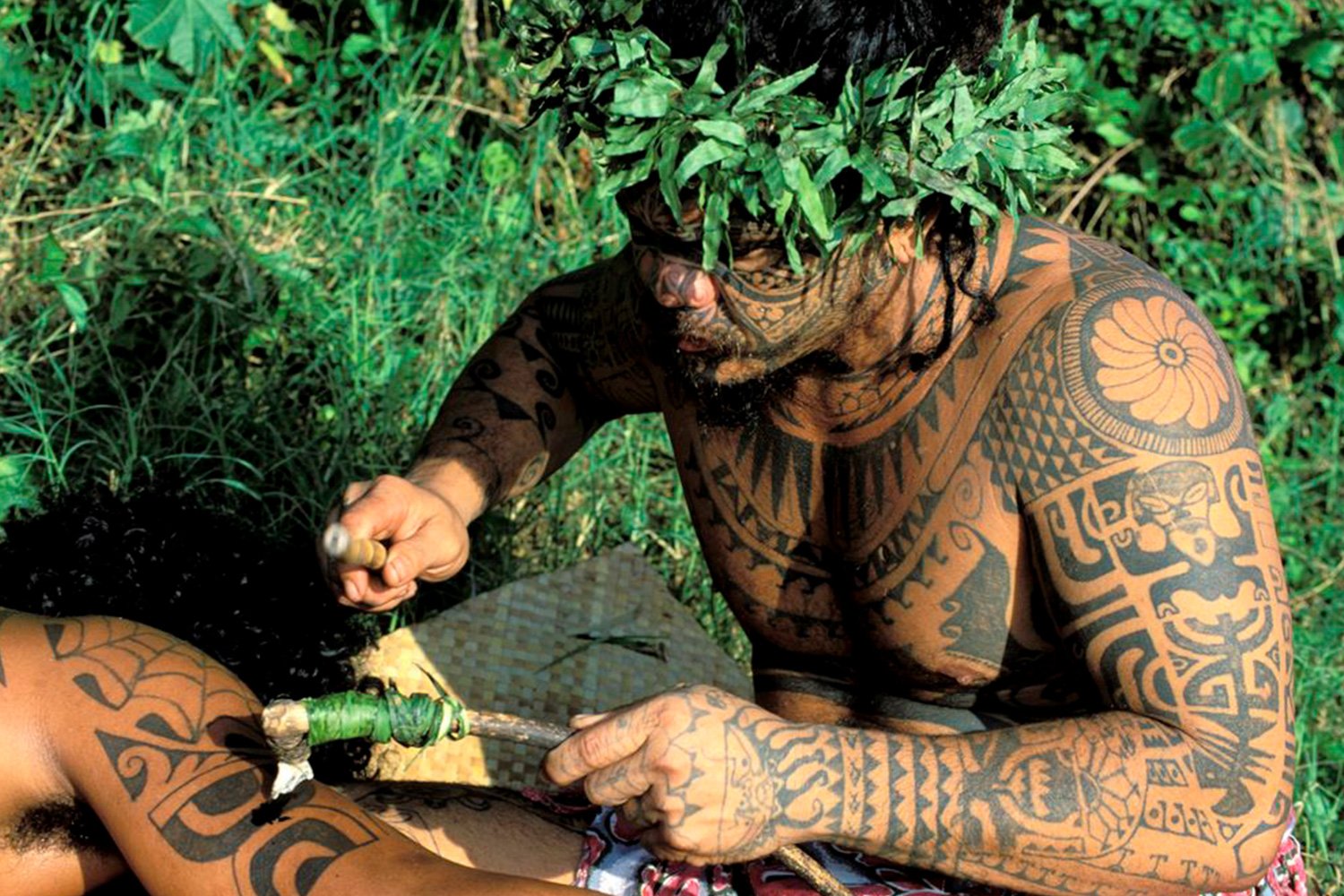
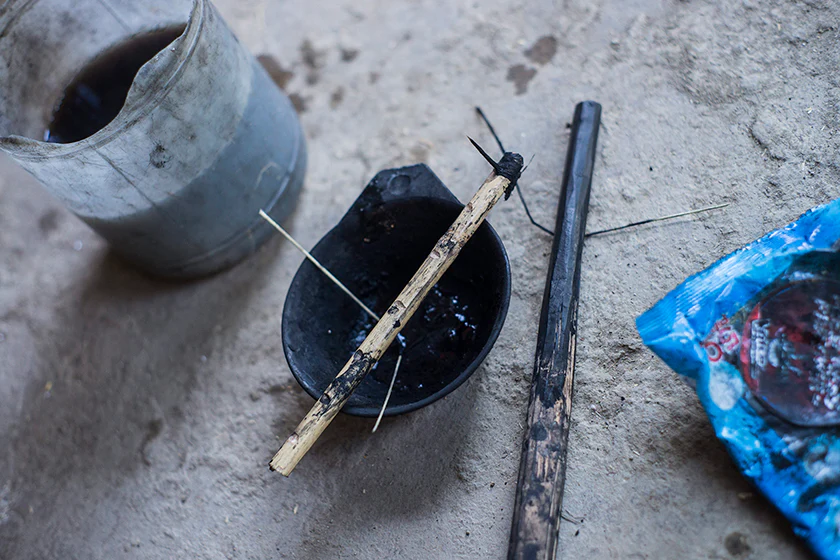
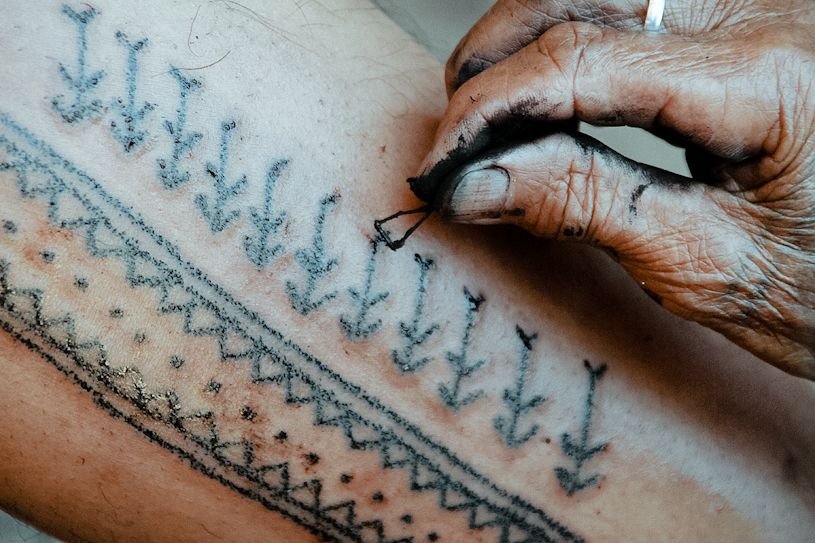
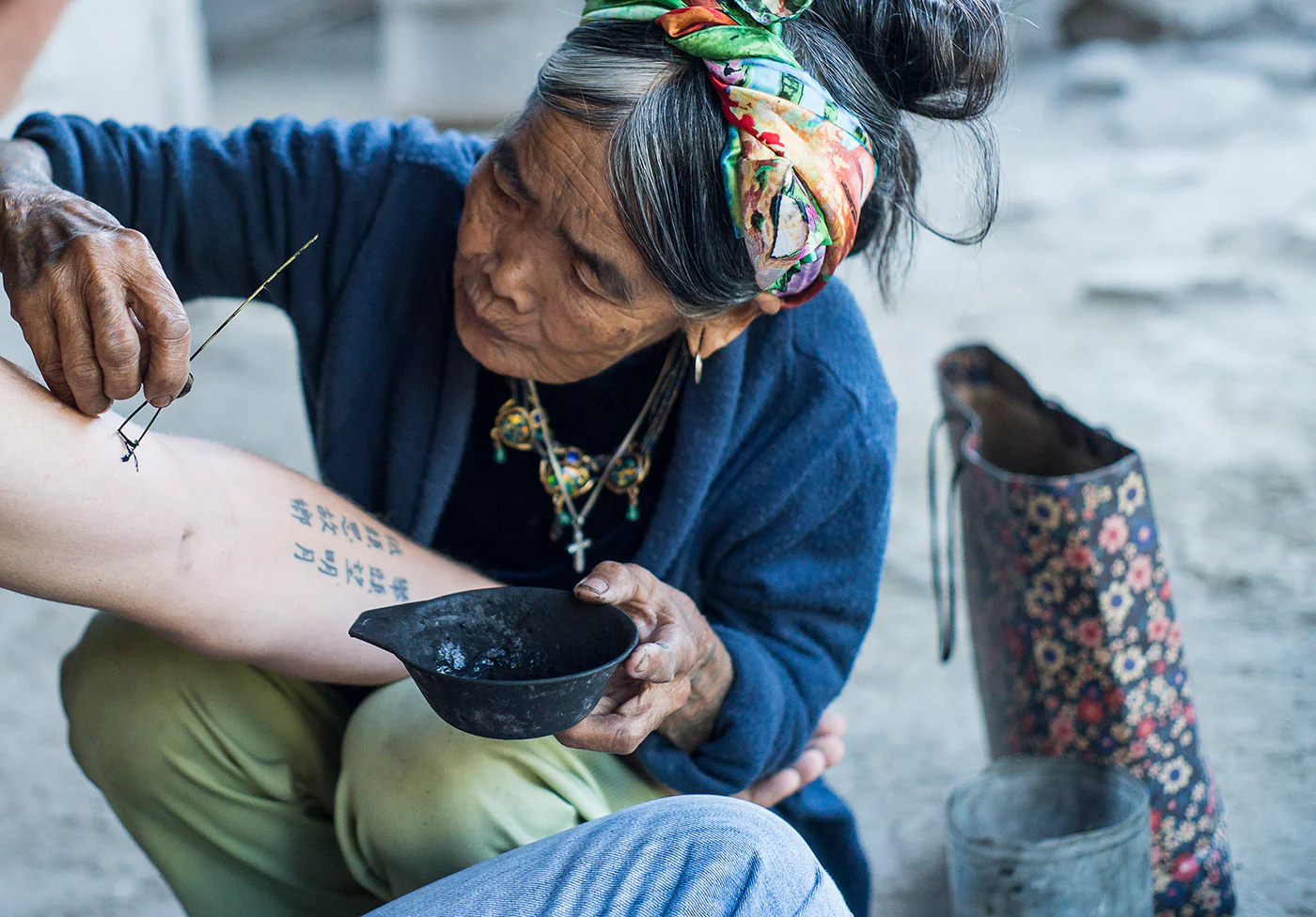
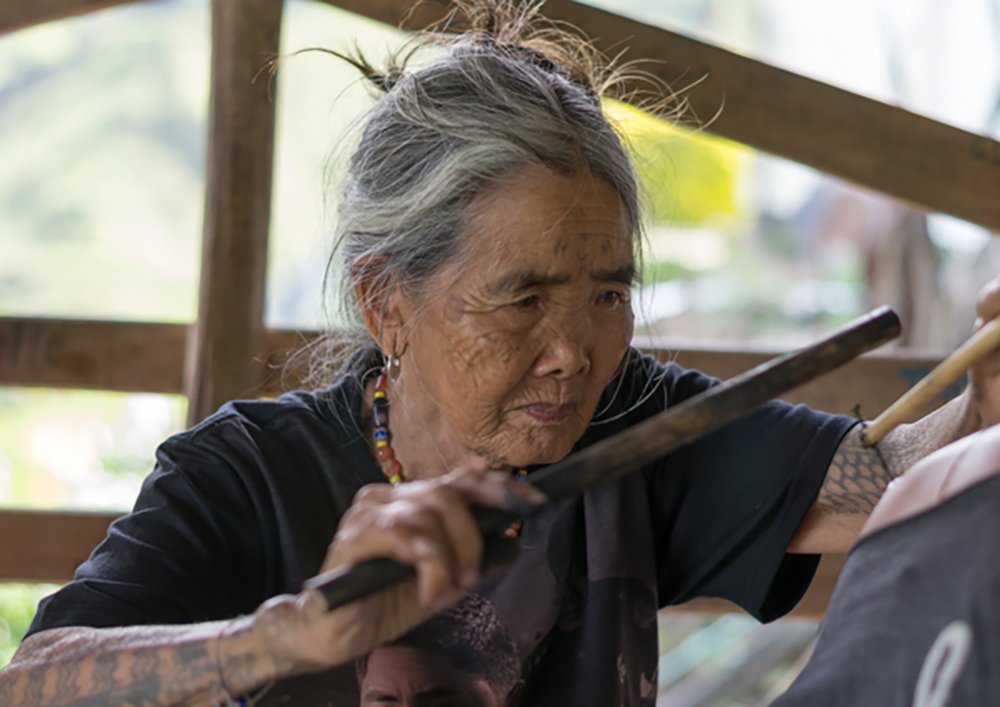
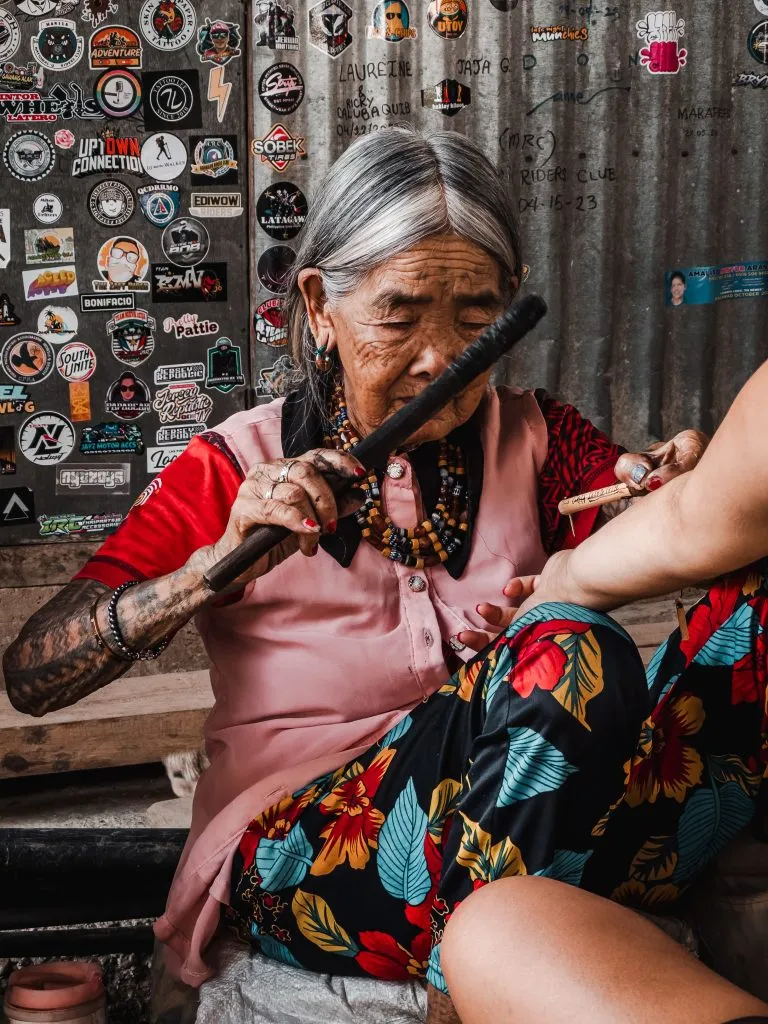
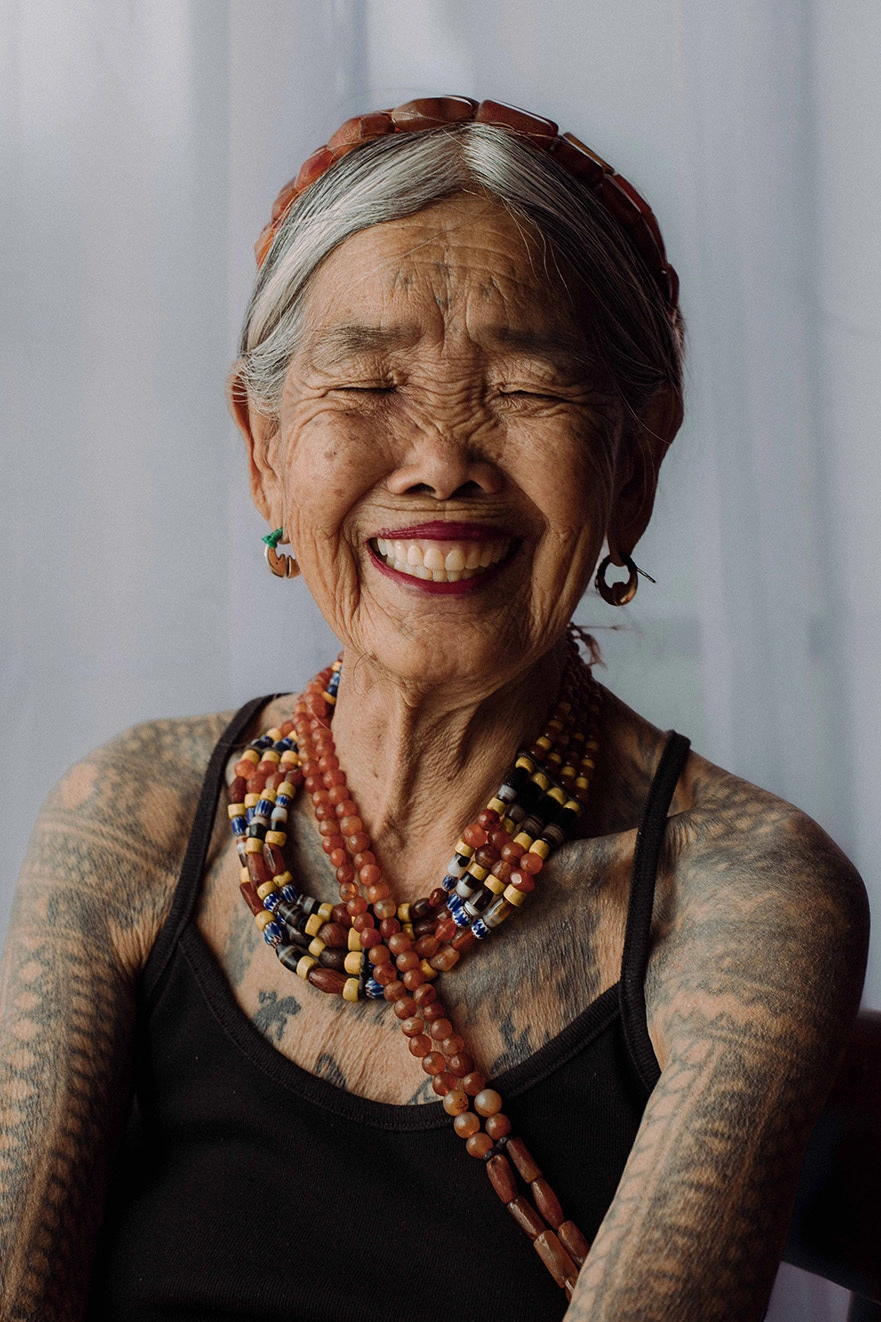
Batok — the Butbut Kalinga term for traditional hand-tapped tattooing — requires three elements: a sharpened thorn from a pomelo or calamansi tree, attached to a bamboo handle; a small wooden mallet; and ink made from soot mixed with water, sometimes with a small addition of tree sap, held in a coconut shell. The thorn is dipped in the ink and tapped repeatedly into the skin. The sound — tak, tak, tak — is the same onomatopoeia that gives the practice its name across different Philippine languages.
The process is slower and more percussive than machine tattooing, and the results have a particular quality — slightly irregular compared to machine lines, with a texture that reflects the handmade instrument. Whang-Od’s signature design, the one she applies to visitors in her later years of active tattooing, is three horizontal dots: a mark of her personal authorship, like a stamp on another artist’s finished work.
Designs and their meanings
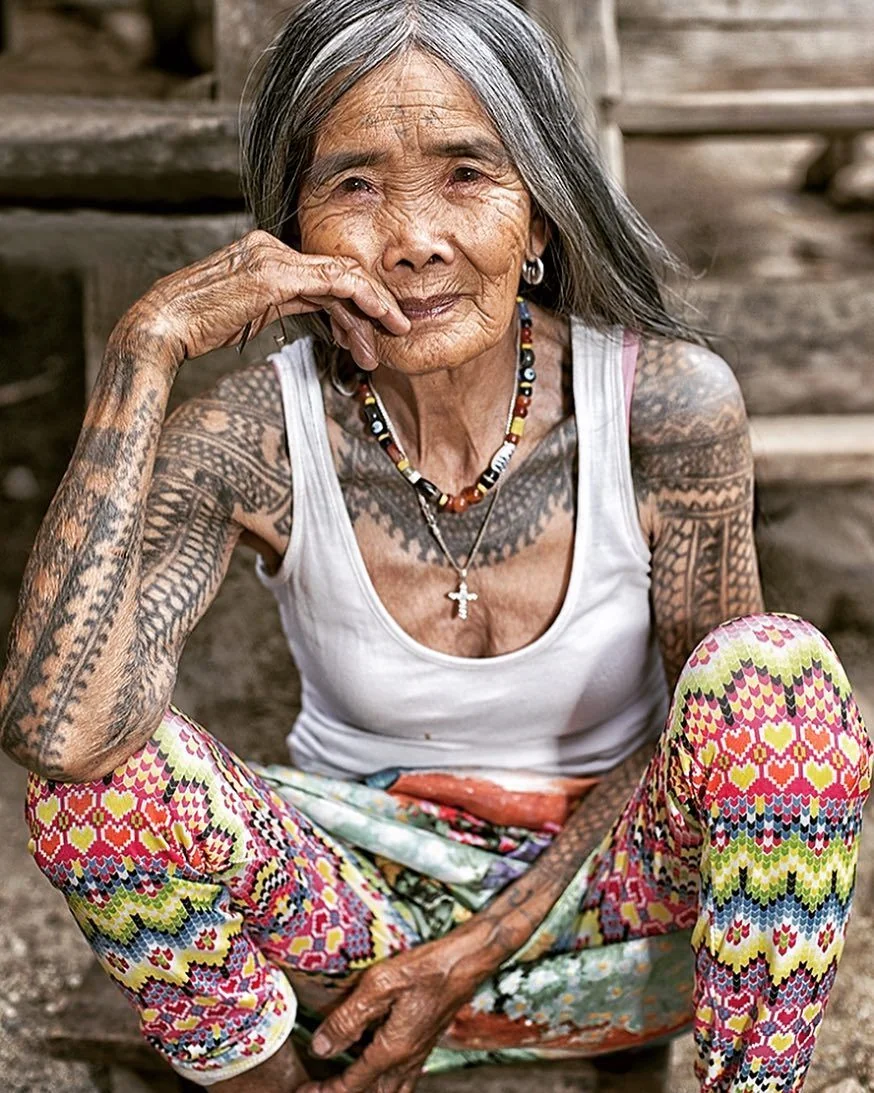
Among the Butbut, tattoo designs were a record system. Fi-ing — warrior chest and arm tattooing — was reserved for men who had participated in headhunting raids (kayaw) or inter-village warfare (baraknit). The first tattoo, marking a young man’s entry into warrior status, was applied to the forearm. As he accumulated combat experience, his tattoos progressed up his arms and eventually reached his chest. The chest tattoo of an accomplished headhunter told other communities who this man was and what he had done.
Fatok, the tattooing of women, marked beauty, status, fertility, and the transitions of adult life — adulthood, marriage, and childbirth. When a Butbut woman’s arm was tattooed in the traditional manner, her family paid the tattooist with a piglet or a bundle of harvested rice, a payment called dalan.
The designs draw from Kalinga’s visual vocabulary:
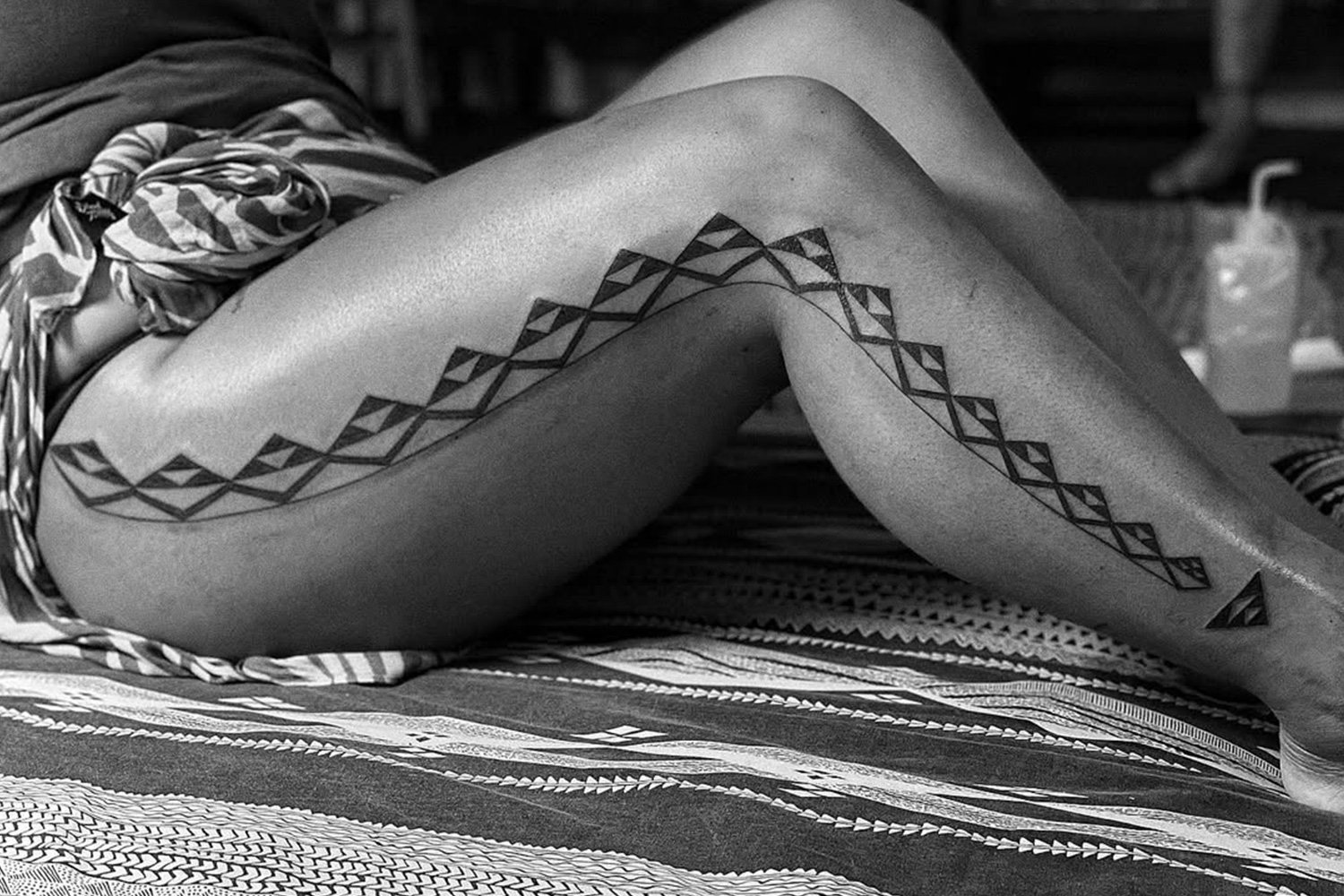
- geometric patterns,
- centipedes (symbolising strength),
- eagles,
- snakes and python scales,
- mountains,
- celestial bodies.
The python scale pattern carries its own origin story: in Butbut cosmology, it was first given to Lagkunawa, a noblewoman of Tinglayan, as a gift from the hero-god Banna, who fell in love with her.
The end of earned tattooing
The Philippine government discouraged headhunting through the twentieth century, and the last traditional fi-ing — warrior tattooing earned through an act of combat — was performed in 1972. In 2007, Whang-Od gave what is documented as the last tattoo earned under traditional criteria: she tattooed her brother-in-law after he killed an opponent in a dispute in a nearby village. With that, the old function of fi-ing ended.
How Whang-Od became known
For most of the twentieth century, Whang-Od worked in Buscalan as the tradition contracted around her. The young people of the Butbut were not interested in the old markings; the pull of lowland employment and changing social norms were drawing the younger generation away from village life. The craft was close to dying out.
In 2007, American tattoo anthropologist Lars Krutak spent two weeks in Buscalan filming for his Discovery Channel series Tattoo Hunter. He found Whang-Od — then nearly ninety years old and still working in the rice fields daily — and documented her practice. The series aired in 2009 and brought the first wave of international attention to Buscalan and to batok. Travel bloggers and journalists followed. Filipino celebrities made the trip. Word spread through social media.
Tourism arrived in force around 2016. At its peak, Buscalan received over 400 visitors a day. Tour vans came up the mountain in convoys. People slept in their vehicles when homestays were full. Facebook groups called “Tattooed by Whang Od” accumulated tens of thousands of members. The village shifted from subsistence rice farming to cultural tourism in a few years.
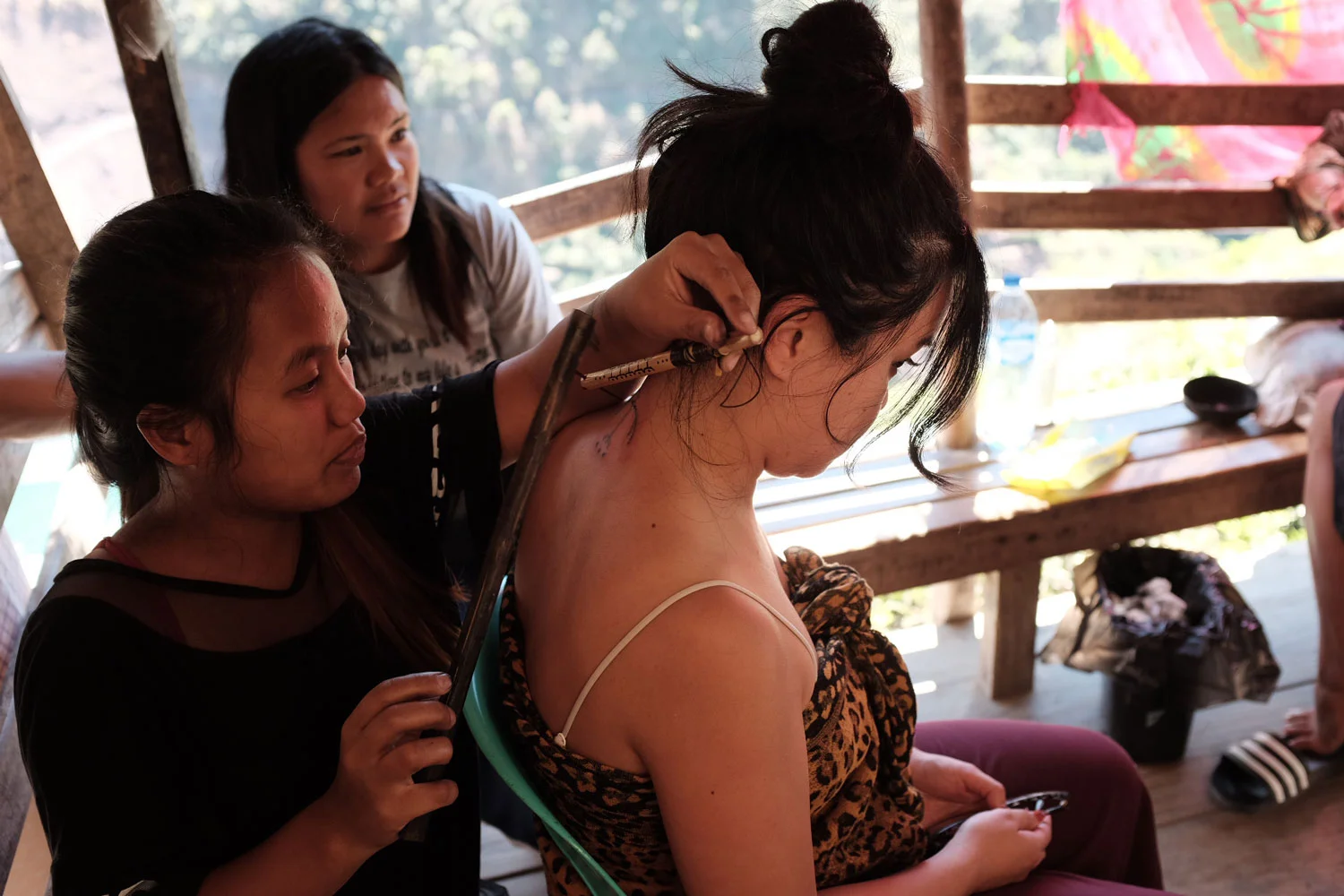
Families opened their homes as homestays. Villagers became tour guides, cooks, and souvenir sellers. Young women who had grown up watching Whang-Od work began learning to tattoo. During the COVID-19 pandemic, when tourists stopped arriving entirely, those women used the quiet to practise — tattooing themselves and each other. By the time visitors returned, more than a hundred new mambabatok had emerged from the village.
As of 2025-26, Buscalan sees around 100 visitors on weekdays and 300-400 on weekends. Cars line the mountain roads. Batok is now the village’s primary economic activity. In interviews, Whang-Od has said she hopes visitors will keep coming even after she stops tattooing — the income the village has built, she says, should outlast her.
Her apprentices and the question of transmission
The Butbut tradition holds that tattooing knowledge can only be transmitted within bloodlines. Whang-Od has no children. After a long period in which the tradition appeared to have no successor, she chose to train her grandnieces, breaking the patrilineal rule for the first time in documented Kalinga history. Her community accepted the decision.
The wider revival has produced approximately a hundred active mambabatok in Buscalan, most of them young women who learned through observation and practice during and after the pandemic. The tradition has moved from bloodline-only transmission to something closer to an open craft practised across the community — at least for the decorative and tourist-facing work.
Grace Palicas began learning from Whang-Od at around nine or ten years old, initially by observing and tapping the thorn while Whang-Od drew the outlines. Grace left for college in 2015; by that point, the tourism boom was accelerating, and Whang-Od needed help. Grace returned to Buscalan and was fully committed to the craft, eventually becoming one of the primary tattoo artists for visiting clients. She is now in her late twenties.
Ilyang Wigan took over more of the practical tattooing as Grace went to college, and has continued alongside her as the primary successor. Together, Grace and Ilyang perform the substantive tattooing for visitors; Whang-Od applies her three-dot mark to each completed piece as a personal authentication.
Den Wigan, a twelve-year-old at the time of the most recent documented reports, represents the next generation in the bloodline.
Filipino cultural anthropologist Analyn Salvador-Amores, who has studied the Kalinga tradition extensively, has documented what is and is not transferring. The hand-tapping technique and the visual vocabulary of the designs are being successfully passed on. The ritual dimensions — the chanting, the fortune-telling that accompanied the tattooing, the deeper cosmological knowledge — are not. These will likely end with Whang-Od. Salvador-Amores has also noted that Whang-Od may not qualify for the GAMABA (National Living Treasures Award) on a technical point: one requirement is that the craft be practised without commercial gain, and Whang-Od earns from tattooing. The question has not been resolved.
Recognition — and the Nas Academy controversy
In 2017, Whang-Od was formally nominated for the Gawad sa Manlilikha ng Bayan (GAMABA), the National Living Treasures Award — the state’s highest honour for traditional folk artists. The nomination was made at the 66th Manila FAME trade event and taken up by the Senate through a resolution sponsored by Senators Nancy Binay and Juan Edgardo Angara. As of the time of writing, the GAMABA has not been conferred — the nomination remains in deliberation, with the commercial-gain question among the unresolved issues.
In 2018, the National Commission for Culture and the Arts gave her the Dangal ng Haraya Award — an honour for contributions to Philippine culture and the arts — at a ceremony in Tabuk, the provincial capital of Kalinga.
In June 2021, vlogger Nuseir Yassin — known online as Nas Daily — announced that his online education platform Nas Academy would offer a paid course called the “Whang-Od Academy,” priced at ₱750, advertising it as an opportunity to learn traditional tattooing from Whang-Od directly. Whang-Od’s grandniece and apprentice, Grace Palicas, immediately alleged in a public Facebook post that Whang-Od had not consented to the course and did not understand what she had agreed to.
Nas Academy responded by posting a video showing Whang-Od affixing her thumbprint to a contract, presenting it as evidence of consent. The National Commission on Indigenous Peoples (NCIP) launched an investigation. In August 2021, the NCIP-Cordillera Administrative Region released its findings: that Whang-Od was not aware of any contract, that the thumbprint she had affixed did not match a thumbprint obtained directly from her by investigators — the discrepancy was referred for forensic study — and that the contract’s terms were “grossly onerous.” The contract granted Nas Academy perpetual, exclusive ownership of all content produced, including Whang-Od’s likeness, image, and voice, and was governed by Singaporean law. The NCIP also stated that under the Indigenous Peoples Rights Act of 1997, commercial use of an indigenous community’s cultural practices requires Free and Prior Informed Consent from the community as a whole — not just from an individual member.
Nas Academy halted Philippine operations on August 8, 2021. On October 24, 2021, the NCIP confirmed that Nas Academy had formally apologised to the Butbut community in a customary process in Buscalan. The case established a practical precedent: individual consent from a community member — even the most prominent one — is insufficient under Philippine law when the cultural property at issue belongs to the entire community.
In September 2022, the Cultural Center of the Philippines gave Whang-Od the HIYAS Award for Indigenous Art, its inaugural award in that category.
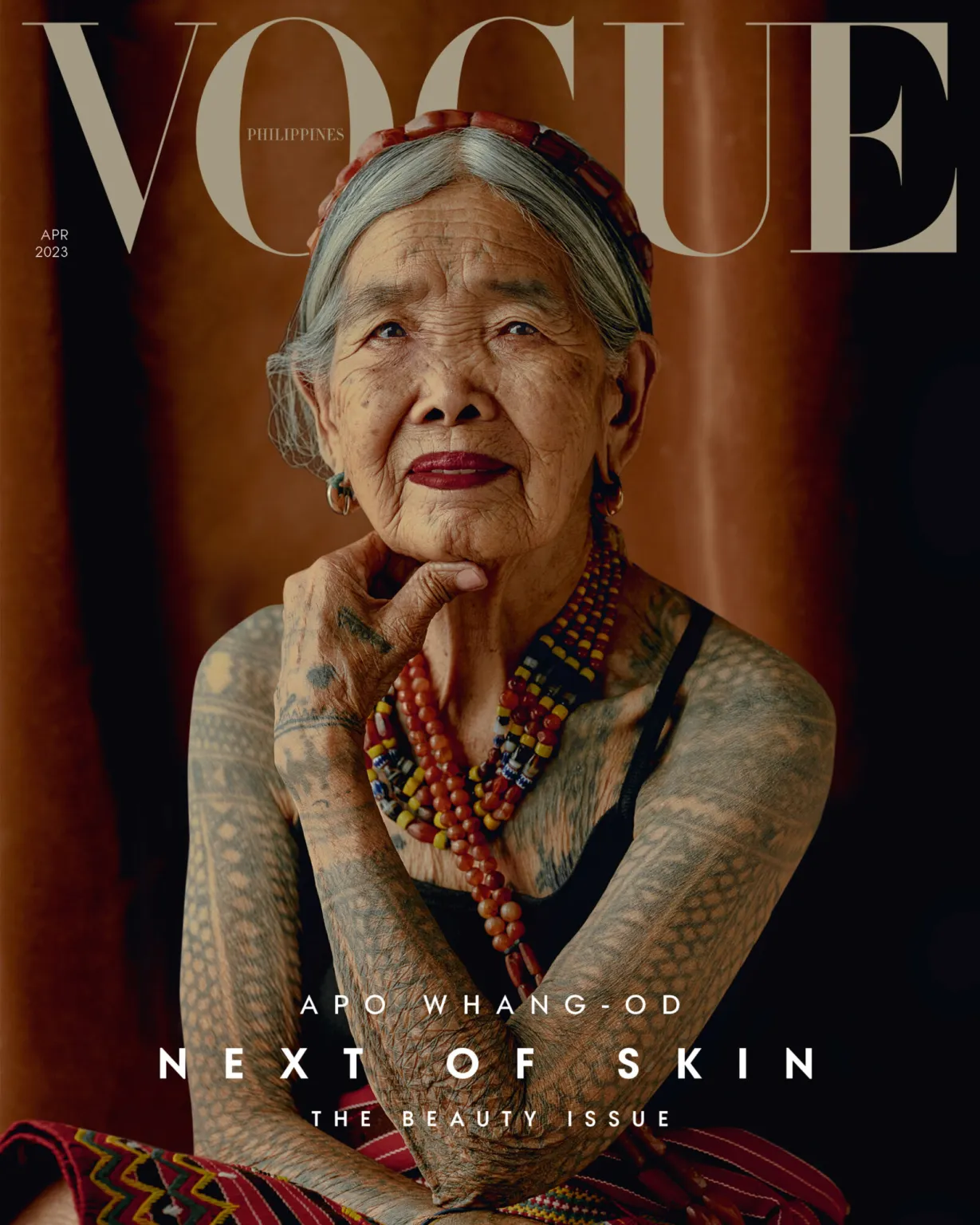
In April 2023, she appeared on the cover of Vogue Philippines for the magazine’s Beauty Issue at the age of 106. The cover, photographed by Artu Nepomuceno, made her the oldest person to appear on the cover of any edition of Vogue in the magazine’s global history.
In February 2024, President Ferdinand Marcos Jr. presented her with the Presidential Medal of Merit.
What Whang-Od represents
Tattoos were stigmatised in mainstream Philippine society for much of the twentieth century — associated with criminal activity, gangs, and people outside respectable norms. The Catholic Church’s long disapproval of body modification reinforced this. For many Filipinos who grew up after independence, the connection between tattooing and pre-colonial indigenous identity had been severed so completely that the two were not understood as related.
Whang-Od’s visibility has worked directly against that. Her appearance on the cover of Vogue Philippines — not as a curiosity but as an aesthetic authority — placed pre-colonial indigenous Filipino identity at the centre of a national conversation about beauty. Michelle Dee, Miss Universe Philippines 2023, competed at the international pageant wearing an evening gown inspired by Whang-Od’s tattoo designs; in May 2024, Dee visited Buscalan and received the three-dot signature directly from Whang-Od.
The broader Filipino cultural reclamation movement — the revival of baybayin script, of pre-colonial spiritual practices, of traditional textile arts, and of indigenous tattooing itself — has drawn sustained energy from Whang-Od’s continued presence and work. For Filipinos in the archipelago and in the diaspora, she is the most visible living connection to a cultural inheritance that four centuries of colonisation tried to erase.
She speaks only Kalinga and Ilocano — not Filipino or English. Every interview, every media interaction, every session with a foreign visitor requires a translator. Every account of what she has said is therefore mediated, and the understanding of her motivations, her beliefs, and her wishes that reaches the outside world is always filtered through at least one layer of interpretation.
Current status
As of August 2025, Whang-Od was still tattooing at approximately 108 years old. She tattoos at a reduced frequency and for shorter sessions than in earlier years; her three-dot signature on work done by Grace or Ilyang remains the primary way visitors can see her direct mark. She continues to live in Buscalan and to work in the rice fields when able.
A 2026 report by Focus Taiwan noted that she is not the oldest person in Buscalan — one woman in the village is 110, another is 104. Longevity in the Butbut community appears relatively common, with a diet of vegetables and traditionally prepared foods, free from the pressures of urban life. Whang-Od has attributed her own health to eating simply, avoiding alcohol and tobacco, and working consistently throughout her life.
Her village will not return to what it was before Lars Krutak arrived in 2007. Whether the ritual knowledge — the chanting, the cosmological understanding of the designs, the tradition’s deeper dimensions — survives Whang-Od is uncertain. What has survived, and what she ensured would survive, is the practice itself: the thorn, the mallet, the soot, the sound of tapping, and the marks left on skin.
Sources & further reading
- Whang-od and Whang-od Academy on Wikipedia, The Free Encyclopedia.
- Lars Krutak. Tattoo Hunter, Discovery Channel (filmed 2007, aired 2009).
- Brent Foster. The Last Mambabatok (movie).
- Audrey Carpio. Apo Whang-Od and the Indelible Marks of Filipino Identity. Vogue Philippines, 2023.
- Lane Wilcken. Skin Stories: The Culture of Tattooing in the Philippines. Vogue Philippines, 2025.
- Focus Taiwan / CNA. 109-year-old Kalinga tattooist keeps legacy alive. March 2026.
- Fred Wissink. The Fascinating Story of a Tattooing Tradition. Fred Wissink Photography, 2023.
- Maia Almendral Esteves. From Brooklyn to Buscalan: A Journey to Whang Od. Positively Filipino, 2019.
- Rappler. Multiple reports on the Nas Academy controversy (August 2021) and NCIP findings. Available at rappler.com.
- Philstar / GMA News Online. Coverage of NCIP findings on the Nas Academy contract. August–October 2021.
- Senate of the Philippines. Senate nominates tribal tattooist for Gawad Manlilikha award. February 2018.
- Spot.ph / PEP.ph. Coverage of Whang-Od’s eligibility for GAMABA vs. National Artist Award, with NCCA commentary. November 2023.
- GMA News Online. Kent Donguines on his Apo Whang-Od documentary, ‘Treasure of the Rice Terraces’. August 2025.
- Rappler. Who is Whang-Od, legendary tattoo artist? August 2021.
- Martin Soukup. The Aura of Tattoos: The Commodification of Tradition in Buscalan Village, the Philippines. ResearchGate, 2021.