Related Posts



Samoan tattooing
Samoan tattoos: the tradition that never broke
Every other Polynesian tattoo tradition was interrupted. In Tonga, Tahiti, Hawai’i, the Marquesas, and Aotearoa, the arrival of Christian missionaries in the eighteenth and nineteenth centuries disrupted or destroyed tattooing practices that had endured for centuries or even millennia. The tools were confiscated, the practitioners discouraged, and the cultural chain was severed — leaving each tradition to be reconstructed, decades or centuries later, from fragments: European explorers’ drawings, ethnographic records, oral memory, and the designs preserved in other media.
Samoa is the exception. The Samoan tatau tradition has been practised continuously, in its traditional form, from pre-contact times to the present. The tools have changed materials (steel and nylon replace bone and coconut fibre), the pigment is now commercially manufactured, and the hygiene protocols have been formalised — but the method, the design system, the cultural protocols, and the hereditary lineage of master practitioners are unbroken. The tufuga ta tatau working in Apia or Auckland today is performing the same ritual, using the same technique, within the same cultural framework as the tufuga who worked before European contact. No other major tattoo tradition in the world can make this claim.
This continuity is the single most important fact about Samoan tattooing. It means that when other Polynesian peoples — Tongans, Tahitians, Hawaiians, Māori, Cook Islanders — sought to revive their own traditions in the late twentieth century, they turned to Samoa. The Samoan tufuga ta tatau became the teachers, the reference points, and, in many cases, the practitioners who performed the first revived tattoos on other Pacific bodies. Samoa’s unbroken chain held the wider Polynesian tattoo world together.
The origin: the legend of the twin sisters Taema and Tilafaiga
The origin: the legend of the twin sisters Taema and TilafaigaThe Samoan account of how tattooing came to the islands is told through the legend of the twin sisters Taema and Tilafaiga. The twins swam from Fiji carrying the tools and knowledge of tattooing, singing a song as they crossed the ocean:
“Tattoo the women, not the men.”
But during the journey — distracted by a giant clam, or bewitched by those who did not wish to share the knowledge — the sisters confused the words of the song. By the time they arrived in Samoa, the instruction had reversed:
“Tattoo the men, not the women.”
The legend explains why the pe’a — the elaborate male tattoo — is the more extensive of the two Samoan tattoo forms, while the malu — the female tattoo — is lighter and less dense. It also explains why the authority to tattoo is understood as a gift brought from outside Samoa (from Fiji) and transmitted through specific lineages: those who can trace their genealogy to Taema or Tilafaiga hold the hereditary right to practise the craft.
The legend is a story about cultural transmission, about the fragility of knowledge in transit, and about the specific relationship between gender and tattooing in Samoa. It is told in multiple versions across Samoan communities, and it is the foundational narrative of the practice.
For men: The pe'a (malofie)
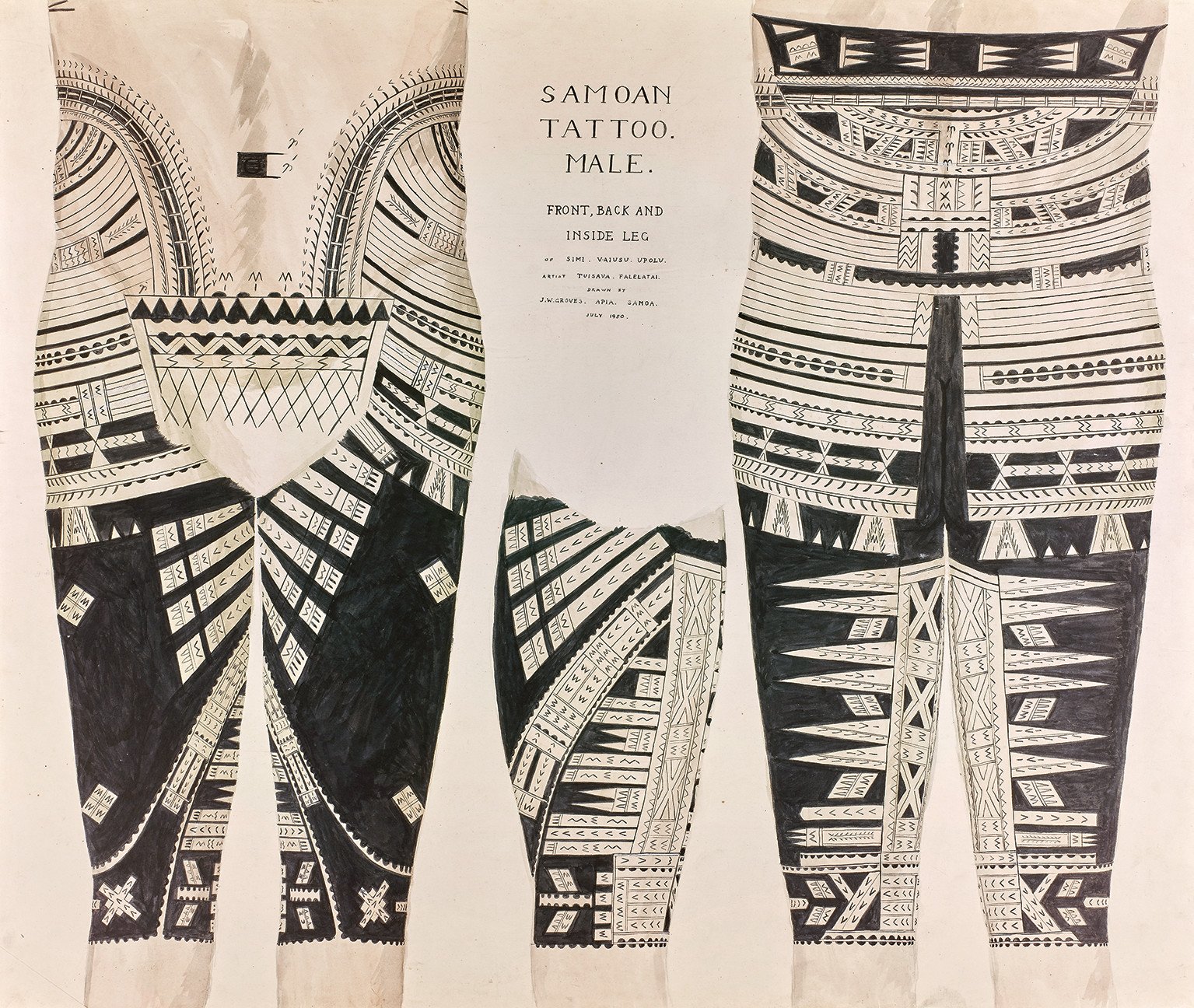
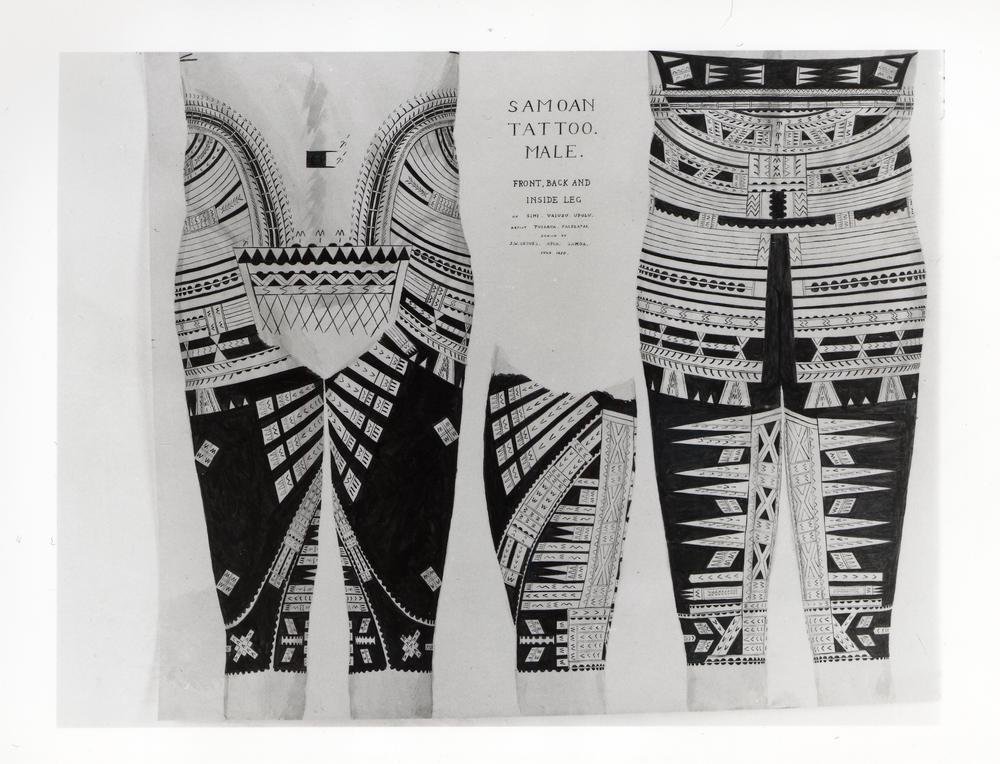
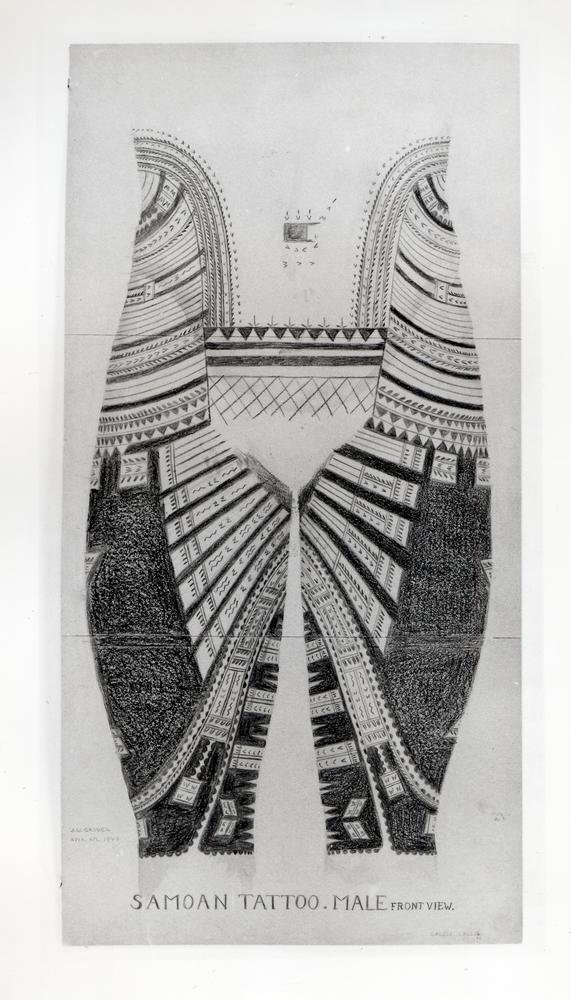
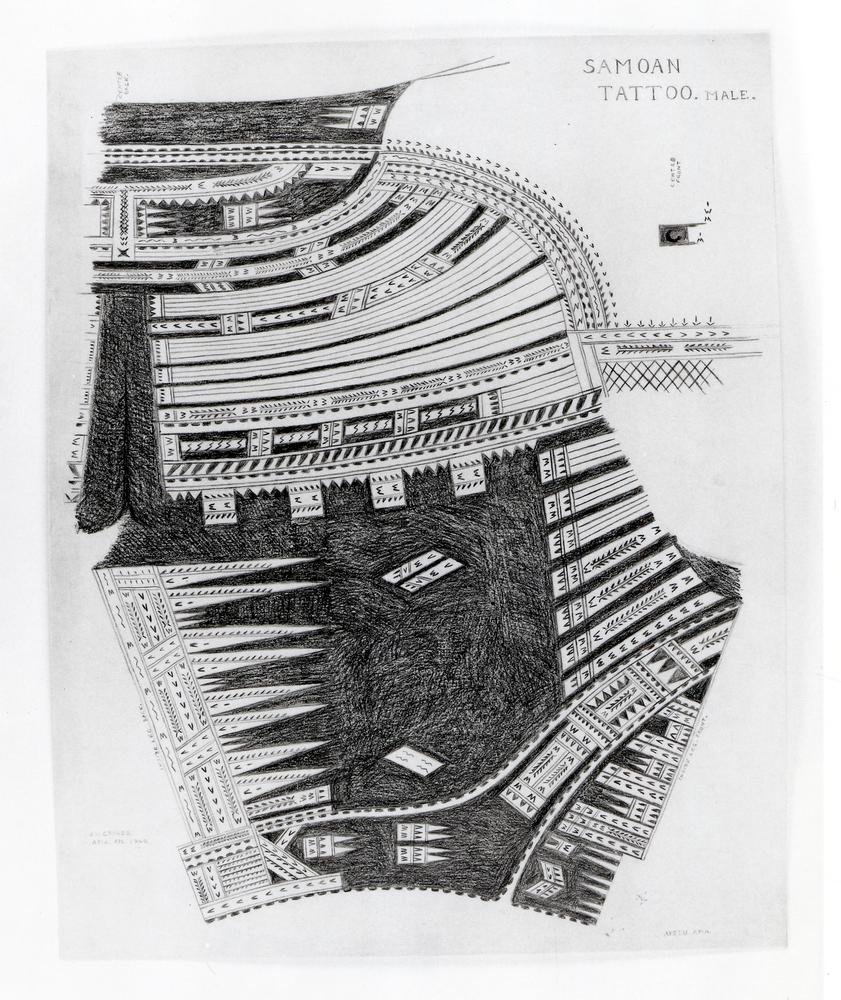
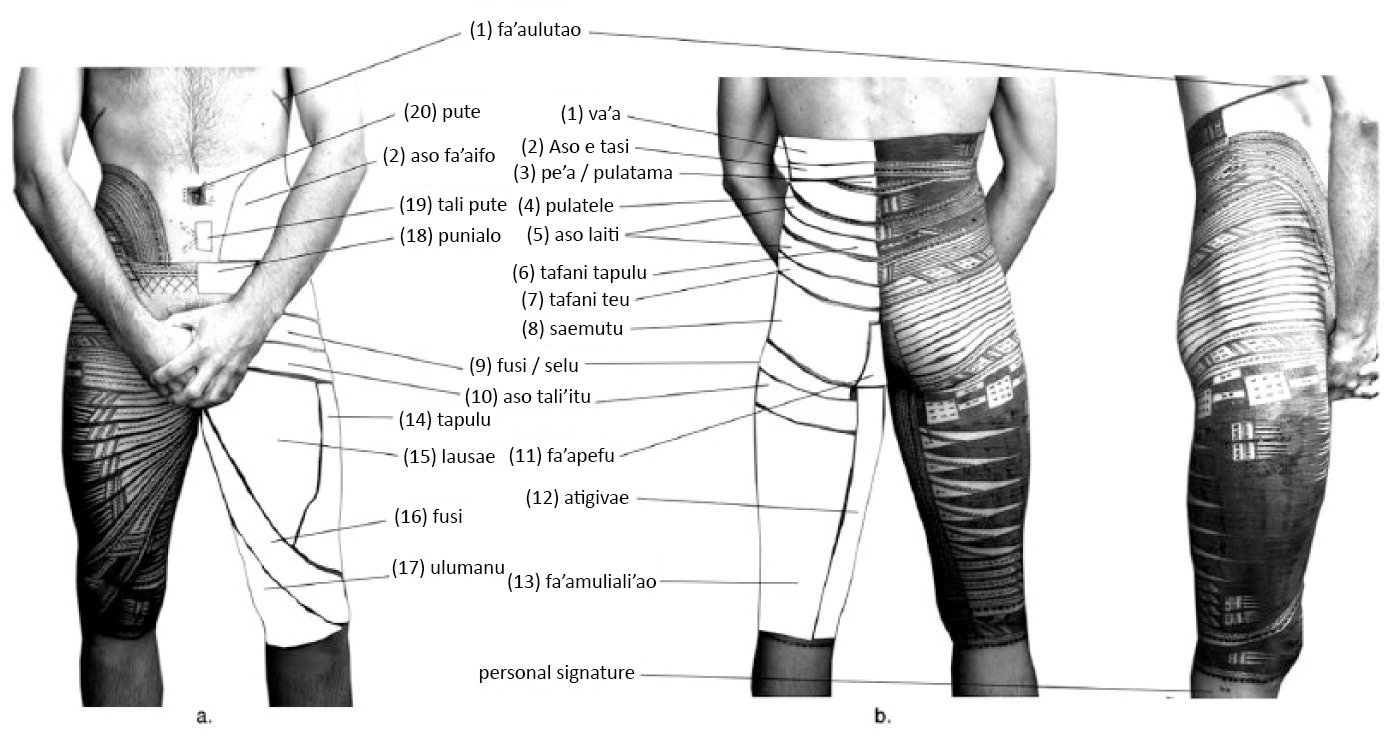
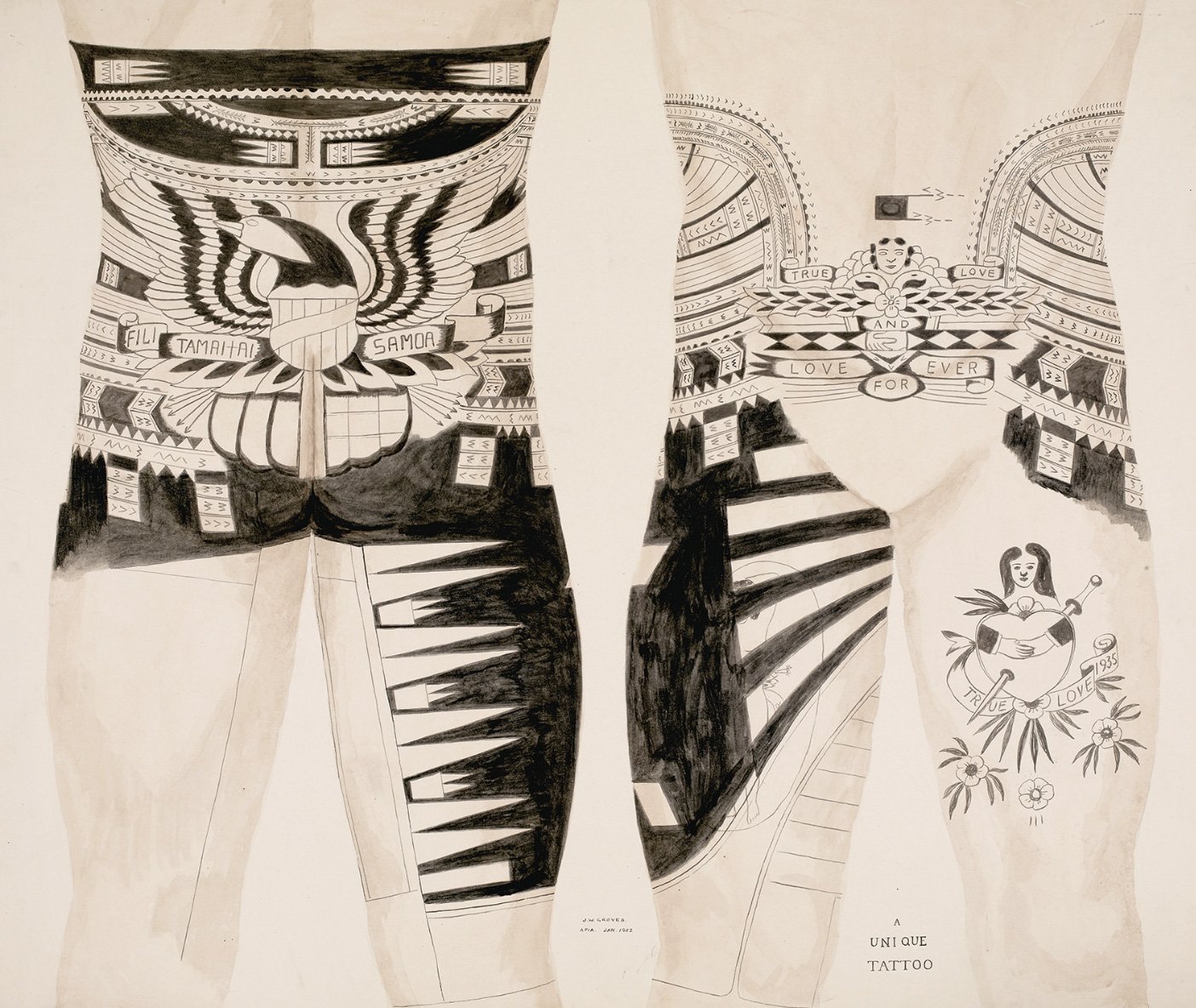
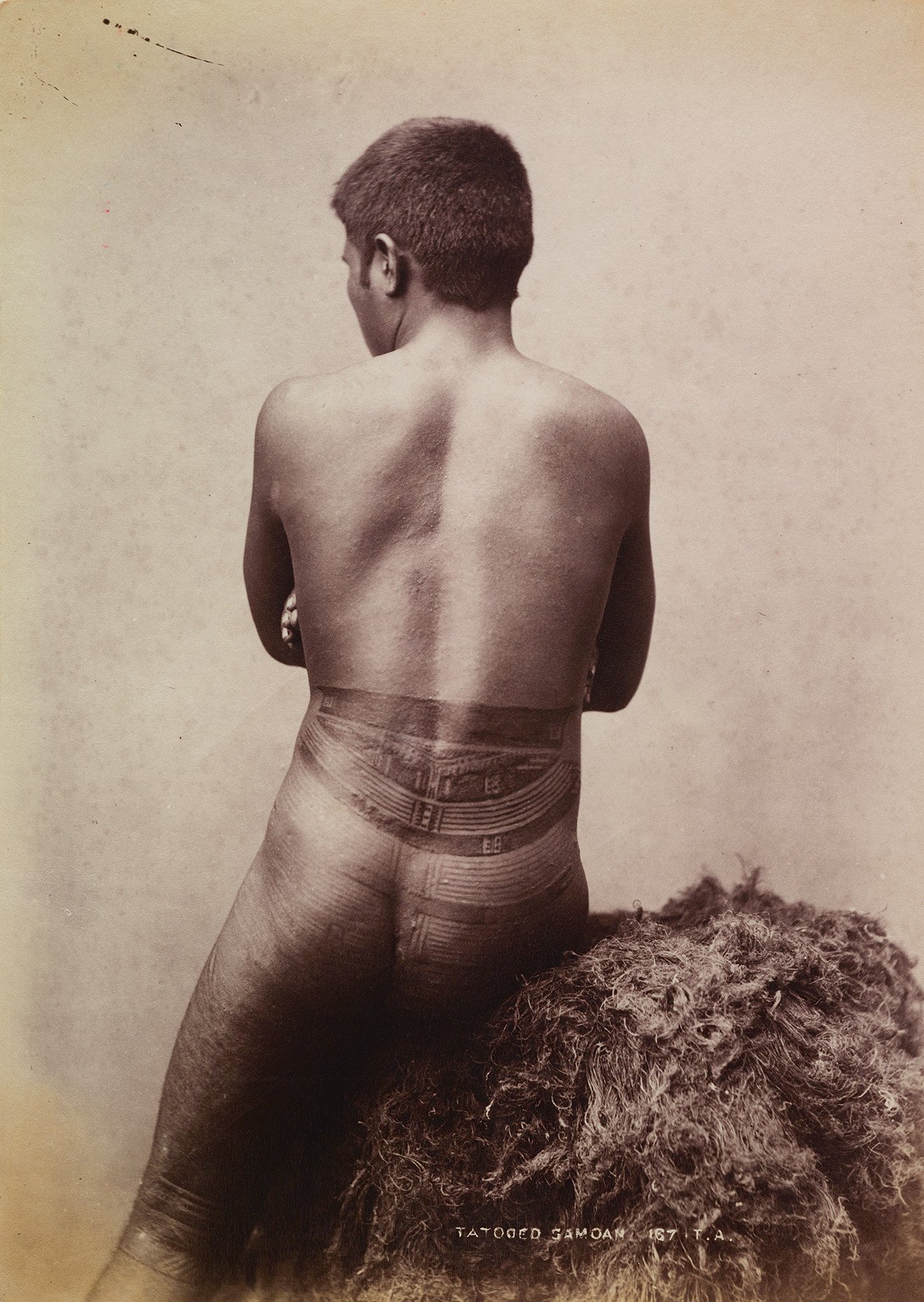
The pe’a is the Samoan male tattoo — a dense geometric composition covering the body from the waist to below the knees. The word pe’a means “flying fox” (fruit bat), and the connection between the tattoo and the animal is visual: when a man wearing a pe’a stands with his legs apart, the dark patterns on the inner thighs and the bands wrapping the legs are said to resemble the wings of a flying fox in flight.
The pe’a covers: the lower back, the buttocks, the hips, the upper thighs (front, back, and sides), and the legs to the knees. The composition is bilaterally symmetrical, following the body’s midline, and it is built from bands, arcs, chevrons, solid fields, and geometric motifs arranged in a specific sequence. The design is structured but not standardised — each pe’a is unique to its wearer, composed by the tufuga according to the wearer’s genealogy, family, village affiliation, and personal qualities. The overall structure is consistent (the zones of the body and the general arrangement of elements), but the specific motifs and their placement are customised.
The final element of the pe’a is the pute — the tattoo of the navel — which completes the design. Until the pute is done, the pe’a is unfinished, and an unfinished pe’a is a source of lasting shame for the wearer and their family.
A pe’a typically requires 30 to 35 hours of tattooing, spread across daily sessions of four to six hours. In historical practice, the pe’a could be completed in as few as five days of intensive work. Contemporary practice often spreads the sessions across a longer period — one to four weeks — depending on the wearer’s tolerance and the tufuga’s schedule.
The process is extremely painful. The pain is understood as an essential part of the experience — a test of endurance, humility, and commitment that the recipient must pass to earn the mark. A man who endures the pe’a has demonstrated the qualities — patience, courage, tolerance of suffering, devotion to family — that the tattoo publicly attests to. Abandoning the process before the pute is applied brings lasting shame: the unfinished pe’a is called pe’a mutu (“broken pe’a”), and it marks its wearer as someone who could not complete what he began.
A man who has received a completed pe’a is called soga’imiti — literally “one who is qualified to squeeze the dye.” The title confers social standing within the Samoan community, particularly in ceremonial and chiefly (matai) contexts. The respectful term for the pe’a is malofie — the word used in formal speech, as opposed to the everyday tatau or pe’a.
For women: The malu
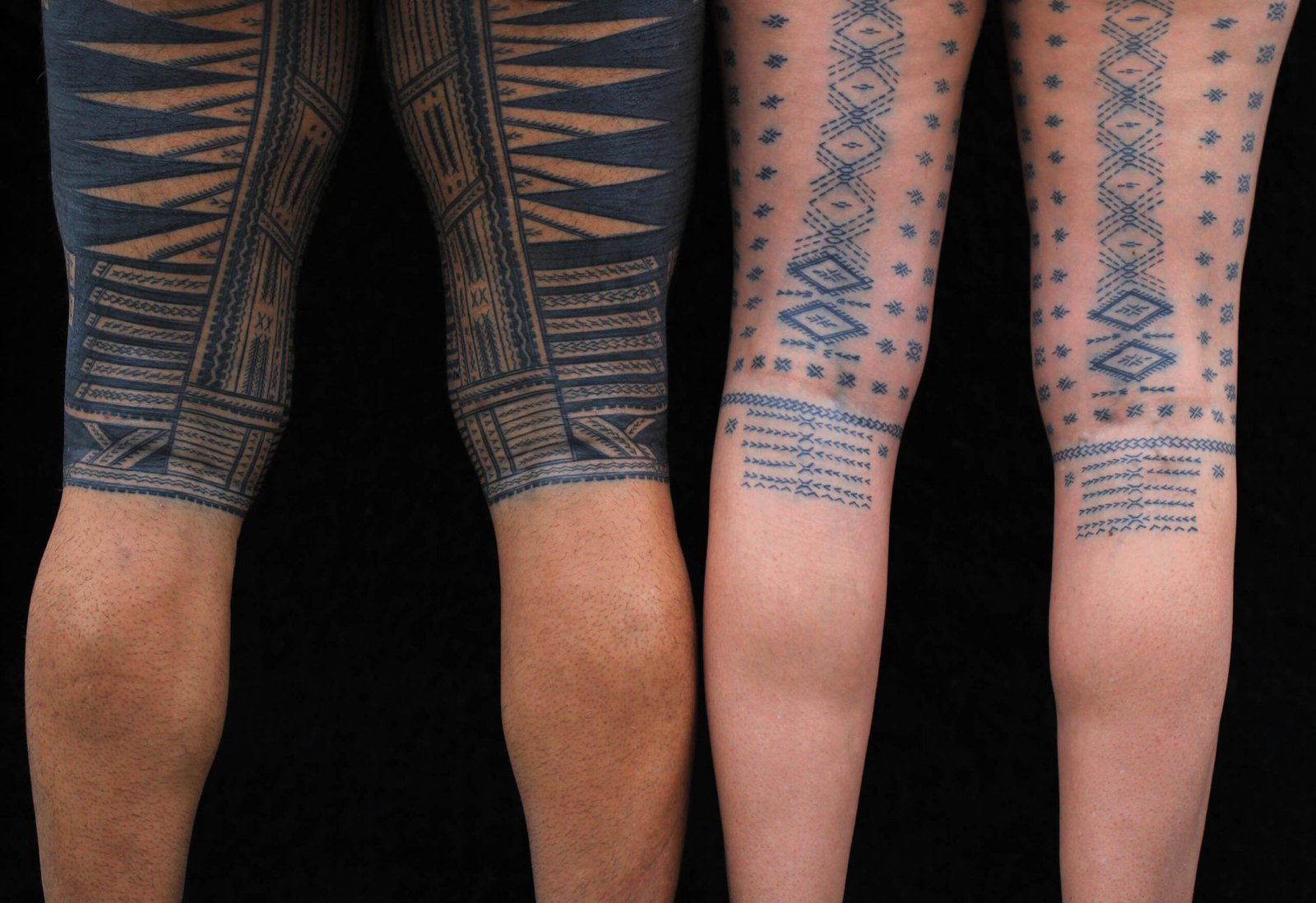
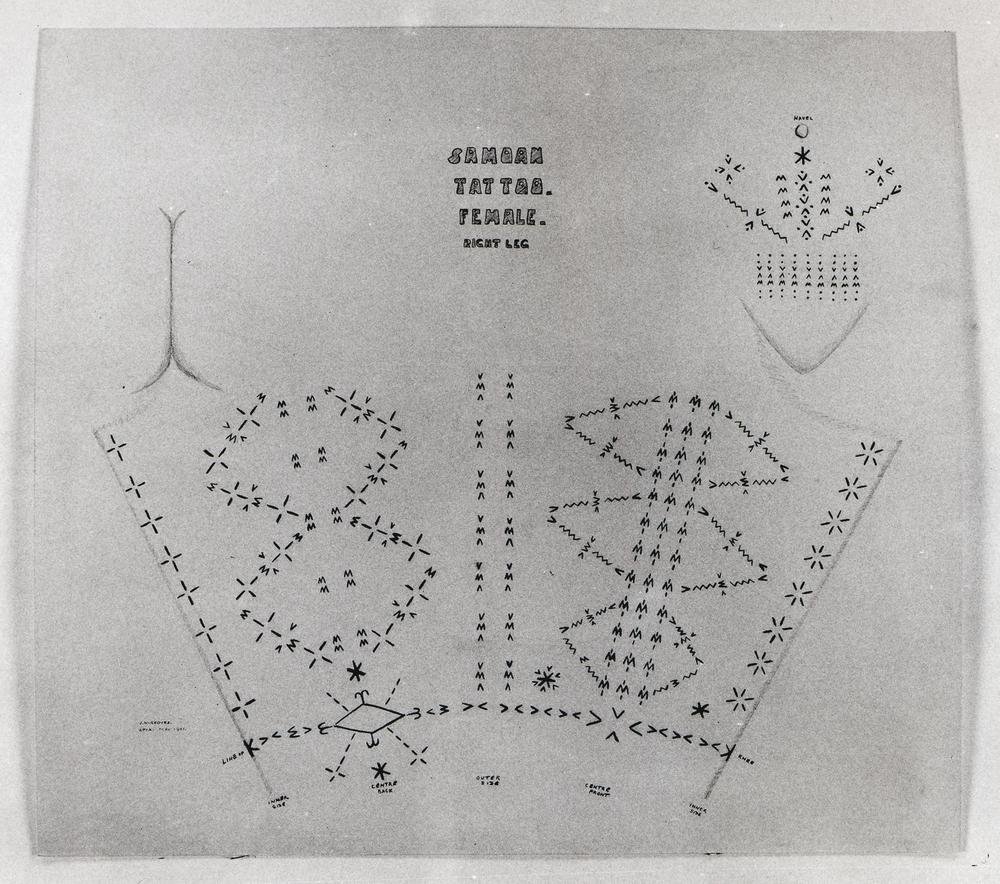
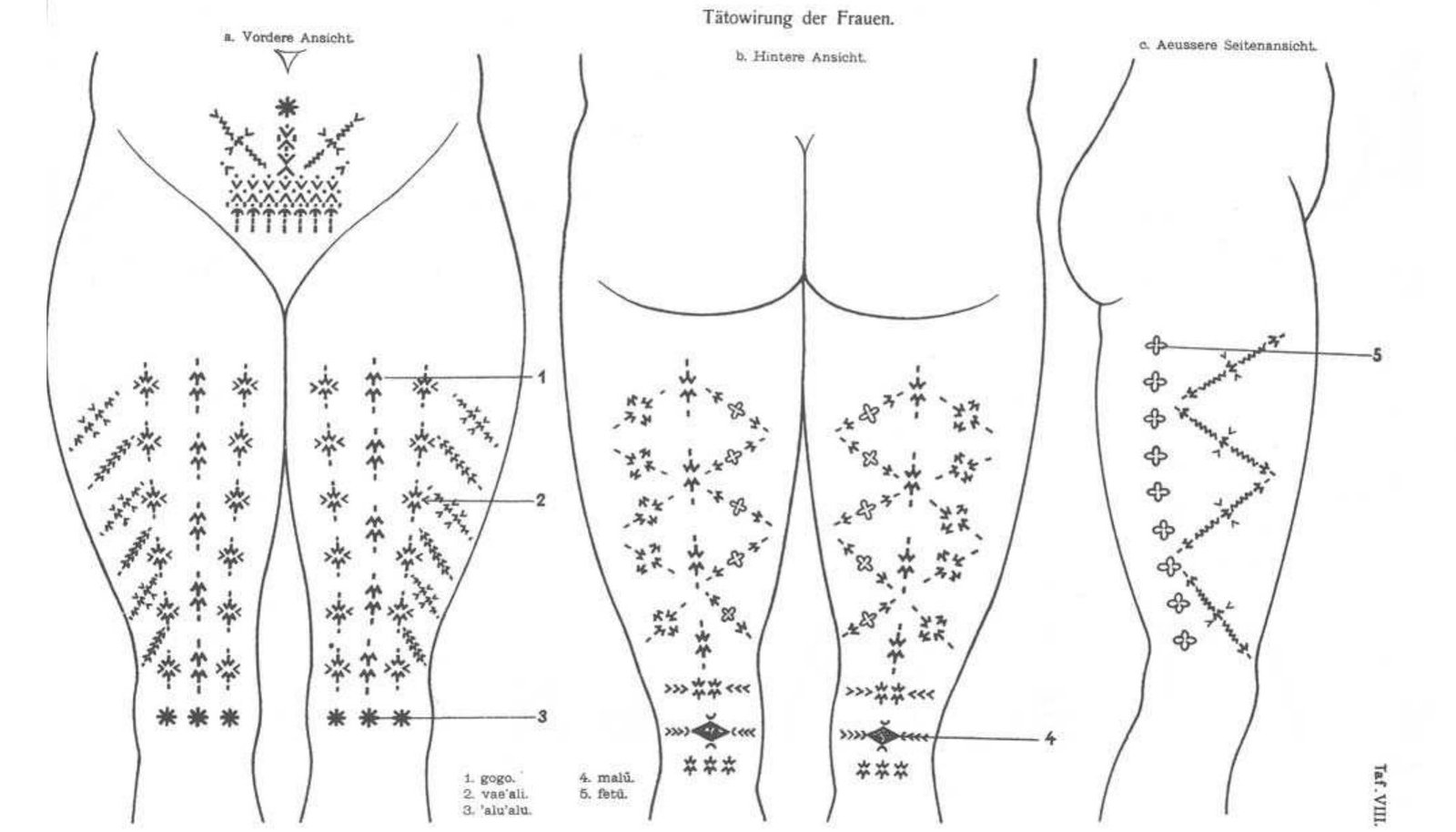
The malu is the traditional female tattoo. It covers the thighs from the upper leg to behind the knee, using finer lines and more open patterning than the pe’a. The word malu means “protection” or “shelter” in Samoan.
The malu includes a distinctive diamond-shaped motif behind the knee — the malu pattern itself — that is specific to the female tattoo and is one of the most recognisable single elements in Samoan design. The overall composition is lighter, more delicate, and more open than the pe’a, but it is applied using the same hand-tapping method and the same cultural protocols.
A malu is often completed in a single sitting or over two days, though larger or more elaborate versions may take longer. Like the pe’a, it is a rite of passage — marking a woman’s maturity, her connection to her family and village, and her readiness to carry the responsibilities of adult female life in Samoan society.
The tufuga ta tatau
The tufuga ta tatau — the master tattooist — holds one of the most respected specialist titles in Samoan society. The title is hereditary, passed through specific families, and the authority to practice is conferred through genealogy and through the formal bestowal of the title by an elder tufuga.
The two principal families are the Sa Su’a (based primarily in Savai’i, Samoa’s largest island) and the Sa Tulou’ena (based primarily in Upolu). A third family, the Lai’afaiva, is also recognised. The relationships between these families and the boundaries of their respective authority are matters of ongoing discussion within the Samoan community.
The Su’a Sulu’ape family — a branch of the Sa Su’a — is the most internationally prominent. Key figures include:
- Su’a Sulu’ape Paulo II (1949 or 1950–1999). Born in Matafa’a near Lefaga, Samoa, Paulo migrated to Auckland, New Zealand, in the 1970s. He began tattooing in 1967 and became the figure who brought Samoan tattooing to international visibility. He tattooed for the Samoan diaspora in New Zealand, he did residencies at the Tattoo Museum in Amsterdam at the invitation of Henk Schiffmacher, and he innovated within the tradition — sometimes controversially — by adapting the practice for new contexts and new clients. He tattooed the New Zealand artist Tony Fomison (who received a pe’a in 1979) and several prominent Samoans in the diaspora. Paulo died in 1999.
- Su’a Sulu’ape Alaiva’a Petelo is Paulo’s brother and the current head of the Sulu’ape family. In 1985, he was the first Samoan tufuga ta tatau invited to an international tattoo convention — held in Rome, at the invitation of Don Ed Hardy and Henk Schiffmacher. He has trained his sons in the practice and has overseen the expansion of the Sulu’ape family’s influence across the Pacific — including the revival of tattooing in Tonga, French Polynesia, the Cook Islands, Hawai’i, and Aotearoa, where new generations of Pacific tattooists have learned from the Sulu’ape lineage.
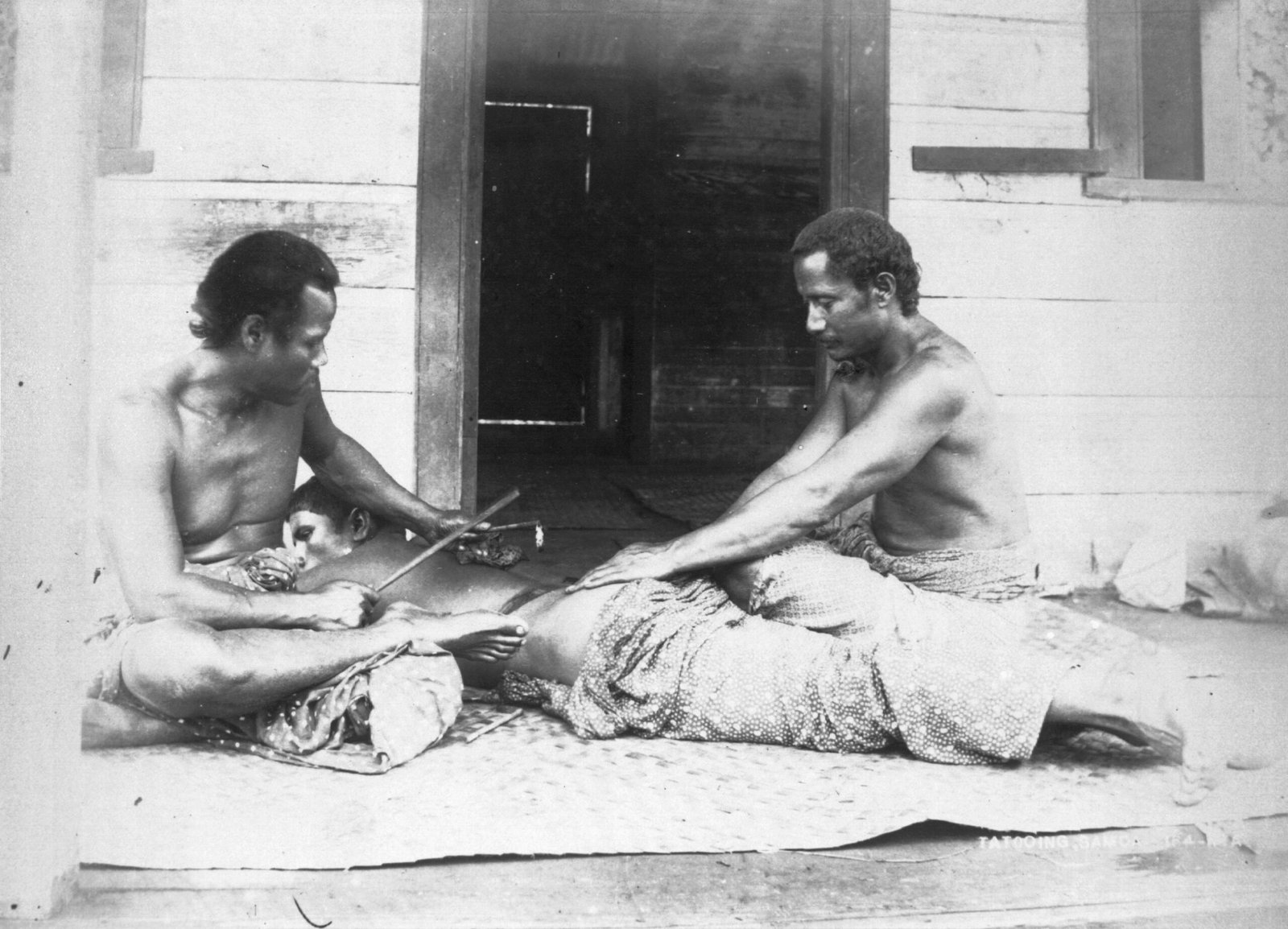
The tufuga ta tatau does not merely execute designs. He is the designer, the cultural authority, and the spiritual officiant of the tattooing process. He assesses the wearer’s genealogy and social position, determines the appropriate motifs and their placement, and makes the compositional decisions that make each pe’a or malu unique. The tufuga’s authority is earned through years of apprenticeship and conferred through the bestowal of the title — the hereditary right to use the family’s tools and to carry the family’s name.
Tattooing tools
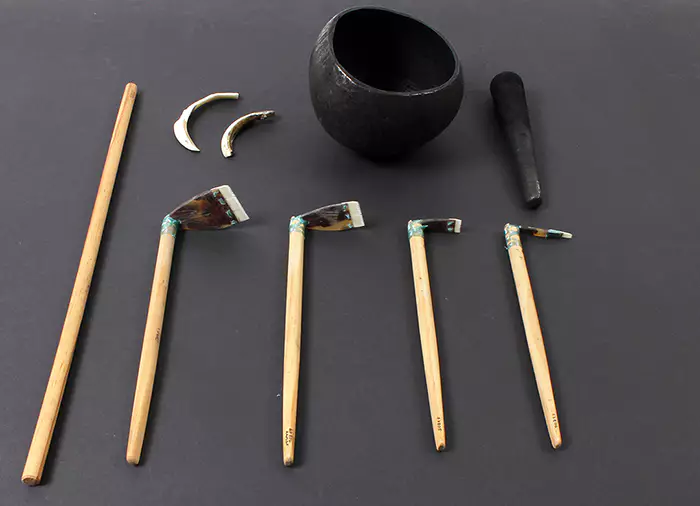
The Samoan tufuga works with a set of handcrafted tools collectively called the ‘au.
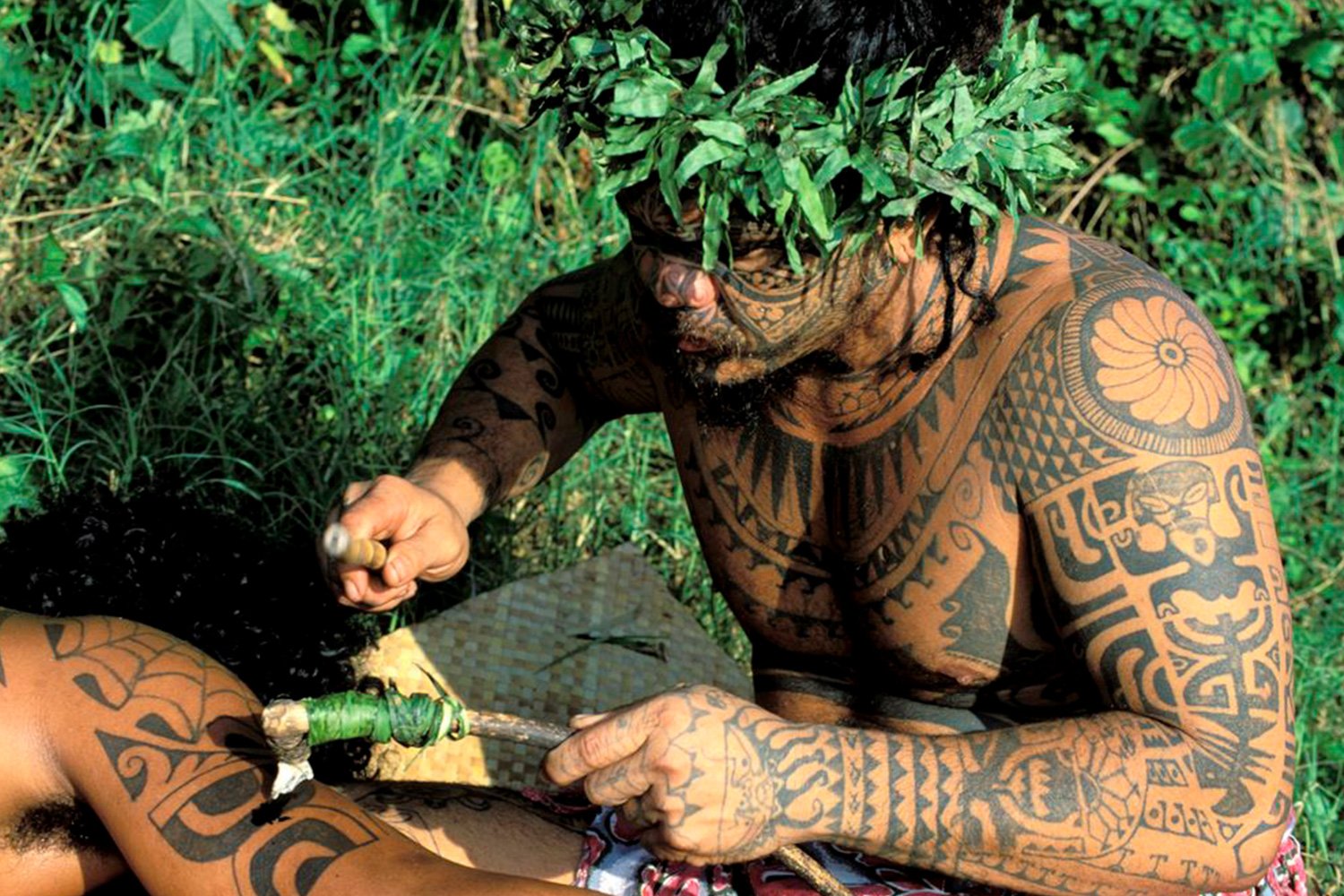
The tattooing comb (‘au ta). The core instrument. A row of sharp teeth — historically made from boar’s tusk or bone, now typically made from surgical steel — mounted on a turtle-shell plate attached to a wooden handle. Different combs have different widths for different purposes:
- The ‘au tapulu — a wide comb, used for filling solid areas and broad patterns.
- The ‘au mono — a narrow comb, used for fine lines and detail work.
- The ‘au sogi — used for specific detail passages.
Each tool is named and serves a specific function in the tattooing process. The tools are treated with respect as cultural objects — they are not disposable implements but components of a set that carries the family’s authority.
The mallet (sausau). A short wooden stick used to strike the comb’s handle, driving the teeth into the skin. The rhythmic tapping of the sausau against the ‘au produces the sound that gives the practice its name — tatau, an onomatopoeia for the tap-tap rhythm of the mallet.
The pigment (lama). Traditionally made from the soot of burned candlenut kernels, collected and mixed with water on a half-coconut shell using a taro leaf as a mixing surface. Contemporary tufuga use commercially manufactured tattoo ink that replicates the quality of the traditional pigment while meeting modern safety standards.
The mortar and pestle (ipu lama and tu’i). Used to grind and prepare the pigment. Sets of these tools are held in museum collections, including the Auckland War Memorial Museum, which holds a complete set made by Su’a Sulu’ape Paulo II, acquired in 1991.
The assistants (‘au toso). Not tools but essential participants. The ‘au toso — typically apprentice tattooists — stretch the skin taut during tattooing, wipe excess ink and blood, and provide physical and moral support to the recipient. The assistants learn the craft by participating in the process over the years before being authorised to tattoo themselves.
Samoa adopted formal hygiene standards for traditional hand-tap tattooing in 2017. The modern tufuga uses synthetic materials that can be autoclaved, disposable stainless-steel combs specially manufactured for the Sulu’ape and other families, and commercially produced inks. The traditional method — hand-tapping with a comb, a mallet, and assistants — is maintained.
Samoan tattoo motifs
The patterns of the pe’a and the malu — called mamanu — are built from a vocabulary of geometric motifs drawn from the natural world, from the built environment, and from the social structure of Samoan life. The motifs are not random decoration; each carries a specific cultural reference. The composition of a pe’a is a readable visual document — each zone of the body carries specific motifs, and their arrangement tells the wearer’s story.
Pe’a (flying fox). The flying fox motif gives the male tattoo its name. It represents connection to the land, to the ancestors, and to the social world. Flying fox motifs often appear in the lower sections of the pe’a.
‘Aso (ribs of the fale). The fale is the traditional Samoan open-sided house, and the ‘aso motif represents its rafters — the structural framework that holds the community together. This motif represents the wearer’s commitment to tautua (service) and duty to the chief.
Nifo mano (shark teeth). Triangular patterns represent strength, guidance, fierceness, and protection. The shark is a sacred animal in Polynesian culture, associated with tenacity and adaptability. Shark teeth are among the most common motifs in Polynesian tattooing.
Fa’amanii (spear head). Triangular patterns that represent the warrior spirit, courage, readiness for battle, and protection. Distinct from the shark-teeth motif in its proportions and context.
Atualoa (centipede). Rows of spine-like elements represent strength and persistence. The centipede moves with many legs toward a single purpose — a metaphor for community working toward a common goal.
Tatau o le vasa (ocean patterns). Wave and ocean geometric forms that represent the sea as a source of life, travel, and ancestral connection. For diaspora Samoans, these motifs carry additional meaning as markers of the distance crossed between Samoa and the communities where they now live.
Fetu (star). Star motifs represent navigation, guidance, and divine connection. The Samoan people are descendants of navigators who crossed the open Pacific using the stars as their primary wayfinding tools.
Pula (circle / eye). Circular forms represent completeness, wholeness, and the cycle of life. Often placed at compositional centres.
Vae (leg / path motifs). Vertical and diagonal line patterns suggest movement, direction, and the borders between different social roles.
The malu diamond. The distinctive diamond-shaped motif behind the knee gives the female tattoo its visual identity. The motif represents shelter and protection — the literal meaning of the word malu.
These motifs connect to the broader visual culture of Samoa. The same geometric vocabulary appears in siapo (bark cloth), weaving, carving, and the ornamental patterns of the fale. The tattoo, the textile, and the architecture share a visual language — a design grammar that runs through the material culture as a whole.
The survival of the Samoan tattoo tradition
The survival of the tatau tradition through the colonial and missionary period, when every comparable Pacific tradition was disrupted or destroyed, demands explanation. Three factors are consistently cited.
Pragmatic Christianity. When missionaries arrived in the 1830s, Samoa adopted Christianity — but not exclusively. Samoans accepted the Christian God alongside their existing spiritual framework. The biblical prohibition on tattooing (Leviticus 19:28) was acknowledged but did not override the deep cultural authority of the tatau. The missionaries pressured, discouraged, and in some periods temporarily suppressed tattooing, but they did not achieve the total prohibition that succeeded elsewhere in the Pacific.
Integration with the chiefly system. The pe’a was inseparable from the matai (chiefly) system that governed — and continues to govern — Samoan village life. A man who aspired to a chiefly title was expected to have a pe’a. Removing the tatau would have undermined the social structure on which the colonial administration itself depended. The practice was too embedded in the governance system to be eliminated without destabilising the society.
The tufuga families. The hereditary families who held the right to practise — the Sa Su’a, the Sa Tulou’ena, and others — maintained the knowledge, the tools, and the transmission within their own lineages. The practice was passed down from father to son within authorised families, and those families protected it during periods of greatest external pressure. The knowledge never left the bloodline.
Samoan tattoos and the diaspora
The Samoan diaspora — concentrated in New Zealand, Australia, the United States (particularly Hawai’i, California, Utah, and the Pacific Northwest), and increasingly in Europe — has carried the tatau tradition with it. Tufuga ta tatau work in Auckland, Honolulu, Salt Lake City, Los Angeles, and other cities, serving diaspora communities that maintain the practice as a connection to Samoan identity and to the Fa’a Sāmoa (the Samoan way of life).
The diaspora context has expanded the practice in specific ways. Tufuga now travel internationally — attending conventions, serving communities across multiple countries, and tattooing non-Samoans who approach the tradition with respect. Su’a Uilisone, a tufuga based in American Samoa, has tattooed in Hawai’i, Utah, and other locations, and he explicitly welcomes non-Samoan clients who show respect for the culture:
“If this is the only thing we can share with the world, we might as well share it, and do it right.”
The diaspora has also produced film documentation that has brought the tradition to wider visibility. Robert Flaherty’s Moana (1926), filmed in Safune on Savai’i, contains the earliest film footage of a pe’a being administered. The photographs of Mark Adams, taken while working alongside Sean Mallon at Te Papa (the Museum of New Zealand), document the Sulu’ape family’s practice over decades. The Japanese American National Museum’s 2014 exhibition Tatau: Marks of Polynesia presented the work of contemporary Sulu’ape practitioners to an American audience.
The cultural boundary
The tatau is a measina — a treasure — of Samoan culture. The Samoan community maintains specific boundaries around the practice.
The full pe’a and malu are understood as earned marks, reserved for people of Samoan heritage who undergo the traditional process and demonstrate commitment to the Fa’a Sāmoa. Receiving a pe’a is a social event involving obligations to family and village — it is not a consumer transaction.
Specific, recognisable pe’a and malu motifs are culturally owned. Displaying them without a cultural connection is considered disrespectful by the community. However, the boundary is not absolute: some tufuga welcome non-Samoan clients for non-specific Polynesian-influenced designs, and the question of who can receive which marks is discussed within the Samoan community with a range of views. The consistent principle is respect for the tradition, the practitioners, the meaning the marks carry, and the community whose identity they represent.
Sources & further reading
- Sean Mallon, Tatau: A History of Sāmoan Tattooing. Te Papa Press, 2002.
- Sean Mallon, Nicholas Thomas, and Peter Brunt, photographs by Mark Adams, Tatau: Sāmoan Tattoo, New Zealand Art, Global Culture. Te Papa Press, 2018.
- Alfred Gell, Wrapping in Images: Tattooing in Polynesia. Clarendon Press, 1993.
- Pe’a, and Su’a Sulu’ape Paulo II on Wikipedia, The Free Encyclopedia.
- Auckland War Memorial Museum, “The art of Samoan tātatau and tatau (tattooing and tattoo).” Barbara Makuati-Afitu. Published 2016, updated 2021.
- Te Papa blog, Samoan tatau: a tufuga begins his work. Published 2014.
- Pacific Journal of Health, Physiology of Pe’a and Malu: Biocultural Case Studies of Endocrine and Immune Responses to Samoan Tatau. Vol. 7, 2024.
- Japanese American National Museum, Tatau: Marks of Polynesia.
- Faasamoa Arts, The Traveling Tufuga Ta Tatau: Samoan Tattooing Around the World. Published March 2023.
- The Koko Samoa, The Sacred Tapestry of Skin: How Traditional Samoan Tattoos Are Done. Published October 2025.
- The Koko Samoa, Samoan Design Patterns: Tatau and Siapo Visual Language. Published March 2026.
- The Koko Samoa, Decoded in Skin: The Profound Meanings of Samoan Tattoos. Published October 2025.
- The Koko Samoa, The Language of Lines: Deciphering the Sacred Meanings in Samoan Designs. Published October 2025.
- Measina Treasures of Samoa, Samoan Mālōfie Motifs and Their Meanings. Published July 2024.
- Lars Krutak, Spiritual Skin: Magical Tattoos and Scarification. Edition Reuss, 2012.
- Margo DeMello, Bodies of Inscription: A Cultural History of the Modern Tattoo Community. Duke University Press, 2000.