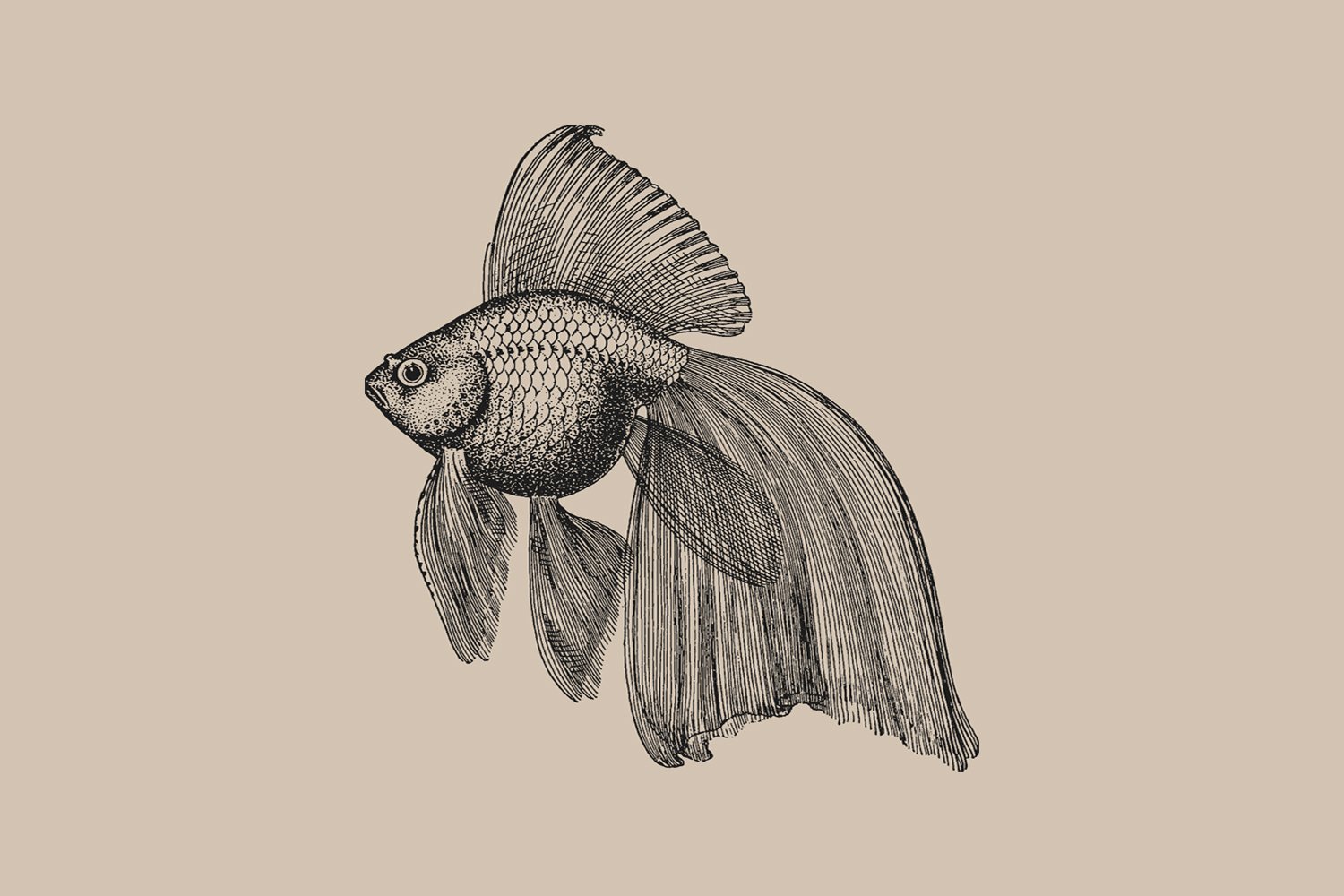
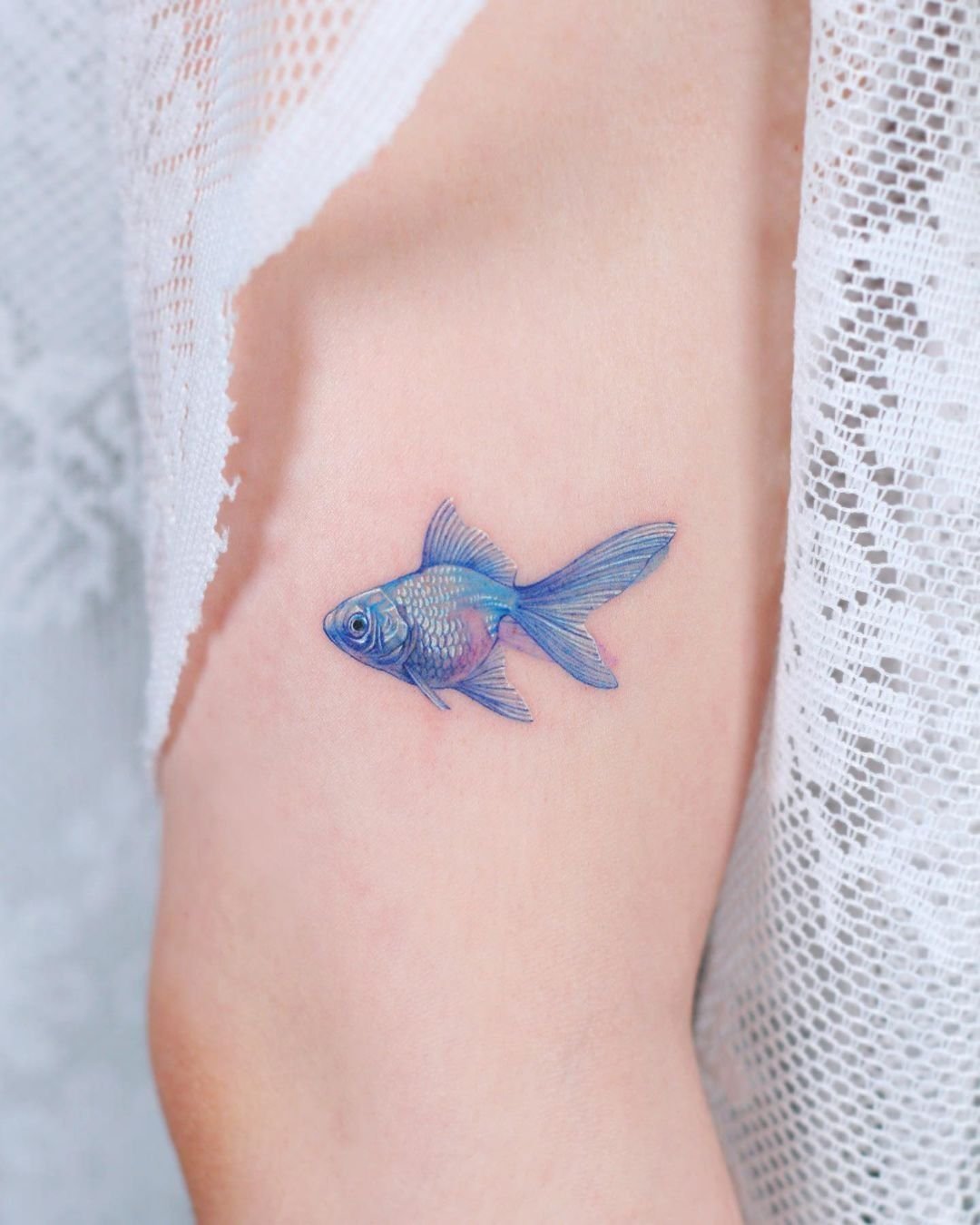
Goldfish tattoo
Goldfish: The oldest ornamental fish in the world
The goldfish is the first animal in history that humans bred purely for beauty. Over a thousand years before the first koi variety was named, Chinese breeders were selecting carp with unusual colouring and raising them in ceramic bowls and garden ponds for no purpose other than to look at them. Every goldfish alive today — from the common fairground fish to the most elaborate fantail or ryukin — descends from that process. A goldfish tattoo carries this lineage, whether the wearer knows it or not: an animal that exists because humans decided that beauty was worth creating deliberately.
In tattooing, the goldfish occupies a specific position. It is smaller, quieter, and less symbolically forceful than its relative the koi, which has its own dedicated article on this site. Where the koi represents perseverance, struggle, and transformation through the Dragon Gate legend, the goldfish represents something different: prosperity, domestic beauty, grace, the quiet pleasure of something refined. In Japanese tattooing, it appears as a subtle counterpoint to the drama of dragons and tigers. In Chinese culture, it carries a linguistic blessing embedded in its name. In contemporary Western tattooing, it offers a subject that is visually striking — flowing fins, vivid colour, elegant movement — while carrying enough cultural depth to reward anyone who looks into it.
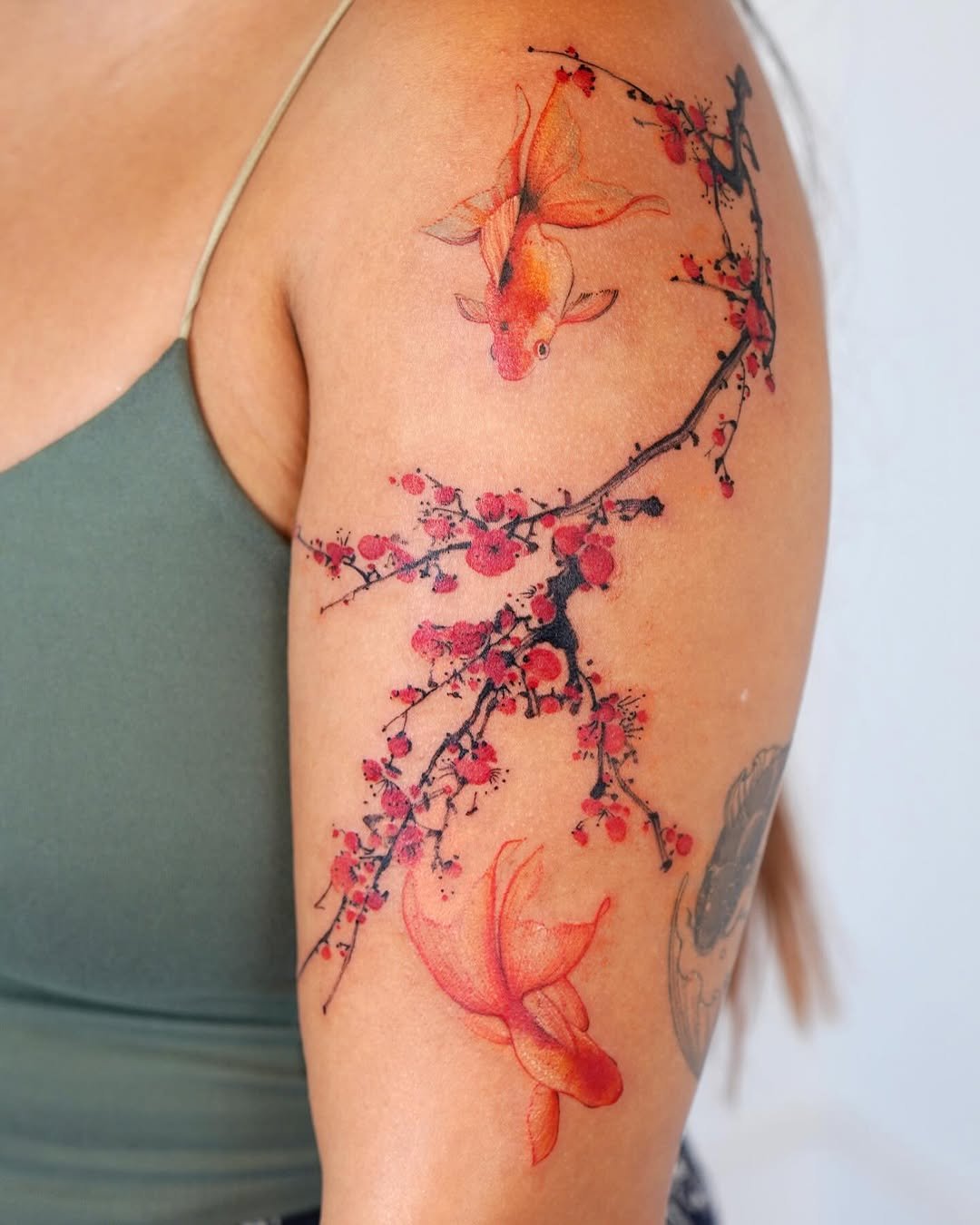
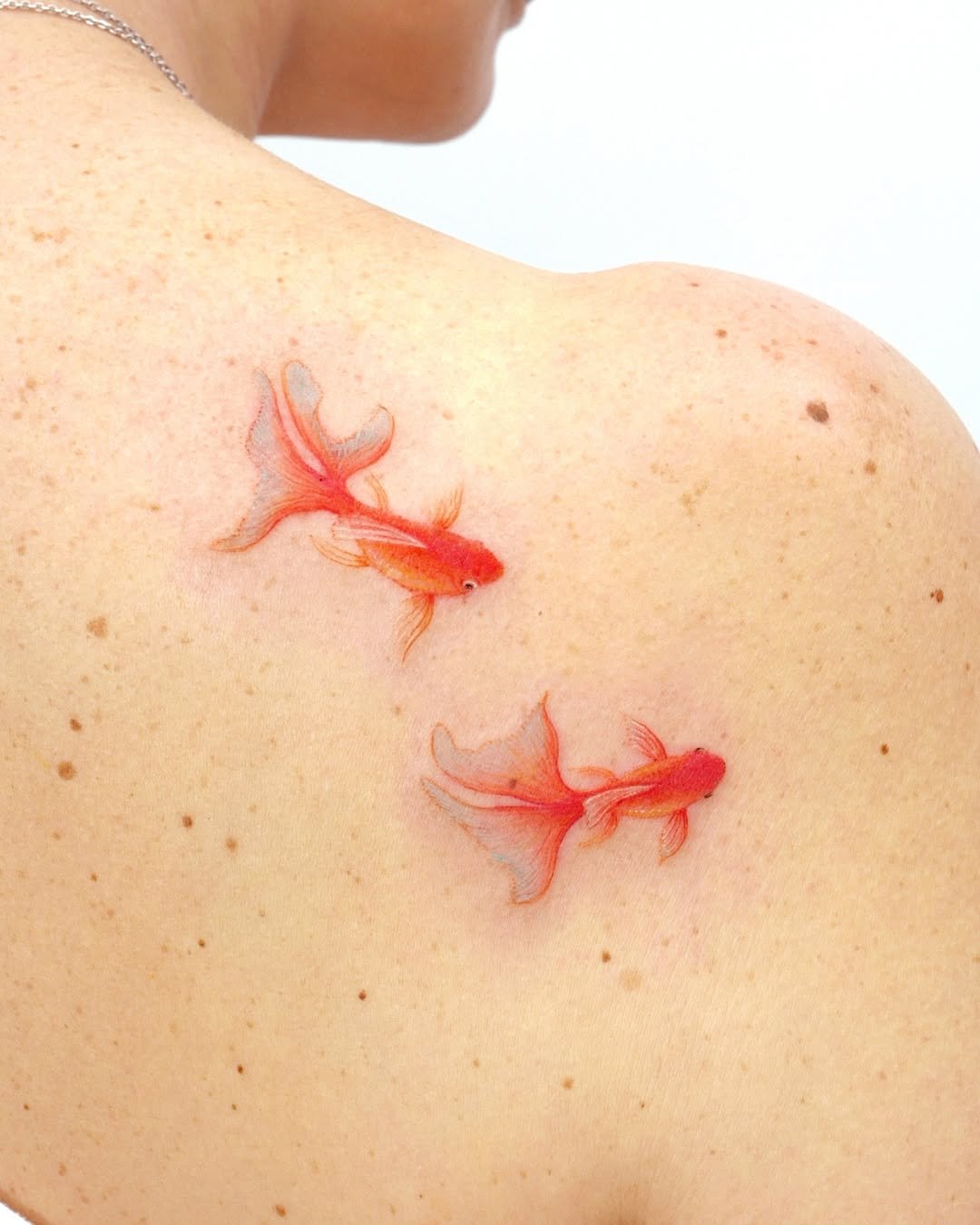
Goldfish tattoo meanings

Wealth and prosperity. The Chinese word for goldfish — jīnyú (金鱼) — is a near-homophone for jīnyù (金玉), meaning “gold and jade.” The phrase jīnyù mǎn táng (金玉满堂) means “a hall filled with gold and jade” — a blessing for wealth and abundance. The goldfish carries this blessing embedded in its name. In Chinese culture, giving someone a goldfish, a goldfish painting, or a goldfish ornament is an act of wishing them prosperity. The homophonic connection between yú (鱼, fish) and yú (余, surplus/abundance) extends further: the phrase nián nián yǒu yú (年年有余) — “surplus year after year” — is one of the most common New Year blessings in Chinese culture, and the fish is its visual emblem.
Good luck and fortune. Connected to the prosperity meaning, but broader. Goldfish in Chinese and Japanese traditions are generally good luck symbols — their presence attracts positive energy and good outcomes. In feng shui, keeping goldfish in the home or office is believed to attract wealth and harmonise the environment. The number, colour, and placement of the fish all carry specific feng shui associations.
Beauty and grace. The goldfish is a creature bred for its appearance. Its flowing fins, vivid colours, and unhurried, graceful movement through water give it an aesthetic quality that most fish do not possess. A goldfish tattoo carries this association with cultivated beauty — beauty developed, refined, and appreciated over centuries.
Domestic happiness and harmony. In Chinese tradition, goldfish represent harmonious family life and marital happiness. Fish that swim in pairs symbolise a loving relationship. The image of goldfish swimming together in a bowl or pond evokes associations of peaceful, prosperous, and contented domestic life.
Fertility and abundance of offspring. Fish reproduce in large numbers, and this biological fact has made them fertility symbols across cultures. In Chinese tradition, goldfish are specifically associated with bearing children and the prosperity of a growing family.
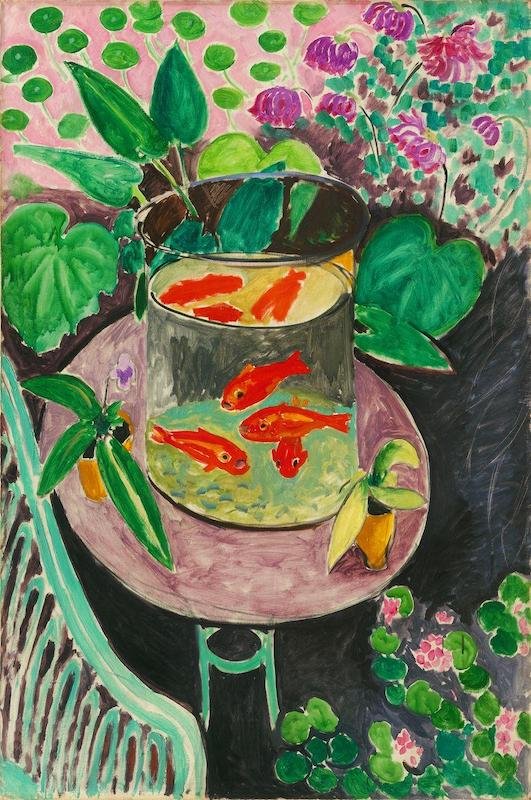
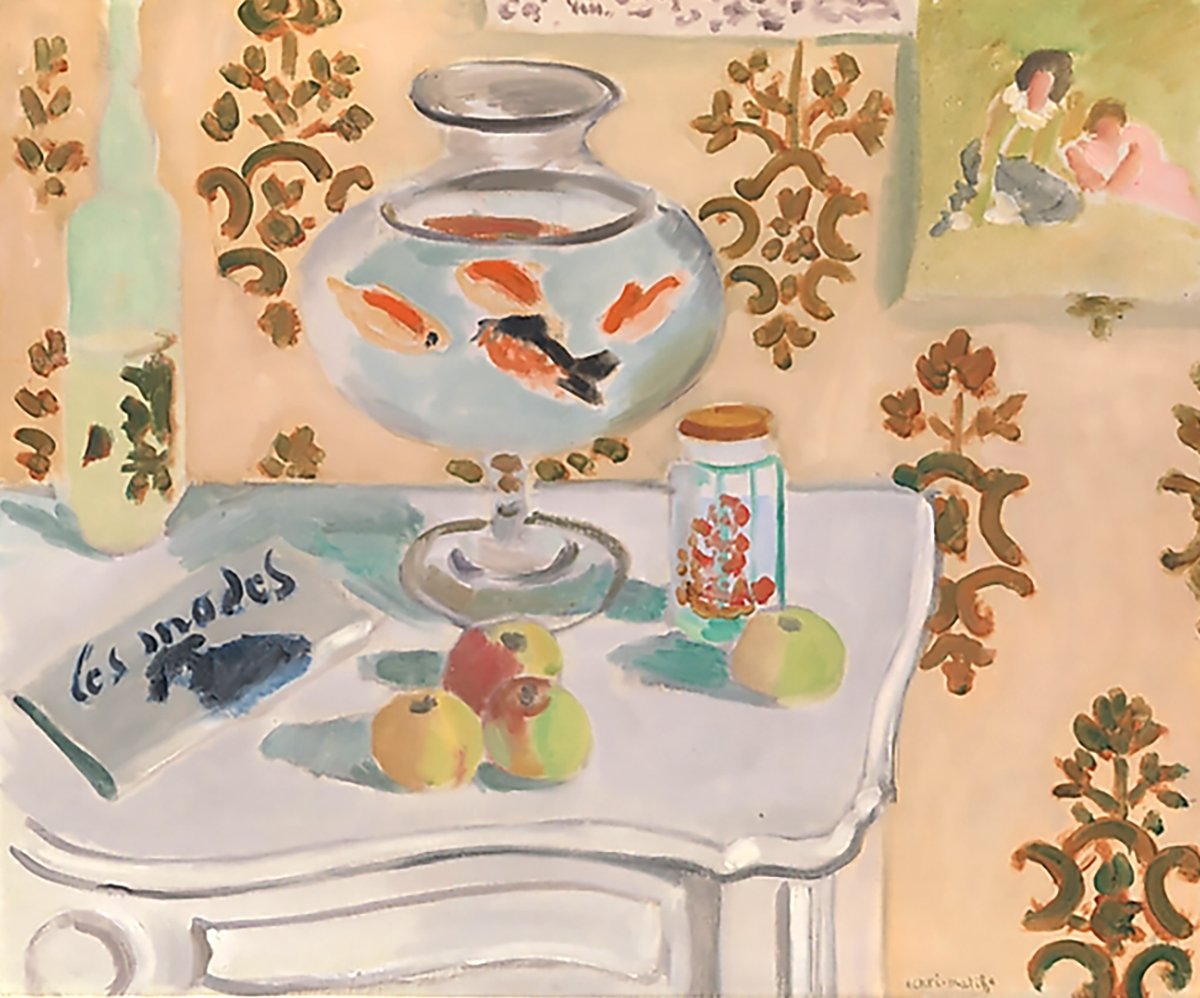
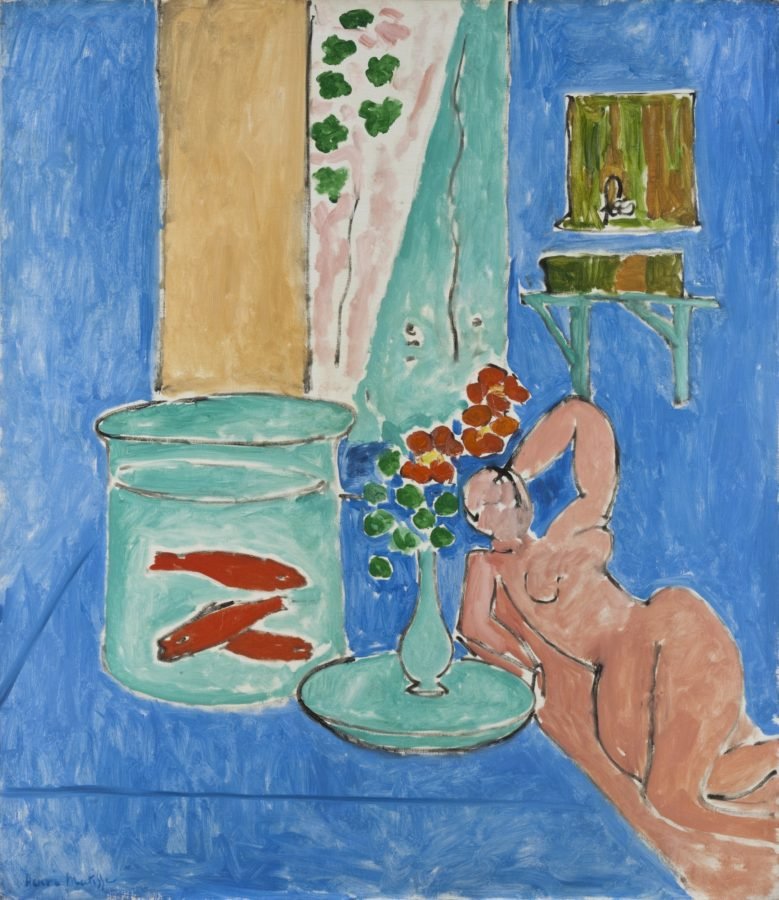
Tranquillity and contemplation. Henri Matisse, who painted goldfish repeatedly from 1912 onward, said he was inspired by watching people in Tangier stare into goldfish ponds with a meditative absorption. The goldfish in a bowl — moving slowly, suspended in clear water, endlessly circling — invites a quality of attention that slows the viewer down. A goldfish tattoo can carry this association with stillness, with being present, with the quiet act of watching something beautiful move through its world.
Femininity. In Japanese culture, the goldfish carries feminine associations — grace, elegance, beauty, refinement. In irezumi, it is often chosen by women or placed in compositional positions that balance the masculine energy of larger, more aggressive subjects.
Freedom within constraint. The goldfish in a bowl is one of the most familiar images in domestic life. The fish is beautiful, visible, and alive — but it lives within a glass boundary. A goldfish tattoo can reference this tension: beauty within limits, a life lived within defined boundaries, or the experience of being seen while contained.
The animal
The goldfish (Carassius auratus) is a domesticated freshwater fish descended from the wild crucian carp, or more precisely, from the Prussian or gibel carp (Carassius gibelio). The species is native to East Asia, and its domestication is among the oldest documented cases of selective breeding for appearance in any animal.
The first recorded observation of colour mutations in crucian carp — occasional individuals displaying red, orange, or yellow scales instead of the standard silver-grey — occurred during the Chinese Jin Dynasty (265–420 CE). During the Tang Dynasty (618–907), people began selectively breeding these coloured fish in ornamental ponds and water gardens. The fish were displayed to guests during social gatherings, temporarily moved from large ponds to smaller containers for the occasion — the earliest known fish tanks.
By the Song Dynasty (960–1279), goldfish breeding was firmly established and had acquired imperial significance. In 1162, the empress of the Song Dynasty ordered the construction of a pond specifically to collect red and gold varieties. The gold (yellow) variety was declared a symbol of the imperial family — commoners were forbidden to keep gold-coloured fish, and the goldfish became known as the “royal fish.” Ordinary people bred the red and orange varieties that were permitted, which is why the most common goldfish colour today is orange-red rather than gold.
During the Ming Dynasty (1368–1644), goldfish keeping moved indoors. Fish were raised in elegant porcelain bowls, and the practice of displaying goldfish as domestic ornaments became widespread among the wealthy. New body shapes and fin configurations emerged through selective breeding — the double tail, the telescope eye, the bubble eye, the lionhead — producing the extraordinary variety that characterises the modern goldfish.
Goldfish reached Japan around 1500, and Japanese breeders developed their own distinctive varieties — the wakin, the ryukin, the ranchu — with specific standards of form and colour that are still maintained through competitive breeding shows today. The fish arrived in Europe in the late 17th or early 18th century, reportedly first reaching England, and were introduced to North America around 1850.
Today, over 120 recognised goldfish varieties exist, classified by body shape, fin type, scale type, eye configuration, and colour pattern. They are the most widely kept ornamental fish in the world and have been for centuries. Under proper conditions, goldfish live 10 to 15 years, with some living significantly longer — the most famous individual, Hanako, reportedly lived to 226 years, though the methodology used to establish that age (microscopic analysis of her scales) has been questioned.
China: the imperial fish
The goldfish’s cultural significance in China extends far beyond pet-keeping. It is woven into language, art, religion, architecture, and the material culture of Chinese life.
The linguistic dimension is foundational. The homophones described in the meanings section — goldfish / gold and jade, fish / surplus — make the goldfish a living pun, a visual representation of prosperity that works at the level of spoken language. This is a specifically Chinese form of symbolism, in which the sound of a word carries as much meaning as its visual referent. Other cultures may associate fish with abundance in general terms; Chinese culture encodes abundance in the fish’s name itself.
Goldfish imagery pervades Chinese decorative arts. During the Ming and Qing dynasties (1368–1912), goldfish appeared on blue-and-white porcelain, cloisonné, silk embroidery, lacquerware, jade carvings, and furniture. Classic goldfish porcelain — blue-and-white vases showing goldfish swimming among water plants — was used by both the imperial court and wealthy families as a symbol of fortune. The goldfish motif on a wedding gift conveyed the wish for a prosperous and harmonious marriage. The New Year decoration invoked the year-after-year surplus blessing.
In feng shui, goldfish are one of the most commonly used living cures for attracting wealth energy. The number of fish matters: eight goldfish and one black goldfish is a traditional feng shui formula, where eight represents prosperity (the number bā, 八, sounds like fā, 发, meaning “to prosper”) and the black fish absorbs negative energy. The placement of the goldfish bowl or aquarium within the home or office is determined by the feng shui map of the space, with the “wealth corner” being the most common position. The goldfish must be healthy, and the water must be clean — sickly fish or murky water are believed to attract the opposite of what is intended.
Goldfish lanterns — paper or silk lanterns shaped like goldfish, lit from within — are traditional decorations for the Mid-Autumn Festival, Lantern Festival, and other celebrations. They are among the most beloved festival objects in Chinese culture, carried by children through streets and hung in courtyards, glowing with the warm light that the goldfish’s body was bred to resemble.
Japan: kingyo, summer, and the quiet counterpoint
The goldfish — kingyo (金魚), literally “gold fish” — arrived in Japan from China around 1500 and became a fixture of Japanese domestic culture, seasonal festivals, and visual art.
In Japan, the goldfish is associated with summer. Kingyo-sukui — the goldfish-scooping game — is one of the most iconic attractions at Japanese summer festivals (matsuri). Players use a thin paper scoop (poi) to catch goldfish from a shallow pool before the paper dissolves. The game is simple, ubiquitous, and deeply associated with childhood, with the sensory experience of the Japanese summer (cotton yukata, festival stalls, paper lanterns, the smell of grilled food), and with the transience of seasonal pleasure — the goldfish caught at the festival often does not survive long in the bowl at home.
This seasonal and nostalgic dimension gives the goldfish a specific emotional register in Japanese culture. It carries associations with fleeting beauty, with summer evenings, with childhood experiences that cannot be repeated. A goldfish tattoo in a Japanese context can reference this register — not the formal symbolism of prosperity or good luck, but the personal, sensory, and emotional associations of a specific cultural experience.
In Japanese art, goldfish appear in ukiyo-e woodblock prints, in painted screens, and in decorative objects. The flowing fins of the elaborate varieties — particularly the fantail, the ryukin, and the ranchu — lend themselves to the sinuous, dynamic line work of Japanese visual tradition. Utagawa Kuniyoshi produced several well-known woodblock prints featuring goldfish, including compositions that anthropomorphise the fish in humorous or narrative scenes.
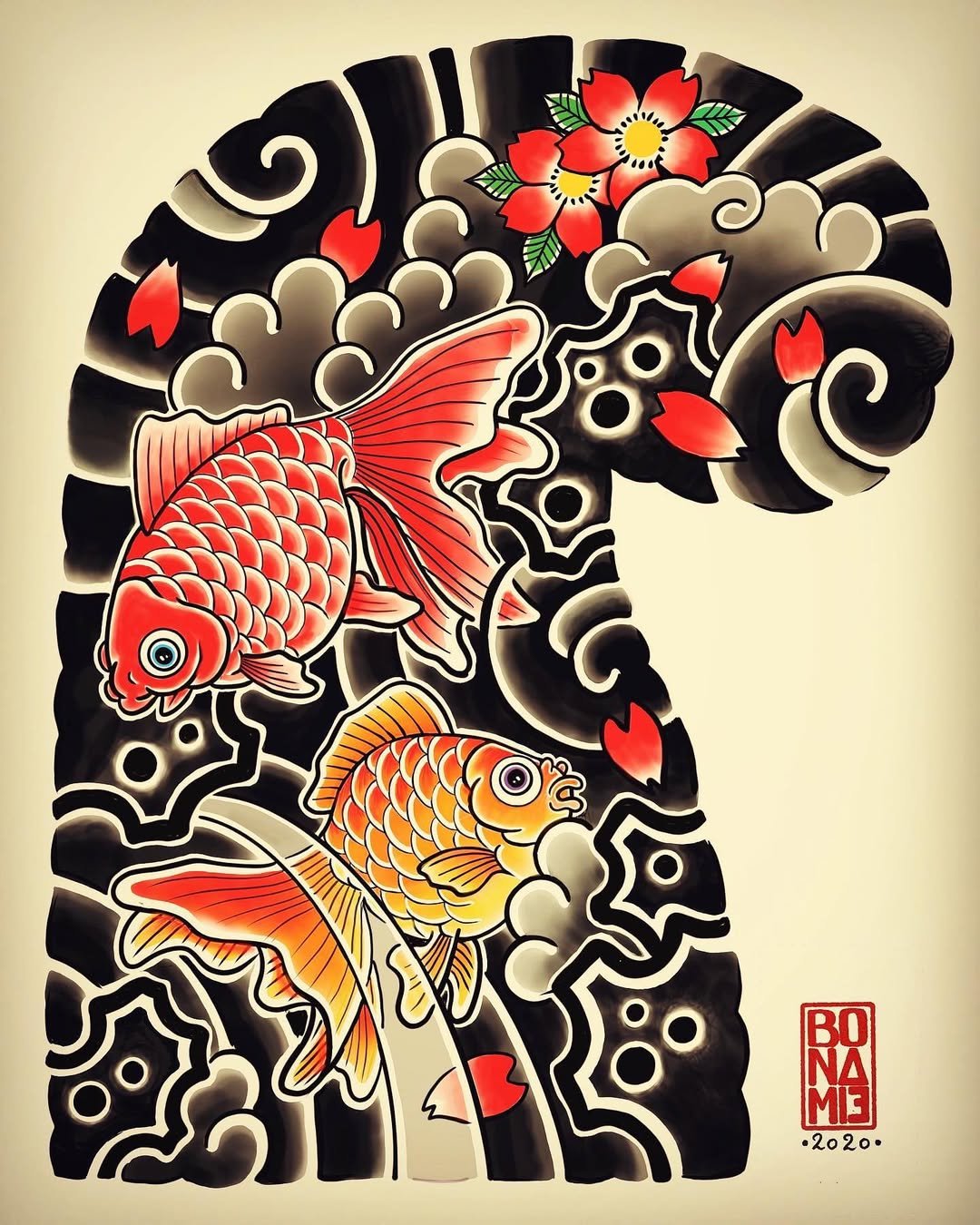
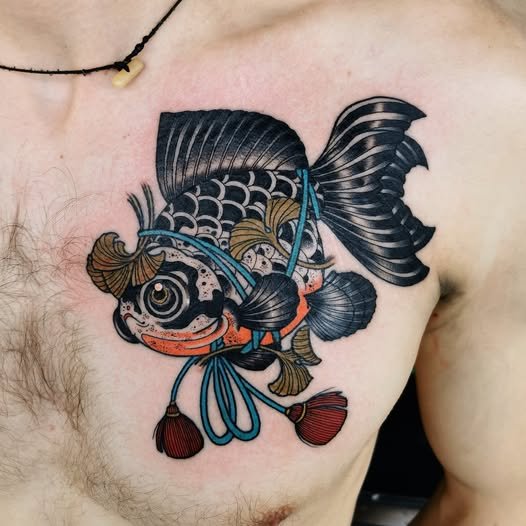
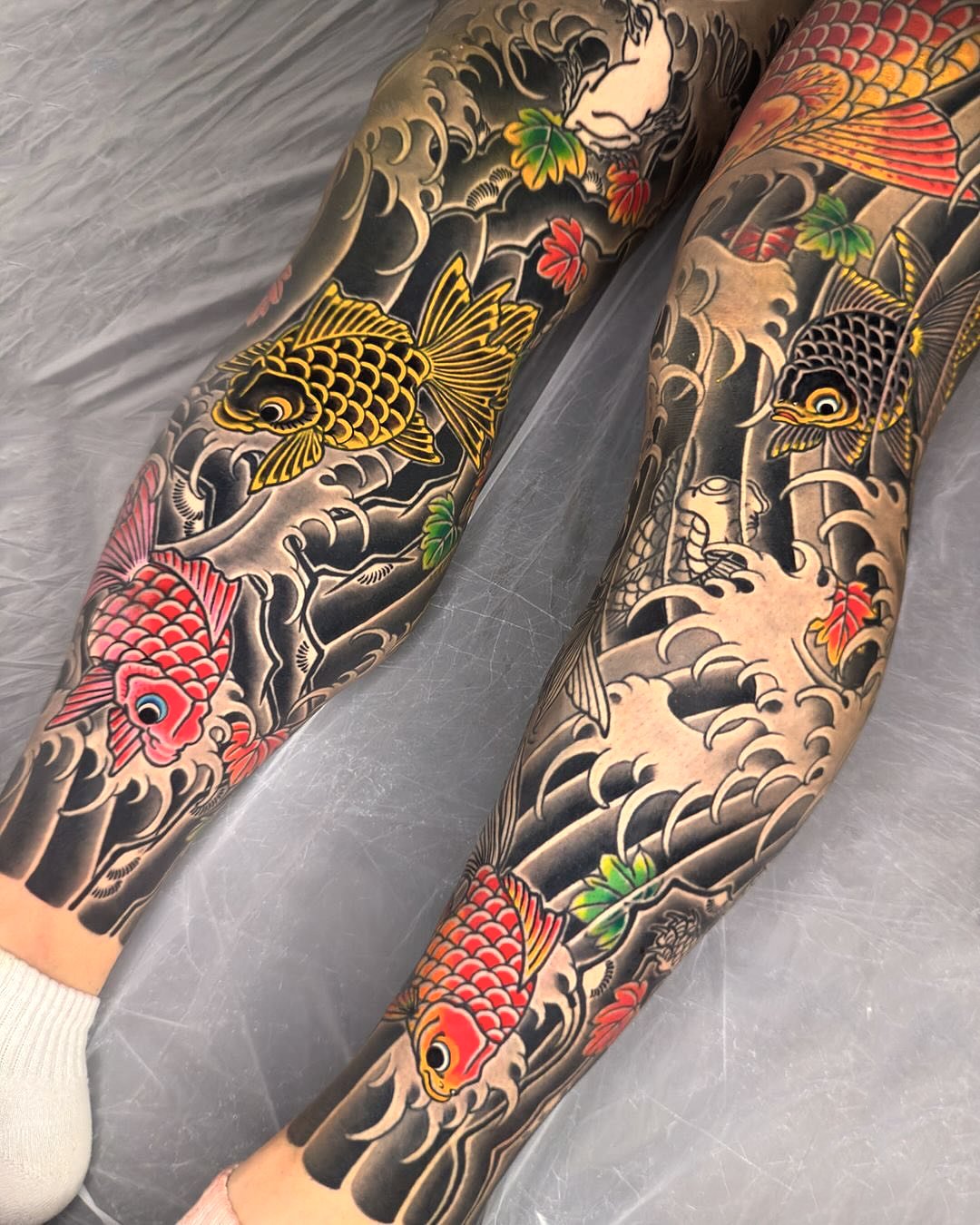
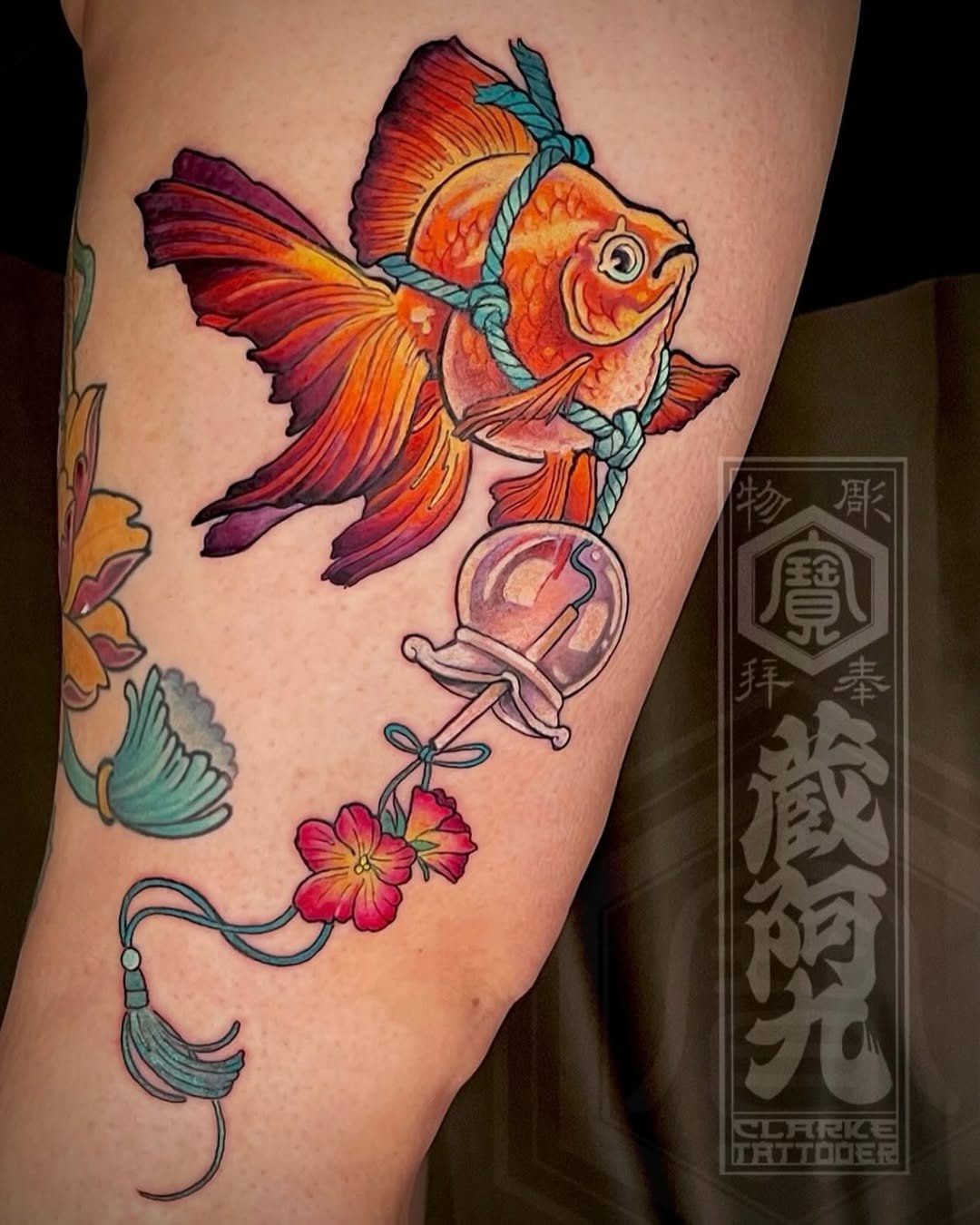
In Japanese tattooing (irezumi), the goldfish — kingyo — is a recognised subject, though far less common than the koi, dragon, tiger, or snake. When it appears in a bodysuit or sleeve, it often occupies a supporting position: a small goldfish or pair of goldfish swimming in the background waves of a larger composition, tucked into the mikiri (the transitional area between the main subject and the background). In this role, the goldfish serves as a grace note — a subtle, charming element that contrasts with the power and drama of the surrounding primary subjects.
As a standalone irezumi subject, the goldfish carries associations with prosperity, good fortune, success, being blessed with children, and domestic harmony. The elaborate fin shapes of Japanese goldfish varieties provide visual material for the flowing, dynamic compositions that irezumi demands. A kingyo rendered with the full compositional treatment — bold outlines, flowing fins, integrated water background, seasonal elements — is a striking image that demonstrates the artist’s ability to bring delicacy and grace to a tradition often dominated by larger, more aggressive subjects.
The goldfish in irezumi is seasonally associated with summer. Appropriate accompanying elements include morning glories (asagao, a summer flower), wisteria (late spring to early summer), bamboo, and water rendered with summer warmth and clarity rather than the turbulent winter waves that accompany other aquatic subjects.
The goldfish in Western art

The goldfish across tattoo styles
Irezumi. The goldfish’s natural habitat in tattooing. Rendered with bold outlines, flowing fin detail, and integrated water backgrounds in the conventions of the Japanese tradition. The elaborate fin varieties (fantail, ryukin, oranda) provide visual complexity that rewards the irezumi artist’s skill. Seasonally paired with summer elements. Often positioned as a supporting element in larger compositions, but capable of carrying a standalone piece when given full compositional treatment.
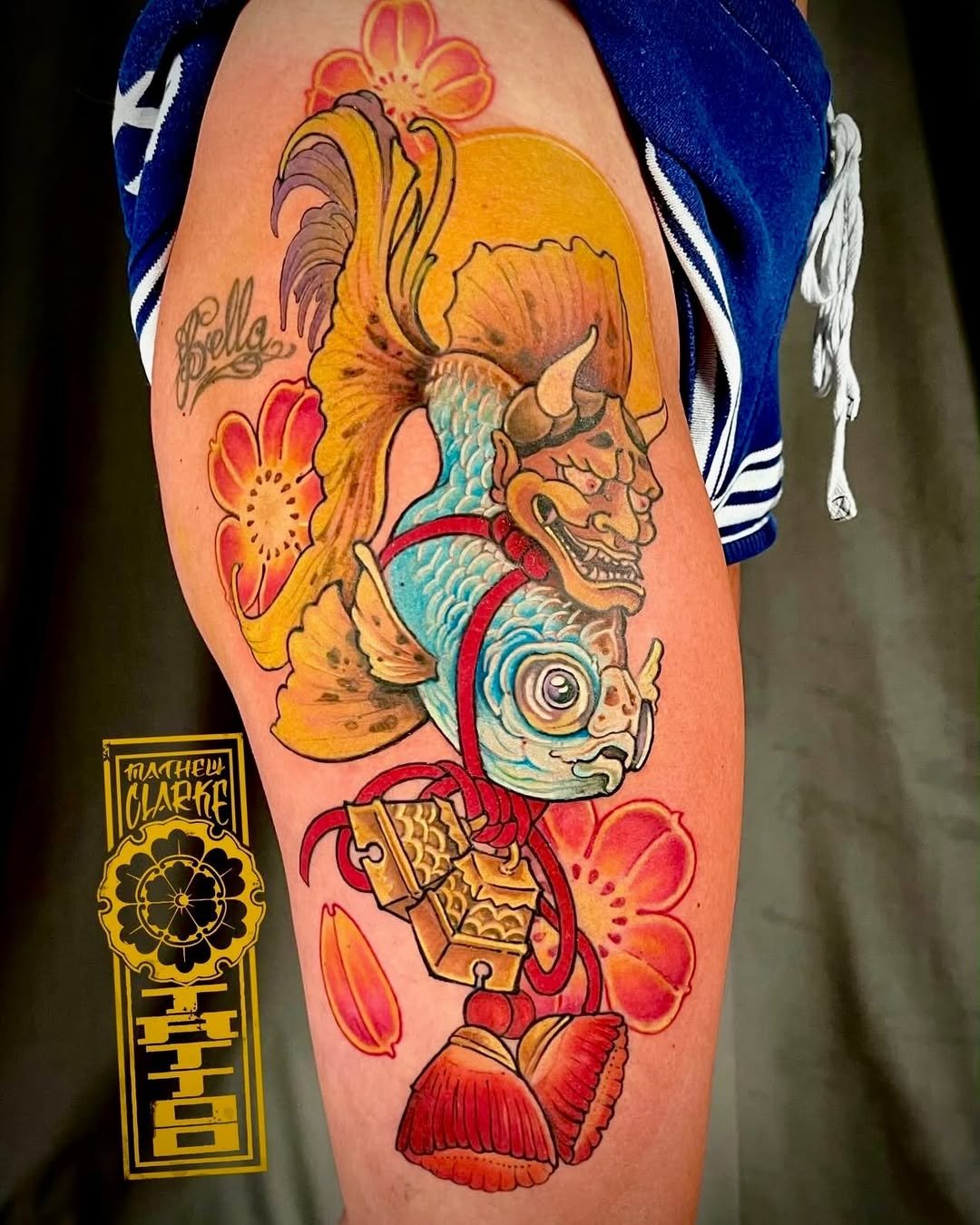
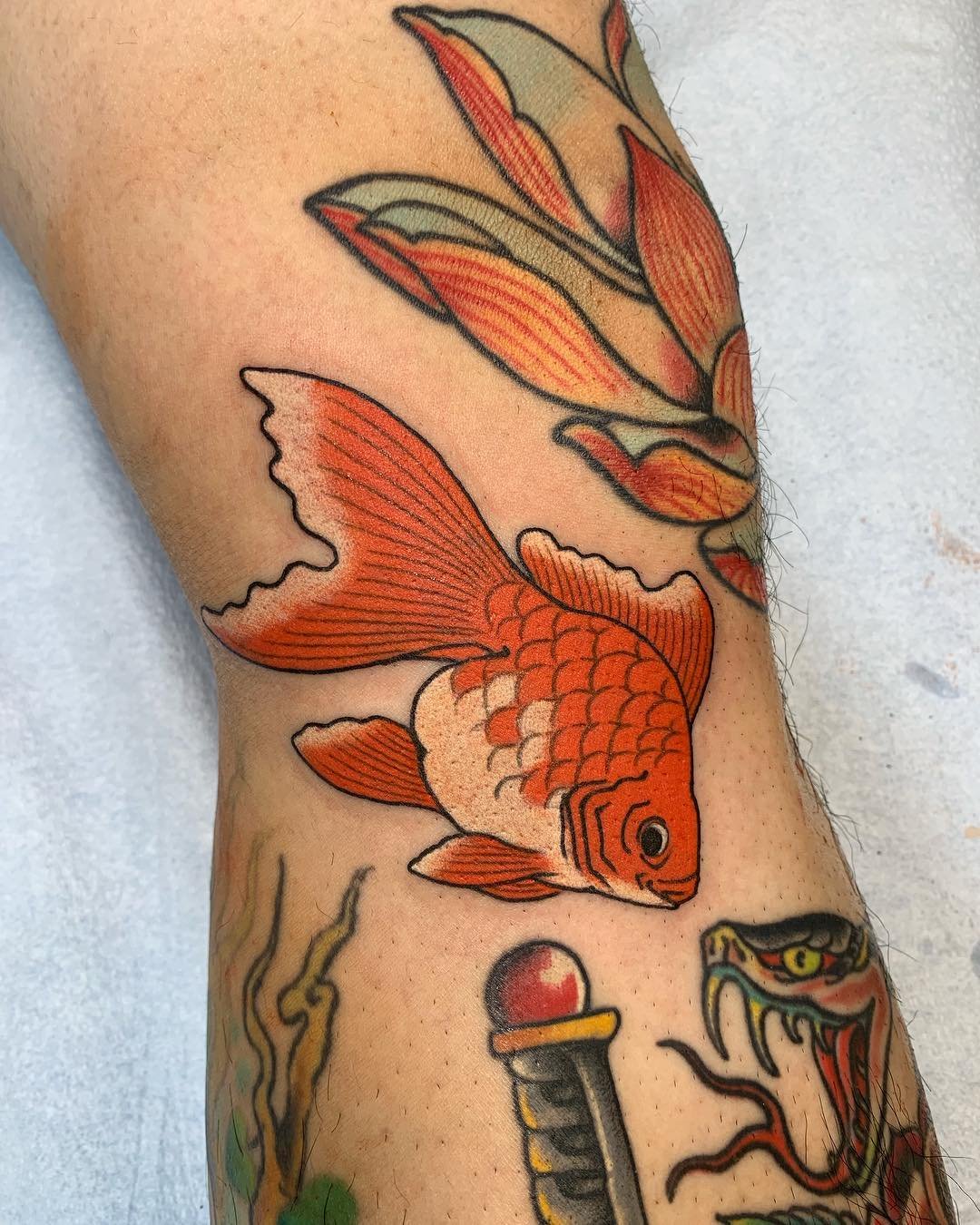
Neo-traditional. The goldfish gains decorative elaboration — Art Nouveau-influenced fin curves, jewel-tone colours, ornamental framing. The flowing, organic quality of goldfish anatomy is a natural fit for the neo-traditional emphasis on decorative line and rich colour. Goldfish paired with flowers (lotus, water lily, peony) produce compositions that balance the aquatic subject with botanical beauty.
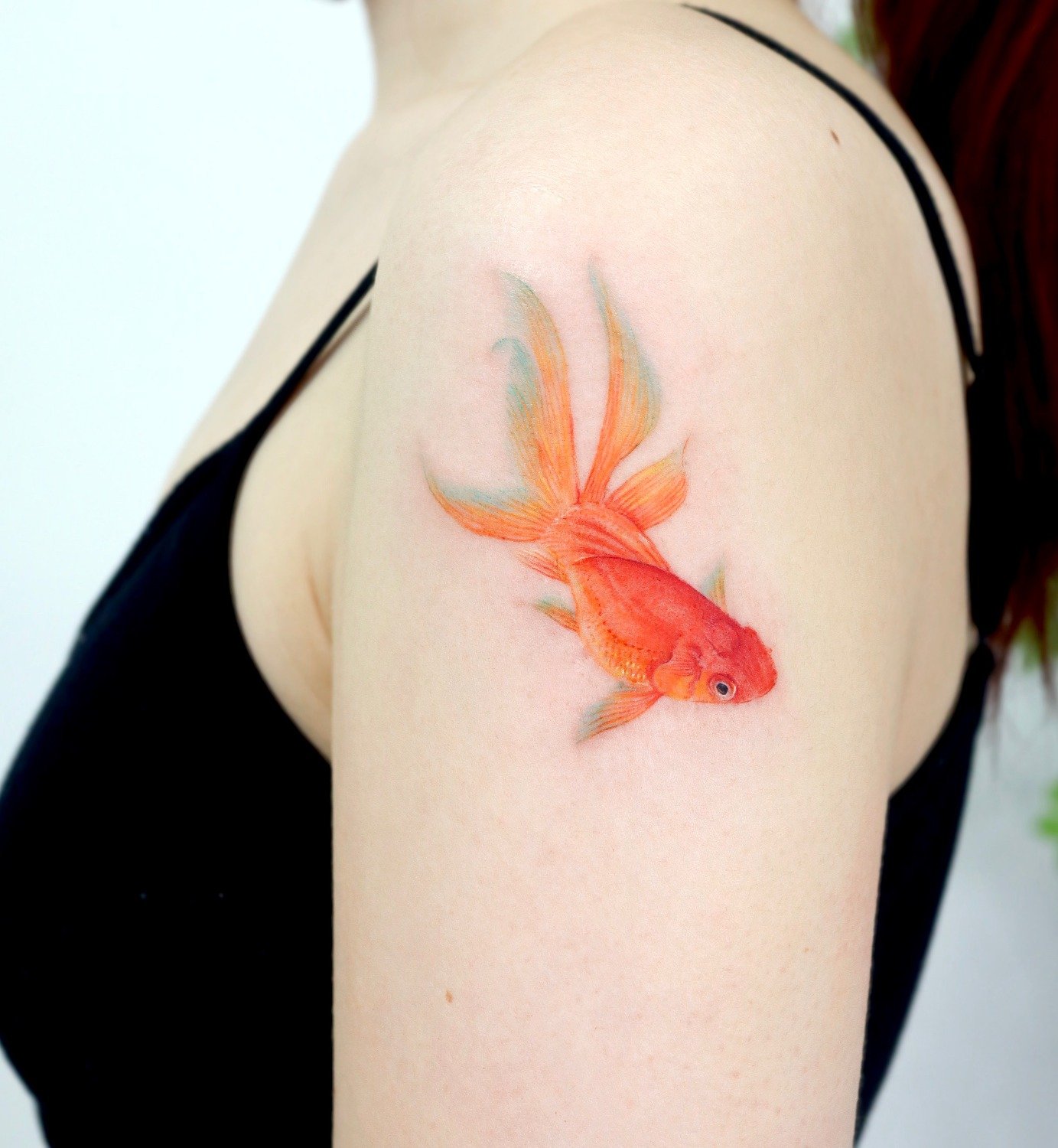
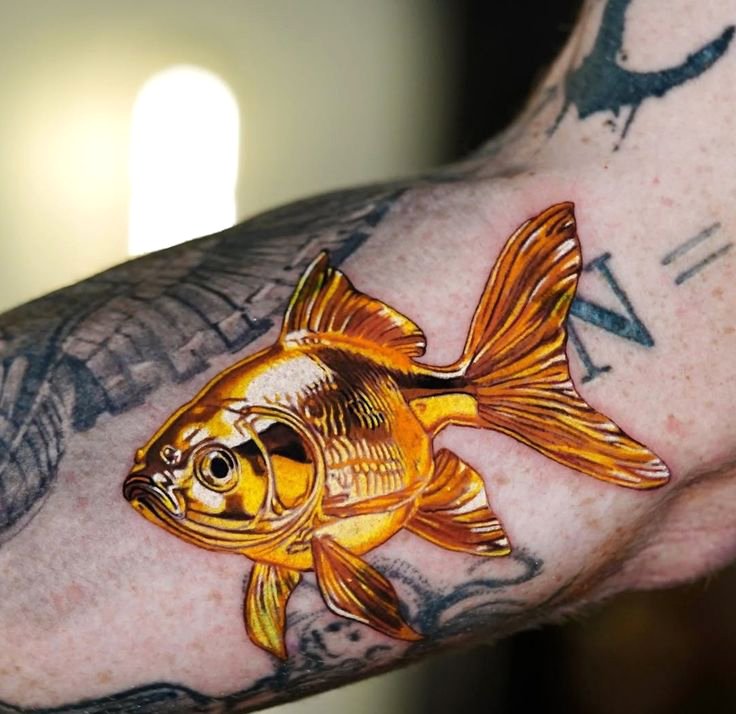
Realism and photorealism. The goldfish becomes a study in translucency, light, and colour. The challenge is rendering the specific qualities that make a goldfish look alive: the sheen of scales, the translucency of fins (particularly the flowing, paper-thin tissue of a fantail’s caudal fin), the way light refracts through the body, and the colour gradients between orange, red, white, and gold that characterise different varieties. A realistic goldfish tattoo often depicts a specific, identifiable variety — a ryukin, a ranchu, an oranda — with the accuracy of a naturalist’s study.
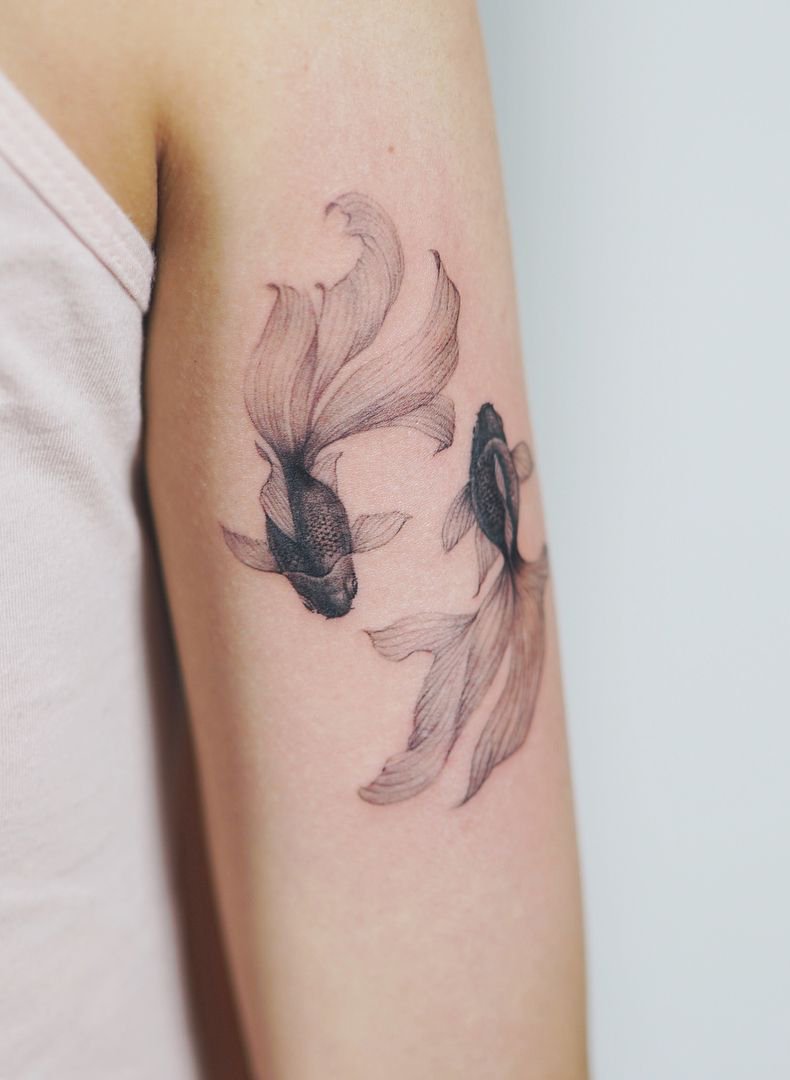
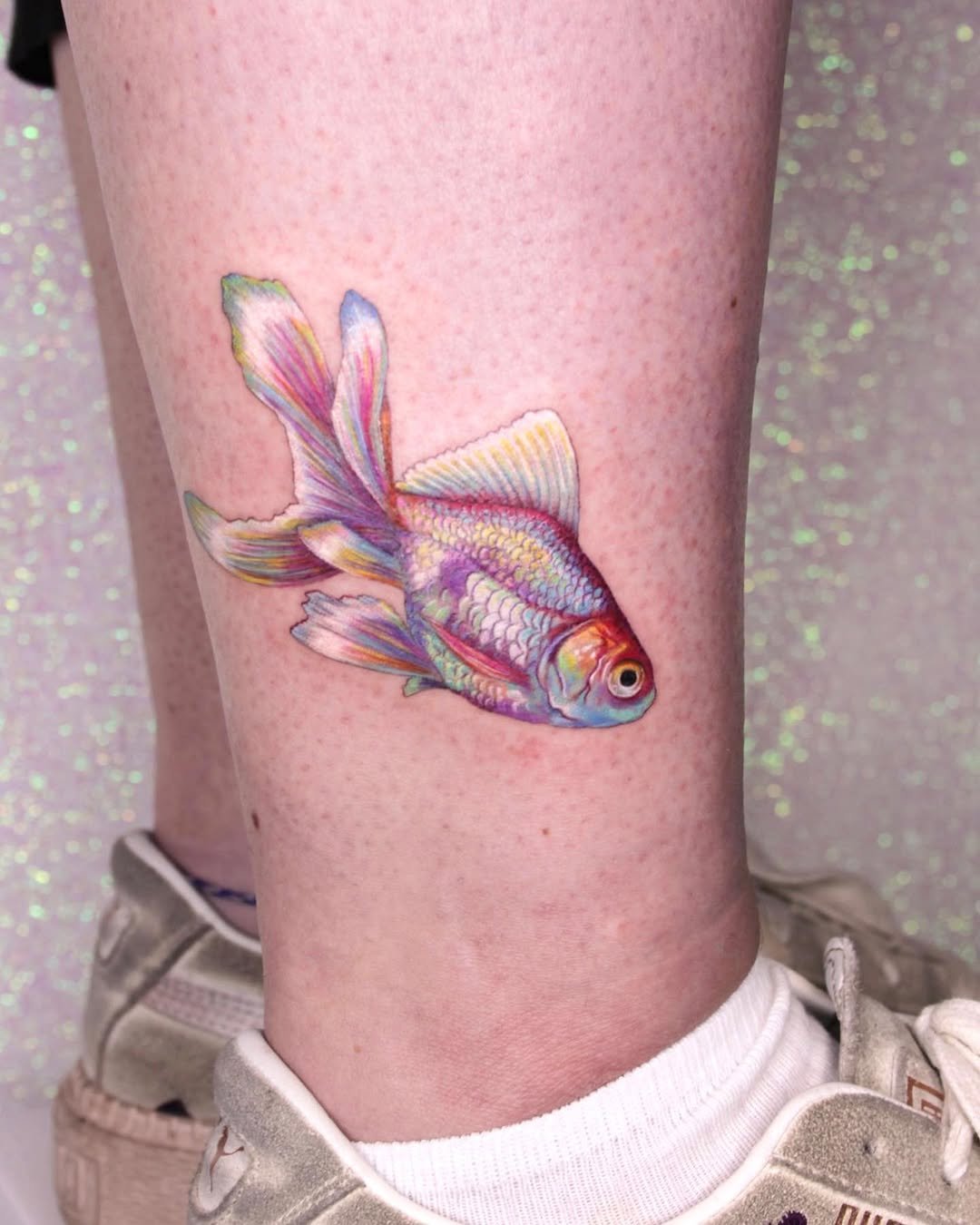
Watercolour. The goldfish is one of the subjects best suited to the watercolour tattoo style. The soft colour washes, fluid boundaries, and translucent quality of the watercolour technique mirror the goldfish’s own medium — water — and produce an effect of lightness and aquatic atmosphere that heavier styles cannot achieve. The goldfish’s vivid colour translates well into the watercolour palette, and the flowing fins become extensions of the fluid, unbounded aesthetic.
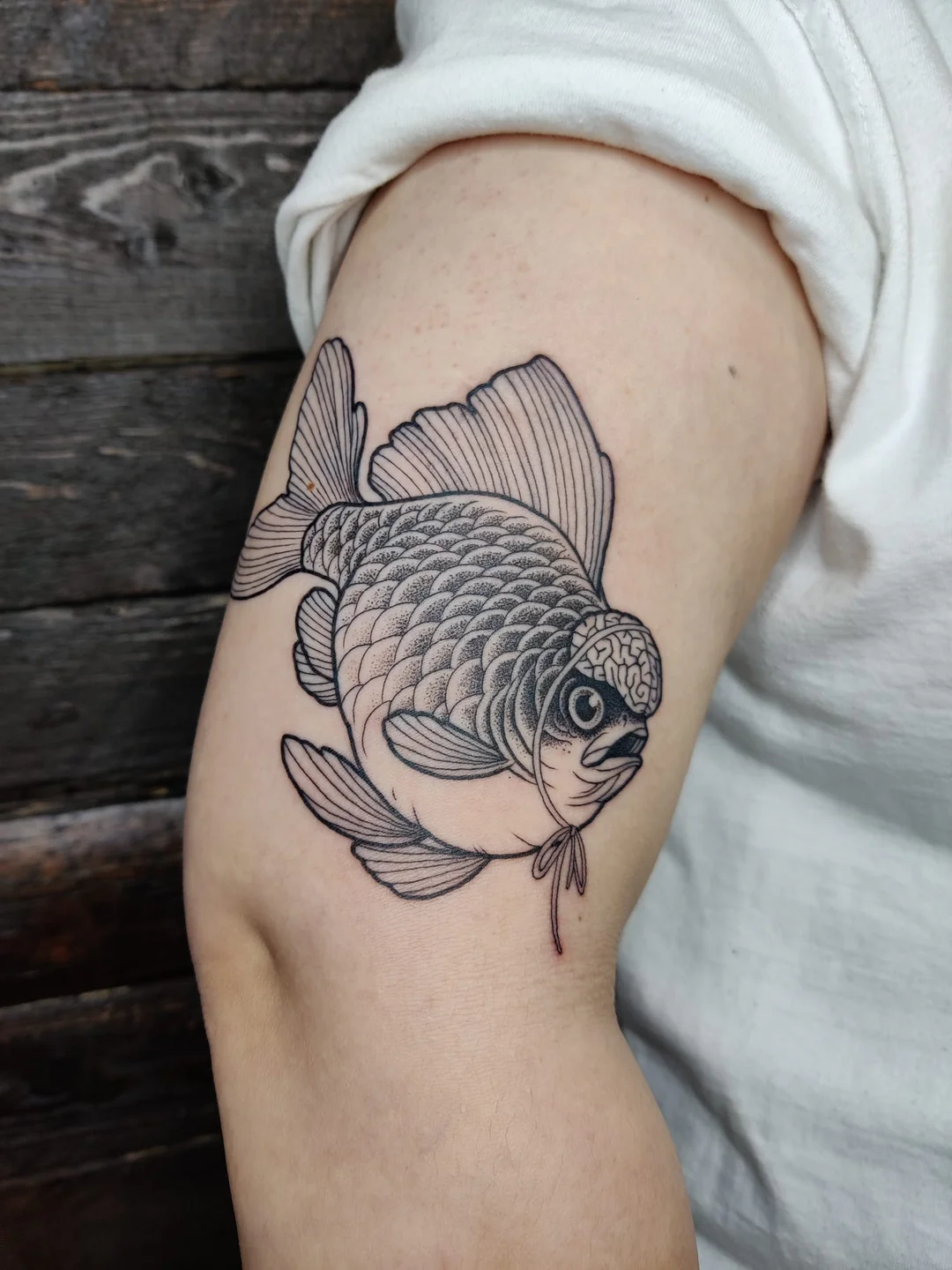
Blackwork and fine line. A goldfish in blackwork loses its colour (one of its defining visual qualities) but gains graphic clarity. The flowing fin shapes and rounded body produce a strong silhouette. In fine line, a goldfish rendered with minimal, precise strokes captures the essential form — the double tail, the rounded belly, the trailing fins — in a compact composition suited to small-scale placement.
Illustrative. Allows the widest interpretive range — storybook goldfish, Art Deco goldfish, Matisse-inspired goldfish, botanical-illustration goldfish, or fantasy and surreal interpretations. The goldfish’s association with domesticity, with bowls and tanks, and with the boundary between a contained world and the world outside lends itself to narrative and conceptual compositions.
Goldfish colour meanings in tattooing
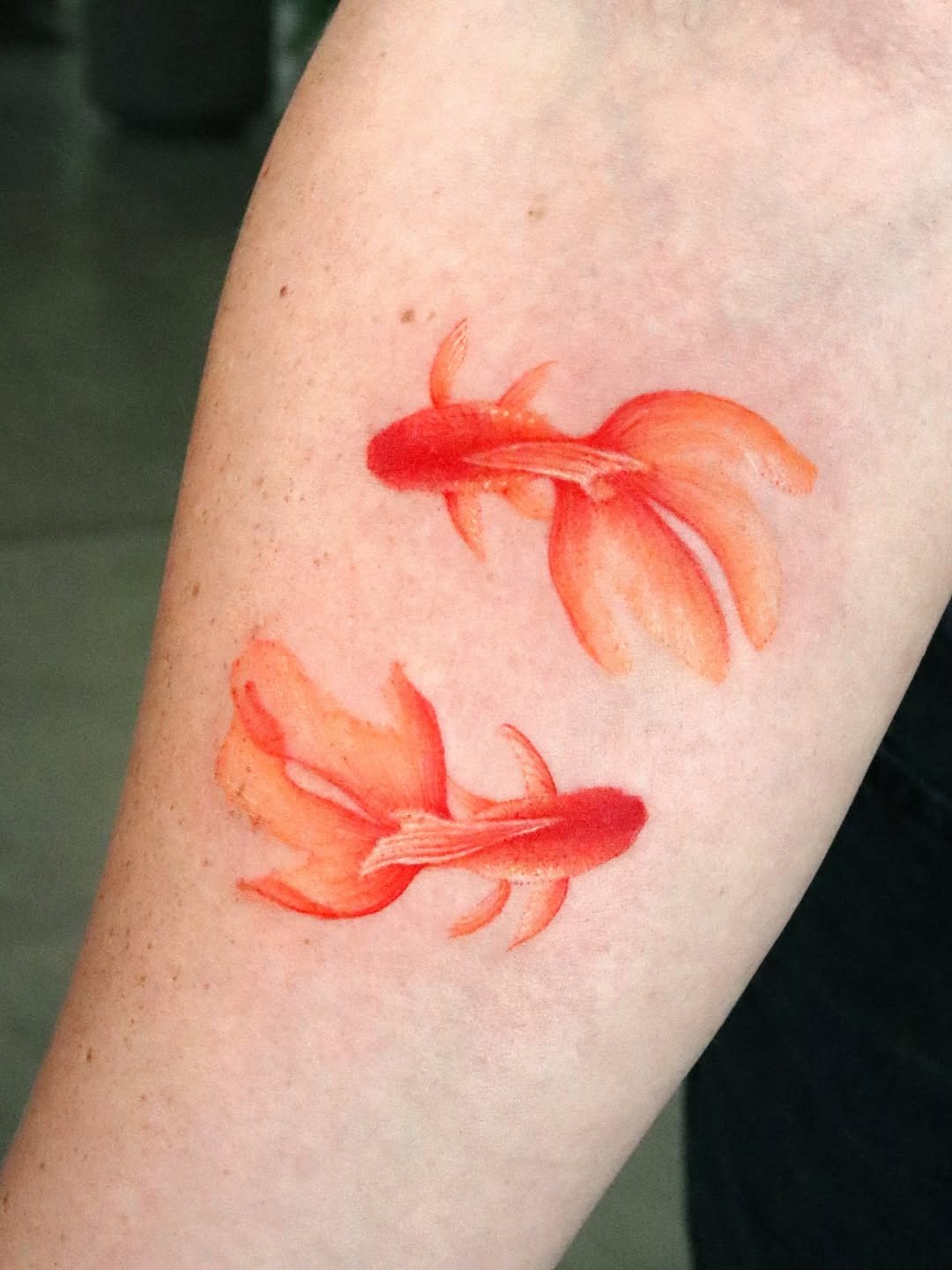
Orange / Red. The most common goldfish colour and the most widely recognised. Carries associations with vitality, energy, warmth, good luck, and the general prosperity symbolism of the goldfish. The colour that Matisse painted and that the festival goldfish display.
Gold / Yellow. The imperial colour — the variety forbidden to commoners during the Song Dynasty. Carries the strongest direct association with wealth, gold, and material abundance. A gold goldfish tattoo is the most explicit invocation of the prosperity symbolism.
Black. In feng shui, the black goldfish absorbs negative energy and provides protection. A black goldfish tattoo can carry associations with protection, warding off misfortune, or the fish’s darker, more mysterious qualities. Black goldfish also provide a strong graphic contrast in tattoo compositions.
White. Purity, new beginnings, and — in some contexts — mourning or remembrance. A white goldfish paired with a red goldfish creates a complementary composition that balances opposing qualities.
Calico / Multi-coloured. The multicoloured patterns of calico goldfish (sanke, shubunkin) carry associations with variety, individuality, and the beauty of natural variation. In tattoo composition, calico goldfish offer more complex colourwork and visual interest than solid-coloured fish.
Composition, placement, and pairing
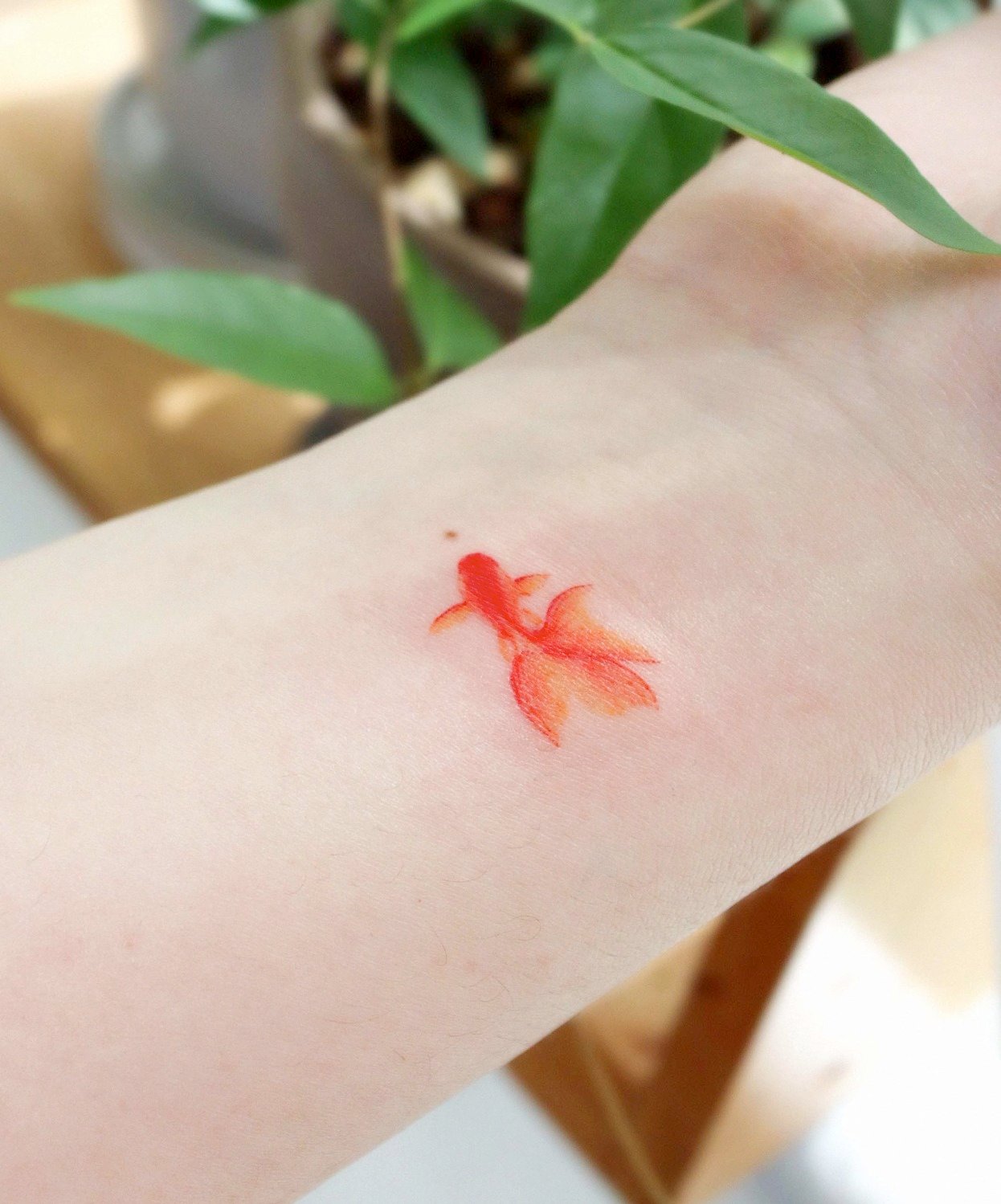
Scale. Goldfish tattoos work effectively at small to medium scale — the fish’s natural size is small, and the tattoo can honour that. A goldfish tattoo on the wrist, the ankle, behind the ear, on the inner arm, or on the ribcage can work at a scale that would be too small for a koi or a shark. The goldfish is one of the few fish subjects that reads naturally at the scale of a few centimetres.
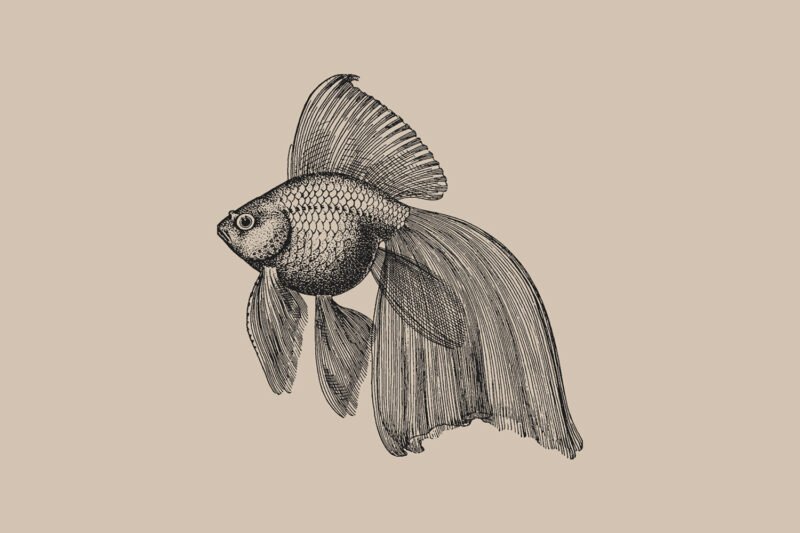
Fins as compositional elements. The elaborate fins of fancy goldfish varieties — particularly the fantail, the butterfly tail, and the ryukin — extend the visual form well beyond the fish’s body. These fins flow, trail, and billow, filling space around the fish and creating a soft, organic frame. In tattoo composition, the fins can be extended and exaggerated to fill a given body area, making a small fish into a visually substantial piece.
Water. As with all aquatic subjects, the treatment of the surrounding water (present or absent, rendered or implied, calm or moving) changes the mood. A goldfish with no water background reads as an icon — a decorative, symbolic image. A goldfish surrounded by rendered water reads as a living creature in its element. A goldfish in a bowl adds the glass boundary, the domestic setting, and the containment dimension.
Common pairings.
- In irezumi: summer flowers (morning glory, wisteria), waves, lotus, water plants.
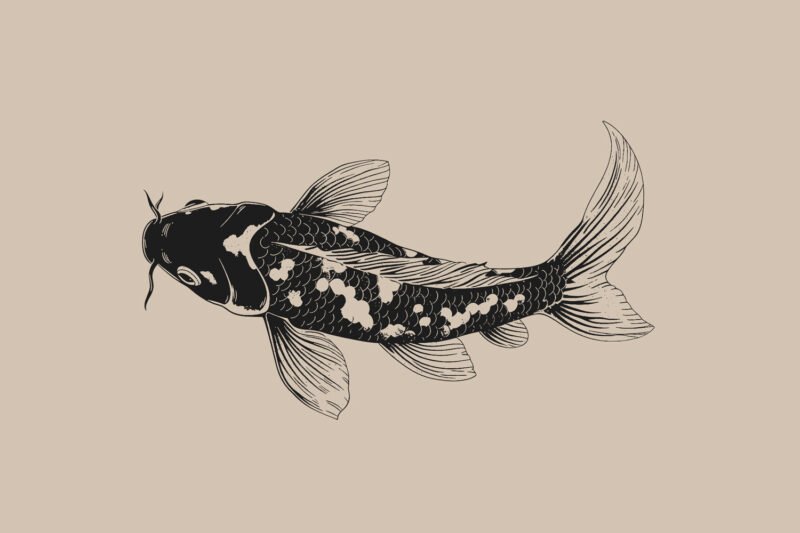
- In broader tattoo practice: water lilies, lotus flowers, cherry blossoms, bubbles, aquatic plants, koi (the two relatives together, contrasting in size and energy), and decorative frames or bowls.
A goldfish and lotus composition combines two symbols of beauty emerging from humble or difficult conditions — the goldfish bred from dull carp, the lotus growing from mud.
Number. A single goldfish emphasises the individual — beauty, grace, solitude. A pair of goldfish emphasises relationship — love, partnership, balance. Multiple goldfish evoke family, community, and the meaning of abundance. In feng shui-influenced compositions, specific numbers (eight plus one, or nine total) carry prosperity associations.
Body placement. The forearm, inner arm, ribs, calf, thigh, and upper back all accommodate goldfish compositions well. The fish’s rounded form sits naturally on the body’s curved surfaces. For smaller pieces, the wrist, the ankle, behind the ear, the nape of the neck, and the hand are all viable placements — the goldfish is one of the few aquatic tattoo subjects that retains its identity and visual impact at a miniature scale.
Sources & further reading
- Chen, Z. et al., The evolutionary origin and domestication history of goldfish (Carassius auratus). National Academy of Sciences (PNAS), 117(47), 2020.
- Smartt, J., Goldfish Varieties and Genetics: Handbook for Breeders. Wiley-Blackwell, 2001.
- Brunner, B., The Ocean at Home: An Illustrated History of the Aquarium. Princeton Architectural Press, 2005.
- Balon, E.K., About the oldest domesticates among fishes. Journal of Fish Biology, 65(s1), 2004.
- Matisse, Henri. Goldfish series (1912–1915). Pushkin Museum, Moscow; Museum of Modern Art, New York; Centre Pompidou, Paris, France.
- Needham, J., Science and Civilisation in China, Vol. 4, Part 3: Civil Engineering and Nautics. Cambridge University Press, 1971.
- Steve Gilbert, Tattoo History: A Source Book. Juno Books, 2000.
- Anna Felicity Friedman (ed.), The World Atlas of Tattoo. Yale University Press, 2015.