Related Posts

Blackout
Blackout: Total coverage, and what it makes possible
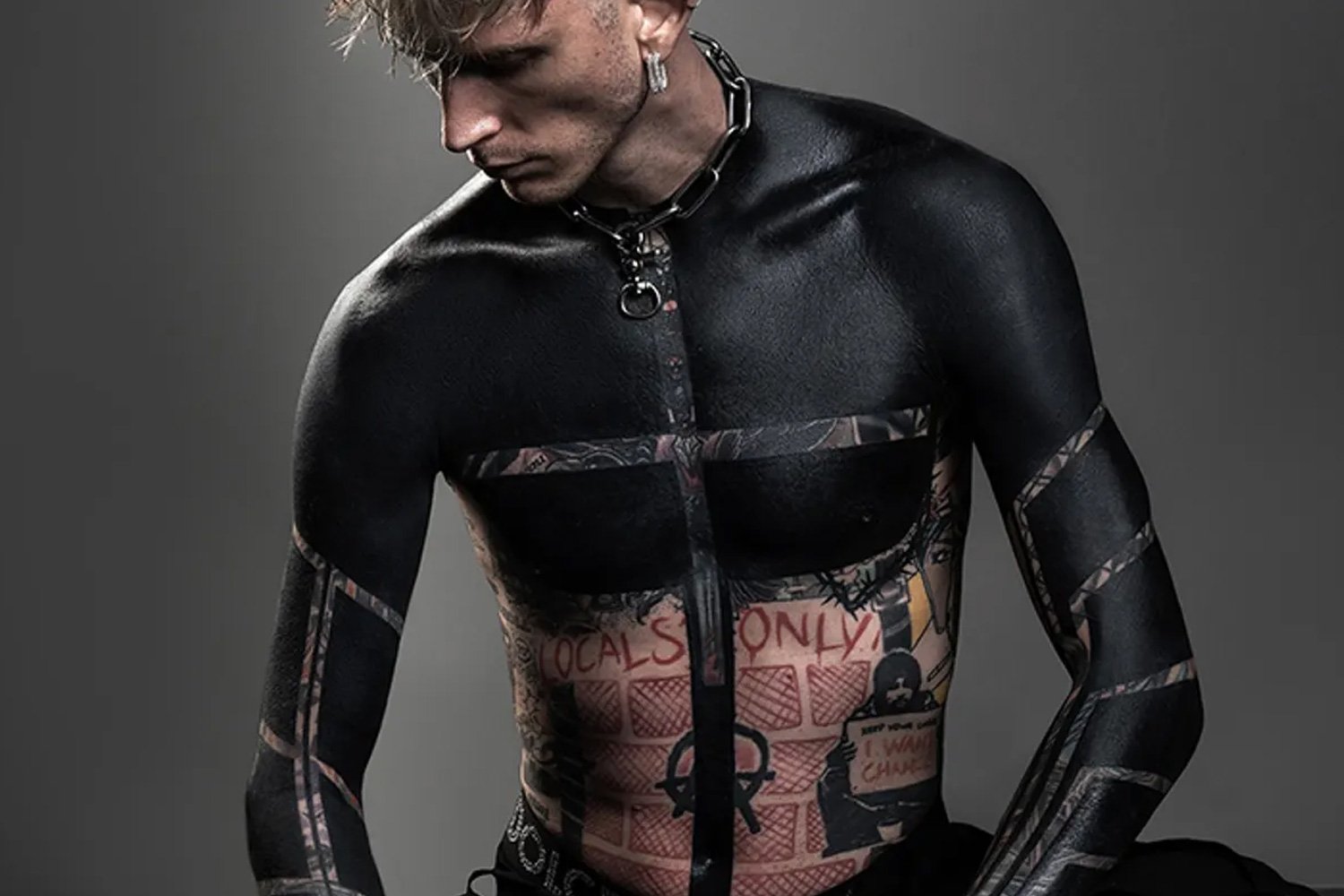
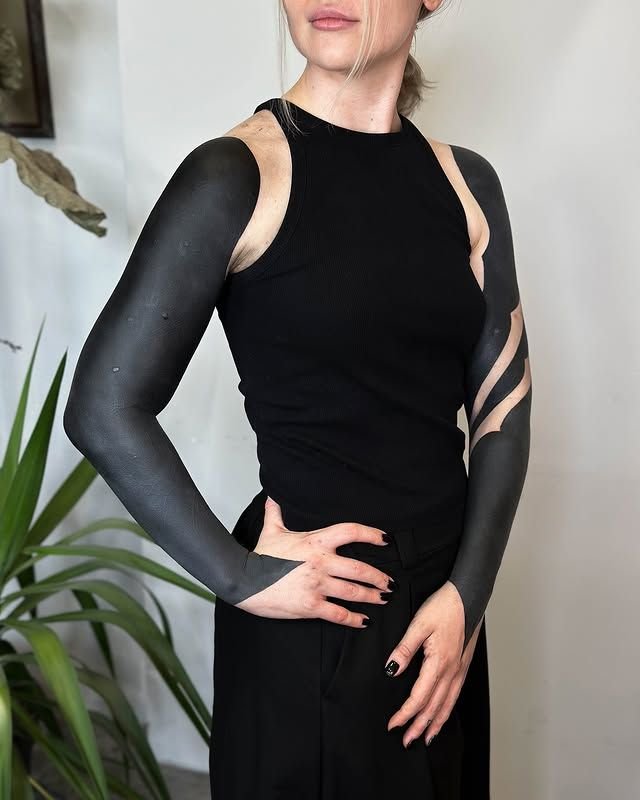
A blackout tattoo is an area of skin tattooed completely solid black. Every millimetre within the designated boundary is filled with dense black ink, leaving no natural skin tone visible. The concept is simple. The execution — packing an even, consistent field of black across a large area of living, reactive, unevenly textured skin — is one of the most technically demanding things a tattooer can do.
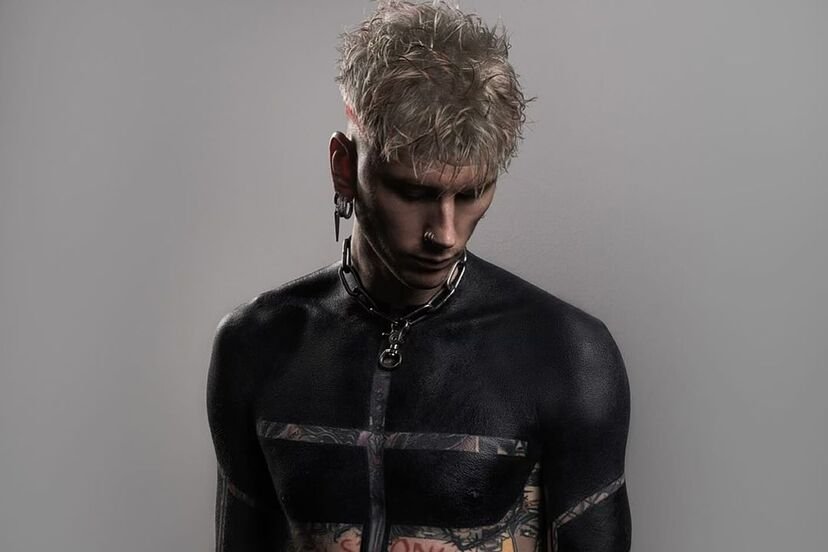
Blackout sits at one end of the blackwork spectrum. Where most blackwork styles use the interplay between black ink and bare skin — pattern, line, dot, negative space — blackout eliminates the interplay. The skin in the designated area turns black. Whatever the skin was before — its colour, its texture, its previous tattoos — disappears under the ink. What remains is a new surface, and what that surface makes possible is the most interesting part of the style.
Where it comes from
Indigenous precedent
Chester Lee and the viral moment
The contemporary blackout tattoo, as a named style, is most closely associated with Chester Lee (@oddtattooer) of Oracle Tattoo in Singapore. Lee began experimenting with large-scale solid black coverage around 2011, initially as an alternative to laser removal for clients who wanted to conceal existing tattoos. His approach was to cover the unwanted work entirely with solid black, then — in some cases — to use the black surface as a new canvas for designs in negative space or in white ink.
Lee’s work went viral on Instagram in early 2016, when photographs of a woman with a solid black chest and sleeve attracted international attention. The images were widely shared and covered by media outlets, including Complex, Daily Mail, and Bored Panda. The viral moment established “blackout tattoo” as a recognisable term and introduced the style to an audience far beyond the tattoo community.
Lee had been developing the approach for several years before the viral moment. He has described pieces that took over twenty hours across several months, and he has spoken about the difficulty of achieving perfectly even coverage across large areas — the technical challenge that defines the style.
Broader development
Blackout did not develop in isolation. Several artists working independently arrived at similar territory through different paths.
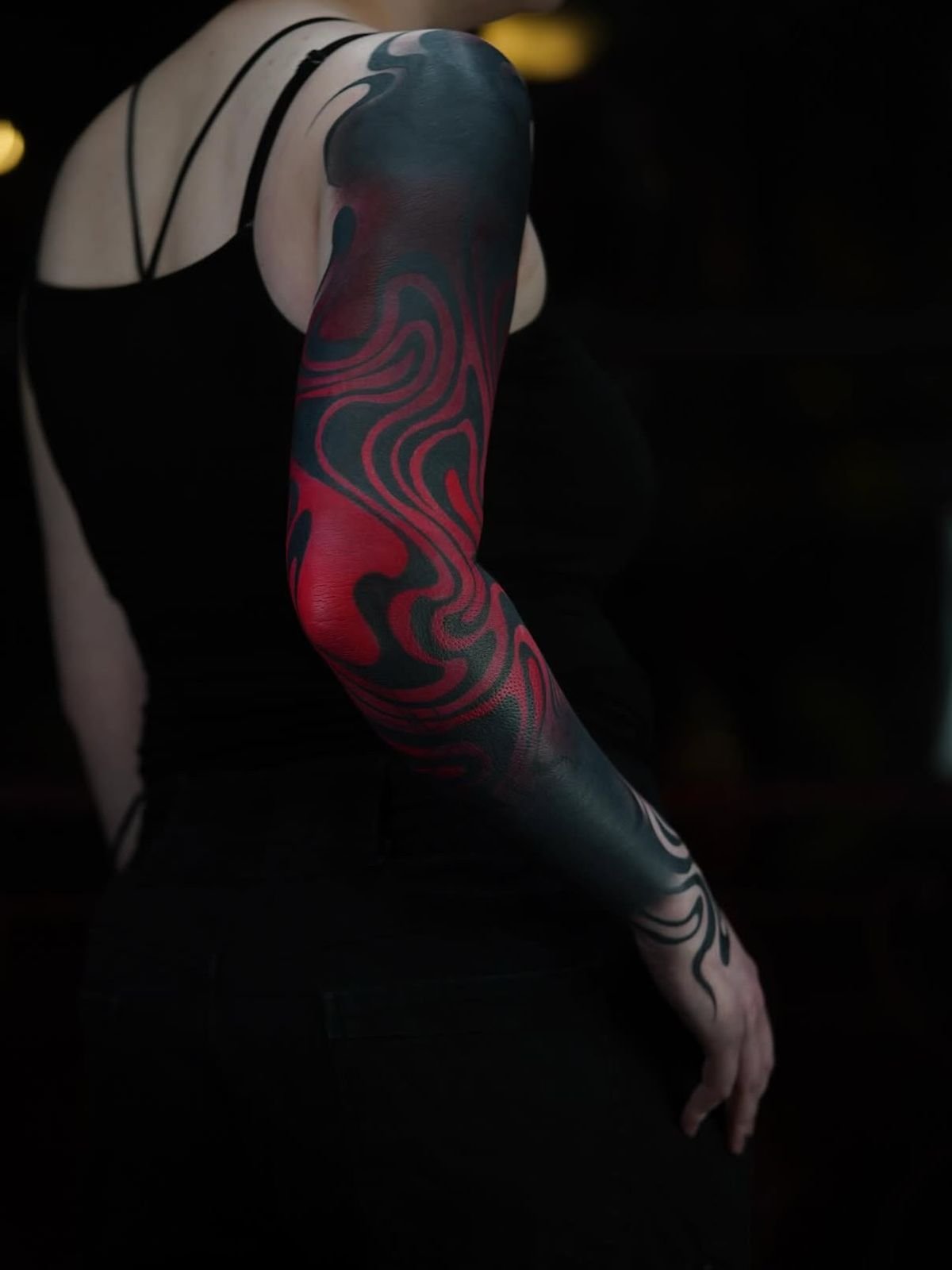
Gakkin (Kenji Nishigaki), a Japanese artist who began tattooing in 1998 at Harizanmai Studio in Kyoto and later relocated to Amsterdam, developed a freehand blackwork practice that incorporates large fields of solid black within Japanese-influenced compositions. Gakkin works without stencils, drawing directly on the body before tattooing, and his pieces frequently use heavy blackout areas as background or negative-space framing for figurative elements — waves, flowers, demons, birds — rendered in the reserved bare skin or in red accent. His approach treats blackout as a compositional tool within the broader Japanese tattoo tradition rather than as a standalone aesthetic.
Roxx (2Spirit Tattoo, originally San Francisco, later Los Angeles), with a career spanning three decades, developed a practice that combines geometric patterns and bold blackwork, frequently incorporating blackout coverage. Roxx’s work bridges geometric blackwork and blackout, using large solid fields as compositional elements within abstract and geometric designs. Her practice influenced the broader geometric blackwork and blackout scenes, particularly on the West Coast.
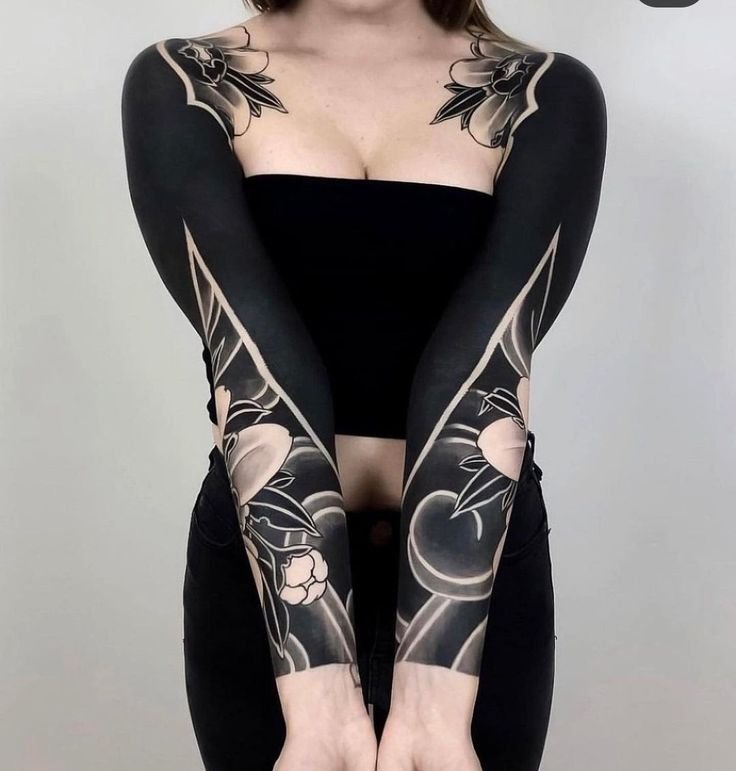
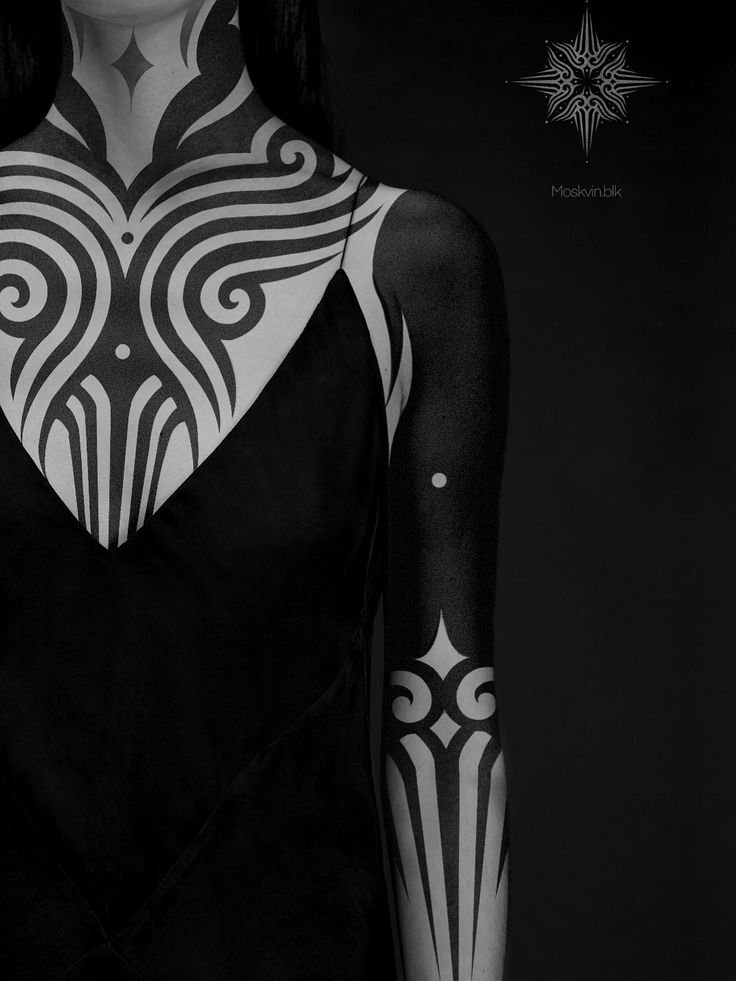
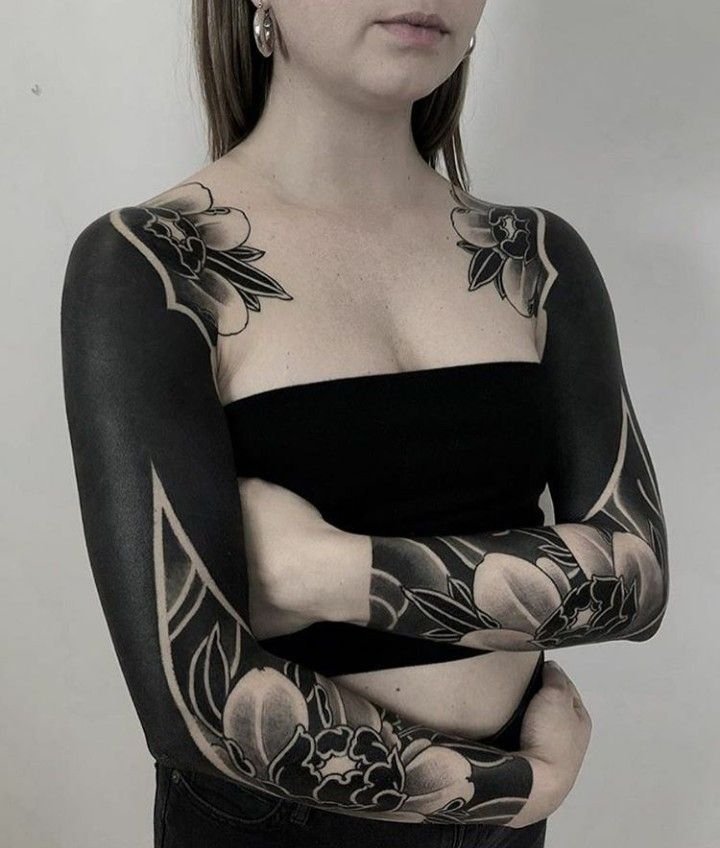
Nazareno Tubaro, an Argentine artist, developed blackout work with strategic negative space — large, solid-black fields from which bare-skin designs emerge. The approach reverses the normal figure-ground relationship: the skin is the drawing, and the ink is the background.
These artists, along with others, established blackout as a practice with multiple entry points — cover-up, Japanese-influenced composition, geometric abstraction, and negative-space design — rather than a single aesthetic with a single origin.
What blackout makes possible
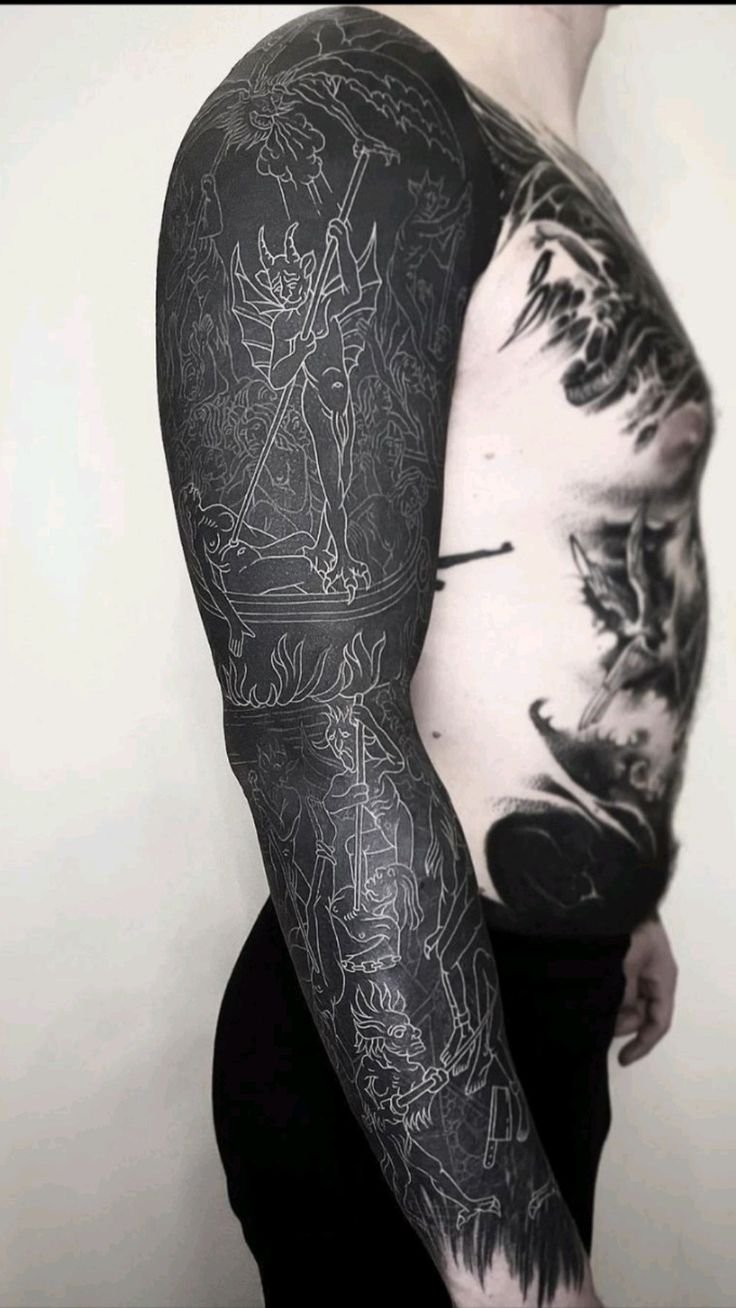
The most distinctive aspect of blackout is what happens after the black is in place. The solid black surface creates a new canvas that supports several design approaches not available on bare skin.

Negative space
White ink on black
Scarification on black
Cover-up
Sculptural effect
What it looks like
Blackout designs vary in their boundary treatment and in how they relate to the body.
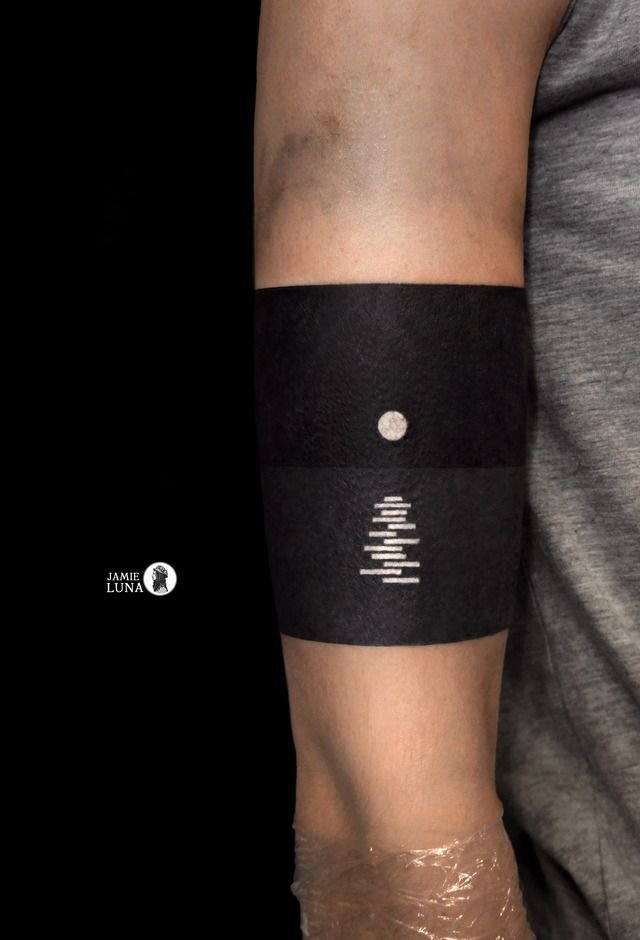
Clean geometric boundaries
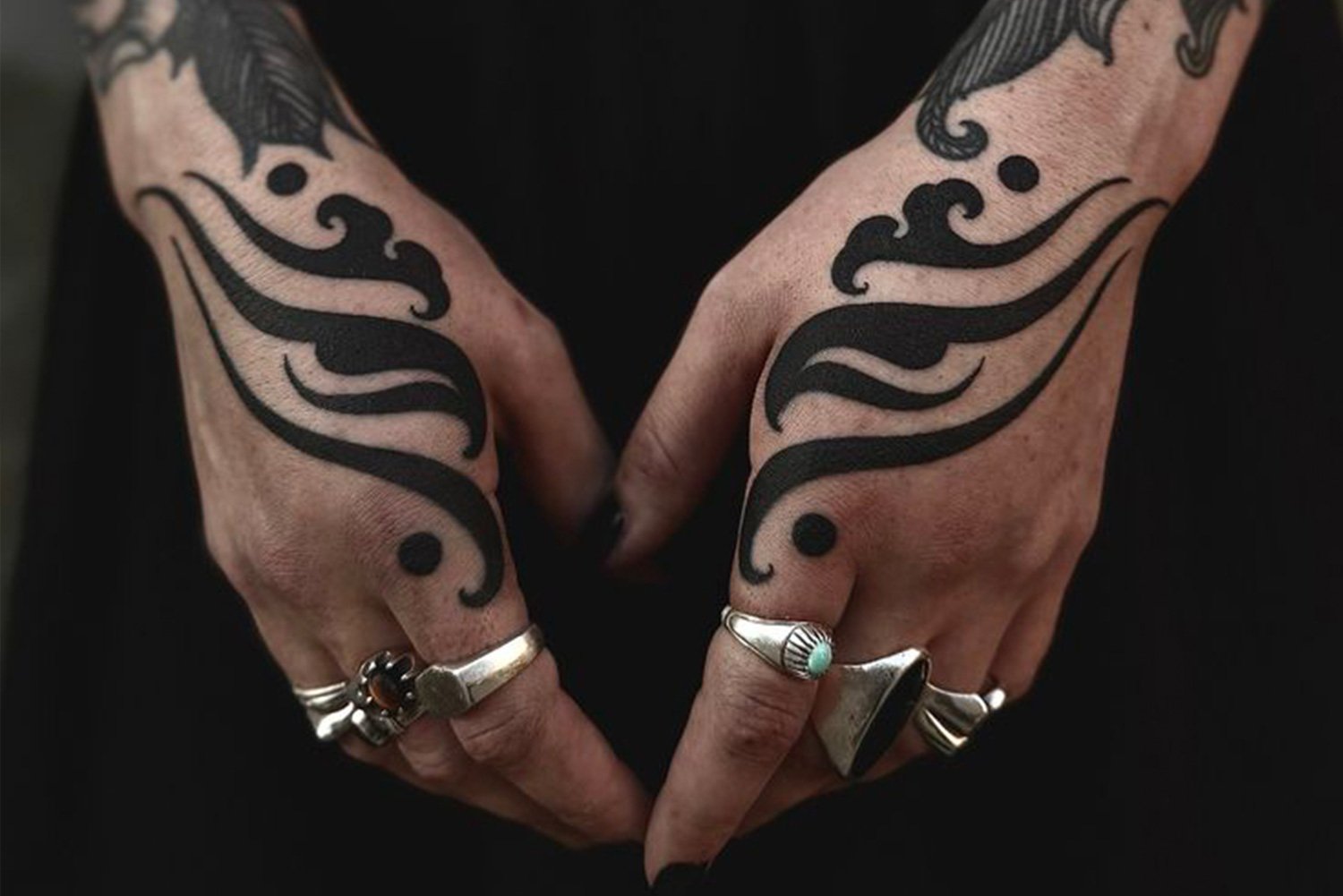
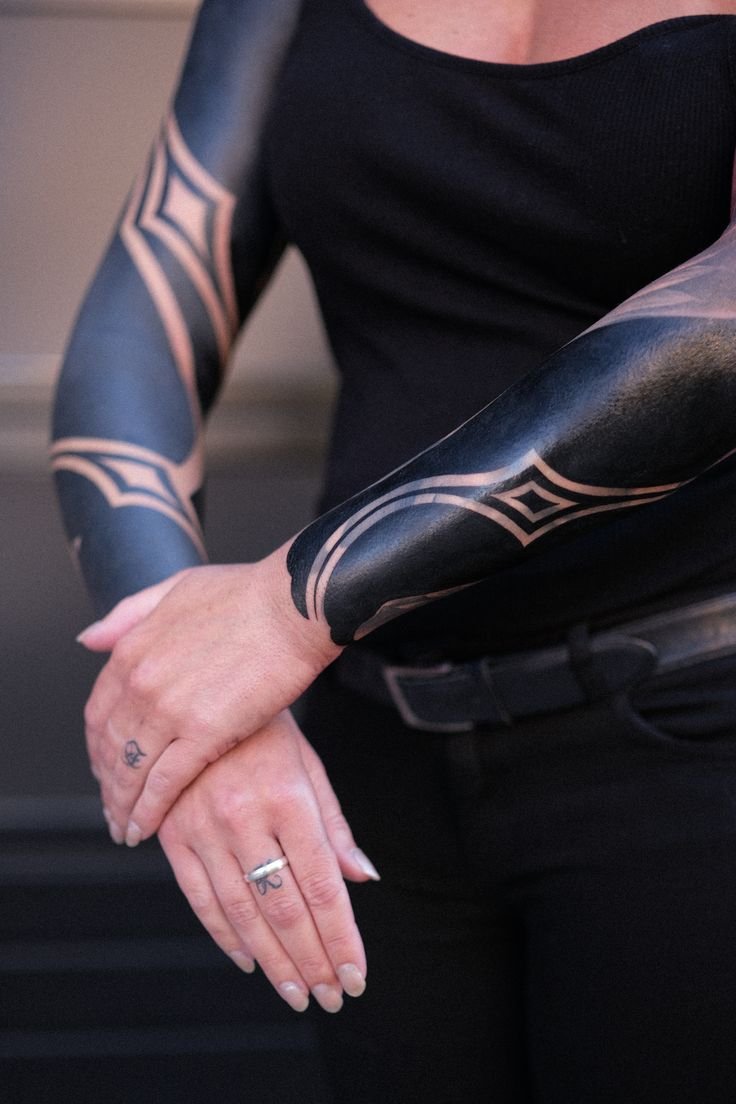
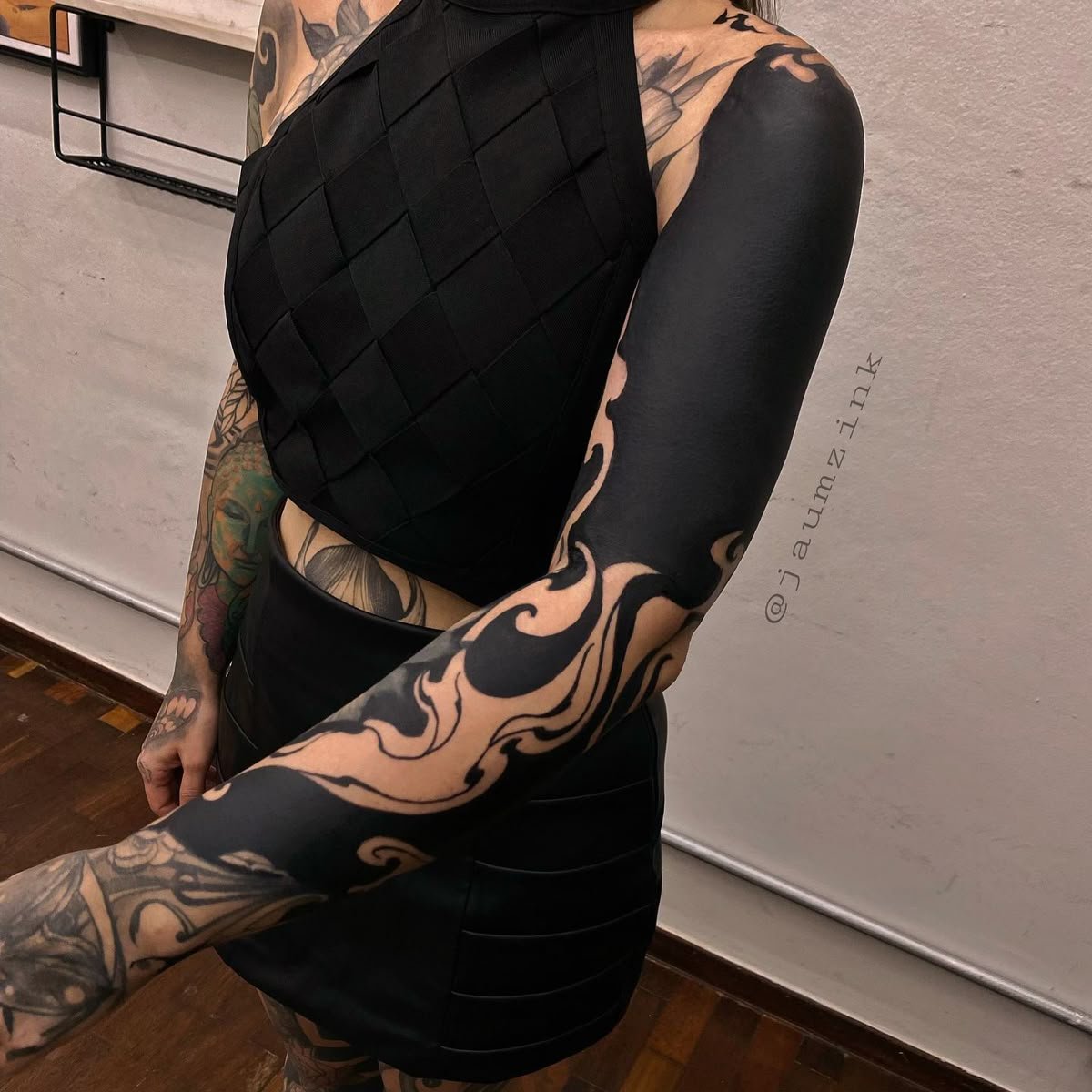
The blackout area terminates in a crisp, straight, or geometrically defined edge — a horizontal line around the arm, a diagonal cut across the chest, a clean border following a geometric shape. The sharpness of the boundary is part of the design, and the contrast between the solid black and the bare skin at the edge is the primary visual event.
Faded or gradient boundaries
The blackout area transitions gradually into bare skin through shading, dotwork, or stipple — a soft edge rather than a hard one. This approach is less graphically aggressive and can integrate the blackout more smoothly with adjacent work or with the body’s natural contours.
Organic and freehand boundaries
The blackout follows organic shapes — the artist designs the boundary freehand to follow the body’s musculature or bone structure, or to incorporate figurative or ornamental elements at the edges. Gakkin’s work exemplifies this approach: the blackout serves the composition, and the boundary is designed for the specific body.
Patterned boundaries
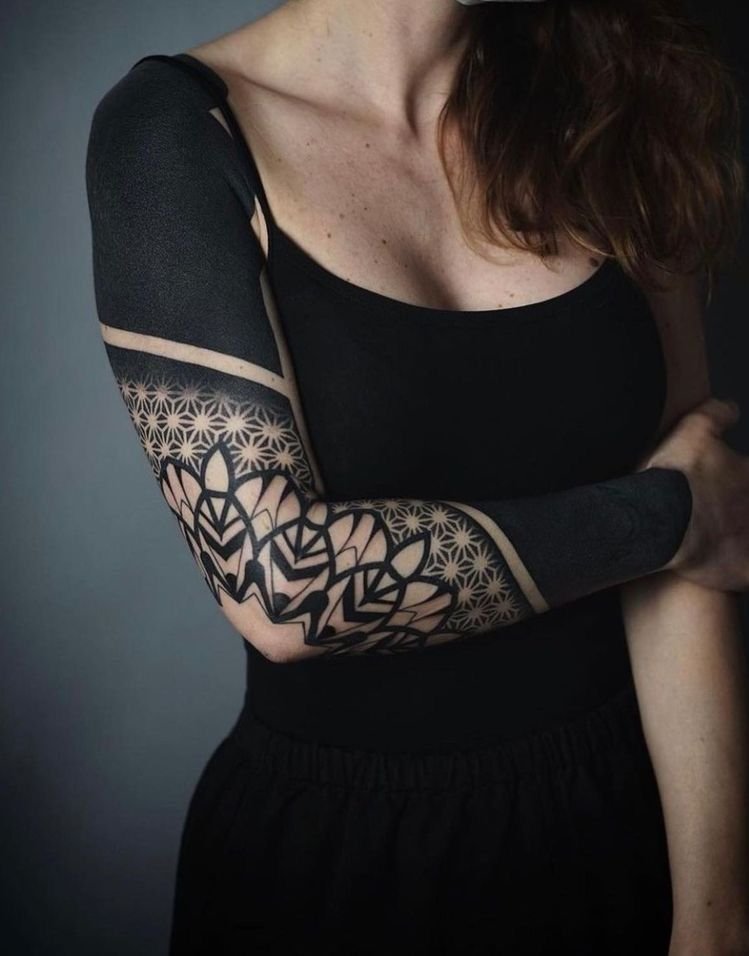
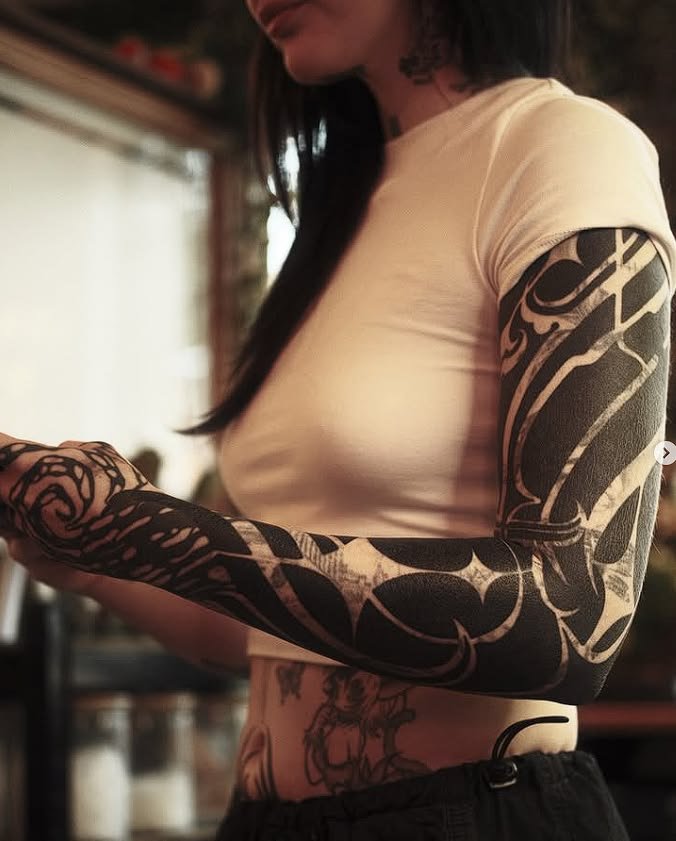
The edge of the blackout area incorporates geometric or ornamental patterns — mandalas, tessellations, or ornamental motifs that transition from solid black through progressively lighter patterning to bare skin. This approach bridges blackout and geometric/ornamental blackwork.
Technical demands
Even saturation
Skin management
Pain
Ink consumption
Health considerations
Dermatological monitoring
Ink composition
Allergic reactions
Healing
Ageing
Solid black tattoo ink is the most stable pigment in tattooing. A well-packed blackout area will maintain its density for decades. The black does not shift colour the way red or green pigments do, and it does not fade as quickly as lighter pigments.
What can change is the texture. Over many years, some blackout areas develop a slight unevenness in surface texture as the skin underneath the ink ages, scars slightly from the application process, or responds to sun exposure. The black remains black, but the surface may show subtle variations in sheen or texture that were not present when the work was fresh. This is a cosmetic consideration, not a structural one — the coverage holds.
White ink applied over blackout fades faster than white ink on bare skin, because the black background is constantly being maintained by the macrophage cycle while the white is being gradually depleted. Touch-ups of white-on-black elements are expected every few years.
Choosing a blackout artist
Check healed saturation. The only honest test of a blackout artist’s technical ability is the evenness and density of their healed work. Fresh blackout always looks solid; the healed result is where patches, grey spots, and texture inconsistencies appear. Ask for healed photographs at six months and beyond.
Check boundary quality. The edge of the blackout — where solid black meets bare skin — is where the artist’s design sense and technical control are most visible. Clean, deliberate, well-placed boundaries are the mark of an experienced blackout artist. Ragged, uneven, or poorly designed boundaries compromise the entire piece.
Ask about session planning. Large blackout pieces are completed over multiple sessions. An artist who can articulate a clear session plan — which areas will be covered in which order, how much healing time between sessions, how many sessions the complete piece will require — is demonstrating the planning discipline the work demands.
Discuss the cover-up situation honestly. If the blackout is covering existing work, the artist should assess the old tattoo’s colours and density and advise on how many passes will be needed to achieve full coverage. Some colours (particularly bright greens and blues) are harder to cover with black than others, and an honest assessment before starting is more valuable than an optimistic promise.
Consider a dermatological consultation. For large blackout pieces, a conversation with a dermatologist before beginning — particularly if you have a family history of skin cancer or a significant number of moles in the area to be covered — is prudent.
Blackout tattoo style today
Blackout occupies a specific position in the tattoo landscape: it is the most extreme form of blackwork, the most effective cover-up method, and one of the most visually transformative practices in contemporary body modification. It appeals to a relatively small but committed client base — people who want large-scale solid coverage, people covering old work, and people drawn to the sculptural and identity-transforming aspects of the practice.
The style has grown steadily since Chester Lee’s viral moment in 2016, and the practitioner base has deepened. The most interesting current work combines blackout with other techniques — negative space, white ink, scarification, ornamental edge work, figurative elements within or emerging from the black — and the development of these hybrid approaches is where the style’s creative energy is concentrated.
For a client considering blackout, the decision should be made with full awareness of the commitment involved: the pain, the healing time, the permanence, the health considerations, and the fact that the covered skin is permanently altered. For clients who have made that decision with open eyes, blackout offers something no other tattoo style can — a total visual transformation of the body’s surface.
Sources & further reading
- Blackout tattoo, Wikipedia entry: en.wikipedia.org/wiki/Blackout_tattoo.
- Chester Lee / Oracle Tattoo, Singapore. Official website: oddtattooer.com, and Instagram: @oddtattooer.
- Gakkin (Kenji Nishigaki): Instagram @gakkinx.
- Roxx / 2Spirit Tattoo. Website: roxxandcats.com, Instagram: @roxx_____
- Nazareno Tubaro: Instagram @xnazax.
- Sean Mallon, Tatau: A History of Sāmoan Tattooing. Te Papa Press, 2002.
- Sean Mallon and Sébastien Galliot, Tatau: Sāmoan Tattoo, New Zealand Art, Global Culture. Te Papa Press, 2018.
- Lars Krutak, Spiritual Skin: Magical Tattoos and Scarification. Edition Reuss, 2012.
- Jørgen Serup, Nicolas Kluger, and Wolfgang Bäumler (eds.), Tattooed Skin and Health. Current Problems in Dermatology, vol. 48, Karger, 2015.
- European Chemicals Agency (ECHA), REACH restriction on substances in tattoo inks and permanent make-up. Entry 75 of Annex XVII, entered into force January 2022. Regulation (EU) 2020/2081.
- Anna Felicity Friedman, The World Atlas of Tattoo. Yale University Press, 2015.
- Matt Lodder, Painted People: Humanity in 21 Tattoos. Harper, 2024.
- Margo DeMello, Bodies of Inscription: A Cultural History of the Modern Tattoo Community. Duke University Press, 2000.
- Nick Schonberger and Rob Kingston, Forever: The New Tattoo. Gestalten, 2012.