Related Posts

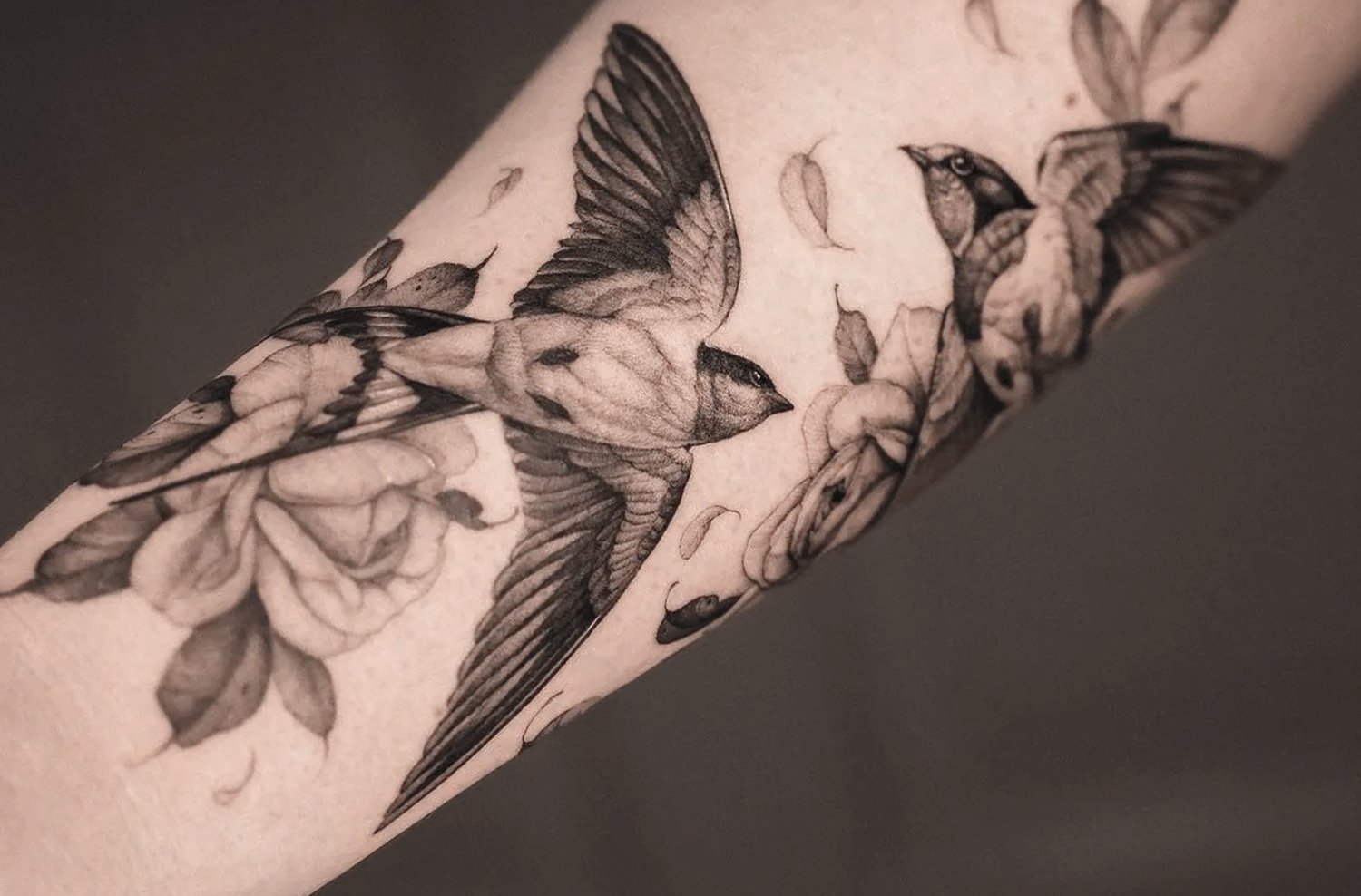
Swallow tattoo
The bird that always comes back
A barn swallow weighs roughly twenty grams — less than a letter in an envelope. It migrates up to eleven thousand kilometres each way, twice a year, returning to the same nesting site with a navigational accuracy that science can describe but not fully explain. It has been doing this for longer than any human civilisation has existed. People noticed.
The swallow is one of the most symbolically loaded birds in the world, and one of the most frequently tattooed. Its meanings have accumulated across millennia — in ancient Greece, in Roman funeral practice, in Chinese poetry, in Christian theology, in the nautical traditions of the Atlantic and Pacific, in British working-class culture, and in the American traditional flash vocabulary that codified it as one of the canonical tattoo images of the twentieth century. A swallow tattoo today carries all of this, whether the wearer knows it or not.
Swallow species
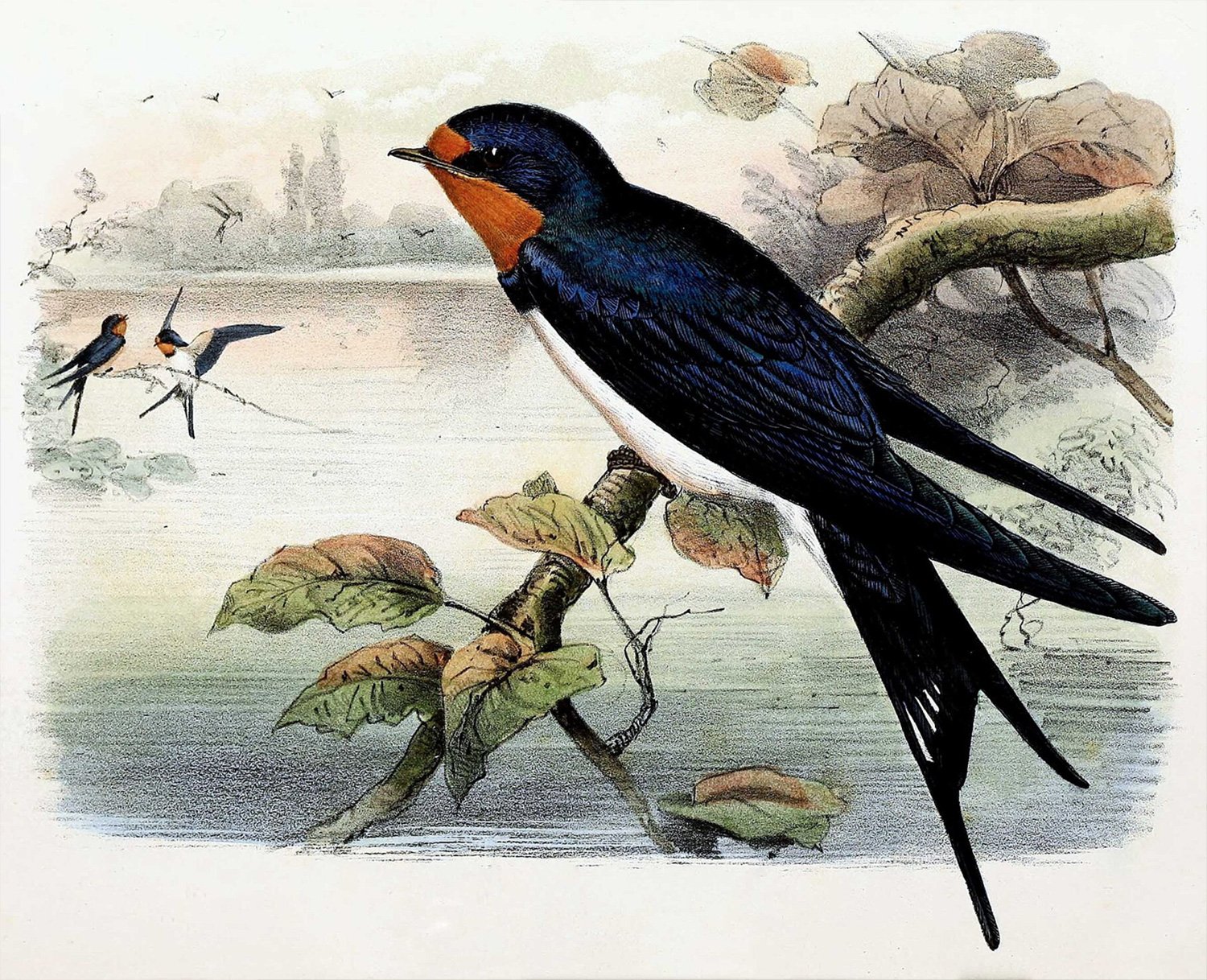
The species most commonly intended by the word “swallow” in tattoo contexts is the barn swallow, Hirundo rustica — the world’s most widely distributed swallow species, found on every continent except Antarctica. It is a small, fast, insectivorous bird with a deeply forked tail, blue-black upperparts, a russet throat, and a pale underside. The forked tail is the visual feature that identifies it at a distance and that distinguishes it in tattoo imagery from the sparrow, which is a different bird entirely (addressed below).
Barn swallows are migratory. European populations winter in sub-Saharan Africa; North American populations winter in Central and South America; Asian populations winter in Southeast Asia and Australia. The migration is long, dangerous, and remarkably precise — individual birds return to the same barn, the same ledge, the same cliff face, year after year. This fidelity to a home site is one of the biological facts that became a cultural symbol.
Swallows nest in proximity to human habitation. The barn swallow’s name is literal — it nests in barns, in sheds, under eaves, on ledges and beams inside buildings. The bird chose to live alongside people, and people responded by weaving it into their stories. The swallow is one of a small number of wild animals that most pre-modern Europeans and Asians would have seen daily during the warmer months, returning each spring and disappearing each autumn with a regularity that invited explanation.
Swallow and sparrow
This distinction matters because the two birds are frequently confused in tattoo culture, and the confusion changes the meaning.
A swallow (Hirundo rustica and related species) is a sleek, fast, fork-tailed bird that catches insects on the wing. It is migratory. It is the bird associated with sailors, with homecoming, and with the nautical tattoo tradition.
A sparrow (Passer domesticus and related species) is a stocky, short-tailed seed-eating bird. It is not migratory. It is associated with different symbolic traditions — ordinariness, community, the common people, the soul of the dead in some European folk beliefs, and the providence of God in the Christian tradition (the sparrow that God watches over in the Gospel of Matthew).
In American traditional tattooing, the bird rendered in flash is usually drawn with a forked tail and is called a swallow or a sparrow interchangeably, even though the visual form is closer to a swallow. The confusion is old and embedded in the tattoo vocabulary. For this article, the focus is on the swallow — the migratory, fork-tailed bird — and the symbolic traditions attached to it.
Swallows in the ancient world
The swallow’s arrival in spring made it a natural symbol of seasonal return, renewal, and resurrection across the ancient Mediterranean.
In ancient Greece, the swallow was associated with Aphrodite and with spring. The arrival of the first swallow was an event worth marking — the Greek proverb mia chelidon ear ou poiei (“one swallow does not make a spring”) survives in most European languages and testifies to the depth of the association. The proverb warns against premature optimism, but its premise is that the swallow is the authentic signal of the season’s turn. When enough swallows have arrived, spring is real.
A Greek vase painting from the late sixth century BCE, now in the Hermitage Museum, shows three figures — often interpreted as a man, a youth, and a boy — pointing at a swallow in flight and exclaiming about its arrival. The inscription reads, roughly:
“Look, a swallow!” / “Yes, by Heracles!” / “There she is!” / “It’s spring!”
The scene captures the intensity of the association: the swallow arrives, and the world changes.
In Roman culture, the swallow carried similar seasonal associations and also appeared in the context of death and the afterlife. Swallows were believed by some Roman writers to hibernate through the winter — disappearing into mud, into water, into hollow trees — rather than migrating. This misunderstanding, which persisted in European natural history until the eighteenth century, gave the swallow an additional symbolic charge: the bird that dies and returns, that disappears and reappears, that enacts a small resurrection every spring. The parallel with the human soul was drawn explicitly by early Christian writers who inherited the Roman tradition.
In Egyptian culture, the swallow was associated with the stars and with the souls of the dead. The Book of the Dead includes a spell for transforming into a swallow, allowing the deceased’s spirit to move freely between the worlds of the living and the dead.
Christianity
The early Church adopted the swallow’s seasonal return as a symbol of the Resurrection — Christ’s rising from death mirrored by the bird’s return from its winter absence. The connection is made explicitly in several early Christian texts and in medieval bestiaries, which treated the swallow as a living emblem of the promise that death is not final.
Medieval Christian art sometimes depicts swallows nesting in the eaves of churches, and the bird’s preference for building its nest in human structures was read as a sign of trust in God’s provision — the swallow makes its home in the house of God. Psalm 84:3 (“Even the sparrow has found a home, and the swallow a nest for herself, where she may lay her young — a place near your altar, Lord Almighty”) was interpreted as confirmation of the bird’s sacred status, though the verse refers to both the sparrow and the swallow.
In later European folk Christianity, the swallow was sometimes described as a bird that attended the Crucifixion — pulling thorns from Christ’s crown, singing to comfort him, or catching his tears. These stories are not biblical; they belong to the folk tradition, but they reinforced the association of the swallow with suffering, compassion, and divine care. In some versions, the russet colouring of the barn swallow’s throat was explained as a stain from Christ’s blood.
Swallow in China
In Chinese culture, the swallow (yàn, 燕) carries a dense cluster of associations.
The swallow is a symbol of spring, fidelity, and homecoming — the returning bird as a sign that the season has turned and that the household will be renewed. Swallows nesting under the eaves of a house are considered auspicious; their return each year is read as a blessing on the household and as a sign that the family is virtuous enough to attract the birds back.
The swallow is also associated with marital fidelity. Barn swallows are socially monogamous — they pair-bond for the breeding season and often re-pair with the same mate in subsequent years. This biological behaviour was observed and incorporated into the symbolic tradition. A pair of swallows can represent a married couple, and swallow imagery appears in Chinese wedding decoration and in gifts exchanged between partners.
In Chinese poetry, the swallow is one of the conventional images of spring and of the passage of time. The Tang dynasty poet Liu Yuxi’s famous poem depicts swallows that once nested in the halls of the aristocracy, now nesting in ordinary houses — the bird unchanged, the world around it transformed. The swallow witnesses history because it outlasts it, returning each year regardless of which dynasty holds power.
The Yanjing suishi ji (Record of the Year’s Seasons in Beijing) and similar historical texts document the cultural significance of the swallow’s arrival and departure as seasonal markers in Chinese life.
Swallows in Japan
The swallow (tsubame, 燕) carries associations with spring, good fortune, safe travel, and — in the samurai tradition — speed and precision. The bird’s quick, darting flight was admired as a model of agility, and the name Tsubame-gaeshi (swallow tail cut) was given to a legendary sword technique attributed to the swordsman Sasaki Kojirō, said to imitate the swallow’s change of direction in flight.
In Japanese folk tradition, a swallow nesting under the eaves of a house is good luck, as in the Chinese tradition. The bird’s return is welcomed, and its departure in autumn is noted with the understanding that it will come back.
The swallow does not hold the same position in the Japanese irezumi tradition as the tiger, the dragon, or the koi. It appears in Japanese art — in woodblock prints, in painting, in textile design — but it is not one of the major subjects of traditional full-body tattooing. In contemporary Japanese-style tattoo work, the swallow sometimes appears as a seasonal element in compositions that reference spring.
The nautical tradition
The swallow’s most significant tattoo association in the Western world is with sailors, and the nautical tradition is the direct ancestor of the swallow’s place in American traditional flash.
The origins of the sailor’s swallow tattoo are not precisely documented, but the custom was well established by the mid-nineteenth century among British and American merchant and naval sailors. The most commonly repeated account ties the tattoo to distance sailed: one swallow for a significant voyage completed, with a second swallow earned after further experience at sea. The specific mileage thresholds vary in the telling — five thousand nautical miles is the figure most often cited, but the number is inconsistent across sources and was probably never standardised.
What is more consistent is the meaning: safe return. The swallow migrates and comes back. The sailor sails and hopes to come back. The bird on the body is a declaration of that hope and, after the voyage is completed, a record of its fulfilment. Two swallows on the chest — one on each side, below the collarbones — is one of the oldest standard placements in the Western tattoo tradition.
There is also a grimmer layer to the association. In some versions of the tradition, a swallow tattoo was thought to ensure that if the sailor drowned, his soul would be carried to heaven by the birds. The swallow as a psychopomp — a guide of souls between the living and the dead — connects the nautical tradition to ancient Egyptian and Greek associations with remarkable continuity. However, it is doubtful whether the sailors were aware of the classical parallels. They may have arrived at the same idea independently because it follows naturally from watching a bird disappear over the horizon and return.
Other nautical tattoo traditions that overlap with or are adjacent to the swallow:
- the nautical star (a guide-home symbol),
- the anchor (stability, a completed Atlantic crossing in some accounts),
- the fully rigged ship (a sailor who has rounded Cape Horn).
The swallow belongs to this constellation of earned maritime symbols, and its meaning is strongest when read within that context.
Swallow in British working-class culture
In twentieth-century Britain, the swallow tattoo acquired additional associations outside the nautical context.
In some accounts, swallow tattoos on the hands — particularly on the web between the thumb and forefinger, or on the knuckles — were associated with street fighting, with having served time in prison, or with a general reputation for toughness. The image of a bird in flight on the fist was read, in some circles, as a signal that the wearer’s hands were fast. Whether this association was widespread or restricted to specific subcultures and regions is debated, and the evidence is largely anecdotal rather than documented.
What is documented is that the swallow became a popular tattoo subject in British working-class culture more broadly — among dockworkers, factory workers, soldiers, and the general population of men who got tattooed from the mid-twentieth century onward. In this context, the swallow often carried the same general meanings as in the nautical tradition (homecoming, loyalty, safe return) without the specific maritime associations. A British factory worker with a swallow on his forearm in 1965 was not claiming to have sailed five thousand miles; he was wearing an image that meant something to his class and his community.
American traditional
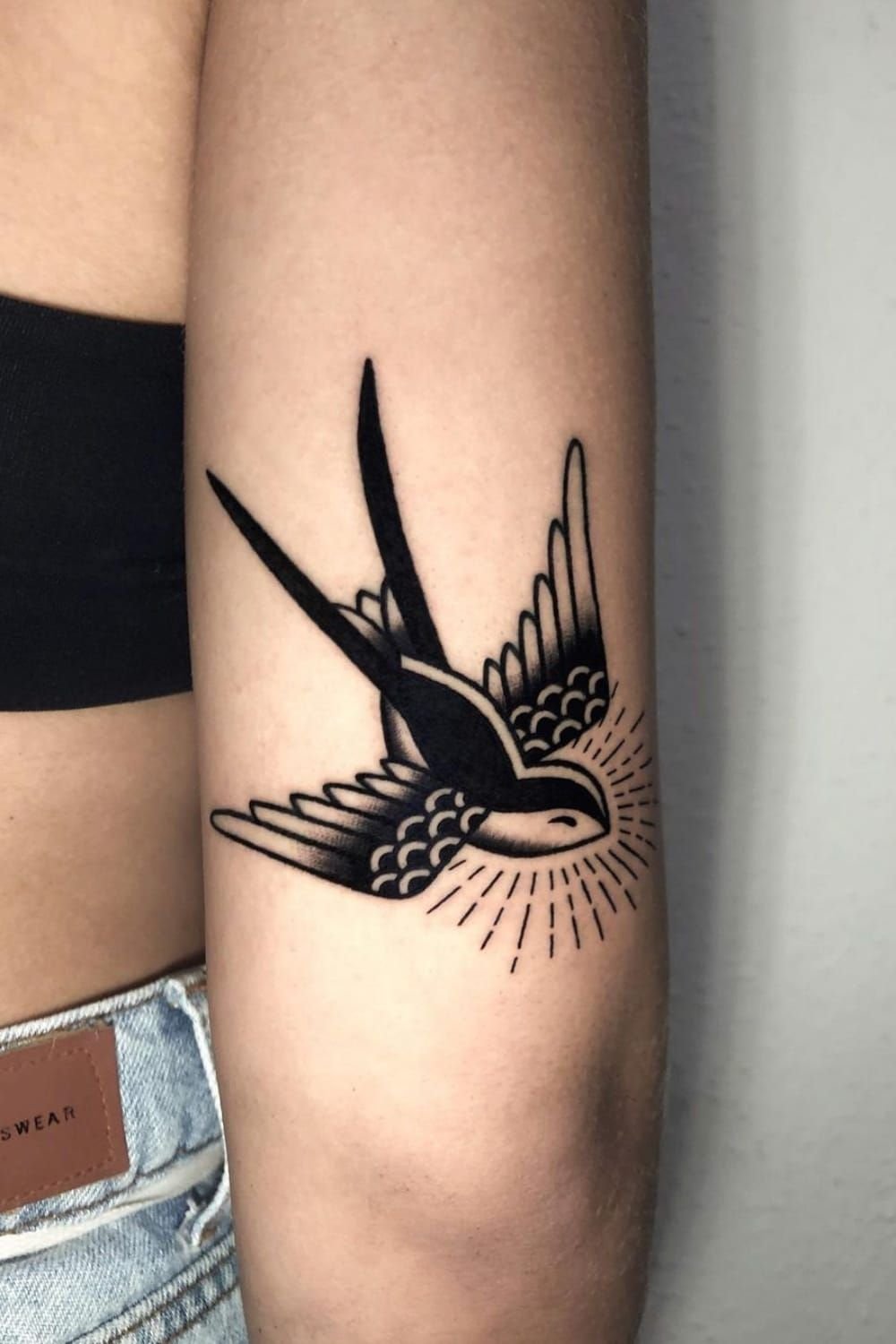
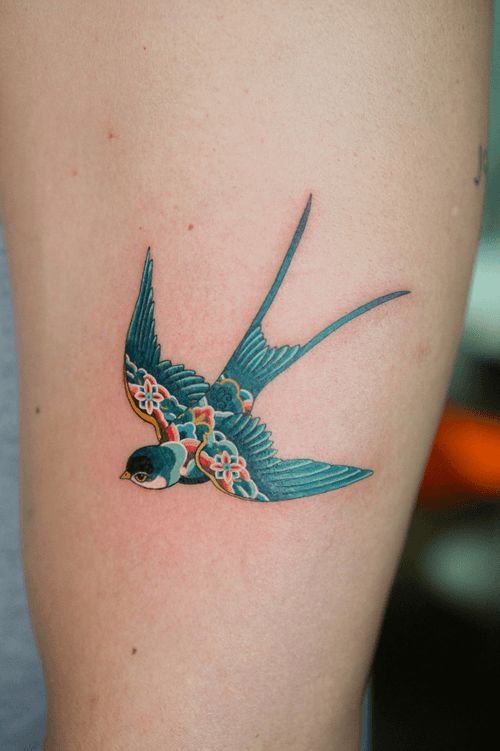
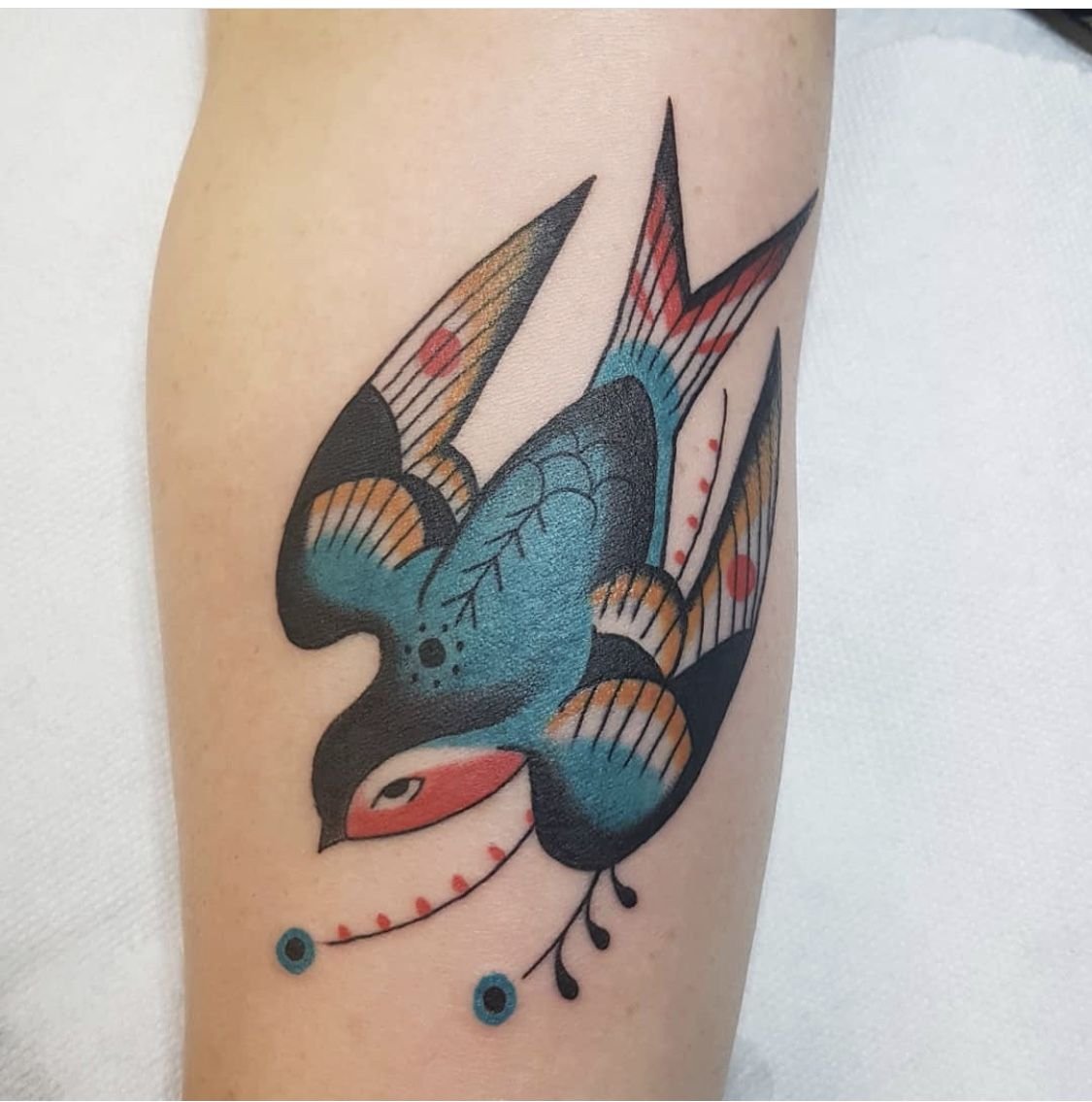
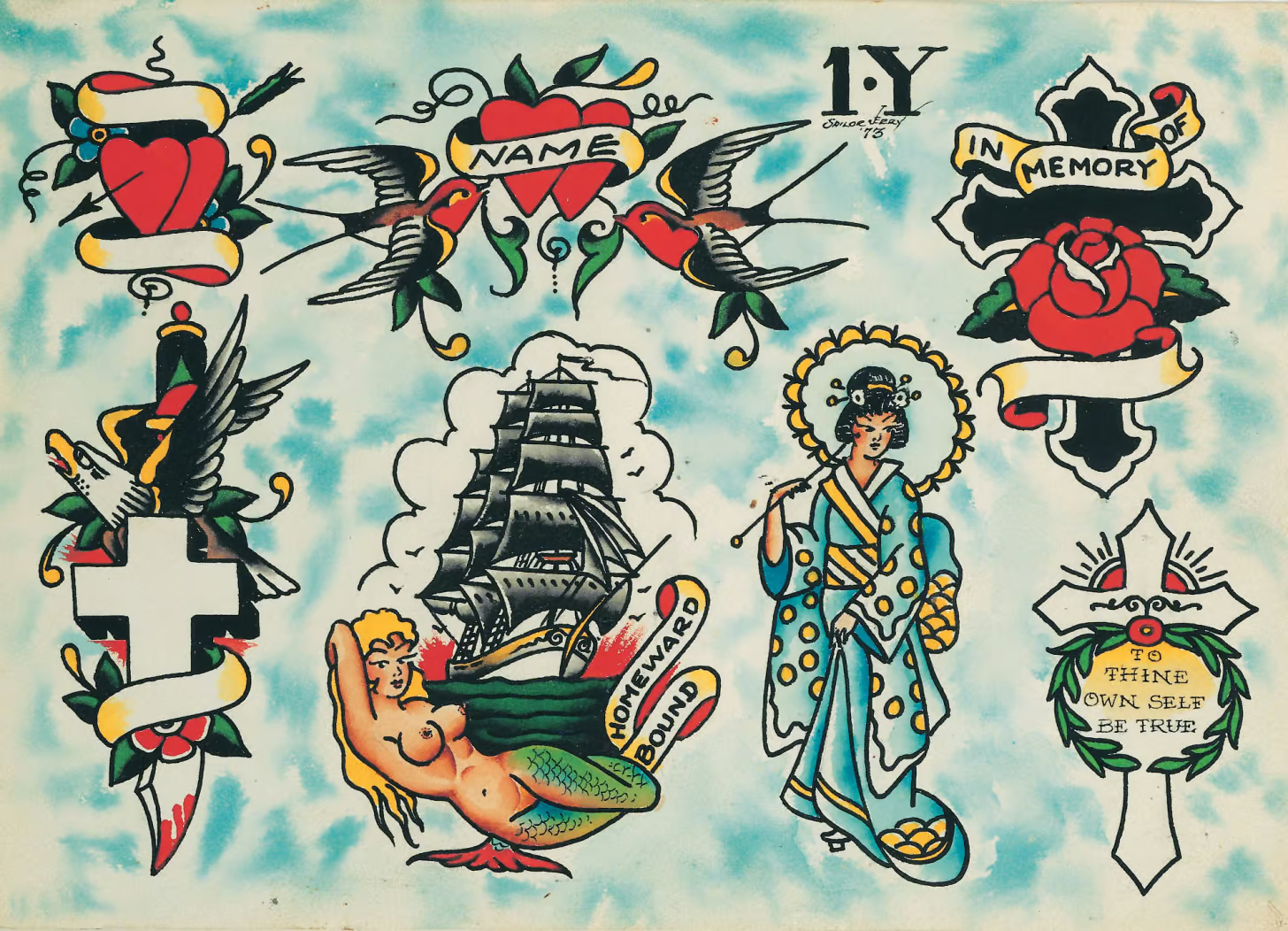
The swallow is one of the fundamental images of American traditional flash. The standard rendering is recognisable: a bird in flight, usually in three-quarter view with wings spread, a deeply forked tail, rendered in blue (or blue-black) and red-orange with a heavy black outline and a white or bare-skin breast. The bird is typically depicted solo or in a pair, and it is one of the few traditional flash subjects that is almost always shown in motion — mid-flight, turning, banking, alive.
The traditional swallow was designed, like all good flash, to read at a distance and to age well. The strong outline, the limited palette, and the simple graphic form ensure that the image remains legible after decades on skin. A traditional swallow from 1950 still looks like a swallow in 2025.
In traditional vocabulary, the swallow is most commonly placed on the chest (one on each side of the collarbone), shoulders, hands, or neck. Chest placement is the most traditional and the most visually connected to the nautical meaning — the birds sit where the heart is, and they point forward, toward home.
The traditional swallow is often combined with other elements: a banner bearing a name or a date, a nautical star, an anchor, a heart, roses, or script reading “homeward bound” or similar phrases. The bird works as a standalone piece and as part of a larger composition.
Meaning of the swallow tattoo

Safe return and homecoming

Distance travelled and experience earned
Loyalty and fidelity
Spring, renewal, and new beginnings
Freedom
The soul's passage
Love
Speed and agility
Good luck and divine favour
Class identity and community
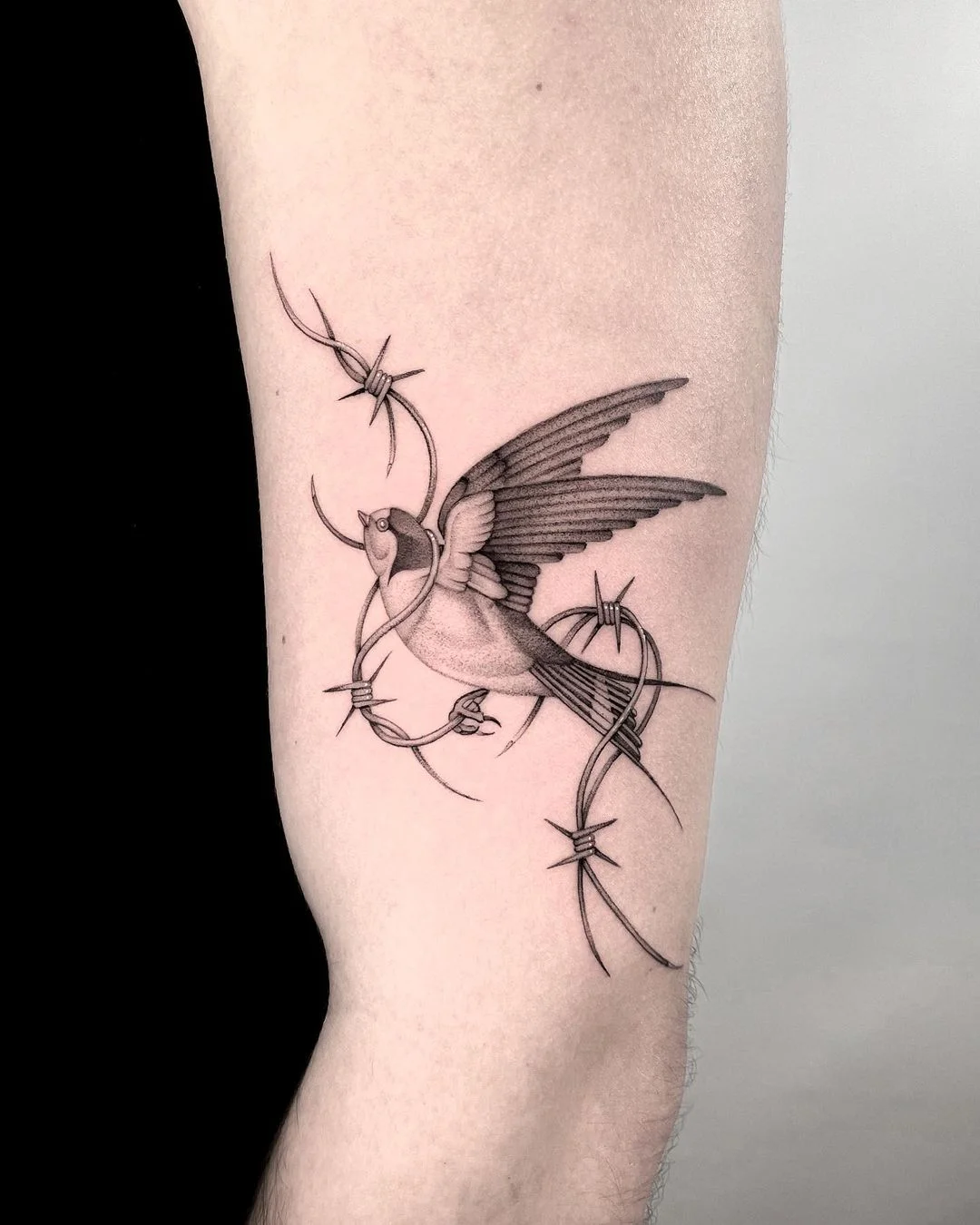
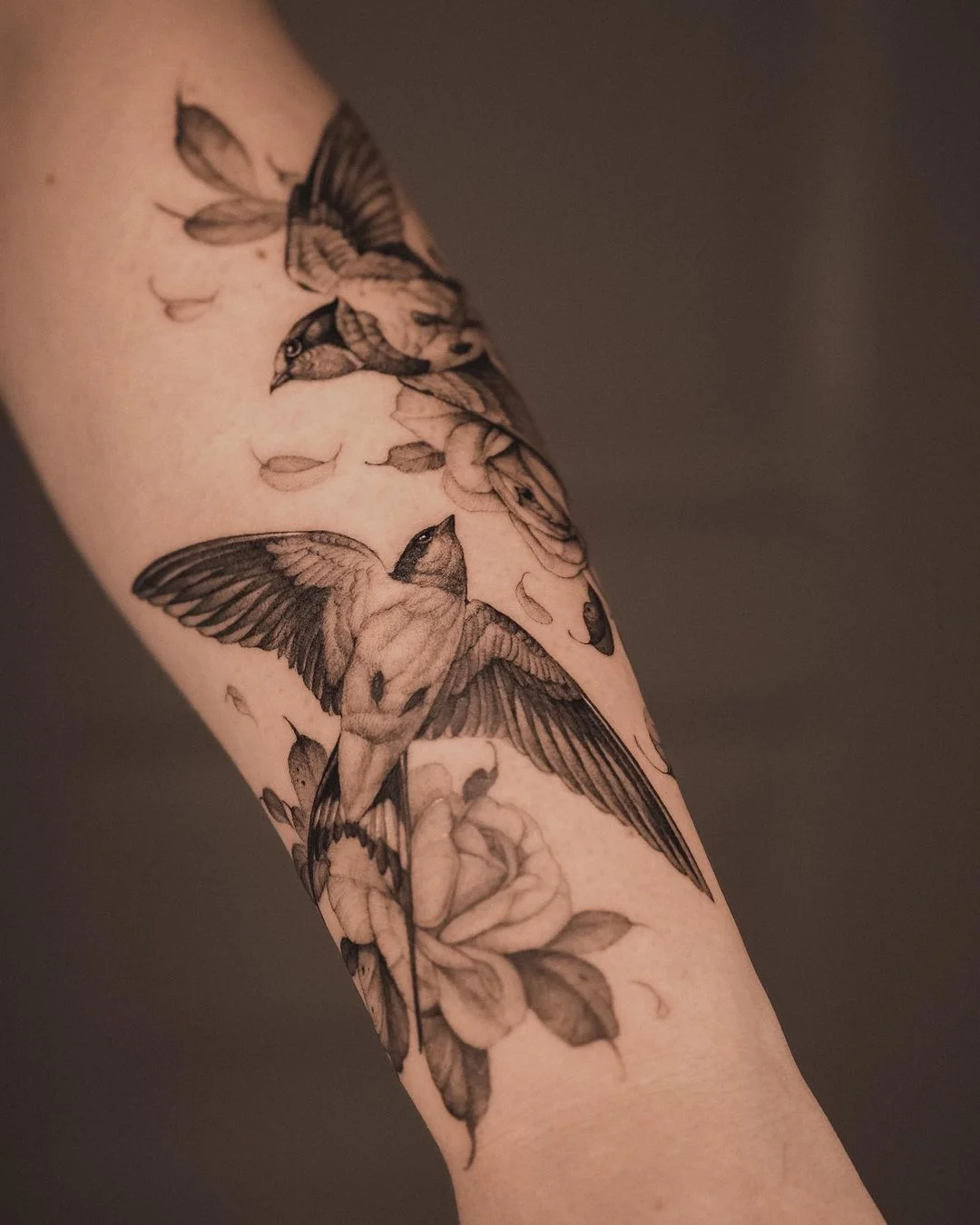
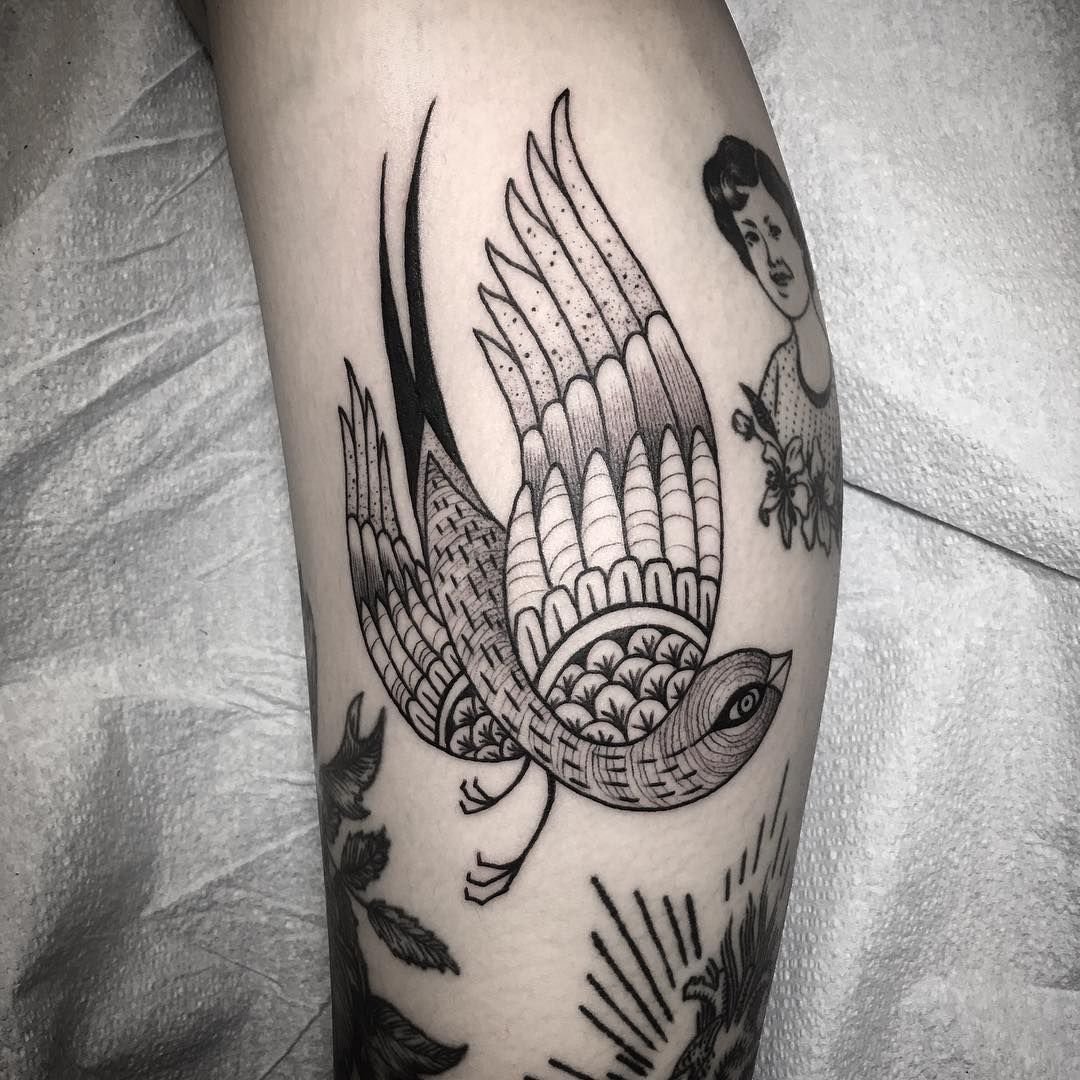
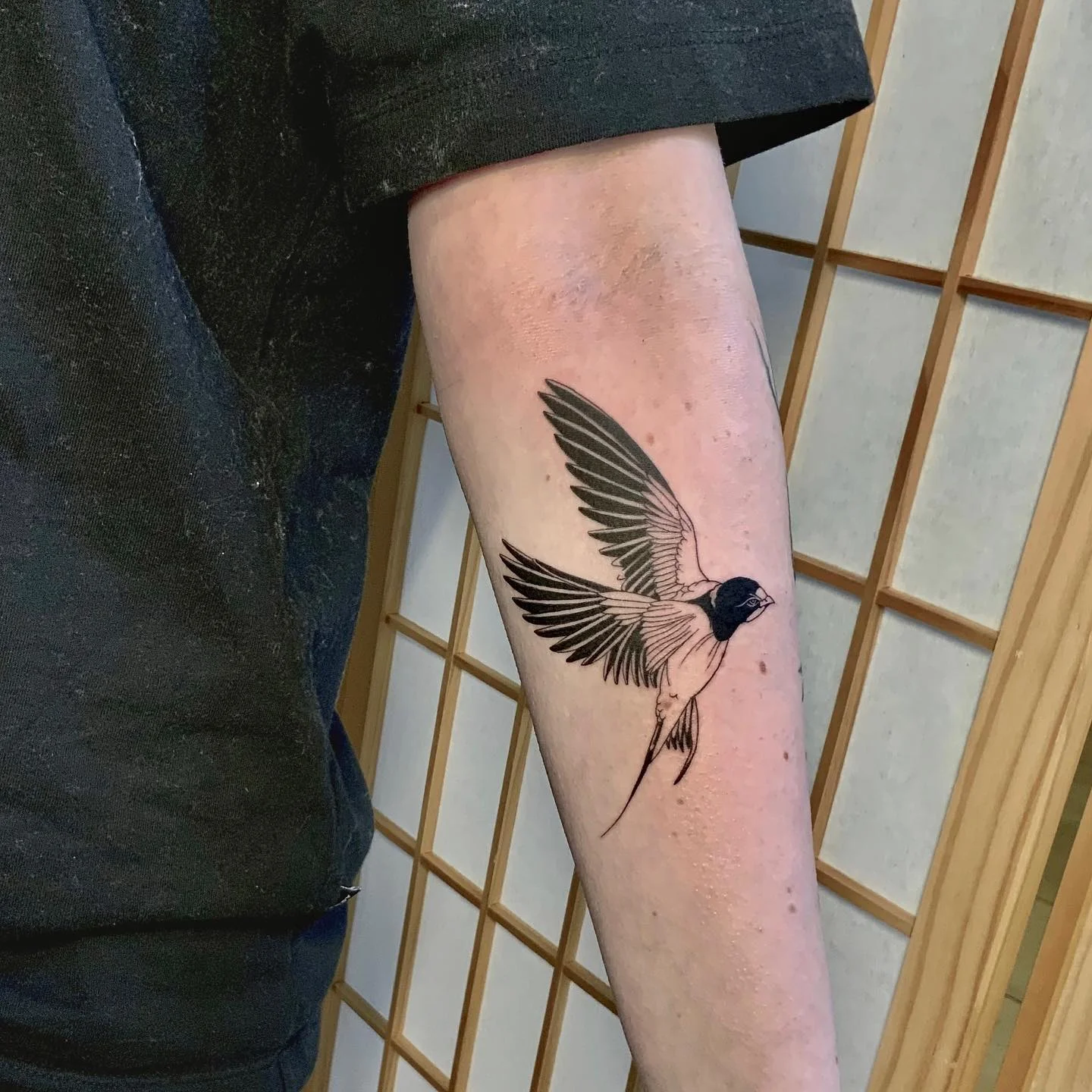
Swallows across tattoo styles
American traditional
Neo-traditional
Realism
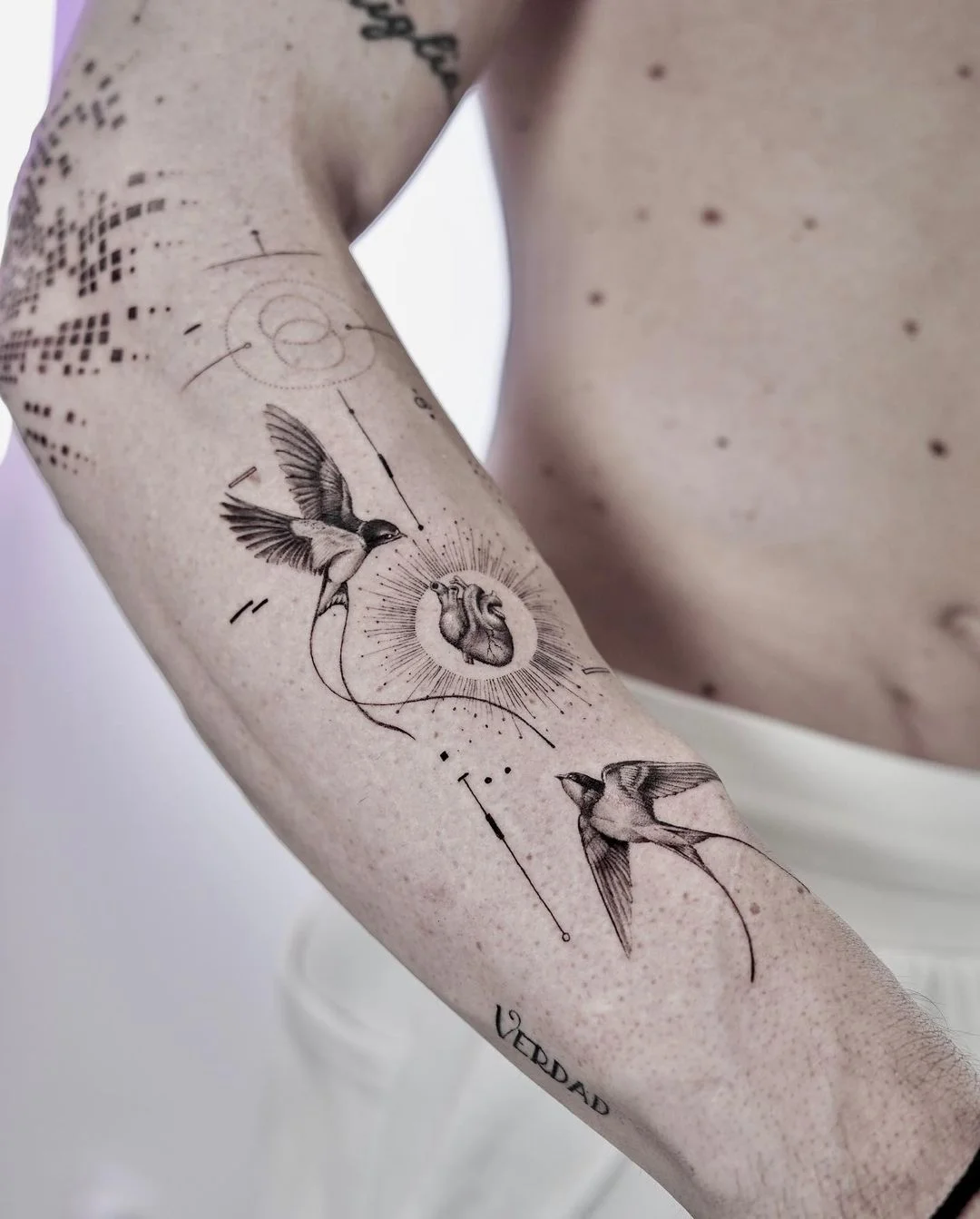
Fine line
Blackwork
Illustrative
Choosing a swallow tattoo
A few practical observations:
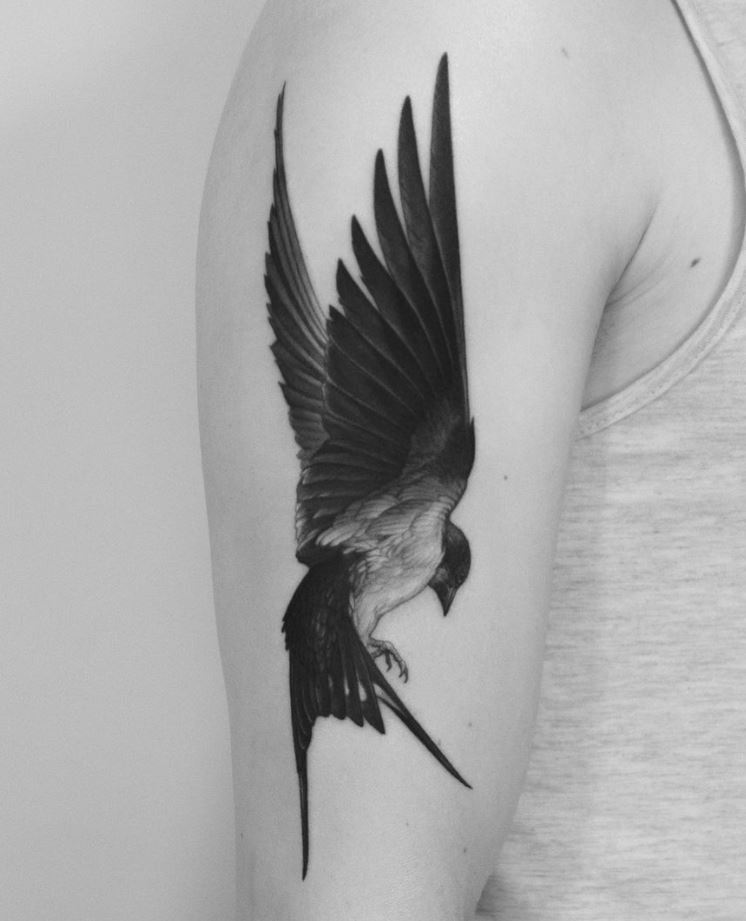
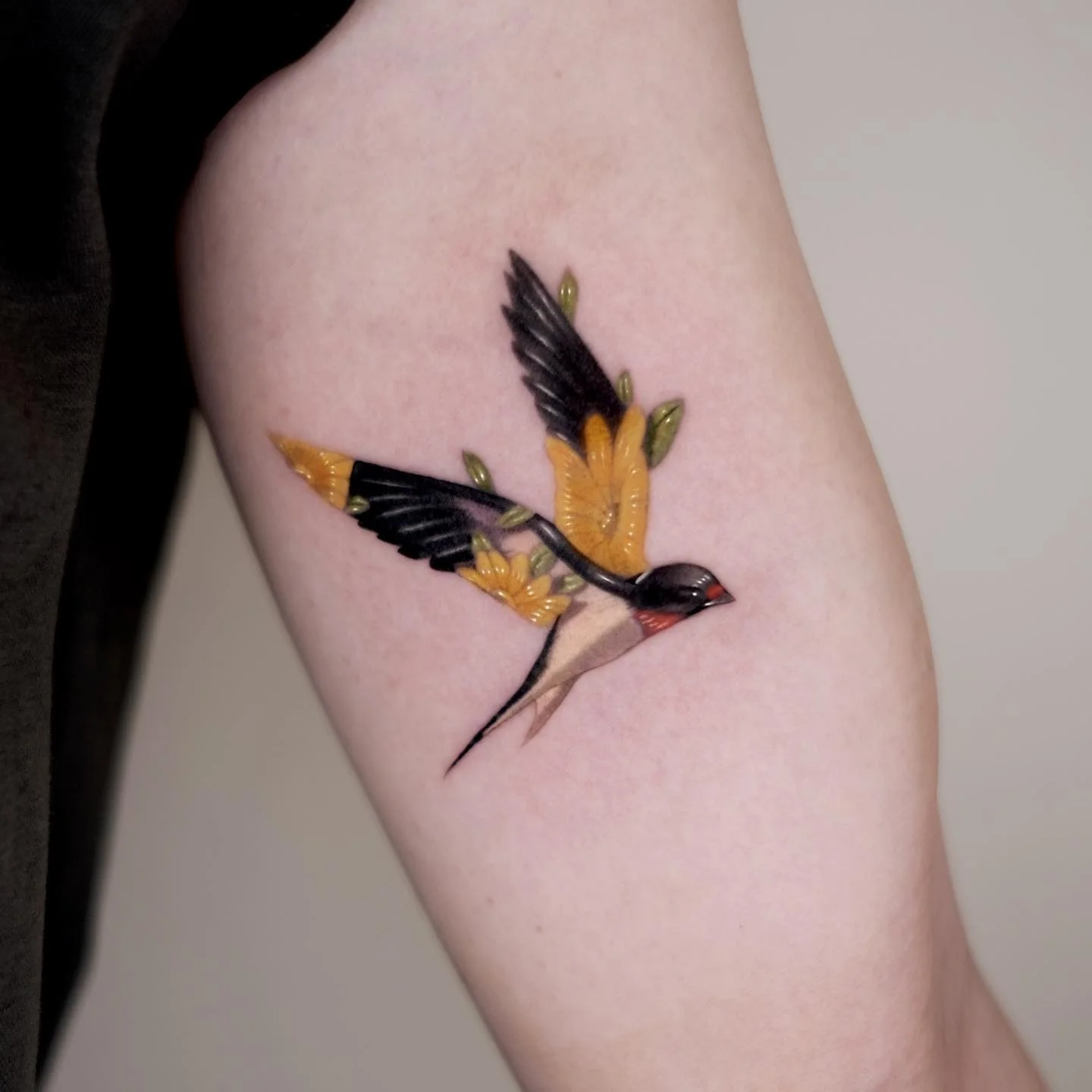
The forked tail is the identifying feature. A swallow tattoo without a clearly forked tail will be read as a sparrow or a generic bird. The fork is what makes the image specific. In traditional flash, the tail streamers are exaggerated for visual clarity; in realism work, the natural proportions of the tail can carry the identification. Either way, the tail should read.
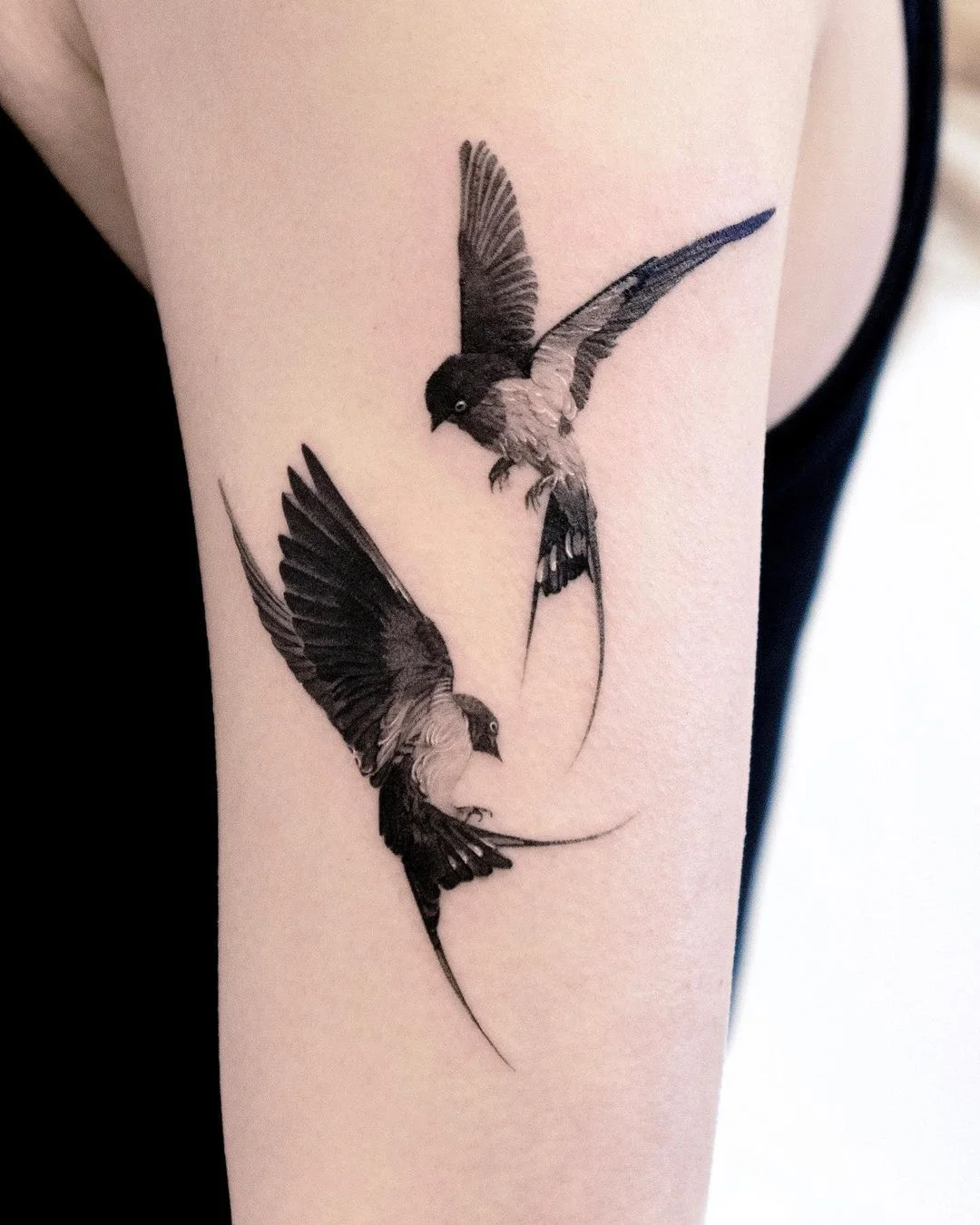
Pair placement has its own meaning. Two mirrored swallows on the chest are among the oldest and most specific placements in the Western tattoo tradition. The pairing carries the nautical associations more directly than a single bird, and the symmetrical chest placement connects the birds to the heart and to the idea of forward motion — the birds fly toward wherever the wearer faces.
The direction of flight matters in some traditions. A swallow flying toward the wearer can represent coming home; a swallow flying away can represent departure, freedom, or a soul leaving. The direction is not standardised, and many traditional renderings show the bird in a banking turn that does not clearly point in either direction. But some clients deliberately choose the orientation, and an artist should ask.
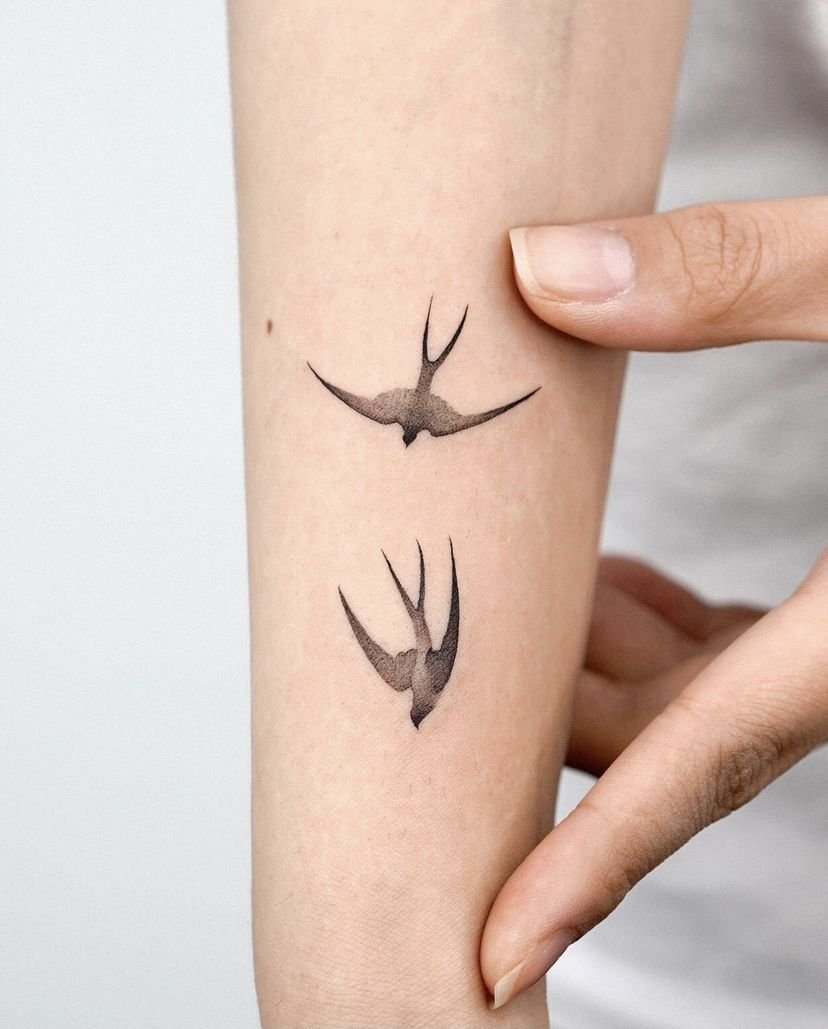
Scale is forgiving. The swallow’s simple visual form — a recognisable silhouette even at very small sizes — makes it one of the few tattoo subjects that works from coin-sized to palm-sized without significant loss of identity. Fine line micro-swallows, traditional medium swallows, and large neo-traditional swallows all read as the same bird. The choice of scale affects the level of detail possible but does not compromise the image’s legibility.
The style sets the tone. A traditional swallow on the chest of a dock worker carries a different social meaning from a fine line swallow behind the ear of a university student. Both are valid uses of the image. The style, placement, and context together determine what the tattoo communicates, and a client should be aware that the same bird can read differently depending on how and where it is rendered.
Sources & further reading
- Anders Pape Møller, The Barn Swallow. Oxford University Press, 1994.
- Angela Turner, The Barn Swallow. T. & A.D. Poyser, 2006.
- Aristotle, Nicomachean Ethics, Book I, Chapter 7.
- Pierre Grimal, The Dictionary of Classical Mythology. Blackwell, 1985.
- Raymond O. Faulkner (trans.), The Ancient Egyptian Book of the Dead. British Museum Press, 1985.
- T.H. White (trans. and ed.), The Book of Beasts: Being a Translation from a Latin Bestiary of the Twelfth Century. Jonathan Cape, 1954; reprinted in Dover, 1984.
- Beryl Rowland, Birds with Human Souls: A Guide to Bird Symbolism. University of Tennessee Press, 1978.
- Edward A. Armstrong, The Folklore of Birds. Collins, 1958; reprinted in Dover, 1970.
- Wolfram Eberhard, A Dictionary of Chinese Symbols. Routledge, 1986.
- Meher McArthur, Reading Japanese Art. Thames & Hudson, 2020.
- Albert Parry, Tattoo: Secrets of a Strange Art. Simon & Schuster, 1933; reissued in Dover, 2006.
- Albert Parry, Tattoo: Secrets of a Strange ArMargo DeMello, Bodies of Inscription: A Cultural History of the Modern Tattoo Community. Duke University Press, 2000.
- Steve Gilbert, Tattoo History: A Source Book. Juno Books, 2000.
- Matt Lodder, Painted People: Humanity in 21 Tattoos. Harper, 2024.
- Jon Savage, England’s Dreaming: Anarchy, Sex Pistols, Punk Rock, and Beyond. St. Martin’s Press, 1992.
- Michael Malone (ed.), Sailor Jerry Collins: American Tattoo Master. Hardy Marks Publications, 1994.
- D’Arcy Wentworth Thompson, A Glossary of Greek Birds. Oxford University Press, 1895; reprinted 1936.