Related Posts

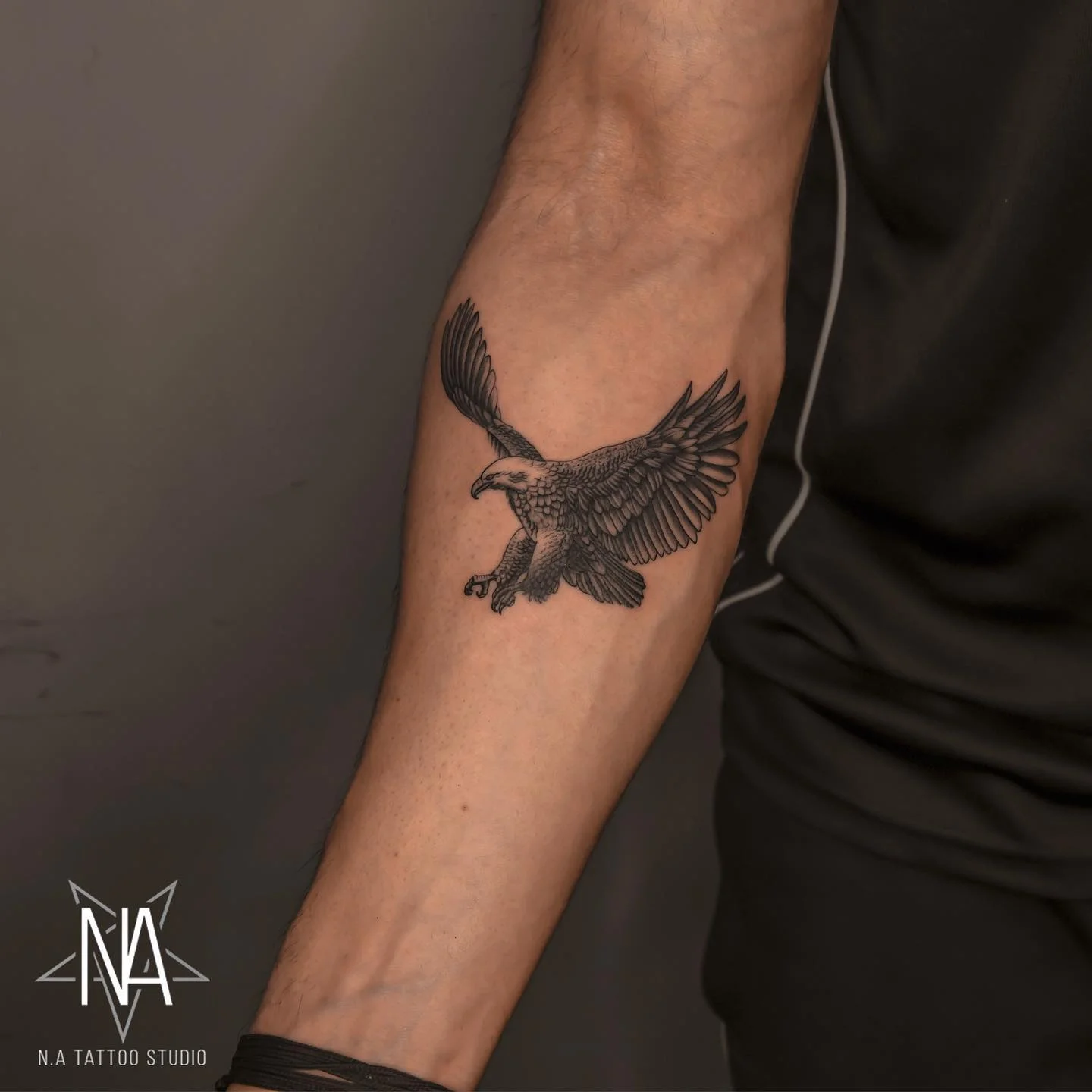
Eagle tattoo
The bird at the top
The eagle occupies the highest position in nearly every symbolic system that includes it. In Greek mythology, it carries Zeus’s thunderbolts. In Roman military culture, it is the legion’s standard. In Christianity, it is the symbol of John the Evangelist and a figure of the Resurrection. In the heraldic traditions of Europe, North Africa, and the Middle East, it represents sovereignty. In the national symbols of the United States, Mexico, Germany, Poland, Egypt, Albania, and dozens of other nations, it represents the state itself. Among the Indigenous peoples of North America, it is the most sacred of birds — its feathers carry legal and spiritual weight that no other animal material in the hemisphere can match.
No other bird holds this position. Hawks, falcons, and condors each carry their own symbolic weight in specific traditions. Still, none of them has been adopted as the primary emblem of divine authority, military power, and national identity by as many cultures over as long a period as the eagle. The reasons are partly biological — the eagle is large, powerful, and hunts from above — and partly visual. The bird in flight, with its broad wings fully extended and its head turned to face the viewer, produces a silhouette that is instantly legible, graphically powerful, and naturally symmetrical. It is one of the most effective heraldic and tattoo images ever developed.
Eagles as species
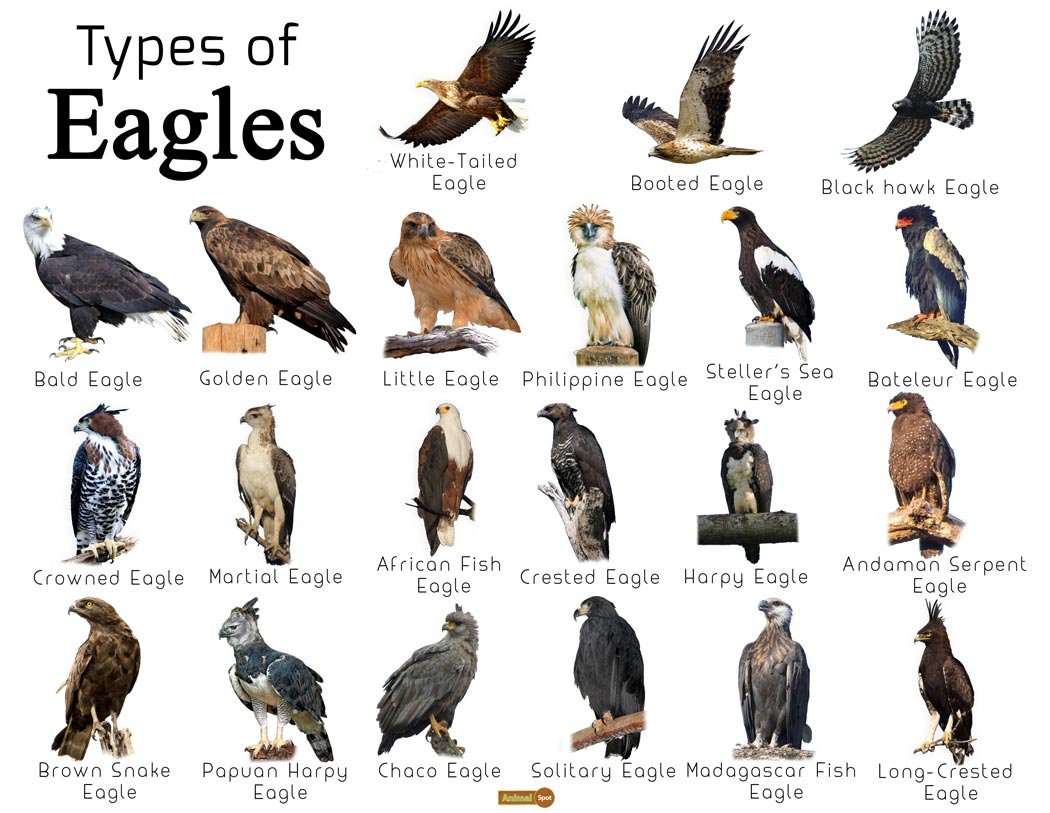
Eagles are not a single species. The word covers a large group of raptors within the family Accipitridae — roughly sixty species worldwide, distributed across every continent except Antarctica. The species that matter most for the symbolic traditions are:
- the golden eagle (Aquila chrysaetos), which ranges across the Northern Hemisphere from Scotland to Japan;
- the bald eagle (Haliaeetus leucocephalus), native to North America;
- the white-tailed eagle (Haliaeetus albicilla), found across northern Europe and Asia;
- the Steller’s sea eagle (Haliaeetus pelagicus) of northeastern Asia;
- the harpy eagle (Harpia harpyja) of Central and South America.
The golden eagle is the species behind most European and Asian symbolism. It was the bird the Romans knew, the bird that carried Zeus’s lightning in Greek art, the bird depicted in the heraldic traditions of central and eastern Europe. The bald eagle is the bird behind American national symbolism — adopted as the national emblem of the United States in 1782 — and it is the bird most commonly rendered in American traditional tattoo flash.
Eagles are apex predators. They hunt from altitude, using vision that is roughly four to eight times sharper than human sight, and they kill with talons capable of exerting enormous crushing force. The golden eagle can take prey as large as foxes, young deer, and other birds of prey. This hunting method — patient surveillance from above, followed by a devastating strike — has been read symbolically by every culture that has watched the bird work.
Eagles of the ancient world
The eagle’s symbolic career begins in Mesopotamia and never stops.
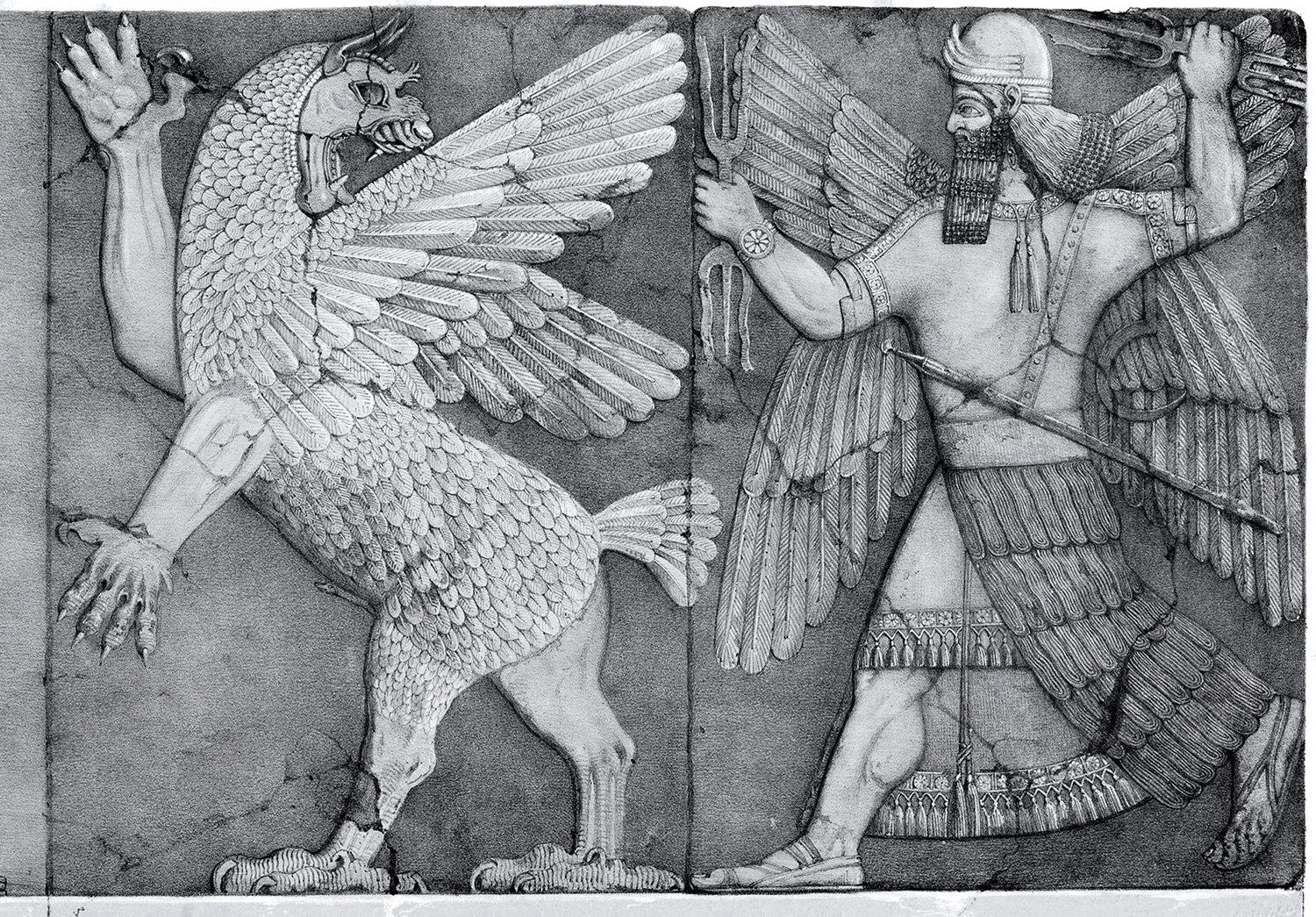
In Sumerian art, the lion-headed eagle Anzu (also called Imdugud) appears as a divine figure associated with storm and power. The motif dates to the third millennium BCE and represents one of the earliest documented uses of eagle imagery as a symbol of divine authority. The Anzu is not a naturalistic eagle — it is a mythological hybrid — but it establishes the template: the eagle is the creature through which divine power is expressed visually.
In ancient Greece, the eagle was sacred to Zeus. The bird served as his messenger, his companion, and the carrier of his thunderbolts. In the myth of Ganymede, Zeus sends an eagle — or transforms into one, depending on the version — to carry the beautiful youth to Olympus. The eagle’s flight between earth and heaven made it a natural mediator between the human and the divine, and this function persisted into Roman and Christian usage.
The Prometheus myth gives the eagle a darker role: it is the bird that Zeus sends to eat Prometheus’s liver every day as punishment for giving fire to humanity. The eagle here is an instrument of divine wrath — still an agent of the supreme god, but now a tormentor. The double capacity of the eagle — protector and punisher, messenger and weapon — is present from the earliest Greek sources.
In Rome, the eagle became a military symbol. The aquila — a gold or gilded eagle mounted on a staff — was the standard of the Roman legion and the most important object in the unit’s possession. Losing the aquila in battle was a catastrophic dishonour; recovering a lost eagle was a campaign objective. The eagle embodied the authority of Rome itself, and its image was synonymous with Roman military power throughout the empire.
The association of the eagle with imperial authority passed from Rome into every subsequent European state that claimed Roman heritage, which, at various points, included most of them.
Christianity
The early Church inherited the eagle from both the Jewish tradition (where the eagle appears in the Torah as a figure of God’s power and protection — “I bore you on eagles’ wings” in Exodus 19:4) and from the Greco-Roman tradition.
The eagle became the symbol of John the Evangelist, one of the four Gospel writers, each of whom was assigned an animal symbol drawn from the vision of four living creatures in Ezekiel 1:10 and Revelation 4:7. Matthew received the man (or angel), Mark the lion, Luke the ox, and John the eagle. The assignment was based on the character of each Gospel — John’s was considered the most spiritually elevated, the most concerned with the divine nature of Christ, and the eagle’s soaring flight was read as a metaphor for the height of John’s theological vision.
The eagle was also associated with the Resurrection, through a tradition drawn from the Physiologus — the early Christian natural history text that became the source for the medieval bestiaries. The Physiologus reported that the eagle renewed its youth by flying toward the sun until its old feathers burned away, then plunging into water to emerge reborn. The story is not accurate in its ornithology. Still, it was taken up enthusiastically by the bestiary tradition and read as a type of baptism and Resurrection — the eagle dies to its old self and is renewed. This imagery persists in Christian art through the medieval and early modern periods.
Eagle-shaped lecterns in churches — from which the Scriptures are read — are one of the most visible surviving expressions of the eagle’s Christian symbolism. The eagle carries the Word of God the way it carried the thunderbolts of Zeus: upward, from above, with authority.
Heraldry
The eagle is the most important bird in European heraldry. It appears in the arms of the Holy Roman Empire (a double-headed eagle), the Russian Empire (a double-headed eagle inherited from Byzantium), the Habsburg dynasty, the Kingdom of Poland, the Kingdom of Prussia, and dozens of lesser states, noble families, and institutional bodies.
The single-headed eagle typically represents sovereignty and authority. It appears in the arms of Poland (the White Eagle, one of the oldest state symbols in Europe, dating to the thirteenth century), Germany, Egypt, and many other nations.
The double-headed eagle represents dual sovereignty or universal dominion — an empire that looks east and west simultaneously. It was adopted by the Byzantine Empire, inherited by the Russian Empire after the fall of Constantinople in 1453, and used by the Holy Roman Empire and the Habsburg dynasty. The double-headed eagle remains the state symbol of Albania, Serbia, Montenegro, and Russia, and it appears in the heraldic traditions of the Armenian Church and of Freemasonry.
The heraldic eagle is stylised rather than naturalistic. Wings are typically displayed (spread wide), the head is turned to one side (dexter, the heraldic right, by convention), and the overall form is designed for legibility at a distance and for reproduction in stone, metal, textile, and paint. This stylised form — the eagle with spread wings, facing to one side, talons displayed — is the direct ancestor of many eagle tattoo compositions.
The United States
The bald eagle was adopted as the national emblem of the United States in 1782, when it was placed on the Great Seal. The choice was debated — Benjamin Franklin famously and perhaps jokingly preferred the turkey — but the eagle won because of its associations with strength, independence, and classical republican virtue. The bald eagle on the Great Seal holds an olive branch in one talon and a bundle of thirteen arrows in the other, representing the nation’s preference for peace and its capacity for war.
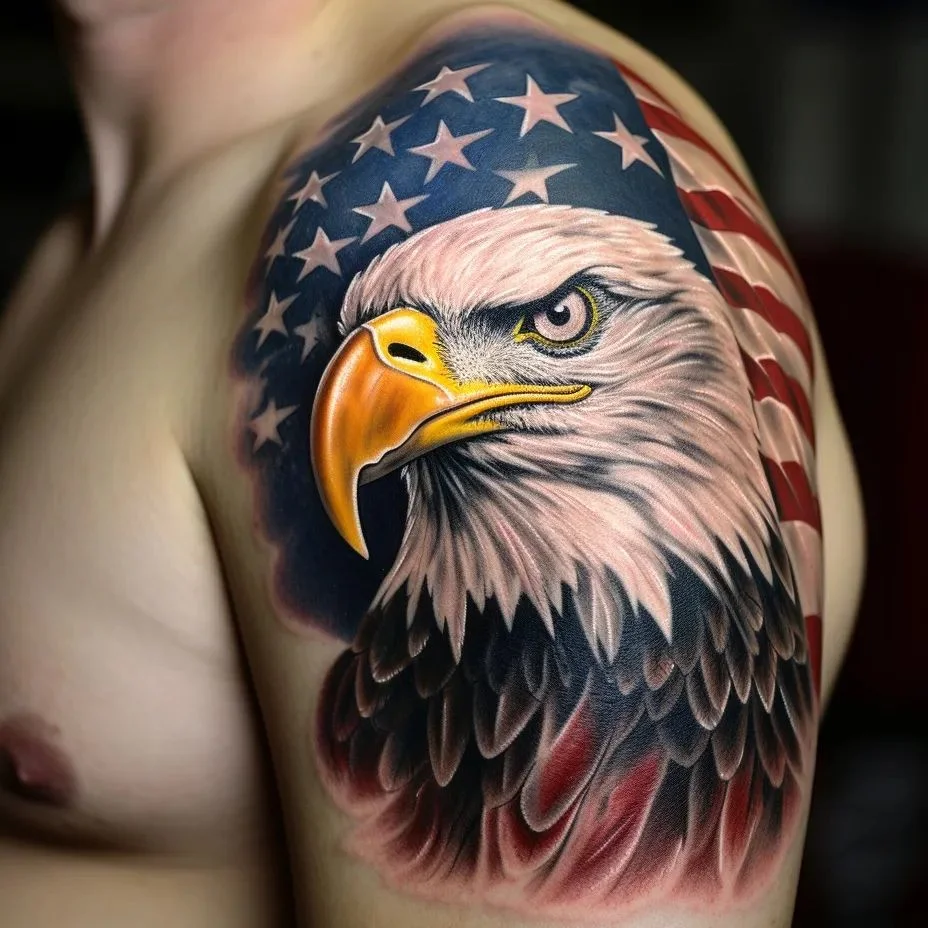
The eagle became the single most important patriotic image in American visual culture, and it entered tattooing through that channel. American traditional eagle tattoos are patriotic by default — the bird carries the flag, the shield, the national colours, and the general weight of American national identity. A bald eagle tattoo on an American serviceman in 1944 was both a personal choice and a declaration of national belonging that did not need to be explained.
The eagle also appears in American tattoo culture through its association with the military, specifically the eagle, globe, and anchor of the United States Marine Corps, the eagle insignia of other service branches, and the general identification of the eagle with military service. A large proportion of eagle tattoos in the American traditional repertoire were done on active-duty or veteran military personnel, and the military association remains strong.
In Indigenous North American cultures, the eagle — particularly the bald eagle and the golden eagle — holds a position of spiritual importance that predates and is independent of the European symbolic traditions. Eagle feathers are sacred objects in many Native American nations, legally protected under the Bald and Golden Eagle Protection Act and the National Eagle Repository system, and their use in ceremonies, regalia, and personal adornment carries specific spiritual and legal weight. Indigenous eagle imagery in tattooing belongs to these specific cultural traditions and should be understood within that context.
Mexico
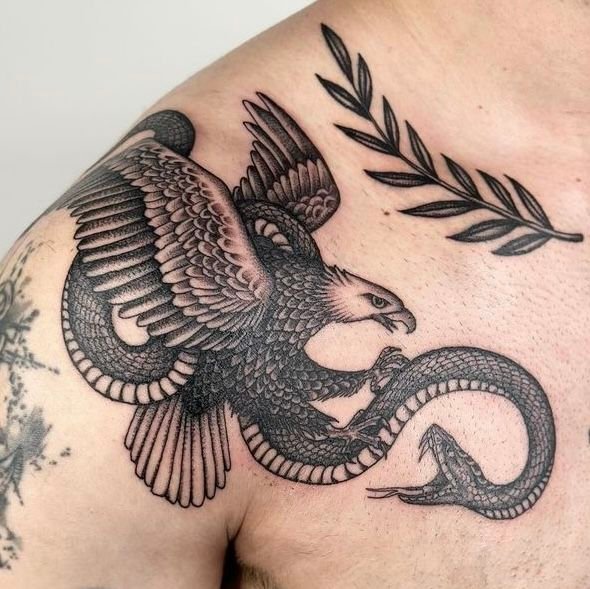
The eagle is central to the founding myth of the Aztec capital Tenochtitlan and, through that myth, to the national identity of Mexico. According to the legend, the Mexica people were told by their god Huitzilopochtli to build their city at the place where they found an eagle perched on a cactus, devouring a serpent. They found this sign on an island in Lake Texcoco, and there they built Tenochtitlan — the city that became Mexico City.
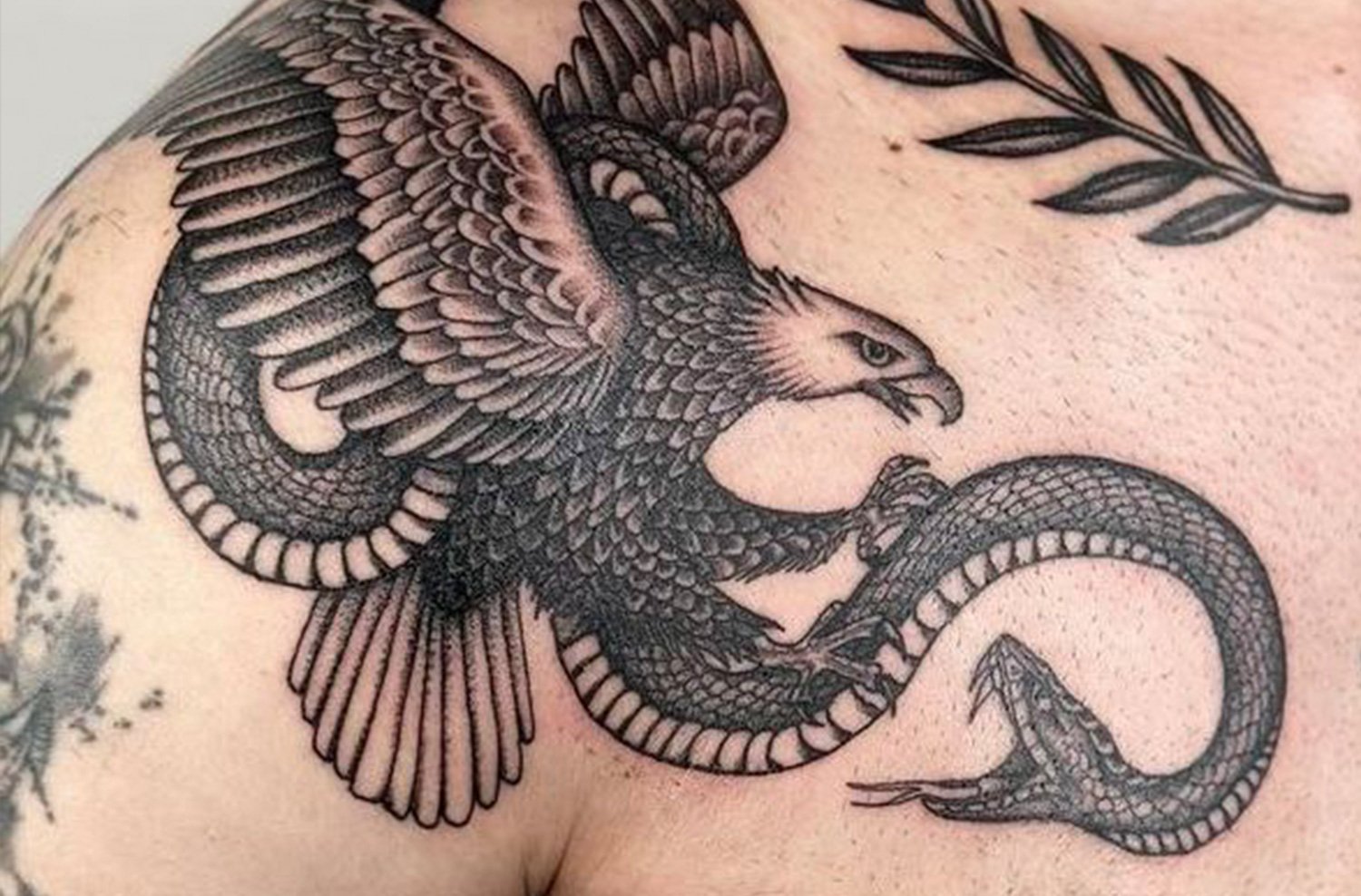
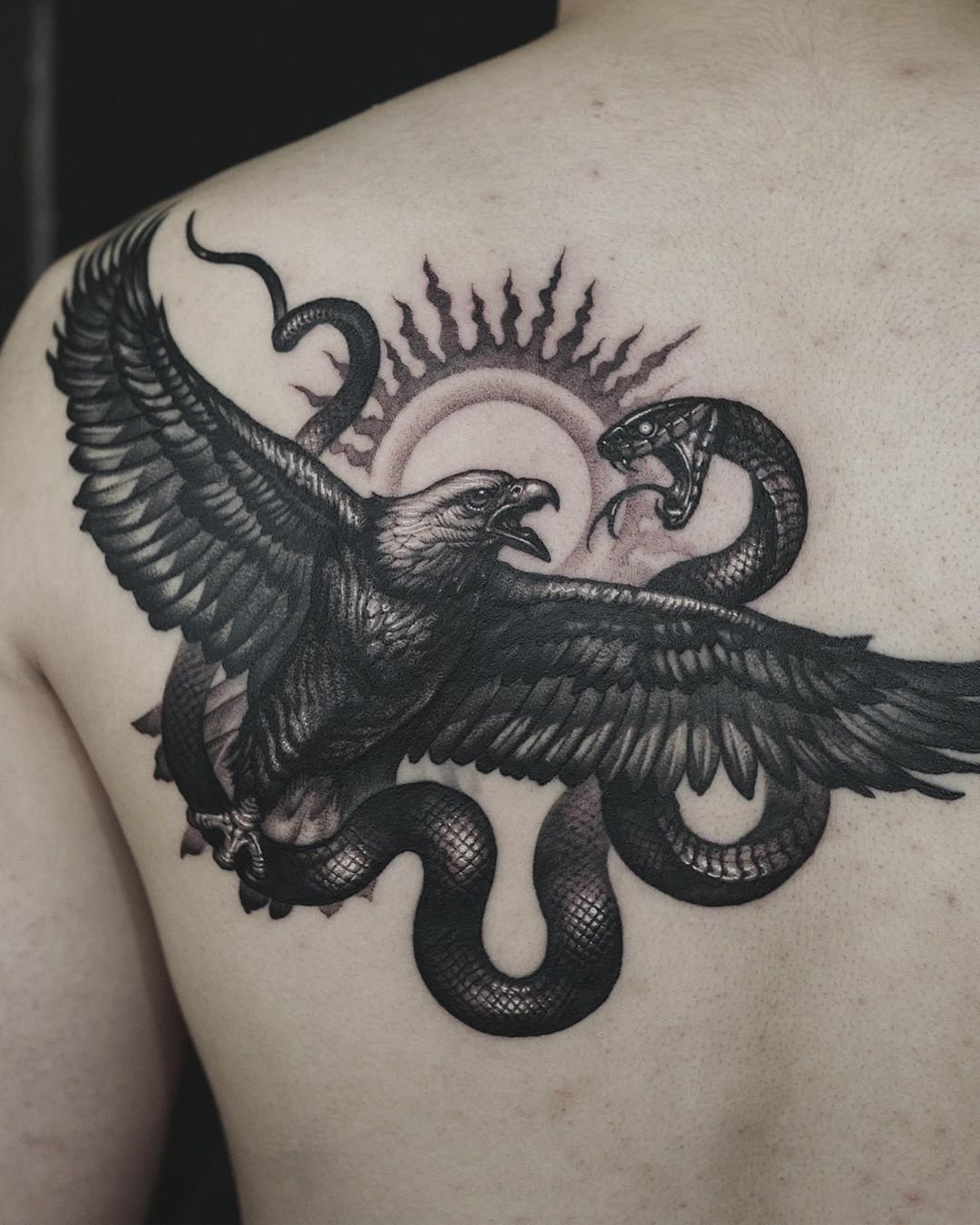
The image of the eagle on the cactus with a serpent is the centrepiece of the Mexican coat of arms and appears on the Mexican flag. It is one of the most widely recognised national symbols in the Americas. In Chicano tattooing and in Mexican and Mexican-American tattoo culture more broadly, the eagle-and-serpent carries national identity, cultural pride, and connection to pre-Columbian heritage. The image is commonly rendered in black-and-grey greywash, often as part of larger compositions incorporating Aztec imagery, Mexican flags, and script.
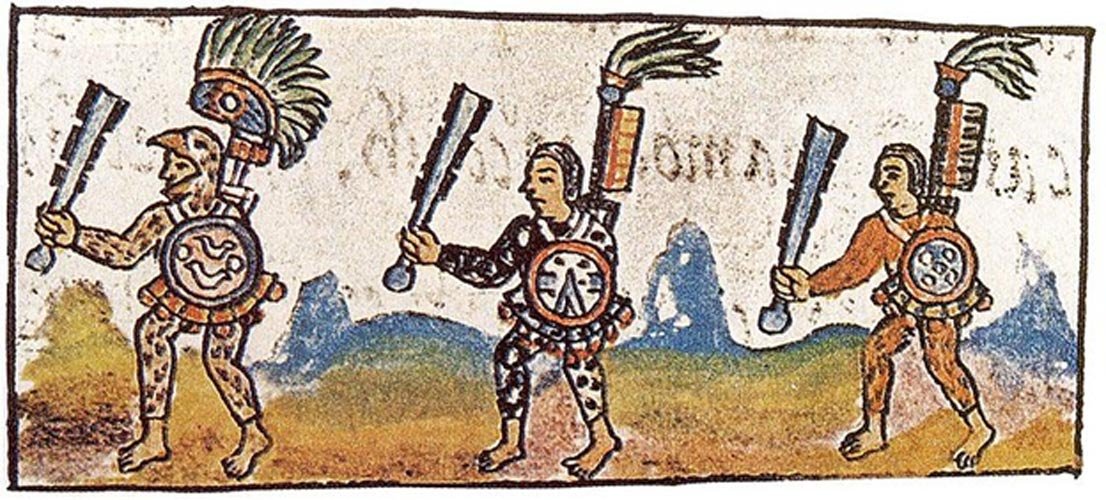
The Aztec eagle warrior (cuāuhtli) — one of the two elite military orders of the Aztec empire, alongside the jaguar warriors — is another significant eagle image in Mexican and Chicano tattooing. The eagle warrior, depicted with an eagle-head helmet and feathered regalia, represents martial courage and pre-Columbian identity.
Central and Southeast Asia
In the mythology of the Eurasian steppe, the eagle is associated with shamanic power, with the sky god Tengri, and with the origin of shamanism itself. In some Siberian and Mongolian traditions, the first shaman was the child of an eagle, or was taught by an eagle, or was transformed into one. The golden eagle — which ranges across the Central Asian steppe — is the bird behind these associations, and the practice of eagle hunting (berkutchi), still alive in Kazakhstan and Kyrgyzstan, maintains a living relationship between the bird and the cultures that revere it.
In Hindu mythology, the eagle — more precisely, the eagle-like divine bird Garuda — is the vahana (mount) of the god Vishnu. Garuda is depicted as a large bird, sometimes fully avian and sometimes as a human-eagle hybrid, and represents speed, martial power, and the defeat of evil — particularly serpents, which Garuda is the eternal enemy of. The Garuda appears in the national emblems of Indonesia and Thailand (where it is called Krut) and in Buddhist iconography across Southeast Asia.
Eagle in tattooing
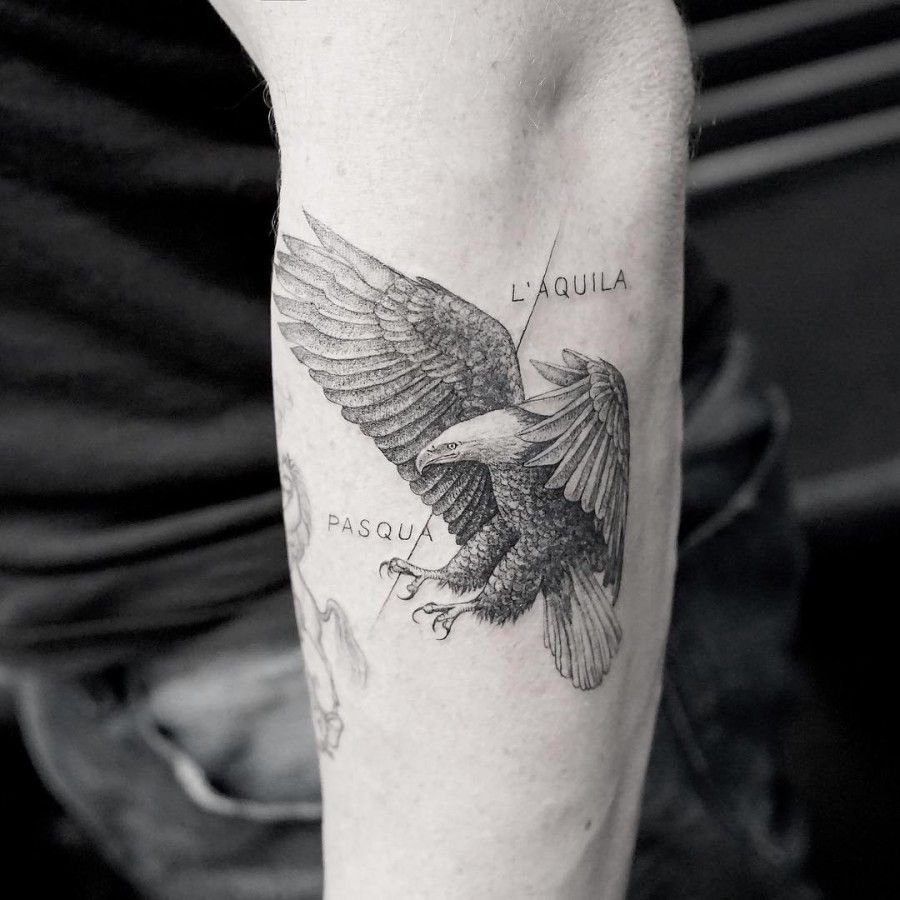
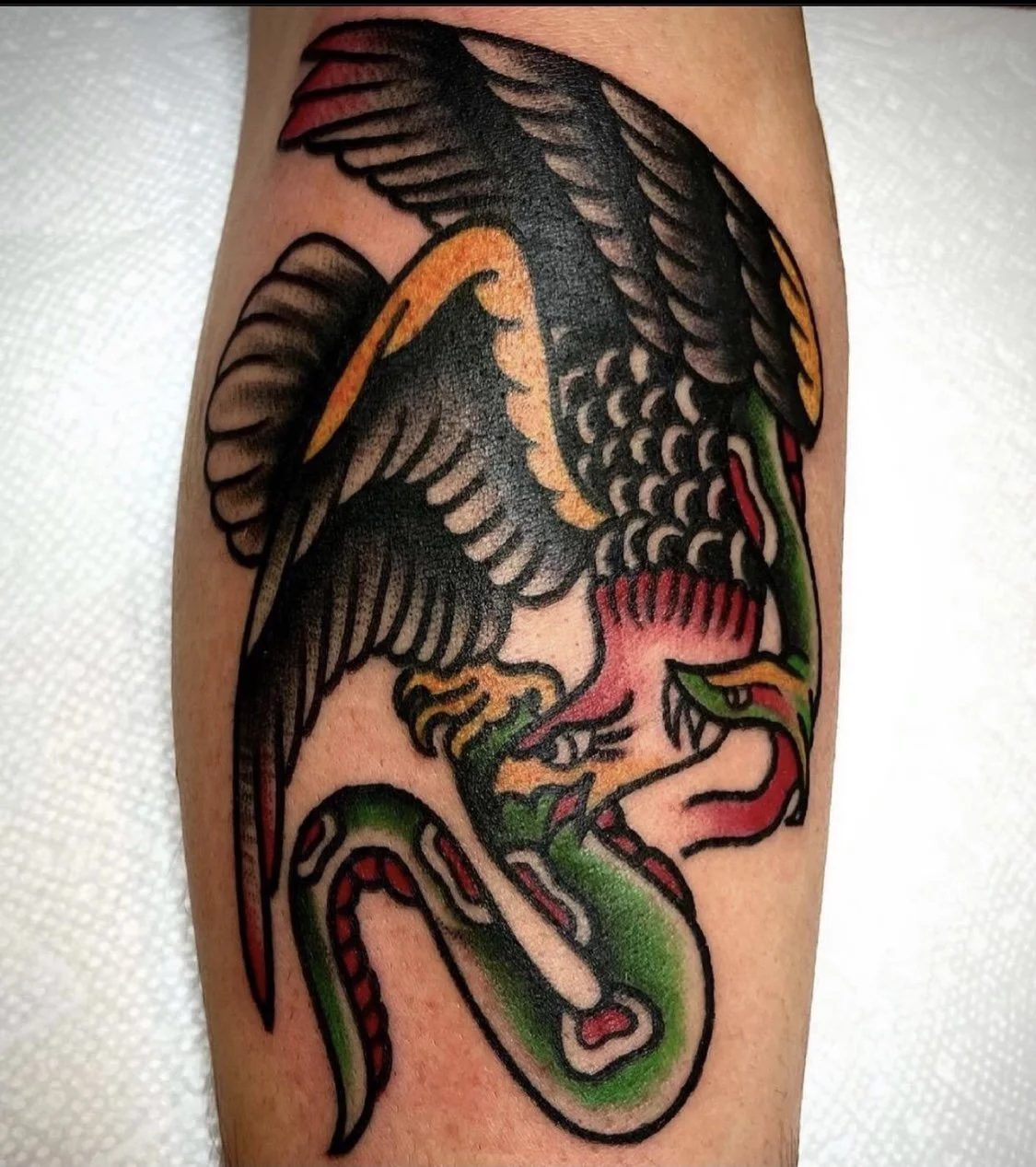
The eagle works across tattoo styles because its visual form — the spread-wing silhouette — is one of the strongest graphic shapes available to a tattooer.
American traditional
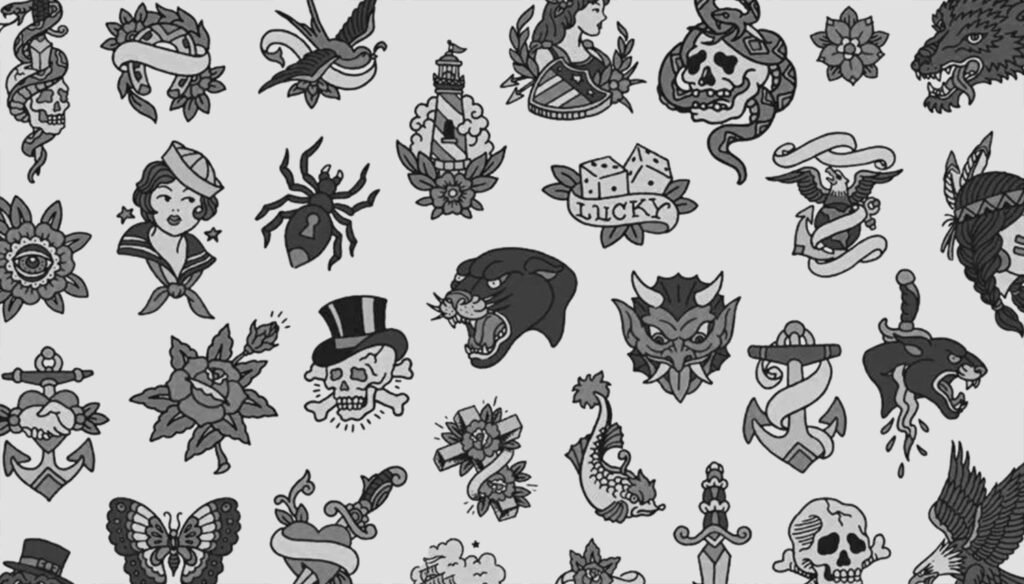
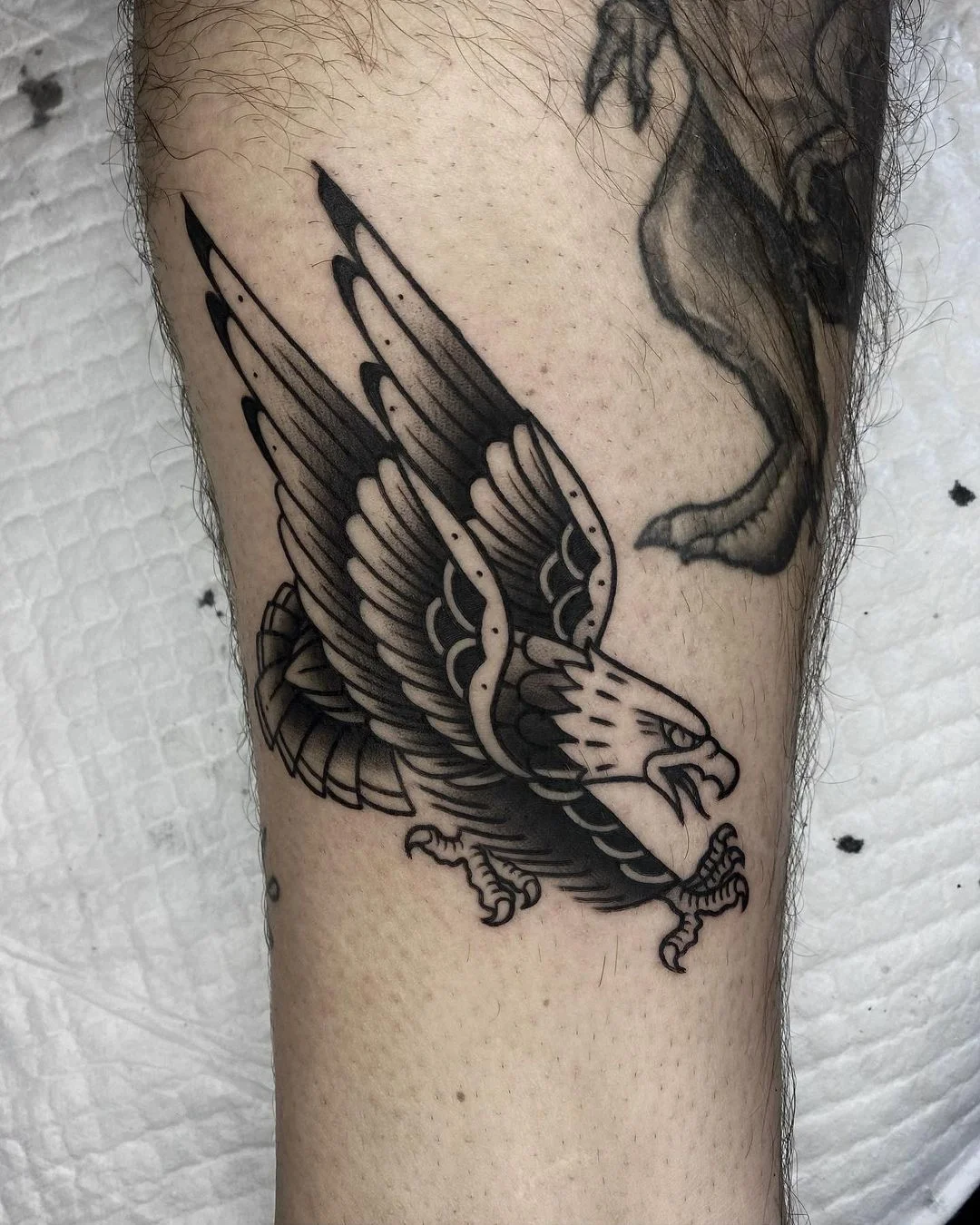
The canonical version. A bald eagle in flight or perched, rendered with heavy black outline and flat colour — typically blue-black or brown body, white head, yellow beak and talons — often holding a banner, a flag, an anchor, or a shield. The composition is usually symmetrical or nearly so, with the wings spread wide. Chest, upper back, and upper arm are the standard placements. The traditional eagle is one of the largest pieces in the flash repertoire and is often a centrepiece.
Chicano
The eagle-and-serpent from the Mexican coat of arms, rendered in black-and-grey greywash, is often incorporated into larger compositions with Aztec imagery, roses, script, and national symbols. Aztec eagle warriors are another significant subject. The meaning is national and cultural identity.
Japanese
The eagle is not a central subject in traditional irezumi, unlike the tiger, dragon, or koi. Still, hawks and other birds of prey appear in Japanese art and tattooing, often in compositions featuring pine trees, snow, or mountain landscapes. Contemporary Japanese-style tattooing sometimes incorporates eagle subjects from Western or hybrid compositions.
Neo-traditional
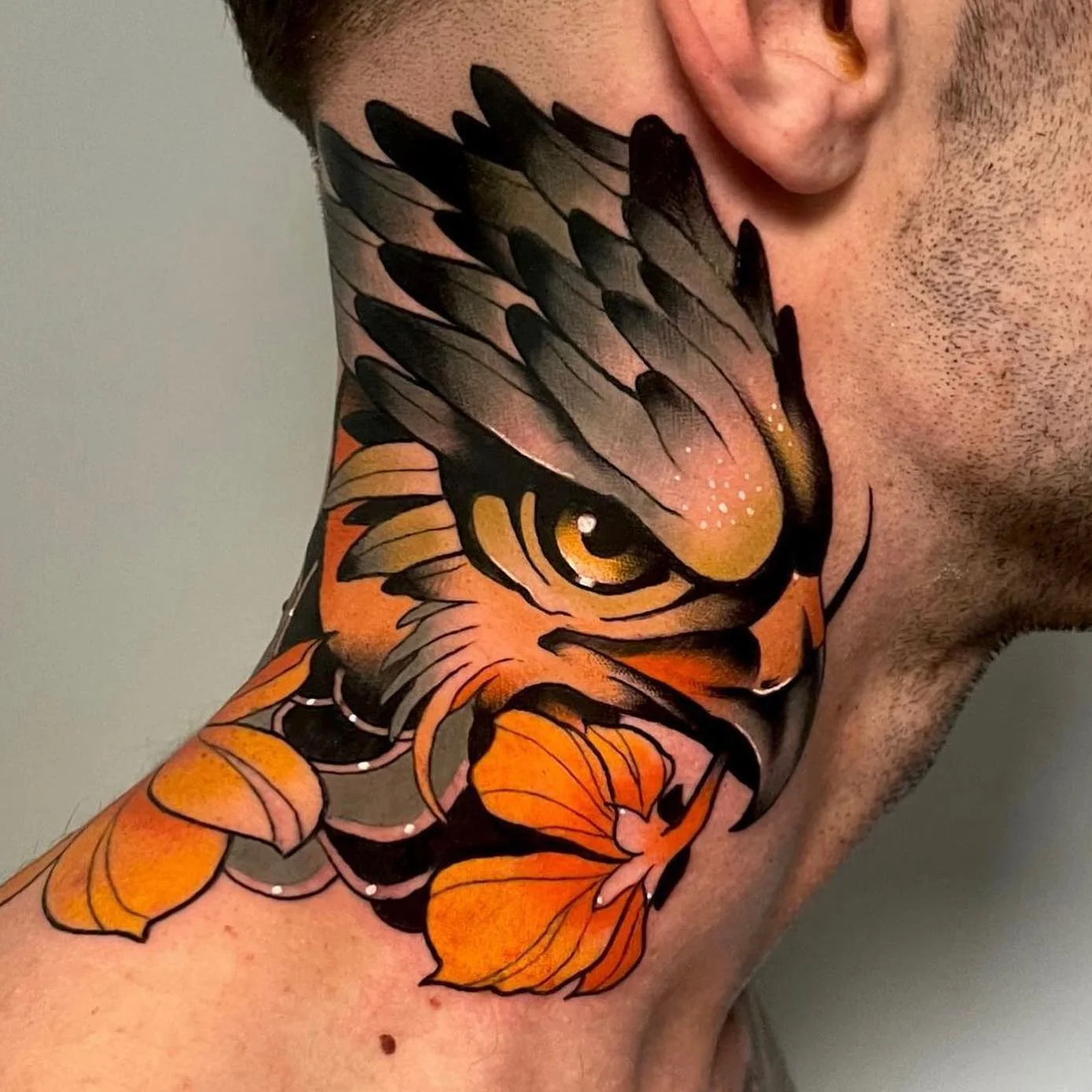
The eagle is rendered with an expanded palette, ornamental framing, and illustrative detail. Neo-traditional eagles often incorporate botanical or geometric elements and use a wider colour range than the traditional version.
Realism
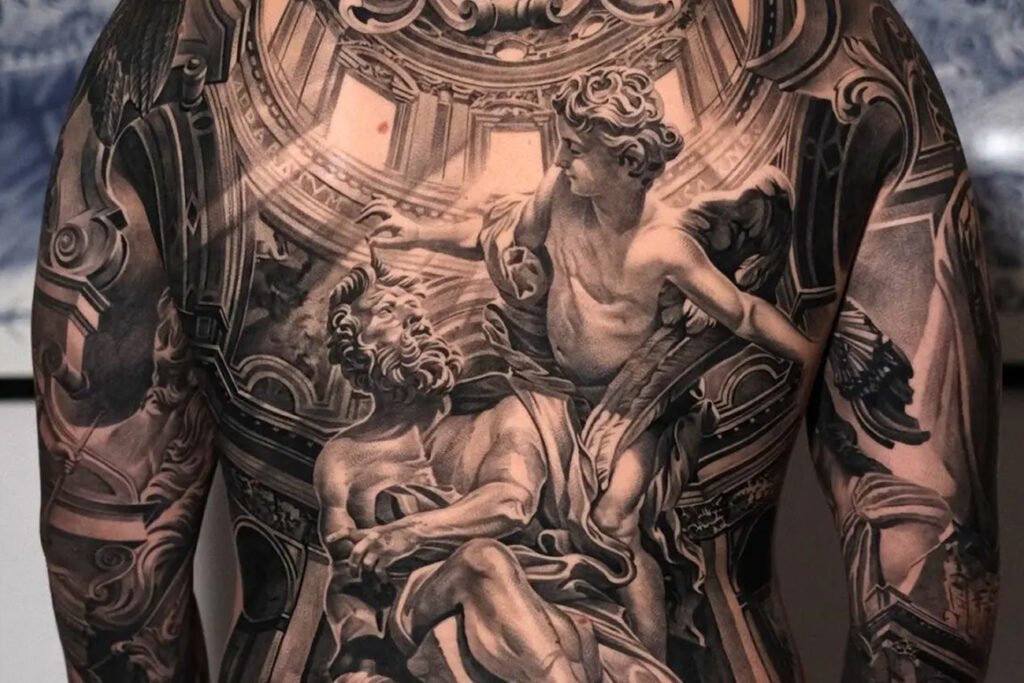
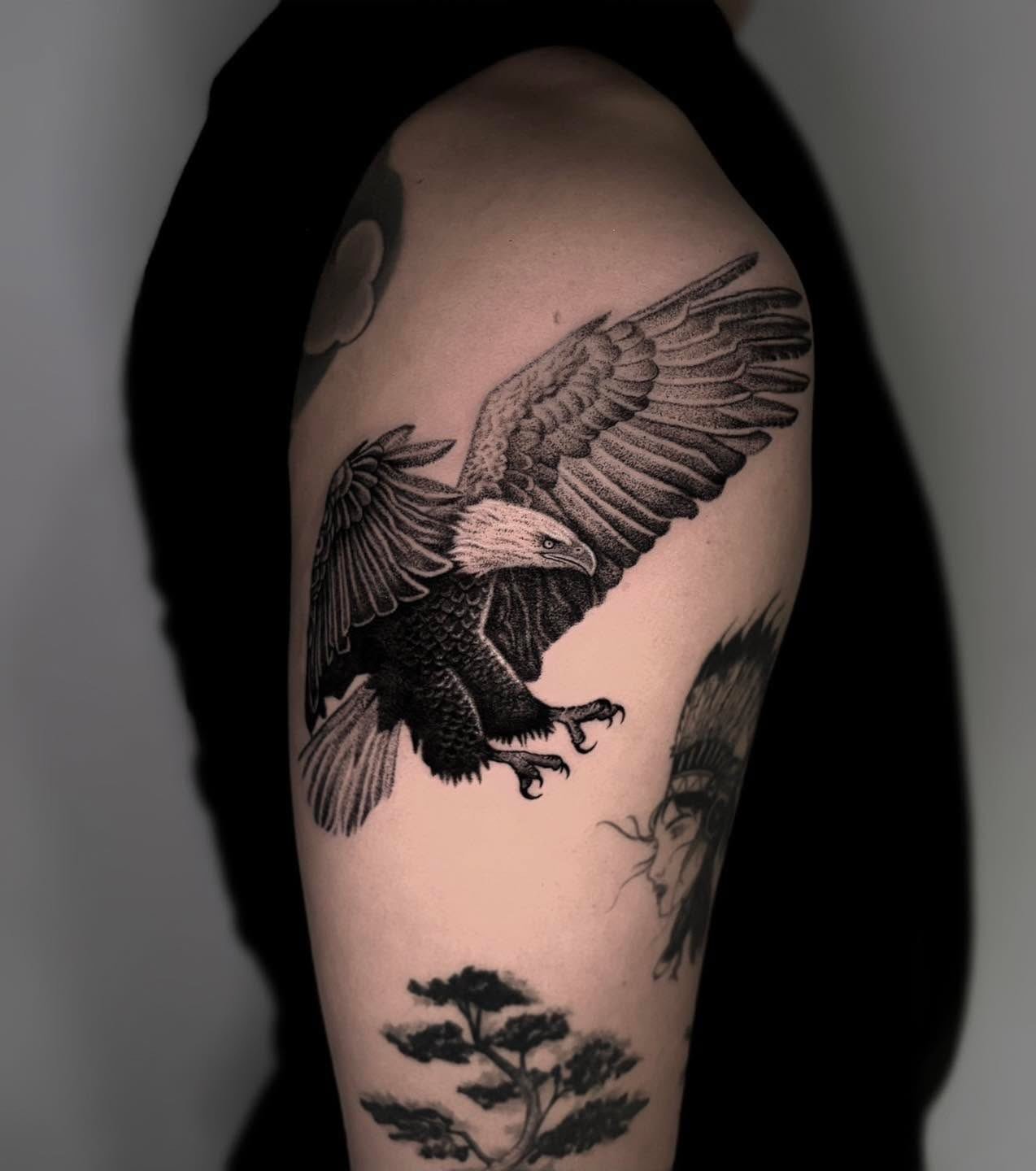
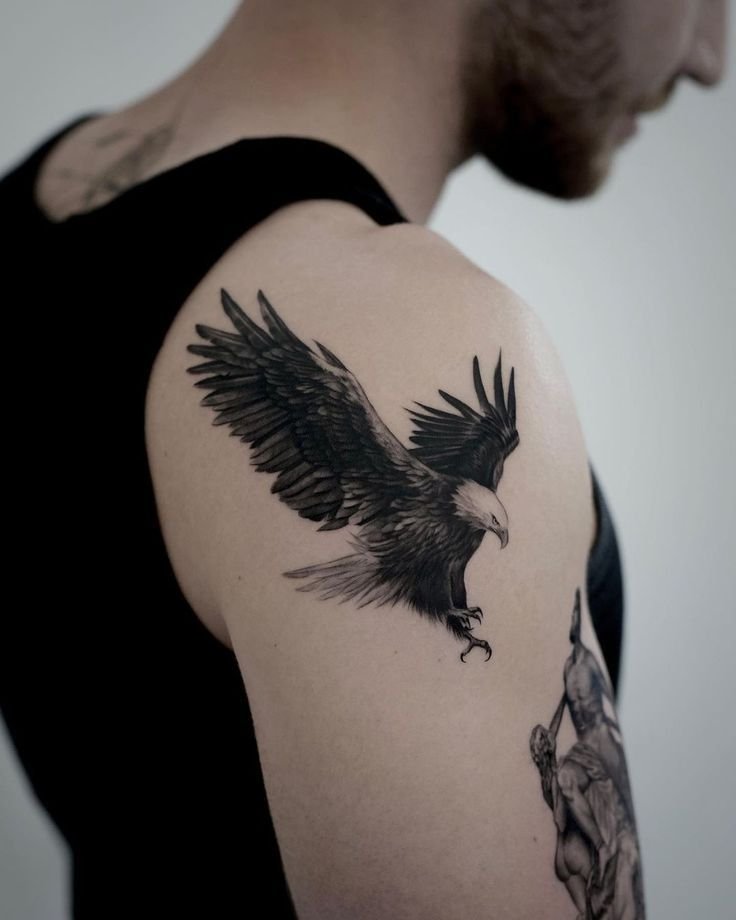
A photographic rendering of an eagle — usually a bald eagle or golden eagle in flight or in close portrait. Realism eagle tattoos are technically demanding because the feather structure, the beak anatomy, and the eye detail are complex enough that any simplification shows. The talons are a particular challenge — they need to look capable of killing, which means correct proportions and a convincing sense of grip.
Blackwork
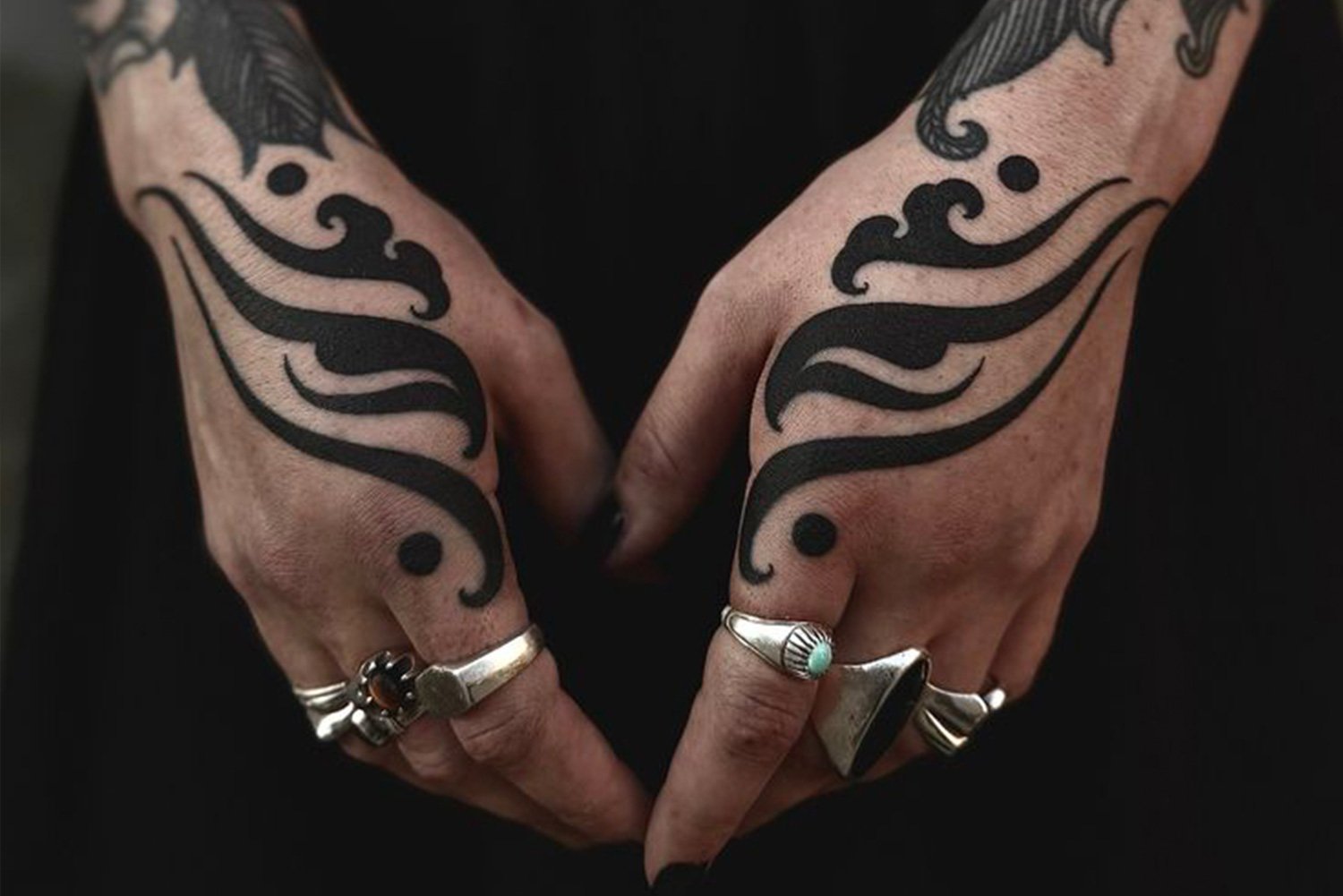
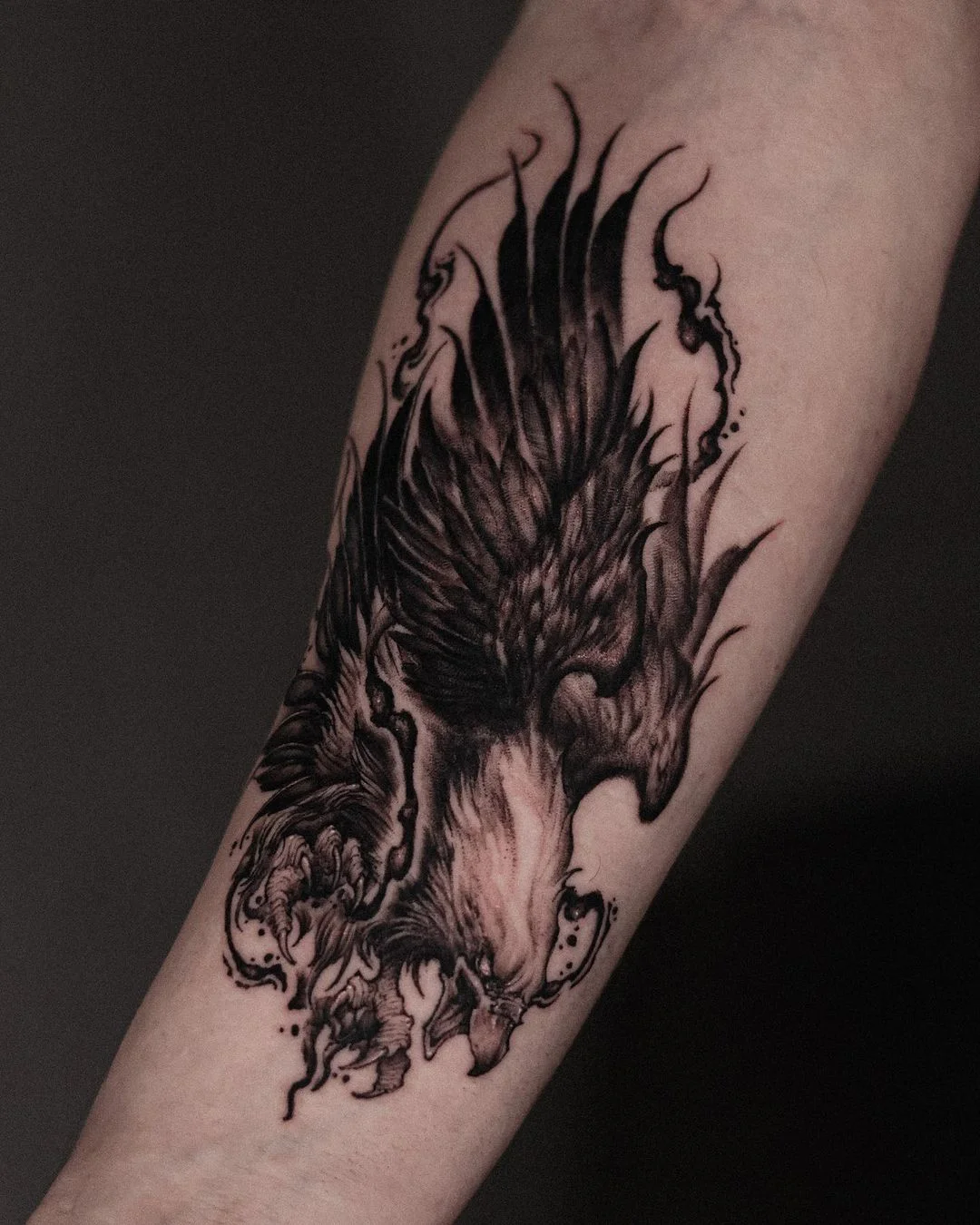
The eagle is rendered in solid black or in bold graphic form. Blackwork eagles often reference heraldic conventions — the stylised spread-wing, displayed-talon form of the heraldic eagle translates directly into blackwork composition.
Tribal
Stylised eagle forms drawn from Polynesian, Native American, and other Indigenous design traditions. The cultural context of these designs should be understood and respected.

What the eagle tattoo means
Power and authority
National identity and patriotism
Military service
Freedom
Divine authority and spiritual elevation
Vision and clarity
Courage and ferocity
Renewal and resurrection
Ancestral connection
Protection


Choosing an eagle tattoo
A few practical observations.
The spread-wing composition demands symmetry. An eagle with wings displayed is one of the most symmetry-dependent tattoo compositions. Any imbalance between the wings — in span, in shape, in feather rendering — is immediately visible. The chest is the strongest placement for a symmetrical spread-wing eagle because the body’s own bilateral symmetry supports the design. On the back, the same logic applies. On a single arm or leg, the composition typically shifts to a three-quarter or profile view to avoid the symmetry problem.
Feather detail is where quality shows. The difference between a competent eagle tattoo and an excellent one is usually in the feathers — how the primaries layer, how the coverts overlap, and whether the feather structure looks like it could generate lift. Artists with strong drawing backgrounds and knowledge of avian anatomy produce eagles that look airborne; generalists often produce eagles that look flat.
Style determines what the eagle communicates. A traditional bald eagle with an American flag reads as patriotic. A Chicano eagle-and-serpent reads as Mexican cultural identity. A blackwork heraldic double-headed eagle reads as imperial symbolism. A fine line eagle outline reads as personal and contemporary. The eagle is common enough that style and context differentiate one eagle tattoo from another.
Scale suits the subject. Eagles are large birds, and the tattoo tends to look best at a scale that reflects this — a palm-sized eagle or larger. Small eagles can work in fine lines or as simplified silhouettes, but the bird’s visual identity is tied to its wingspan, and the full-spread composition needs room to read.
Consider the cultural weight of specific designs. The eagle-and-serpent on the Mexican coat of arms carries national meaning. The double-headed eagle carries imperial and sometimes political associations (Russian nationalism, Byzantine revivalism). Indigenous eagle imagery carries specific spiritual and legal weight within the nations that use it. The bald eagle with American flag imagery carries patriotic meaning that some wearers intend and others do not. An artist should discuss these associations with the client, particularly for designs drawn from specific national or cultural traditions.
Sources & further reading
- Pierre Grimal, The Dictionary of Classical Mythology. Blackwell, 1985.
- Jeremy Black and Anthony Green, Gods, Demons and Symbols of Ancient Mesopotamia: An Illustrated Dictionary. British Museum Press, 1992.
- Stephanie Dalley (trans.), Myths from Mesopotamia: Creation, the Flood, Gilgamesh, and Others. Oxford University Press, 1989.
- T.H. White (trans. and ed.), The Book of Beasts: Being a Translation from a Latin Bestiary of the Twelfth Century. Jonathan Cape, 1954; reprinted in Dover, 1984.
- Beryl Rowland, Birds with Human Souls: A Guide to Bird Symbolism. University of Tennessee Press, 1978.
- Edward A. Armstrong, The Folklore of Birds. Collins, 1958; reprinted in Dover, 1970.
- D’Arcy Wentworth Thompson, A Glossary of Greek Birds. Oxford University Press, 1895; reprinted 1936.
- Gertrud Schiller, Iconography of Christian Art. Lund Humphries, 1971–72, two volumes.
- Arthur Charles Fox-Davies, A Complete Guide to Heraldry. T.C. & E.C. Jack, 1909; revised edition: Skyhorse, 2007.
- Stephen Slater, The Illustrated Book of Heraldry. Lorenz Books, 2002.
- Richard Patterson, The Eagle and the Shield: A History of the Great Seal of the United States. US Department of State, 1976.
- David Hackett Fischer, Liberty and Freedom: A Visual History of America’s Founding Ideas. Oxford University Press, 2005.
- Mark Hirsch, After the Seal: The History and Symbolism of the Bald Eagle. Smithsonian Institution, various publications.
- Eduardo Matos Moctezuma, The Great Temple of the Aztecs: Treasures of Tenochtitlan. Thames & Hudson, 1988.
- Richard F. Townsend, The Aztecs. Thames & Hudson, 2000; revised edition 2009.
- Davíd Carrasco, Quetzalcoatl and the Irony of Empire: Myths and Prophecies in the Aztec Tradition. University Press of Colorado, 2000.
- Robert Strom, Eagle Hunters of Mongolia. Strom Images, 2014.
- Jan Bondeson, The Feejee Mermaid and Other Essays in Natural and Unnatural History. Cornell University Press, 1999.
- Robert L. Brown, Ganesh: Studies of an Asian God. SUNY Press, 1991.
- C.A.S. Williams, Chinese Symbolism and Art Motifs. Tuttle, 1941; multiple revised editions.
- Wolfram Eberhard, A Dictionary of Chinese Symbols. Routledge, 1986.
- Margo DeMello, Bodies of Inscription: A Cultural History of the Modern Tattoo Community. Duke University Press, 2000.
- Steve Gilbert, Tattoo History: A Source Book. Juno Books, 2000.
- Anna Felicity Friedman, The World Atlas of Tattoo. Yale University Press, 2015.
- Matt Lodder, Painted People: Humanity in 21 Tattoos. Harper, 2024.
- Albert Parry, Tattoo: Secrets of a Strange Art. Simon & Schuster, 1933; reissued in Dover, 2006.
- Freddy Negrete with Steve Jones, Smile Now, Cry Later: Guns, Gangs, and Tattoos — My Life in Black and Gray. Seven Stories Press, 2016.