Related Posts

Rose tattoo
The most tattooed flower in the world
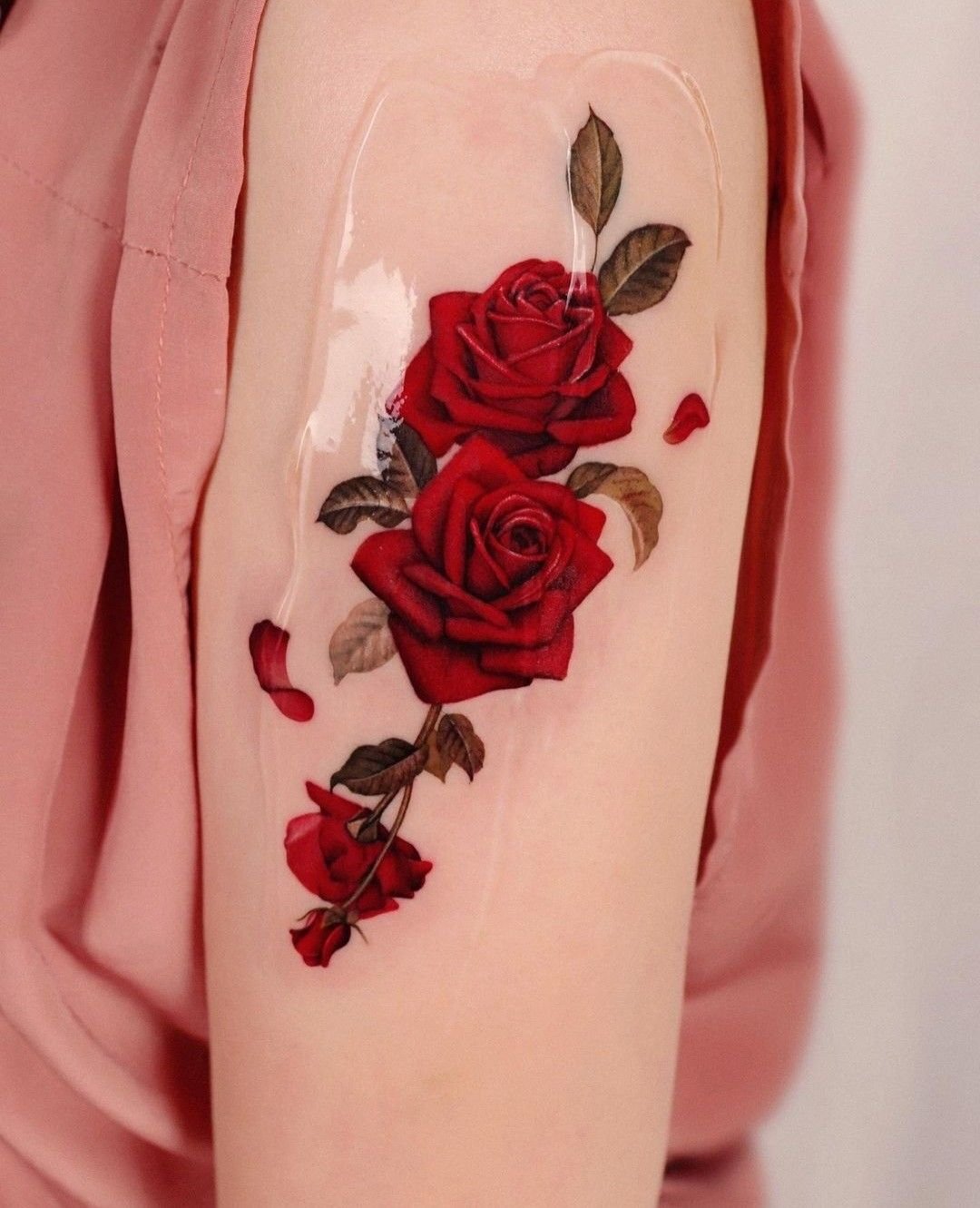
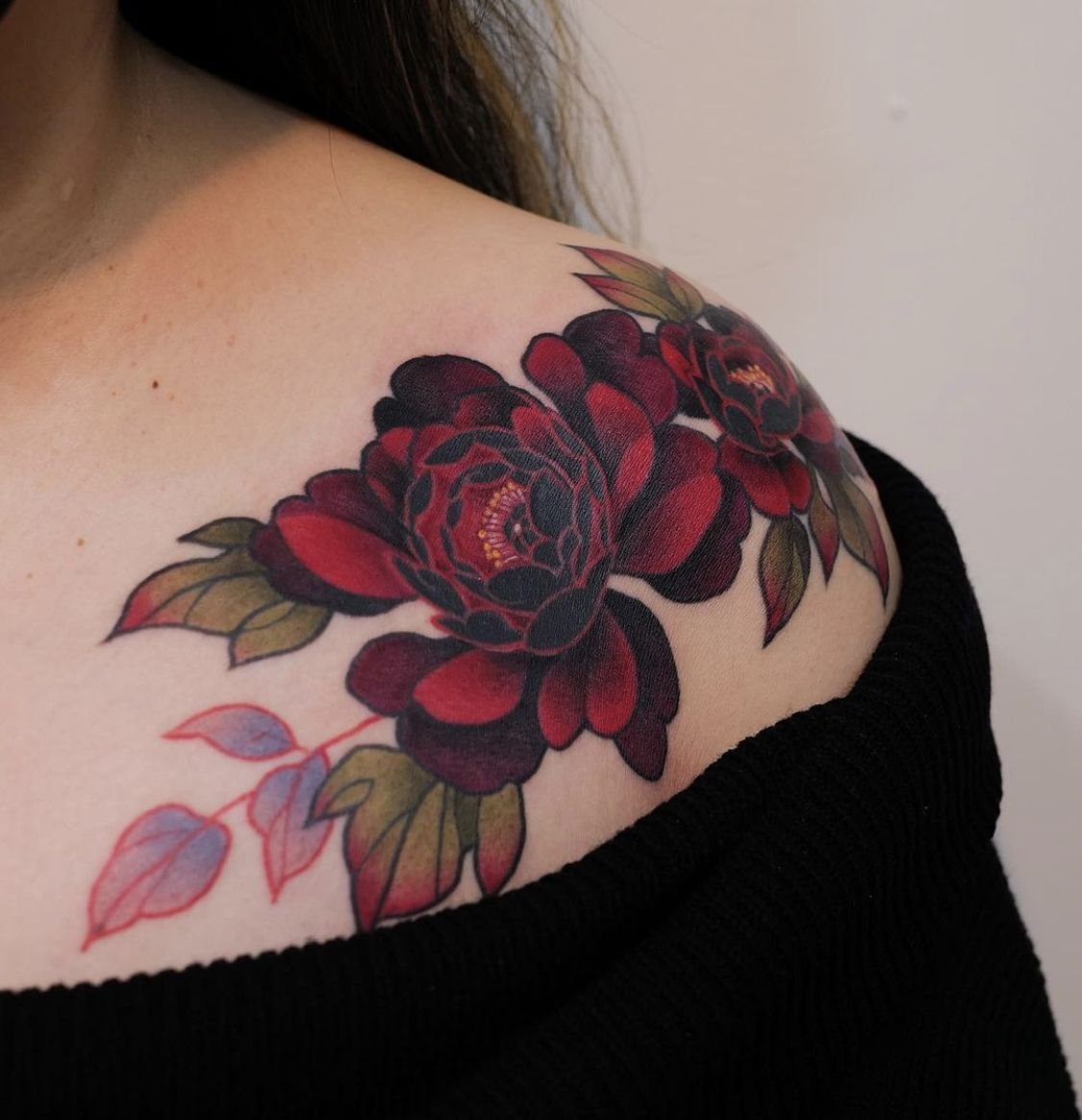
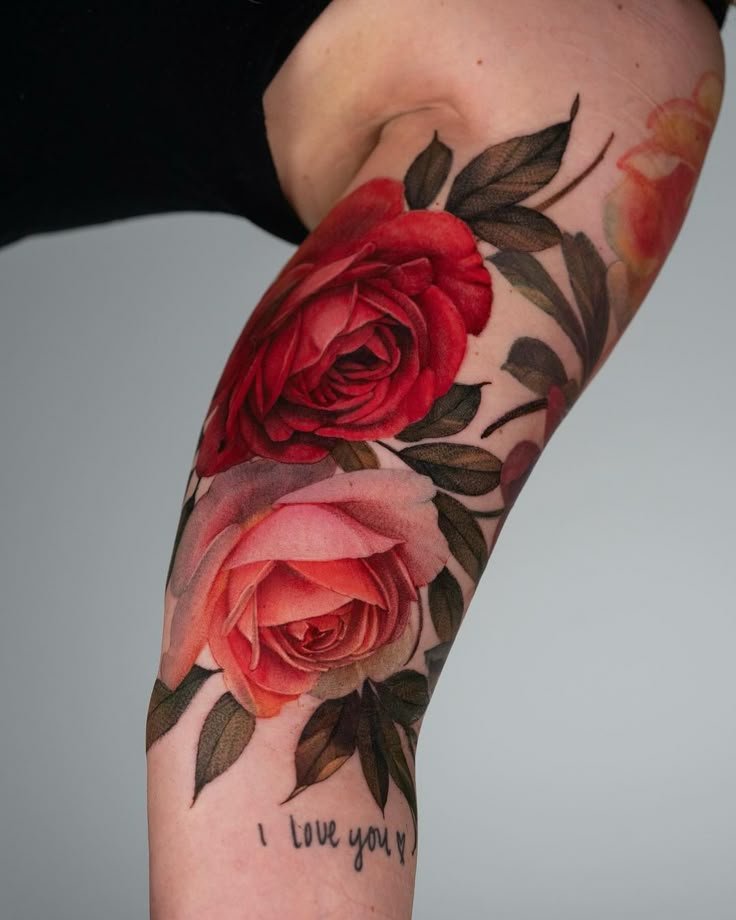
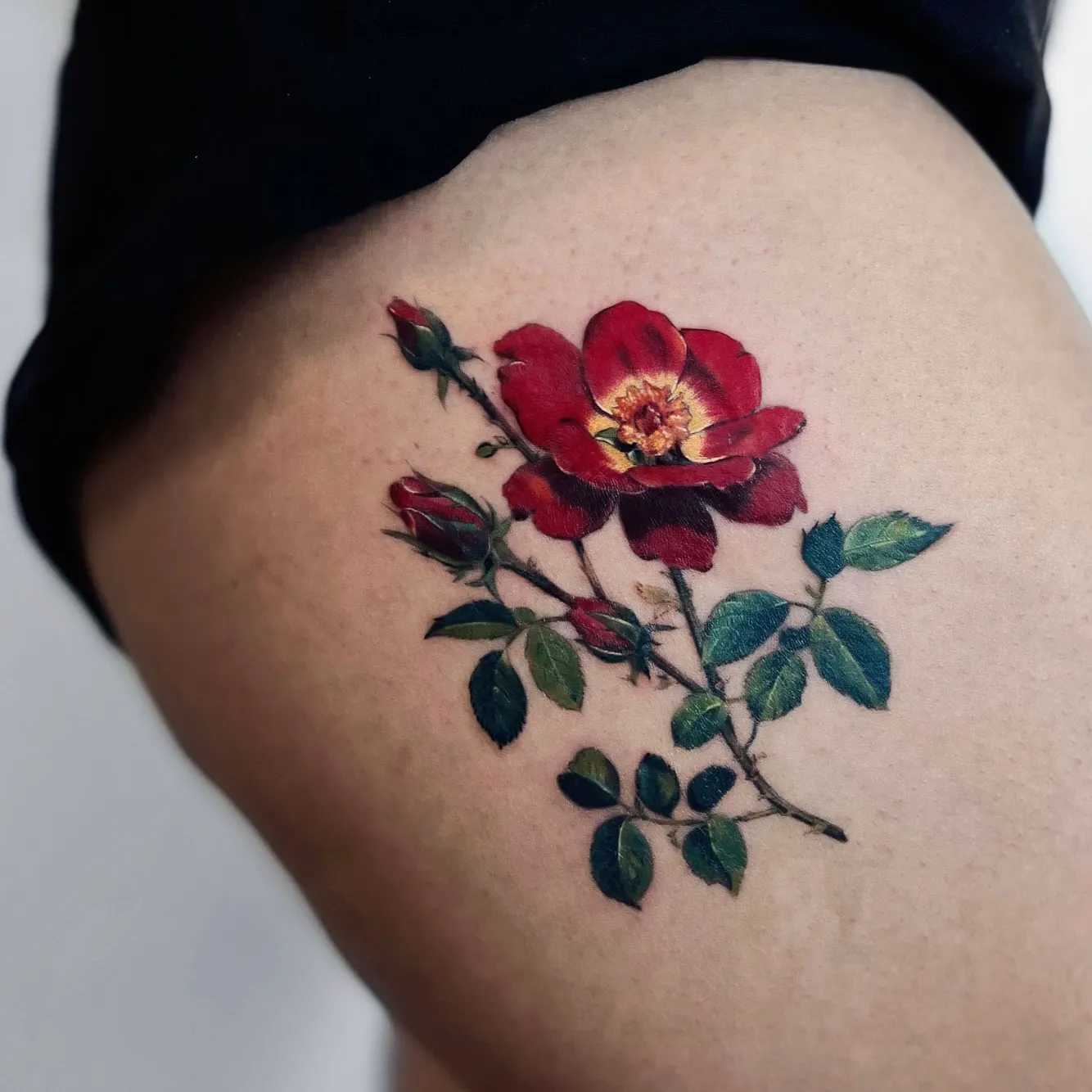
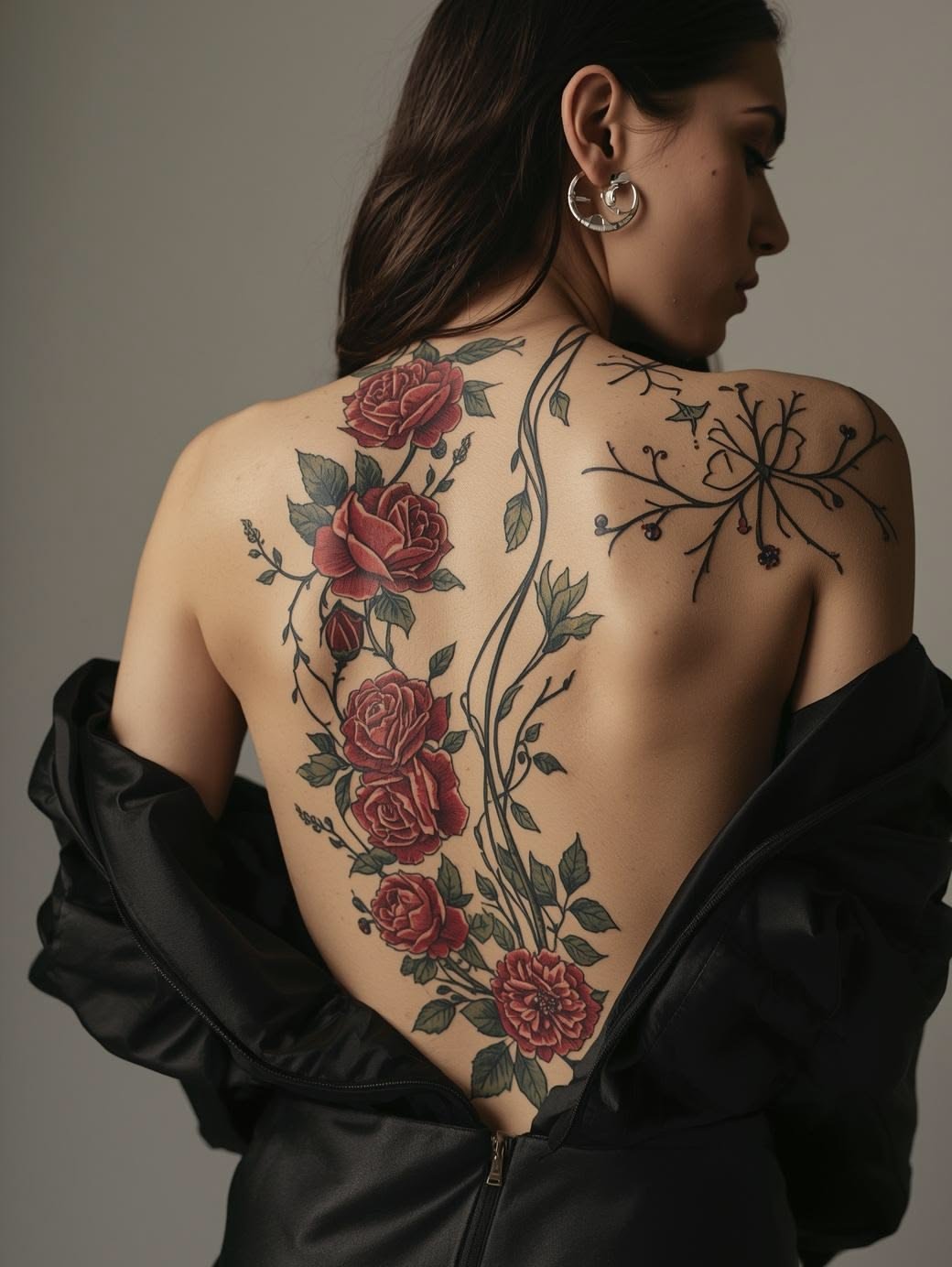
The rose is almost certainly the single most frequently tattooed image in Western tattooing. It has been part of the flash vocabulary since the earliest commercial tattoo shops, it crosses every major style from traditional to fine line, it appears on every body part, and it carries a range of meanings wide enough to accommodate almost any personal intention. A person getting a rose tattoo today is participating in a visual tradition that stretches back through twentieth-century tattoo flash, centuries of European painting, medieval Christian symbolism, Persian poetry, Roman imperial ceremony, and Greek mythology, to the earliest recorded uses of the flower as a cultural symbol.
The rose’s dominance in tattoo imagery is not accidental. The flower has a visual structure — layered petals opening from a tight centre, thorned stems, leaves with serrated edges — that translates well to skin at nearly any scale and in nearly any style. It pairs easily with other subjects. It reads at a distance. It ages well when rendered with the technical conventions the tattoo tradition has developed for it. And it carries enough accumulated meaning that a client can attach almost any personal significance to it without the image seeming arbitrary.
Understanding what the rose has meant across different traditions and historical periods is useful for anyone choosing one, because the meanings are specific and layered, and knowing them gives the wearer something more substantial than “I liked how it looked.”
The flower
The genus Rosa contains between 100 and 300 species, depending on the taxonomic authority, with a natural range spanning Europe, Asia, North America, and parts of North Africa. The cultivated rose has been bred for at least five thousand years — early cultivation is documented in China, Persia, and the eastern Mediterranean — and the modern garden rose, with its dense petals and wide colour range, is the product of centuries of deliberate hybridisation, particularly the crossing of European and Chinese species from the eighteenth century onward.
Wild roses typically have five petals. The cultivated roses that appear in most art and most tattoos have many more — the layered, spiralling petal structure of the garden rose is a human creation, bred for visual density and fragrance. This distinction matters occasionally in symbolic contexts: the five-petalled wild rose and the many-petalled garden rose can carry different associations.
Roses have thorns — technically prickles, which grow from the outer tissue of the stem rather than from the wood. The thorns are as much a part of the rose’s symbolic identity as the flower itself. The combination of beauty and the capacity to draw blood has been noted and used by every culture that has engaged with the plant.
Rose in the ancient world
The rose was already symbolically loaded in the ancient Mediterranean.
In Greek mythology, the rose is associated with Aphrodite, the goddess of love. The most common version of the origin story has the rose springing from the blood of Adonis, Aphrodite’s lover, after a wild boar killed him — the flower born from a wound, beauty from violence. In some versions, the rose was originally white and was stained red by Aphrodite’s blood as she ran through a rose garden to reach the dying Adonis, cutting her feet on the thorns. The association of the red rose with love and with suffering — specifically, with love that costs something — is present from the earliest surviving versions of the myth.
The Romans adopted and amplified the Greek association. Roses were used lavishly in Roman public and private life: scattered at banquets, worn as garlands, used in funeral rites, and cultivated in dedicated gardens. The phrase sub rosa — “under the rose” — referred to the practice of hanging a rose above a meeting table to indicate that the conversation was confidential. The rose as a marker of secrecy and discretion has persisted in Western culture, and the phrase is still used.
Roman roses were also associated with excess and with the transience of pleasure. The poet Horace urged his readers to enjoy the roses while they bloomed — carpe diem, and the roses are linked from the start. The rose that fades and dies is, in Roman poetry, the same rose that is most beautiful at the moment of its fullest opening. The flower became an emblem of pleasures that do not last, which is a more complicated meaning than simple beauty.
In Egyptian culture, roses were used in religious ceremonies and funerary practices. Rose petals have been found in Egyptian tombs, and the flower appears to have been associated with renewal and the afterlife.
Christianity
The Christian tradition transformed the rose from a pagan symbol of love and pleasure into a symbol of the Virgin Mary, martyrdom, divine grace, and the blood of Christ. The transformation was gradual and deliberate — early Church writers sometimes rejected the rose because of its association with Roman excess and with Aphrodite/Venus, but by the medieval period, the flower had been thoroughly Christianised.
The red rose became associated with the blood of Christ and with the suffering of the martyrs. The white rose became associated with the purity of the Virgin. The combination of red and white roses could represent the dual nature of Christ — divine (white) and human/suffering (red). The rosary — the prayer cycle central to Catholic devotion — may take its name from the rose (rosarium, a rose garden), though the etymology is debated. The prayers are sometimes described as a garland of roses offered to Mary.
In medieval Christian art, the rose garden (hortus conclusus, the enclosed garden) is a recurring setting for images of the Virgin and Child. The enclosed garden is itself a symbol of Mary’s virginity, drawn from the Song of Solomon, and the roses within it represent divine love and grace. The rose window — the circular stained-glass window found in Gothic cathedrals — takes its name and its radiating petal-like structure from the flower.
The five-petalled wild rose was sometimes interpreted as a symbol of the five wounds of Christ. The thorns of the rose were read as the crown of thorns. The entire plant — beauty, suffering, blood, growth through adversity — mapped onto the Christian narrative of redemption with such completeness that the rose became one of the most important symbols in Christian visual culture.
Dante places a celestial rose at the centre of Paradise in the Divine Comedy — a vast rose of light formed by the ranks of the blessed, with the Virgin Mary at its centre. The image fuses the pagan rose of love with the Christian rose of grace into a single structure that encompasses all of heaven.
Islam and Persian poetry
In Sufi mysticism, the rose represents divine beauty and the soul’s longing for God. The nightingale-and-rose (gol-o-bolbol) is one of the foundational motifs of Persian poetry: the nightingale sings to the rose, consumed by love for its beauty, and the rose is silent — beautiful, indifferent, and transient. The nightingale’s love is unrequited, and the rose’s thorns wound the bird that presses too close. The pairing is a metaphor for the soul’s relationship to the divine: an aching, ecstatic love for something beautiful that cannot be possessed.
Hafez, Rumi, and Omar Khayyam — the three most internationally read Persian poets — all use the rose extensively, each with specific emphasis. In Hafez, the rose is the beloved, and the poem is the nightingale’s song. In Rumi, the rose is a door to divine presence — the beauty of the created world understood as evidence of the creator. In Khayyam, the rose is transient, and its brevity is the argument for drinking wine and enjoying the present — a position closer to Horace’s carpe diem than to Sufi mysticism. However, the two traditions coexist in Persian culture.
The rose garden (gulistan) is the title of one of the most important works of Persian literature — Sa’di’s thirteenth-century collection of stories and poems — and the word carries connotations of paradise, refinement, and the cultivated life of the spirit.
In Islamic decorative art, the rose appears constantly — in tile work, in manuscript illumination, in textile design, in the geometric and floral patterns of mosque decoration. The flower is one of the few naturalistic images that appear widely in Islamic art traditions, which otherwise favour geometric abstraction, because the rose is understood as a reflection of divine beauty rather than a representation of a created thing.
The War of the Roses and heraldry
The rose as a political and heraldic symbol has its own distinct history, most famously in the English Wars of the Roses (1455–1487), in which the House of Lancaster (red rose) and the House of York (white rose) fought for the English throne. The Tudor rose — a combined red-and-white rose — was adopted by Henry VII after his victory at Bosworth Field to symbolise the unification of the two houses. The Tudor rose remains part of the British royal arms.
Heraldic roses appear in the arms and insignia of families, institutions, cities, and nations across Europe. The five-petalled heraldic rose is a conventional form — stylised, symmetrical, and distinct from the naturalistic garden rose — and its colour carries meaning within the heraldic system: red for sacrifice or love, white for purity or peace, gold for excellence, and so on.
The rose is the national flower of England, and it was adopted as the national flower of the United States in 1986. It holds similar symbolic status in several other countries, and it appears in the national insignia and heraldic traditions of nations across Europe and beyond.
The rose in Western tattooing
The rose entered the Western tattoo vocabulary early and has never left.
American traditional
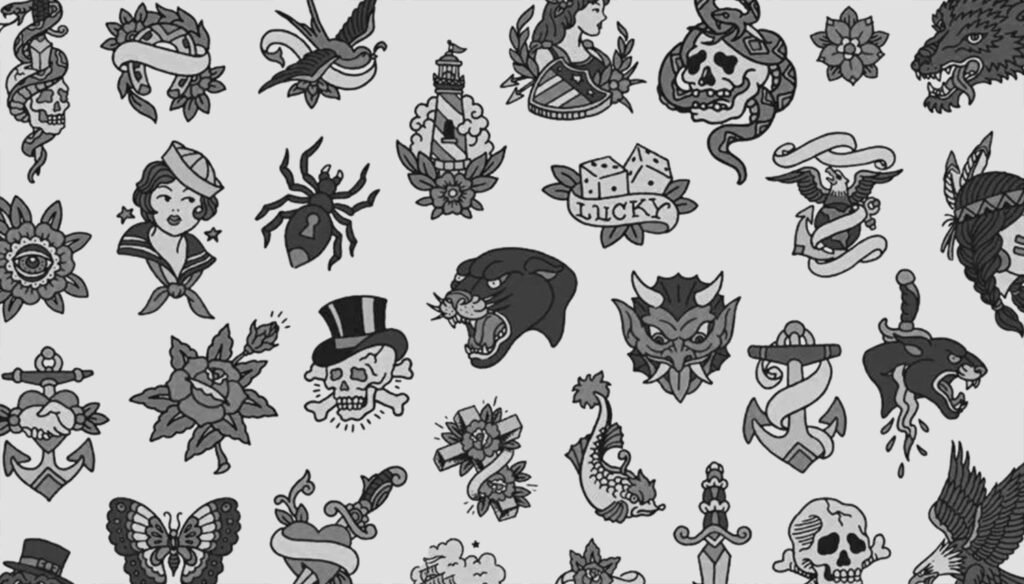
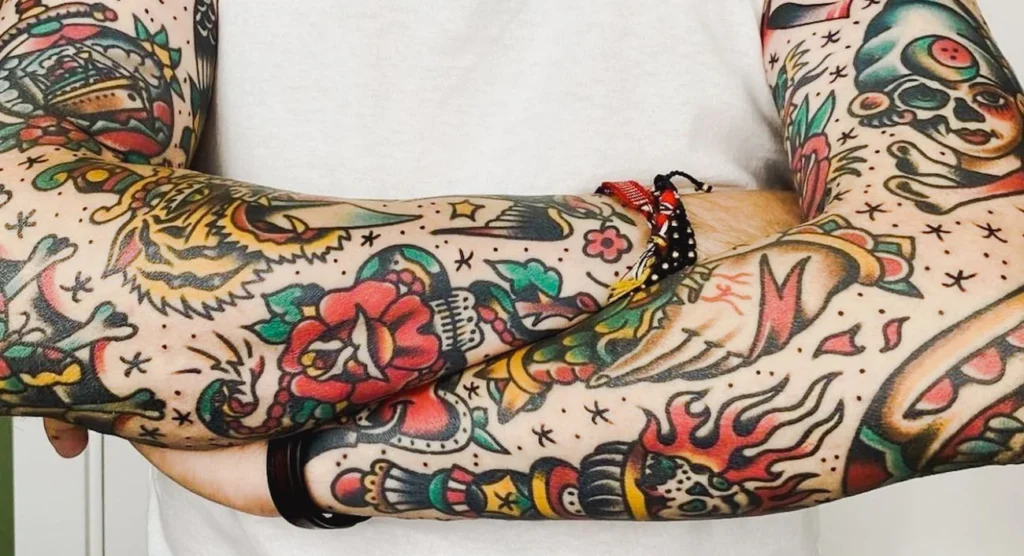
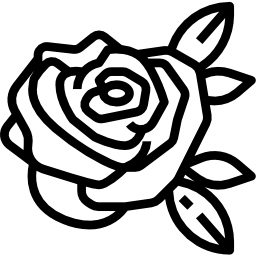
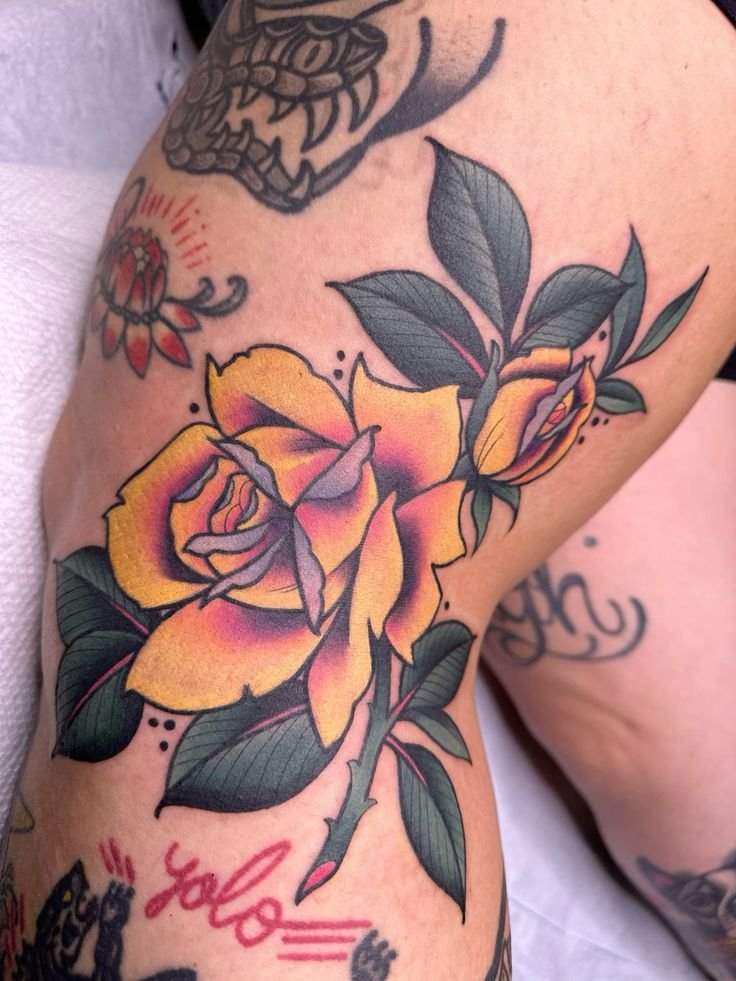
The traditional tattoo rose has a specific and recognisable form: a heavy black outline, five or six visible petals rendered in two or three tones of red and pink (sometimes yellow), with a tight centre, a few green leaves, and often a thorned stem. The rose is one of the fundamental pieces of American flash, appearing on its own, paired with daggers, wrapped around anchors, held in the mouths of skulls, framing banners bearing names and dates, and combined with hearts in every conceivable configuration.
In traditional symbolism, the rose most commonly represents love — a woman, a relationship, or a person missed. It is one of the most frequently paired images in memorial and romantic tattooing: a rose with a name banner is one of the oldest and most common compositions in the repertoire. The dagger through a rose represents love betrayed or love that has caused pain. The skull-and-rose represents the proximity of beauty and death, or love that outlasts mortality.
The traditional rose is designed to age well. The heavy outline holds the shape as the ink softens over decades. The flat colour fields stay readable. The five-petal structure is robust enough to survive blurring without losing its identity. A traditional rose from 1960 still looks like a rose in 2025. This durability is one of the reasons the traditional rose has endured as a design while other flash subjects have fallen out of fashion.

Chicano
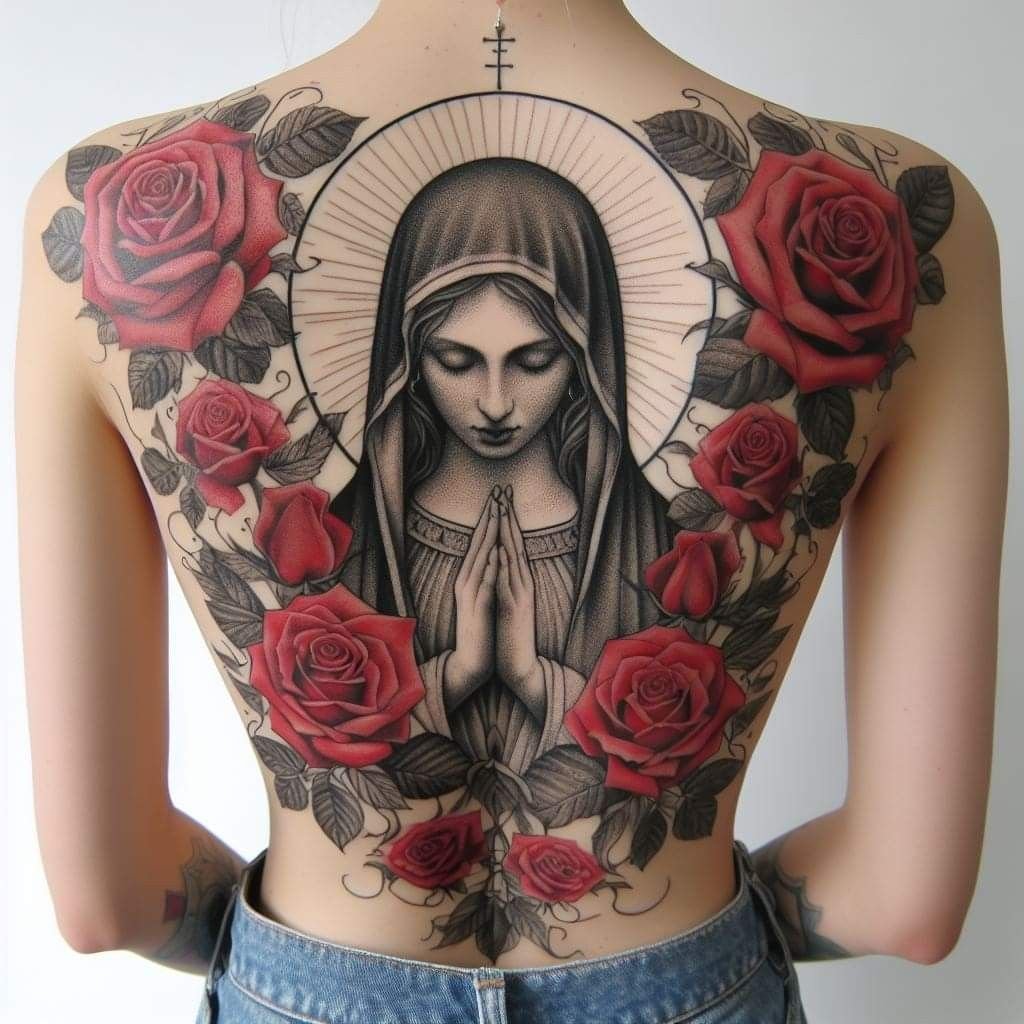
The rose is one of the most important subjects in Chicano tattooing, rendered in black-and-grey greywash with smooth tonal gradients, usually at medium to large scale, and frequently as a supporting element in larger memorial or devotional compositions. The Chicano rose often surrounds a portrait, frames a religious image, or accompanies script and lettering. Its meaning in this context is tied to the broader Chicano devotional and memorial tradition — love, grief, beauty in the presence of suffering, the feminine, the Marian.
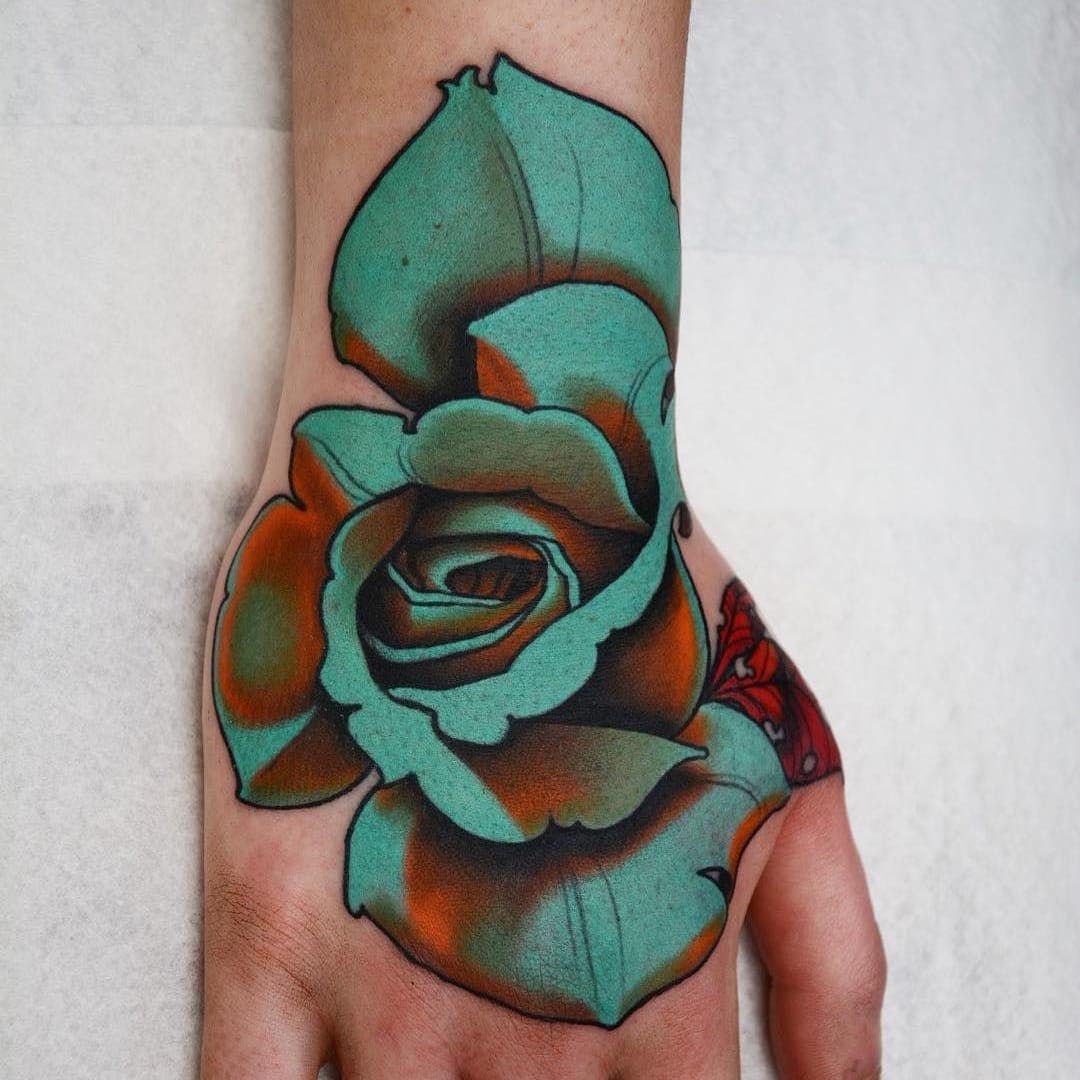
Neo-traditional
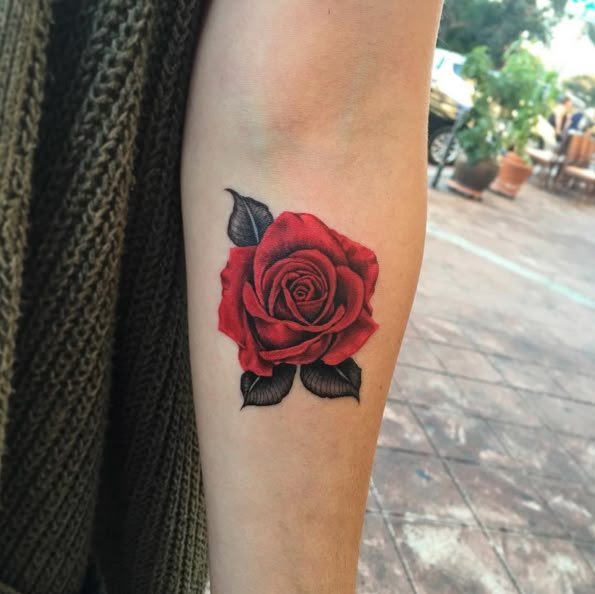
Realism
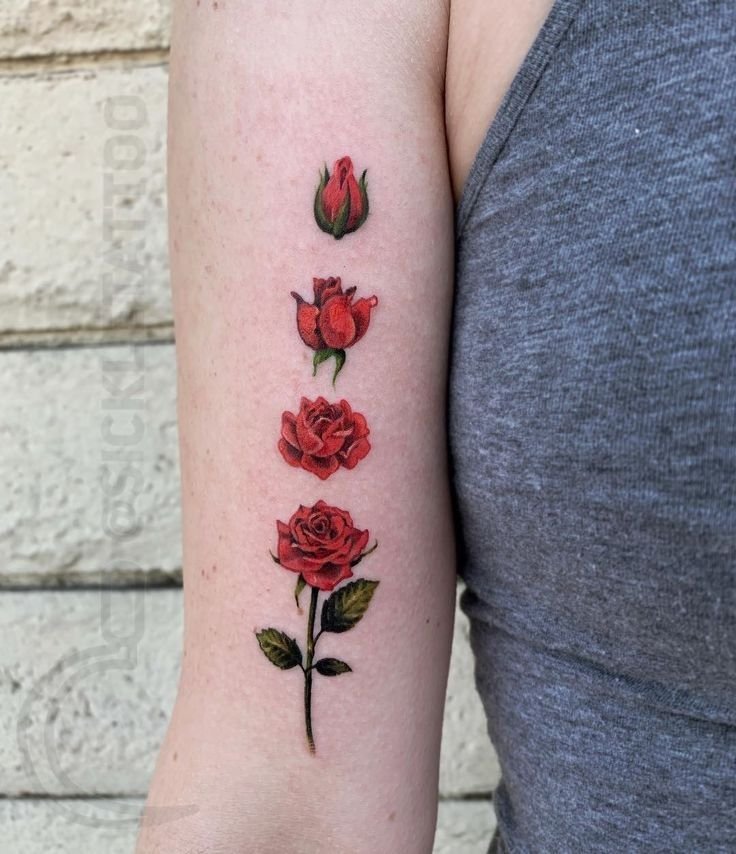
Fine line
Blackwork
The rose in East Asian tattooing
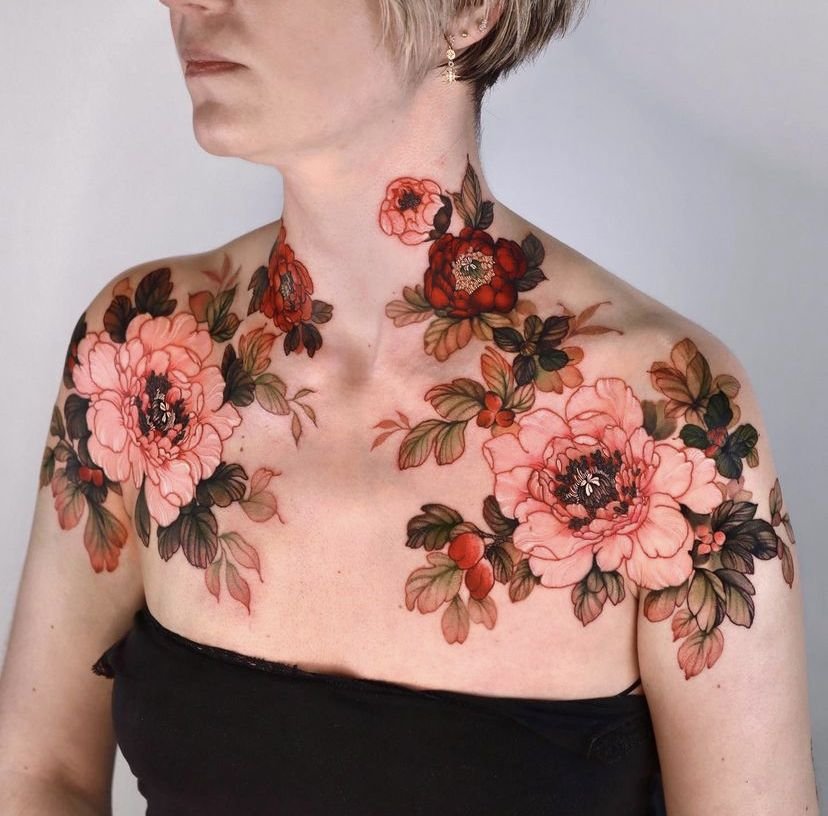
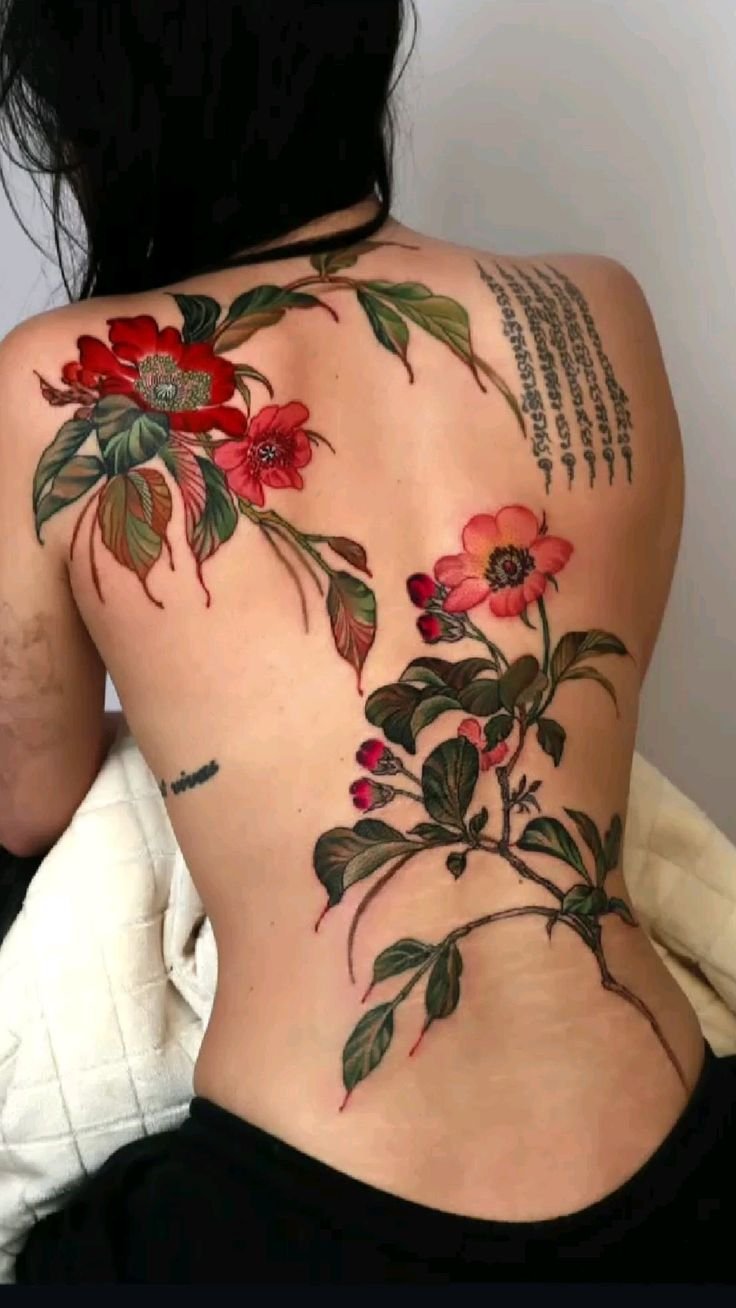
The rose is not a traditional subject in Japanese irezumi. The flower that occupies the rose’s compositional and symbolic position in Japanese tattooing is the peony (botan). This large, layered, visually dense bloom represents wealth, prosperity, honour, and the beautiful recklessness of the gambler. A full Japanese back piece or sleeve is more likely to include peonies, chrysanthemums, cherry blossoms, or lotus flowers than roses.
Contemporary Japanese-style tattoo work — particularly work by Western artists working in the Japanese compositional idiom — sometimes incorporates roses, and the hybrid compositions that result are a recognisable category in modern tattooing. But within the traditional irezumi vocabulary, the rose does not have a settled place.
In contemporary Korean and Chinese tattooing, the rose appears frequently, usually in fine-line, illustrative, or neo-traditional renderings, without the specific symbolic load it carries in Western or Islamic traditions. The flower is treated primarily as an aesthetic subject.
Meanings of roses
Love
Grief and memorial
Beauty that costs something
Secrecy and confidence
The Virgin Mary and devotion
Transience and mortality
Balance of opposites
Political and national identity
The feminine
Across multiple traditions, the rose is associated with women — with female beauty, with the feminine divine (Aphrodite, the Virgin Mary), and with qualities culturally coded as feminine: softness, receptivity, nurturing. This association is pervasive but not universal — roses are tattooed on men and women in roughly equal numbers, and the meaning shifts with context.
Resilience
New beginnings
Colour meanings
Rose colour carries meaning in the broader cultural tradition of flower language (floriography), which was formalised in the Victorian era but draws on older associations. The major colour meanings are:
- Red — love, desire, passion, respect. The most commonly tattooed colour and the most straightforwardly understood.
- White — purity, innocence, reverence, new beginnings. In Christian contexts, the Virgin Mary. In funerary contexts, memorial and mourning.
- Pink — grace, gratitude, admiration, gentleness. A softer version of the red rose’s meaning.
- Yellow — friendship, joy, warmth. In some older traditions, jealousy or infidelity — though this negative reading has largely faded from contemporary use.
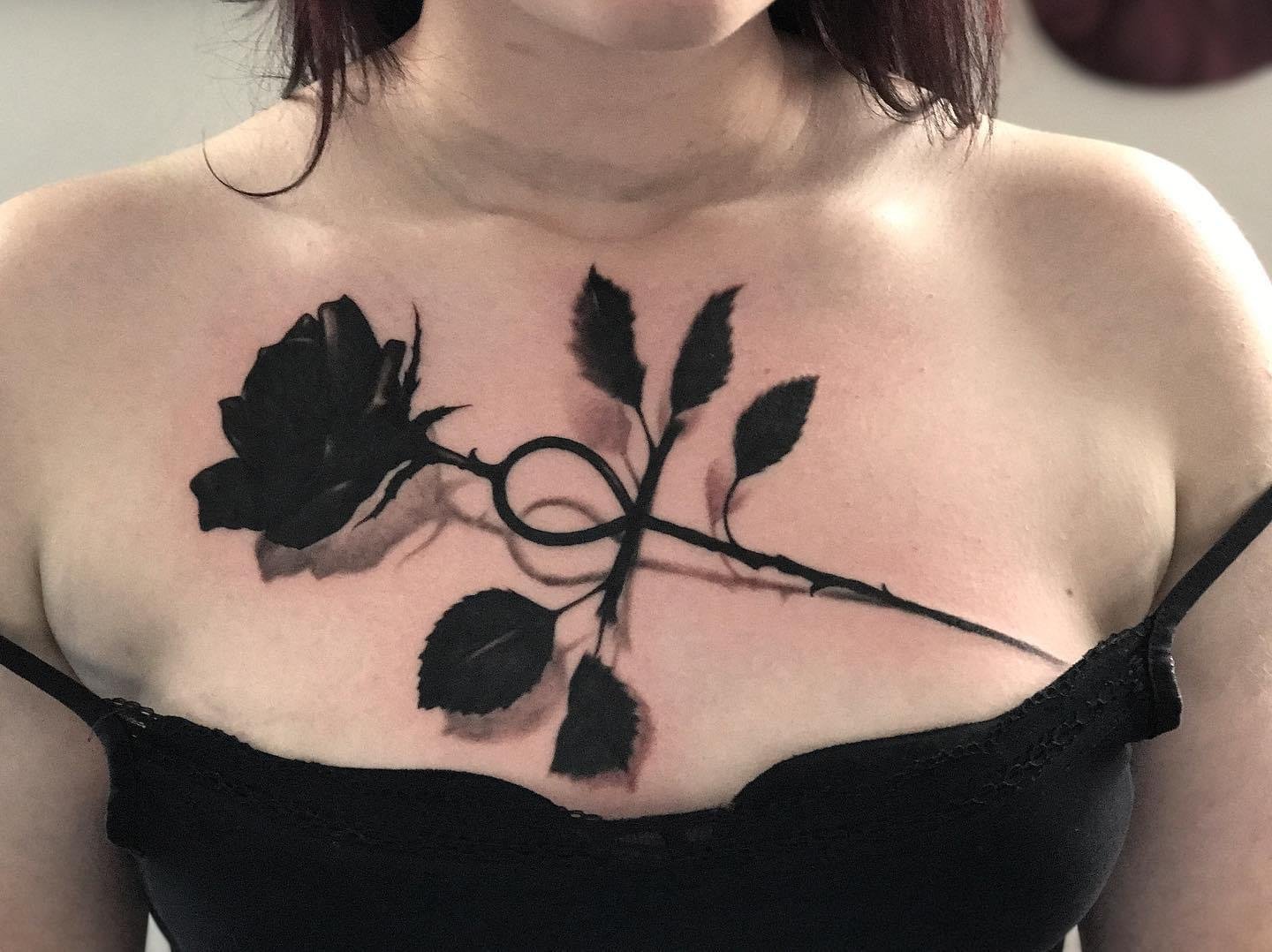
- Black — death, farewell, grief, rebellion. The black rose does not exist in nature; it is a symbolic invention, and its meanings are correspondingly dramatic. Black rose tattoos are often associated with endings, with mourning, or with a darkly romantic sensibility.
- Blue — mystery, the unattainable, the impossible. Like the black rose, the blue rose does not exist in nature, and its meaning draws on that impossibility. A blue rose can represent a desire for something out of reach.
- Orange — enthusiasm, energy, desire. Less commonly tattooed than red or pink, it carries fewer accumulated cultural associations.
- Purple or lavender — enchantment, wonder, royalty. Associated with the extraordinary and the rare.
These colour meanings are cultural conventions and not fixed rules. A client who chooses a yellow rose because it reminds them of their grandmother’s garden is using the flower correctly, regardless of what the Victorian flower-language guides say. The meanings listed above are useful as context, not as constraints.
Choosing a rose tattoo
A few practical observations.
Style determines longevity. A traditional rose with heavy outline and flat colour will outlast a realism rose with subtle tonal gradients, which will outlast a fine line rose with no outline at all. A client choosing a rose for life should consider the style’s ageing behaviour as part of the decision.
The rose pairs with almost anything. This is one of its strengths as a tattoo subject and occasionally a weakness — because the rose is so versatile, it can be added to compositions where it does not earn its place. The strongest rose tattoos are ones where the rose is chosen for a reason that connects to the rest of the piece, or where the rose is the entire piece and needs no pairing.
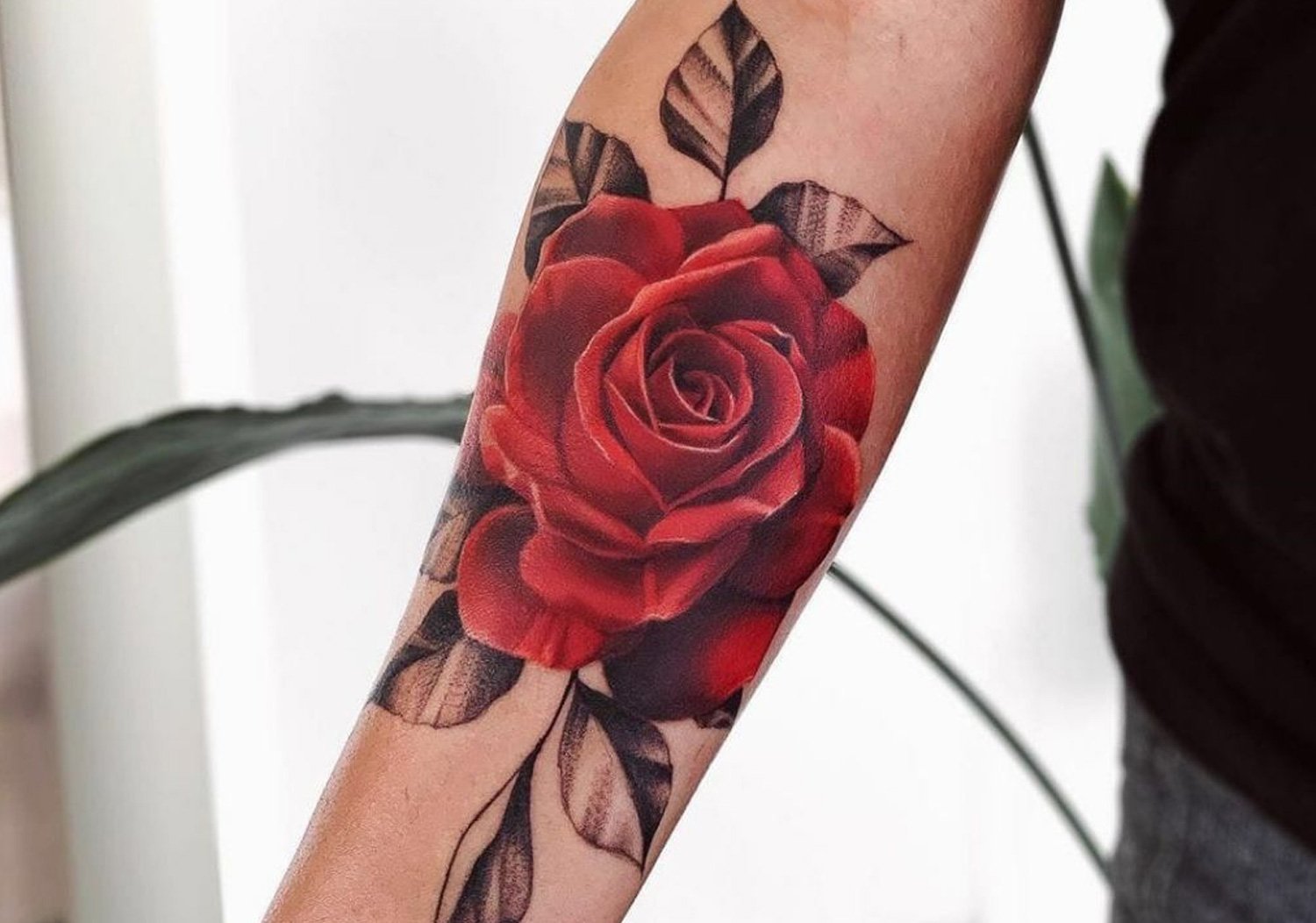
Colour choice matters for ageing. Red ink fades and shifts more than black. Yellow fades fastest of all common tattoo pigments. A rose that depends on subtle colour distinctions between petals for its effect will lose some of those distinctions over time. Traditional and neo-traditional approaches to rose colour — which use two or three distinct tones rather than a smooth gradient — age better than photorealistic colour rendering.
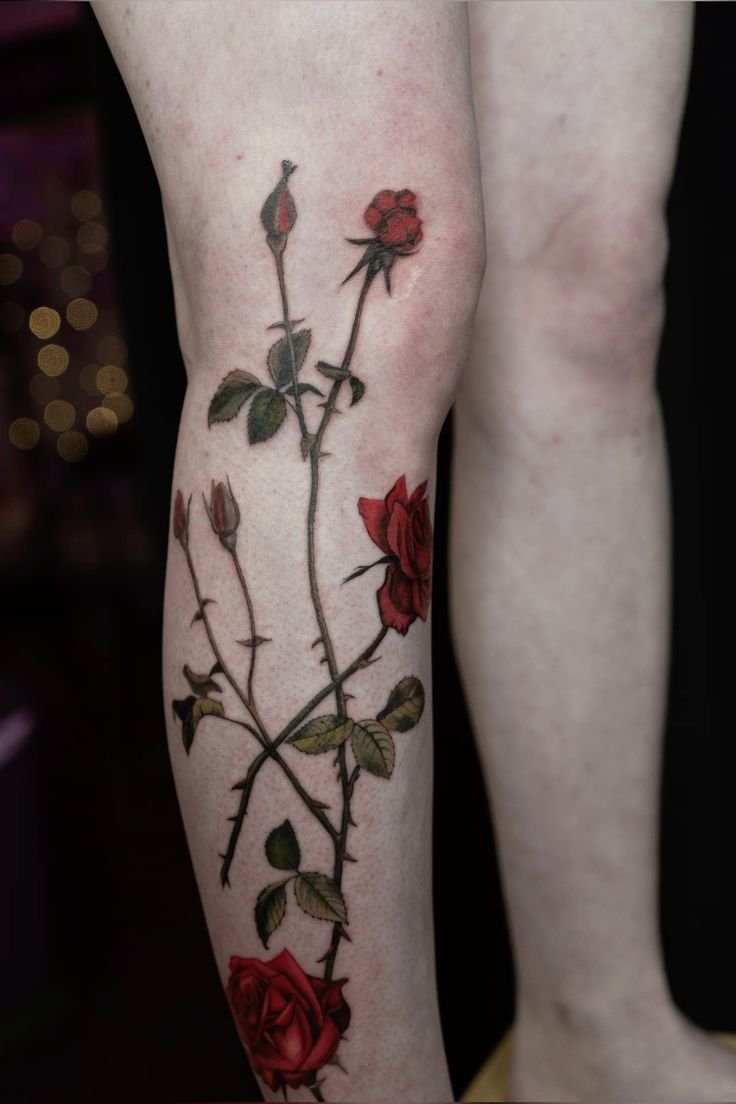
Thorns and stems are optional and meaningful. A rose without thorns reads differently from a rose with them. A rose with a prominent thorned stem reads differently from a rose rendered as a bloom alone. The thorns add a note of pain, defence, or earned beauty that the flower alone does not carry. Including or omitting them is a design decision that affects meaning.
Scale is forgiving. The rose is one of the few tattoo subjects that works at almost any size — from a small fine line rose on the wrist to a full traditional rose filling the upper arm. The petal structure is recognisable even when simplified, and the flower’s visual identity survives stylisation better than most other subjects. A rose can be reduced to a few lines and still read as a rose.
Placement carries meaning in some traditions. In American traditional and Chicano tattooing, rose placement has some conventional associations — a rose on the chest can signal love held close, a rose on the hand can signal something the wearer wants to show the world. These are conventions, not rules, and they apply most strongly within the communities where they developed.
The rose is never a neutral image. Because the rose carries so much accumulated cultural meaning — love, loss, beauty, thorns, the Virgin, the beloved, the grave — it is always read as significant, even when the wearer chose it primarily for its appearance. This is an advantage if the wearer wants their tattoo to carry weight. It is something to be aware of if they do not.
Sources & further reading
- Peter Harkness, The Rose: An Illustrated History. Firefly Books, 2003.
- Charles and Brigid Quest-Ritson, The Royal Horticultural Society Encyclopedia of Roses. DK, 2011.
- Pierre Grimal, The Dictionary of Classical Mythology. Blackwell, 1985.
- Ovid, Metamorphoses. A.D. Melville translation. Oxford World’s Classics, 1986.
- Marina Warner, Alone of All Her Sex: The Myth and the Cult of the Virgin Mary. Weidenfeld & Nicolson, 1976.
- Annemarie Schimmel, A Two-Colored Brocade: The Imagery of Persian Poetry. University of North Carolina Press, 1992.
- Annemarie Schimmel, Mystical Dimensions of Islam. University of North Carolina Press, 1975.
- Sheila Blair and Jonathan Bloom, Islamic Arts. Phaidon, 1997.
- Dan Jones, The Wars of the Roses: The Fall of the Plantagenets and the Rise of the Tudors. Viking, 2014.
- Michael Hicks, The Wars of the Roses. Yale University Press, 2010.
- Beverly Seaton, The Language of Flowers: A History. University Press of Virginia, 1995.
- Anna Felicity Friedman, The World Atlas of Tattoo. Yale University Press, 2015.