Related Posts



Hamsa (Hand of Fatima) tattoo
The open hand
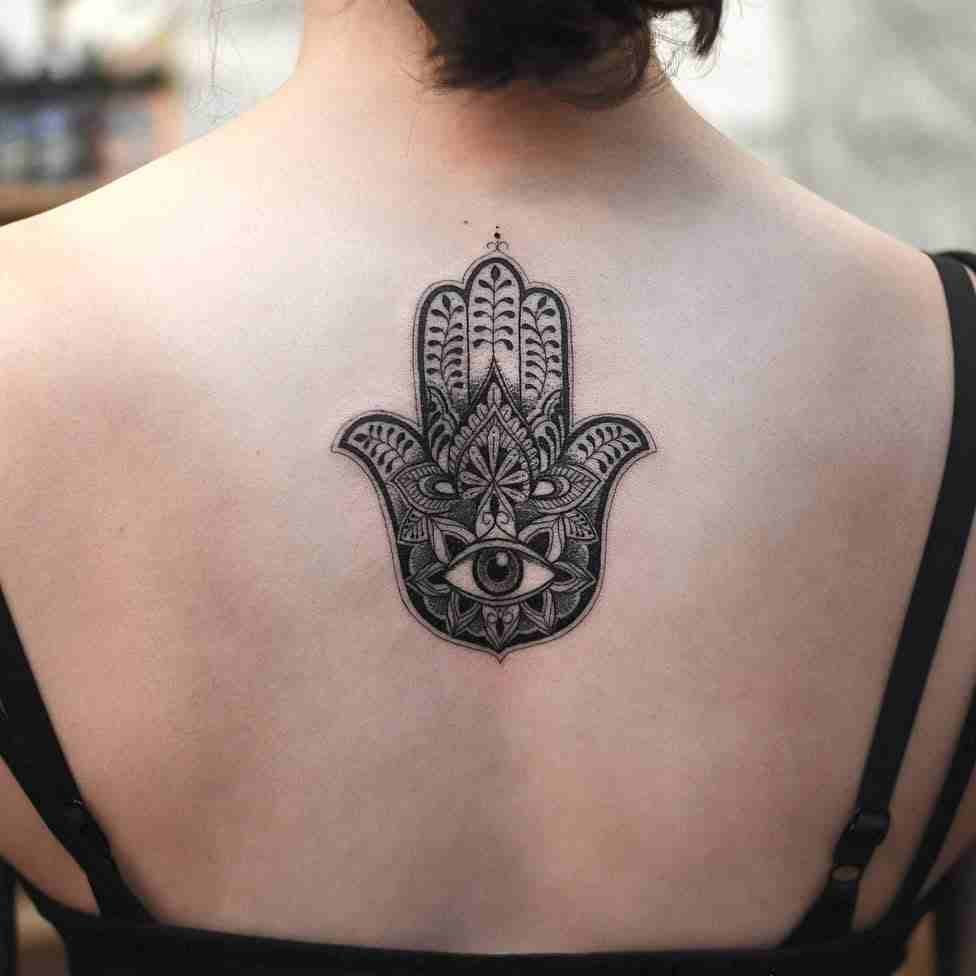
An open right hand, fingers together or slightly spread, palm facing outward. Sometimes symmetrical — the thumb and little finger are mirrored, so the hand has no anatomical left or right. Sometimes with an eye centred in the palm. Sometimes decorated with geometric patterns, floral motifs, or script. The image is instantly recognisable, appears across at least three major religious traditions and several pre-religious folk cultures, and carries protective meaning in all of them.
The hamsa — also spelt khamsa, also called the Hand of Fatima, the Hand of Miriam, the Hand of Mary, or simply the protective hand — is one of the oldest continuously used apotropaic symbols in the world. An apotropaic object is one designed to turn away evil, and the hamsa’s function has been consistent for millennia: it protects the wearer or the household from the evil eye, from malevolent forces, and from bad luck. The symbol predates Islam, predates rabbinic Judaism in its current form, and probably predates any of the religious traditions that have adopted it.
As a tattoo, the hamsa has become one of the most requested symbolic designs of the past two decades, popular across cultural boundaries and tattooed on people with and without any connection to the traditions that produced it. Understanding where the symbol comes from, what it means in its home traditions, and what it means when removed from them is worth the effort — both for the wearer and for the artist.
The name
The word hamsa comes from the Arabic khamsah, meaning “five.” The reference is to the five fingers of the hand. The number five itself carries protective meaning in several Mediterranean and Middle Eastern traditions — five is associated with warding off the evil eye in Arabic, Berber, and Hebrew folk practice, and the open hand with five spread fingers is one of the most ancient gestures of protection documented in the region.
The symbol goes by different names in different traditions:
- Hand of Fatima (Yad Fatimah or Khamsa) in Islamic tradition, named after Fatima al-Zahra, the daughter of the Prophet Muhammad. The association with Fatima gives the symbol a specifically Islamic identity in the Sunni tradition, though its use in Islam predates and extends beyond the Fatima association.
- Hand of Miriam (Yad Miriam) in Jewish tradition, named after Miriam, the sister of Moses and Aaron. The name connects the symbol to the Exodus narrative and to Miriam’s role as a prophetess and protector of her people.
- Hand of Mary in some Christian communities of the Middle East and North Africa, named after the Virgin Mary. This association is less widespread than the Fatima and Miriam names but exists in Levantine Christian folk practice.
- Khamsa in North African usage, particularly in Berber (Amazigh) and Tunisian, Algerian, and Moroccan folk culture, where the name refers simply to the number five and the symbol is used without necessarily attaching it to any named religious figure.
The multiplicity of names is itself significant. The same symbol has been adopted, named, and given theological justification by different traditions operating in the same geographic region across centuries. The symbol came first; the names and the explanations followed.
Before the religions
The open-hand motif as a protective symbol in the Mediterranean and Near East is older than any of the religious traditions that currently use it. Hand motifs appear in Mesopotamian art, Phoenician and Carthaginian amulets, ancient Egyptian protective imagery, and the pre-Islamic folk traditions of North Africa. The archaeological evidence is not precise enough to identify a single point of origin. Still, the protective open hand was widespread across the region well before the rise of Christianity and Islam, and before the codification of rabbinic Judaism.
Carthaginian and Phoenician amulets in the shape of an open hand have been found across the western Mediterranean — in modern-day Tunisia, Sicily, Sardinia, and the Iberian Peninsula — dating to the first millennium BCE. The Phoenician goddess Tanit, whose symbol sometimes incorporated an open hand or a hand-like form, has been cited as one possible channel through which the motif entered North African folk culture.
In Mesopotamia, hand motifs with apotropaic function appear in Assyrian and Babylonian contexts, though the precise continuity between these ancient hand symbols and the later hamsa is debated among scholars. What can be said with confidence is that the open hand as a gesture of protection against unseen malevolent forces is among the oldest symbolic conventions in the region, and that the hamsa as it exists today is the surviving form of a very old idea.
The Berber (Amazigh) peoples of North Africa are probably the most important vector for the hamsa’s survival and transmission across religious boundaries. Berber folk culture predates the Arabisation and Islamisation of North Africa, and the khamsa was part of Berber protective practice before it was given an Islamic theological framing. When the region became predominantly Muslim, the symbol was retained and reinterpreted — attached to Fatima, given Quranic associations — rather than abandoned. The same process occurred in Jewish communities across North Africa, where the symbol was retained and attached to Miriam.
The evil eye
The hamsa cannot be understood without understanding what it protects against. The evil eye — the belief that certain people can cause harm through an envious or malevolent gaze — is one of the most widespread folk beliefs in human history, documented across the Mediterranean, the Middle East, South Asia, Central Asia, and parts of Latin America and East Africa.
The evil eye is taken seriously across a much wider social range than Western secular observers sometimes assume. In Turkey, the nazar (the blue glass eye bead) is ubiquitous — hung on doorways, pinned to babies’ clothing, dangling from car mirrors. In Greece, the mati serves a similar function. Across the Arab world, the phrase mashallah (“what God has willed”) is spoken partly as a verbal protection against the evil eye when praising something or someone. In Jewish tradition, the phrase kein ayin hara (“no evil eye”) serves the same function. In South Asian cultures, the nazar concept appears under various names and is associated with similar protective practices.
The hamsa is one of the principal physical defences against the evil eye. The open hand faces the source of the gaze and deflects it. The eye in the centre of the palm — when it appears — looks back at the looker, turning the gaze against itself. The logic is consistent across traditions: the hamsa does not attack; it returns. It is a mirror, a shield, a hand raised to say stop.
Judaism
The hamsa is widely used in Jewish communities of North African and Middle Eastern origin — Sephardi and Mizrahi Jews — and has been for centuries. Its use in Ashkenazi (European Jewish) communities is more recent and has grown substantially in the last few decades.
In Jewish folk practice, the hamsa is hung on walls, placed above doorways, worn as jewellery, and carried as an amulet. It frequently appears alongside other Jewish protective symbols: the Star of David, the Hebrew letter shin (the first letter of Shaddai, one of the names of God), the chai (life) symbol, and inscriptions from the Torah or from Psalms. The combination of the hamsa with Hebrew text is a specifically Jewish variant that distinguishes it visually from the Islamic and Berber versions.
Jewish theological commentary on the hamsa is limited — the symbol sits in the folk tradition rather than in the rabbinic mainstream, and some Orthodox authorities have questioned its use as potentially idolatrous or as an import from non-Jewish practice. Despite these reservations, the hamsa is one of the most widely recognised Jewish cultural symbols internationally, particularly among Sephardi and Mizrahi communities, for whom it is part of the inherited material culture.
The association with Miriam connects the hamsa to the broader Exodus narrative and to themes of protection, guidance, and divine provision. Miriam’s Well — the miraculous water source that, according to rabbinic legend, accompanied the Israelites through the desert because of Miriam’s merit — extends the protective symbolism of the hand into a specifically Jewish theological framework.
Islam
The hamsa is used widely across the Islamic world, particularly in North Africa, the Levant, and among Shia communities. Its status within Islamic theology is complicated.
The association with Fatima al-Zahra gives the symbol a specifically Islamic identity. Fatima is one of the most revered women in Islam — the daughter of the Prophet Muhammad, the wife of Ali ibn Abi Talib, and the mother of Hasan and Husayn. In Shia Islam, the family of the Prophet (Ahl al-Bayt) holds a particularly central theological and devotional position, and the Hand of Fatima carries additional weight within Shia traditions. The five fingers of the hamsa are sometimes interpreted in Shia contexts as representing the five members of the Ahl al-Bayt: Muhammad, Fatima, Ali, Hasan, and Husayn.
In Sunni Islam, the hamsa is used widely in folk practice but sits uneasily with orthodox theological positions. Mainstream Sunni theology discourages the use of amulets and talismans, and some scholars have criticised the hamsa as a form of shirk (associating other things with God’s power) or as a pre-Islamic superstition incompatible with Islamic monotheism. Despite these theological objections, the hamsa remains enormously popular across the Sunni Muslim world — in household decoration, jewellery, textiles, and the visual culture of daily life.
The tension between the symbol’s folk popularity and its theological status is real and should be understood by anyone considering a hamsa tattoo with Islamic associations. The symbol is culturally Islamic in much of its usage, even when it is theologically contested within Islam.
An additional complication: tattooing itself is generally considered haram (forbidden) in mainstream Islamic jurisprudence, though the prohibition is applied with varying strictness across different communities and traditions. A hamsa tattoo with Islamic associations thus involves a doubly complex cultural situation — a theologically contested symbol rendered in a theologically contested medium.
North African folklore
In Morocco, Tunisia, Algeria, and Libya, the khamsa is part of the everyday visual environment. It appears on doors, on jewellery, woven into textiles, pressed into leather, painted on ceramics, and incorporated into architectural decoration. Its use in this context is often more cultural than explicitly religious — the khamsa is a protective symbol inherited from Berber and broader North African folk tradition, used by Muslims, Jews, and others who share the regional material culture.
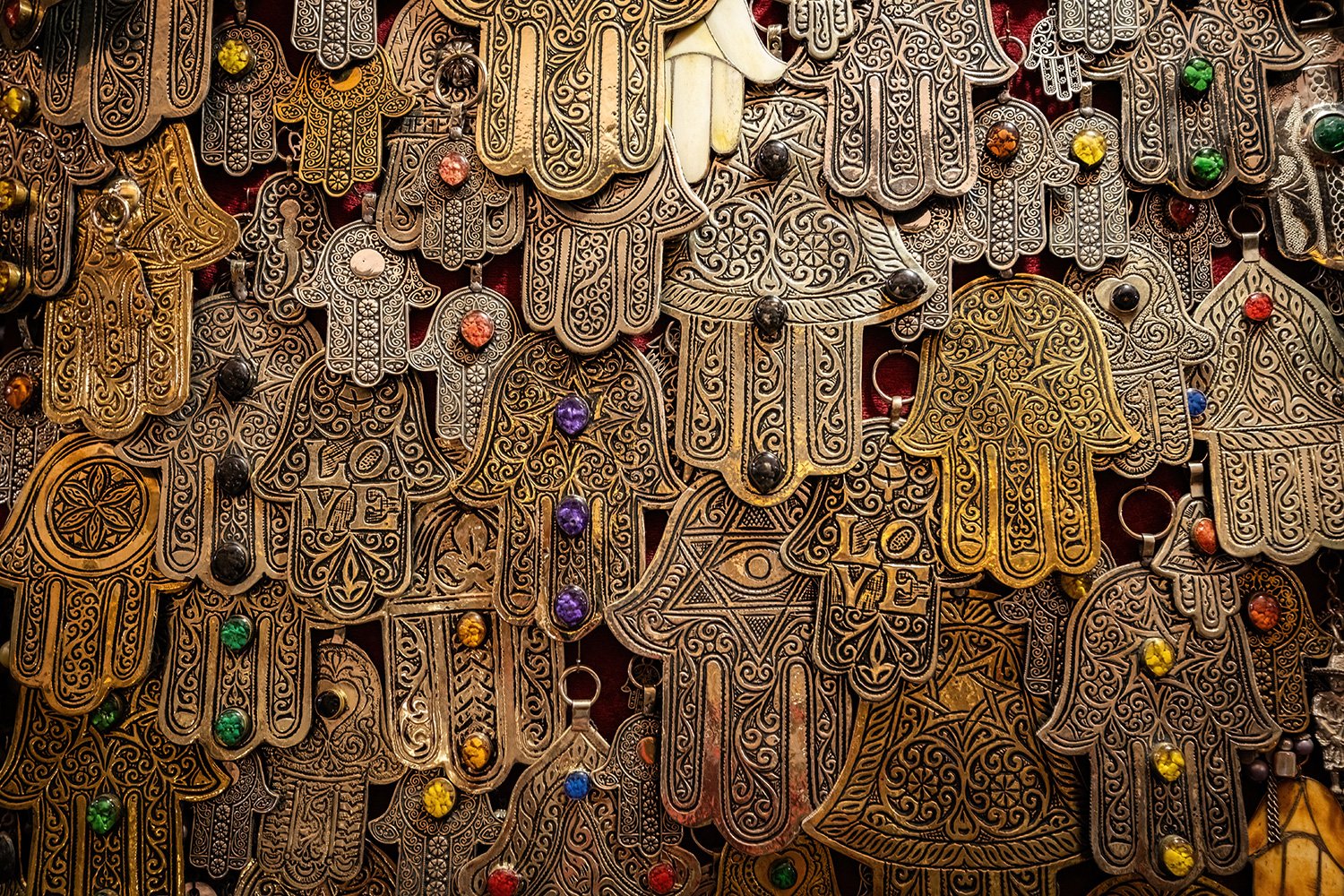
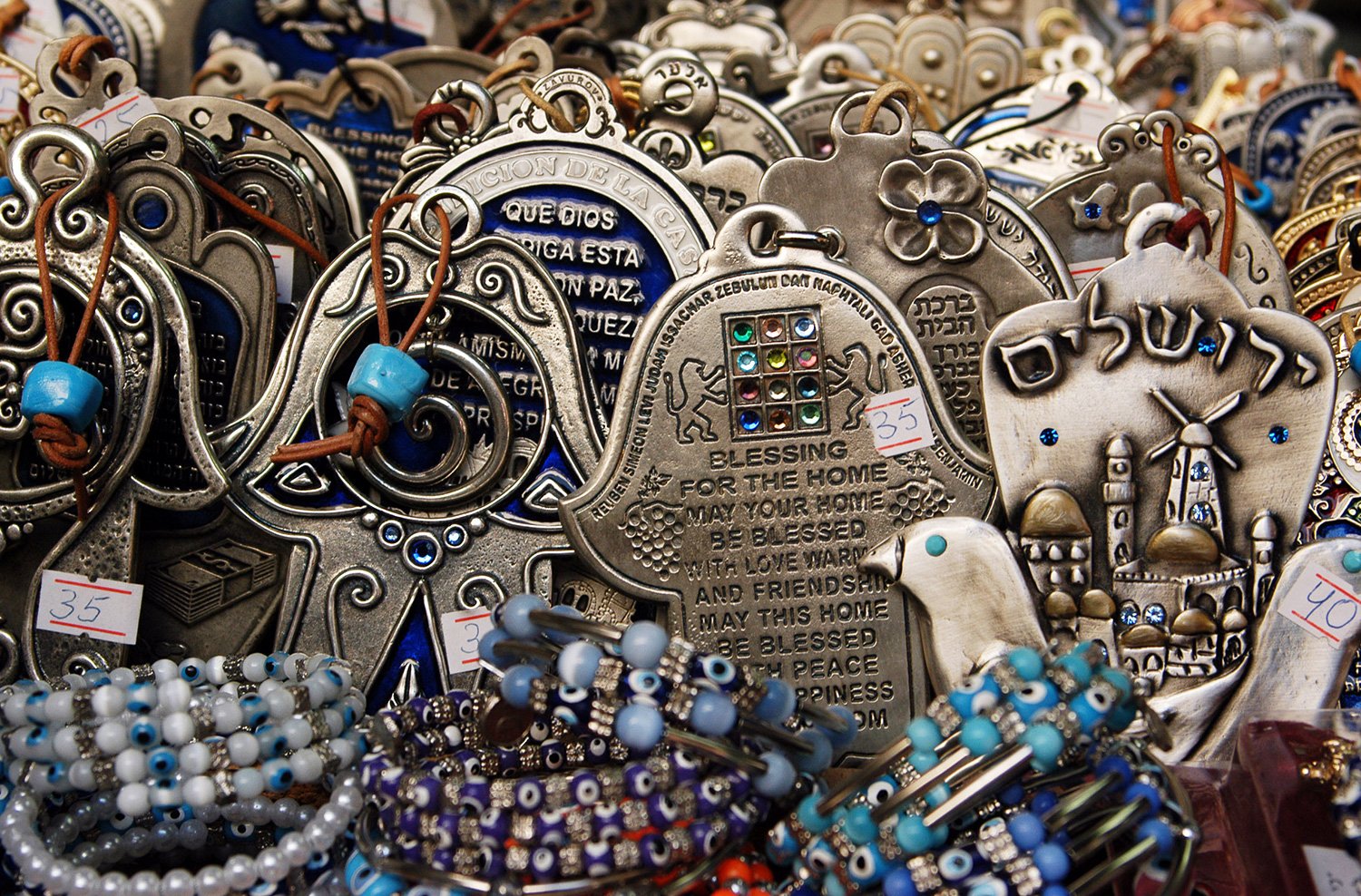
Moroccan Jewish communities, before the mass emigration of the mid-twentieth century, used the khamsa extensively, and the symbol is one of the clearest examples of a shared visual culture between Jewish and Muslim communities in the Maghreb. Moroccan khamsa designs — often highly ornamental, incorporating geometric patterns, filigree metalwork, and coloured enamel — represent a distinct regional aesthetic that differs from the simpler forms found in Levantine or South Asian usage.
Tunisian khamsa designs are similarly distinctive, often featuring the hand in a highly stylised, symmetrical form with elaborate internal decoration. The khamsa is widely considered a cultural symbol of both Tunisia and Algeria, and it appears in the visual culture and folk traditions of both countries.
The design

Symmetrical hamsa

Anatomical hamsa

Hamsa with eye

Hamsa with fingers up

Hamsa with fingers down

Decorated hamsa
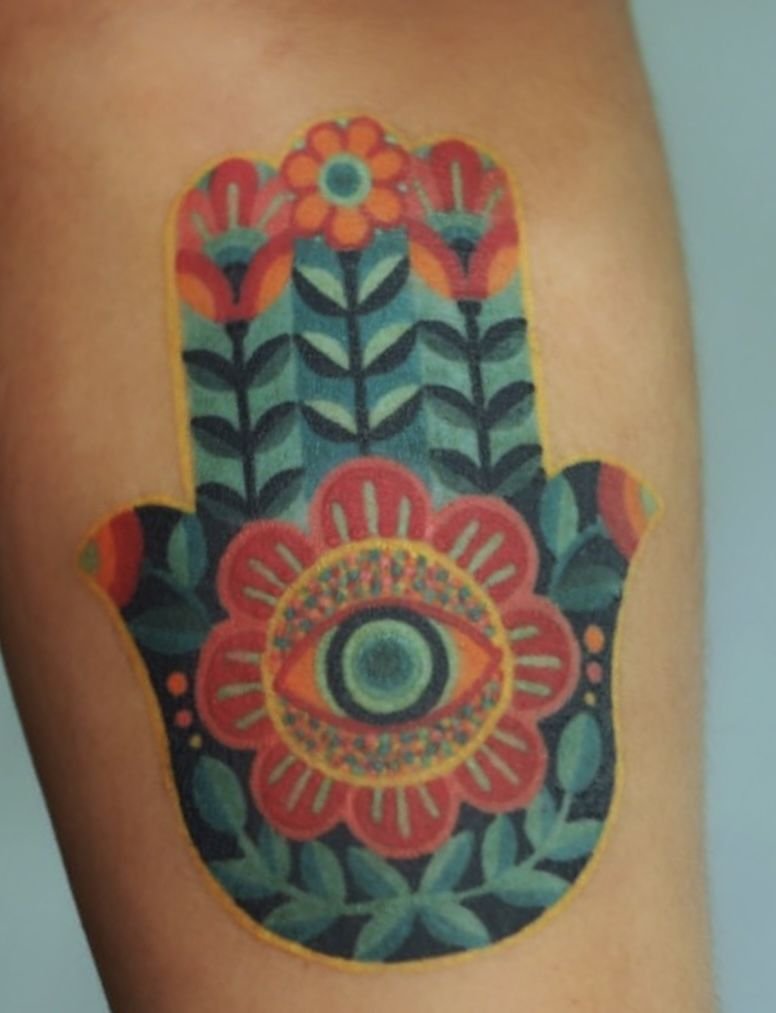
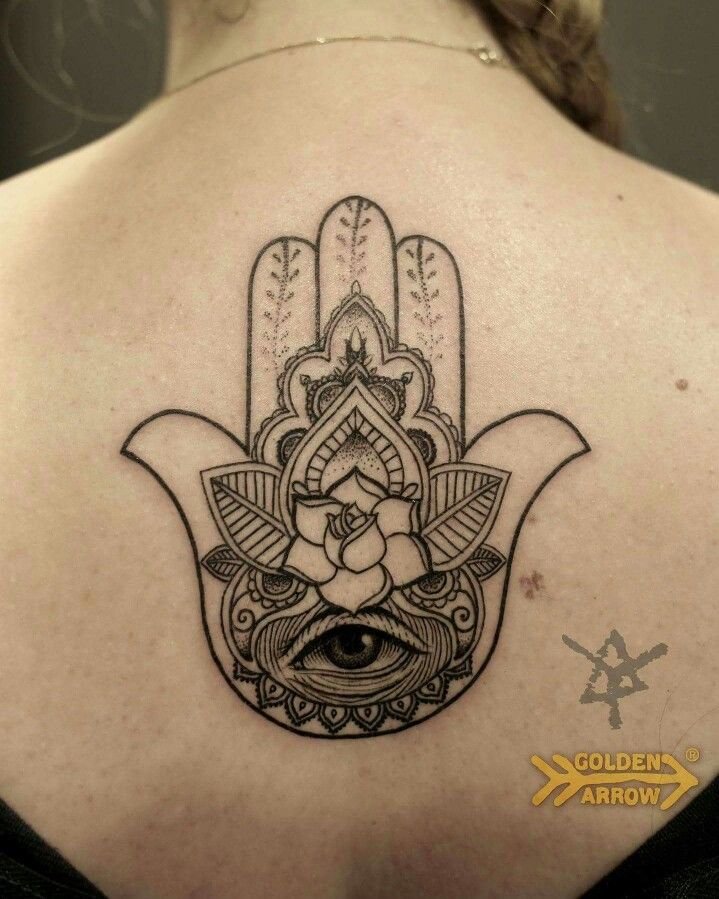
The interior of the hand is filled with patterns — geometric, floral, or calligraphic. In North African metalwork and jewellery, the decoration can be extraordinarily detailed: filigree, enamel, engraving, and inlaid stones. In tattoo designs, the interior decoration often draws on mandala patterns, Islamic geometric art, Indian mehndi (henna) designs, or botanical motifs. The decoration is often the primary visual interest of the tattoo.

Minimal hamsa
Meanings of hamsa
Protection from the evil eye
Divine protection
Blessing and good fortune
Femininity and the feminine divine
Patience, faith, and endurance
The number five
Harmony between faiths
Cultural considerations of the hamsa tattoo
The hamsa is shared across multiple traditions, and this sharing complicates the question of appropriation in ways that differ from those for symbols belonging to a single community.
A Jewish person wearing a hamsa tattoo is using a symbol from their own inherited culture. A North African Muslim wearing a hamsa pendant (though not a tattoo, given Islam’s stance on tattooing) is using a symbol from their own heritage. A Berber person wearing a khamsa is using a symbol that predates all the religious frameworks attached to it.
The situation is more complex for people outside these traditions. The hamsa has become a popular tattoo subject among people with no connection to Judaism, Islam, or North African folk culture — chosen for its visual appeal, its general association with protection and spirituality, or its appearance in yoga and wellness culture, where it has been adopted alongside other symbols from various traditions (the lotus, the om, the mandala).
This adoption is not universally welcomed. Some members of the traditions of origin view the use of the hamsa as a decorative or wellness symbol with discomfort, particularly when the symbol is stripped of its specific cultural and religious meanings and reduced to a generic emblem of “spirituality.” The hamsa’s specific meaning — protection against the evil eye, rooted in a particular folk cosmology — is not the same as a generalised sense of spiritual wellbeing, and flattening the one into the other can feel dismissive to people for whom the symbol carries real weight.
At the same time, the hamsa’s long history of crossing cultural and religious boundaries — from pre-Islamic North Africa into Islam, into Judaism, into Christianity — means that cultural boundary-crossing is part of the symbol’s own history. It has always moved between communities. The question is whether a particular use respects the symbol’s accumulated meaning or ignores it.
The practical guidance is familiar: understand what the symbol means in the traditions it comes from, approach it with respect for those traditions, and do not use it in ways that trivialise or contradict its function. A hamsa tattoo chosen with awareness of its history and meaning is a different act from one chosen because it “looked spiritual” on Pinterest.
Across tattoo styles
The hamsa translates well across most tattoo styles, and the style affects what the piece communicates.
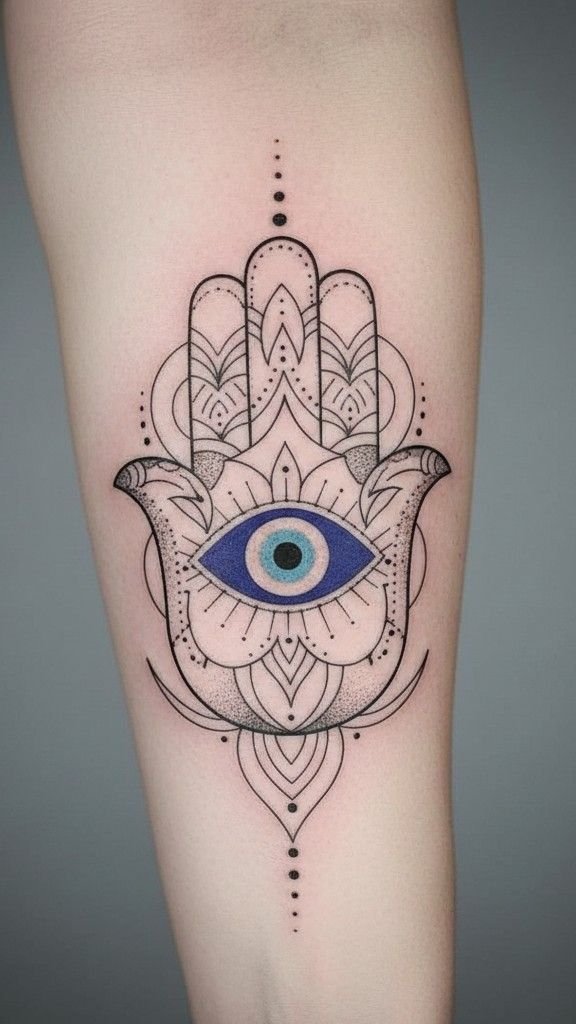
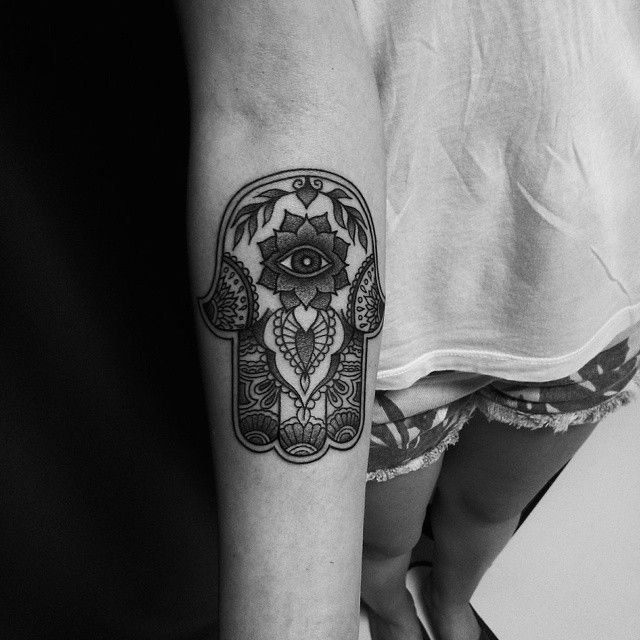
Ornamental and geometric. The most common contemporary approach. The symmetrical hamsa is filled with mandala patterns, geometric motifs, or detailed internal decoration, usually in black ink or black-and-grey. This style draws on North African and Islamic decorative traditions and produces pieces that read as both ornamental and symbolic.
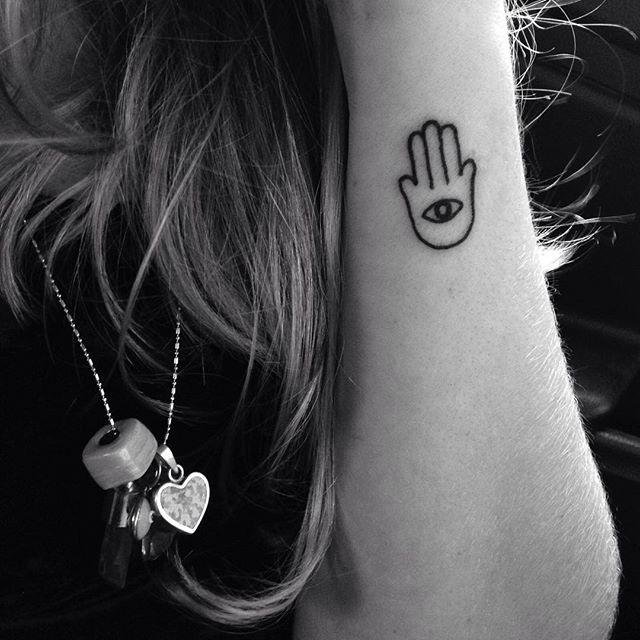
Fine line. A simple hamsa outline, with or without an eye, at a small to medium scale. The minimalist approach is common in first tattoos and in placements that favour discreet work. The fine-line hamsa has become one of the most recognisable images in the contemporary fine-line vocabulary.
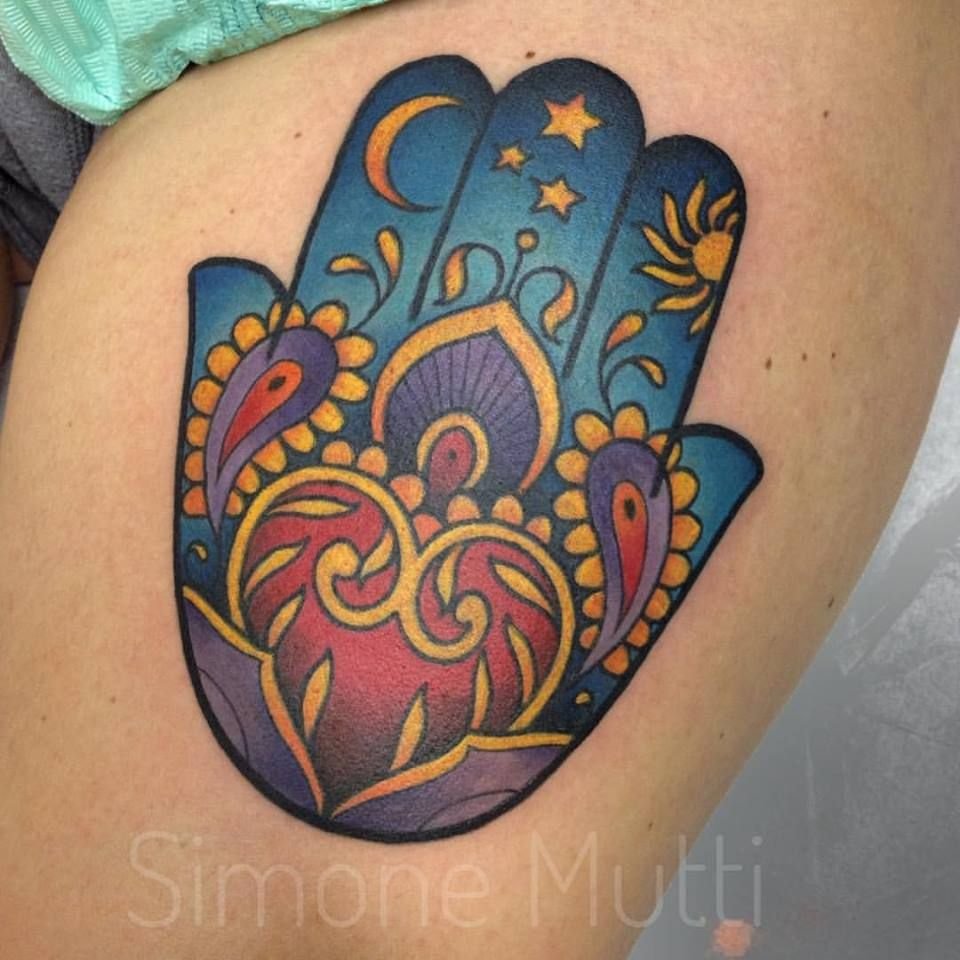
Illustrative. The hamsa rendered with botanical elements, watercolour effects, or mixed-media composition — sometimes incorporating flowers, celestial imagery, or other symbolic elements within or around the hand. This style is common in neo-traditional and illustrative studios.
Dotwork. The hamsa is built entirely from stippled dots, often in mandala or geometric patterns. Dotwork hamsas can be highly detailed and texturally rich, and the technique has a natural affinity with the geometric decorative traditions that inform the symbol.
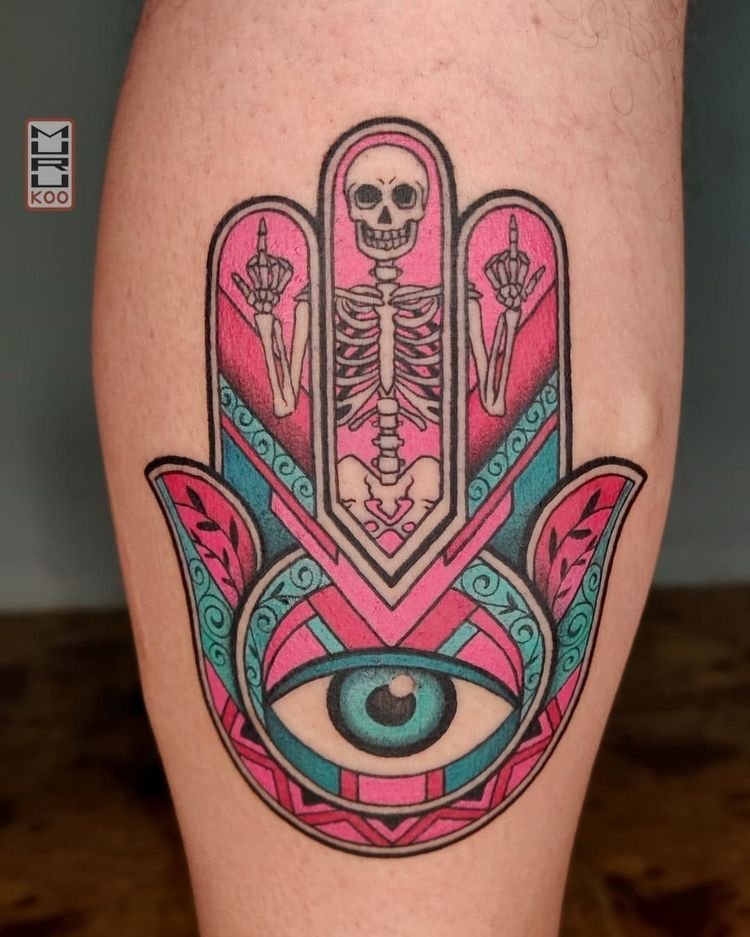
Traditional and neo-traditional. Less common, but the hamsa can be rendered in bold outline with flat colour, treating the symbol as a flash-style icon. The result is visually distinct from the ornamental approach and reads more as a Western tattoo than as an imported cultural symbol.
Blackwork. The hamsa is rendered in solid black or in heavy contrast, sometimes as part of a larger blackwork composition. The blackwork approach can lend the symbol a totemic weight suited to its protective function.
Before choosing a hamsa tattoo
A few practical observations:
The symmetry of the design is unforgiving. A symmetrical hamsa with even the slightest asymmetry in the outline will read as a mistake. The design demands precise line work, particularly in the outline and any internal geometric patterning. Artists who specialise in ornamental or geometric work are the safest choice for detailed hamsas.
Internal decoration is where the piece lives or dies. A hamsa with a blank interior is a simple design. A hamsa with detailed internal patterning — geometric, floral, or mandala-based — is a much more complex piece that requires real compositional and technical skill. The quality of the internal decoration is usually what separates a strong hamsa tattoo from a weak one.
Scale determines detail. A hamsa the size of a palm can carry substantial internal complexity. A hamsa the size of a coin cannot. Small hamsas work best as simple outlines or silhouettes; larger ones reward detailed decoration. The fine internal patterns that make a large hamsa visually striking will merge into a blur at a small scale as the piece ages.
Placement. The hamsa appears in tattoos on the hands, forearms, upper arms, backs, chests, ribs, and the back of the neck. Hand placement is symbolically resonant — a protective hand on the wearer’s actual hand — but ages fastest. The forearm and upper arm are the most common and most durable placements. The back of the neck and the space between the shoulder blades are also popular, placing the protection behind the wearer where they cannot see it.
Cultural awareness is part of the design process. A client who chooses a hamsa with Hebrew text should understand what the text says and what tradition it belongs to. A client who chooses a hamsa with Islamic geometric patterning should understand that the pattern comes from a specific decorative tradition. An artist who receives a hamsa request should be willing to discuss the symbol’s meaning and to guide the client toward a design that respects the traditions it draws from.
Sources & further reading
- Alan Dundes (ed.), The Evil Eye: A Casebook. University of Wisconsin Press, 1992.
- Frederick Thomas Elworthy, The Evil Eye: The Classic Account of an Ancient Superstition. John Murray, 1895; reprinted Dover, 1989.
- Clarence Maloney (ed.), The Evil Eye. Columbia University Press, 1976.
- Franck Goddio and David Fabre (eds.), Osiris, Egypt’s Sunken Mysteries. Flammarion, 2015.
- Avigdor Shinan and Yair Zakovitch, From Gods to God: How the Bible Debunked, Suppressed, or Changed Ancient Myths and Legends. Jewish Publication Society, 2012.
- Fatemeh Keshavarz, Jasmine and Stars: Reading More Than Lolita in Tehran. University of North Carolina Press, 2007.
- Wael Hallaq, An Introduction to Islamic Law. Cambridge University Press, 2009.
- Liyakat Takim, The Heirs of the Prophet: Charisma and Religious Authority in Shi’ite Islam. SUNY Press, 2006.
- Lucienne Thiry, La Main de Fatima. Eddif, 2000.
- Cynthia Becker, Amazigh Arts in Morocco: Women Shaping Berber Identity. University of Texas Press, 2006.
- Emily Gottreich, The Mellah of Marrakesh: Jewish and Muslim Space in Morocco’s Red City. Indiana University Press, 2007.
- Issam El-Said and Ayşe Parman, Geometric Concepts in Islamic Art. World of Islam Festival Publishing, 1976; reprinted by Dale Seymour, 1993.
- Eric Broug, Islamic Geometric Patterns. Thames & Hudson, 2008.